
A family-owned, veteran-operated Provo company
Vault Mold Removal LLC is a family-owned business, founded in August 2020 and run by owner Timothy Ellis, a veteran. We work out of a staffed office, shop and warehouse at 1169 S 760 W in Provo, and every job is done by our own W-2 crew. We don’t refer work out or sell leads to other companies.
When you call (385) 250-2825, the Vault crew answers, day or night. When we put our name on a job, it comes with a 24-month workmanship warranty and a 90-day mold warranty.
About Vault Mold Removal
Timothy Ellis started this company after one specific March call. A young family in Rock Canyon, split-level built in 1994 with original Type M copper supply lines, came home from a weekend in Park City to standing water where their basement rec room used to be. The failure point: a pinhole leak in a 30-year-old ¾” copper riser behind the drywall, running unchecked for approximately 34 hours. The previous restoration company they’d called quoted $18,400 for tear-out and reconstruction, based on a moisture reading taken with a pin meter at three points. Timothy showed up at 6:47 a.m. with a Delmhorst BD-2100, a Protimeter Surveymaster, and a FLIR E60 thermal camera, mapped the actual moisture perimeter across 62 grid points, found the wet zone was contained to a 14-foot span rather than the entire basement, and completed structural drying with three LGR dehumidifiers and eight axial fans in 71 hours for $3,900. That gap — between what the meter actually shows and what the customer gets quoted — is the reason this company exists.
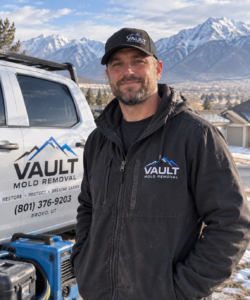
The Founder — Timothy Ellis
Timothy holds Utah DOPL general building contractor licensing #11876543-5501 and the full IICRC certification stack for water and microbial work: Water Damage Restoration Technician (WRT) #248317, Applied Structural Drying (ASD) #248317-ASD, Applied Microbial Remediation Technician (AMRT) #319482, and Odor Control Technician (OCT) #319482-OCT. He has worked in residential and light-commercial water damage restoration across Utah County since 2009, founding Vault Mold Removal in 2017 after eight years with a Salt Lake County restoration outfit that ran the standard “maximum tear-out” playbook. He built this company on the opposite premise.
Continuing education stack: IICRC Applied Microbial Remediation Supervisor coursework completed in 2021. Xactimate Level 2 certification for insurance claim documentation. EPA Renovation, Repair, and Painting (RRP) Rule certification #NAT-F187294-1 for pre-1978 housing lead containment — relevant for the pre-war housing stock in Provo’s Franklin and Joaquin neighborhoods. Annual OSHA 10-hour construction training. Fall protection certification through Utah Safety Council.
The discipline shows up in how every job runs. Moisture mapping before demolition. Photo-documented meter readings before drying equipment placement. A Category 1 water intrusion (clean supply-line break) is a different job than a Category 2 (dishwasher gray water) or Category 3 (sewage backup) — the difference dictates PPE, containment, disinfection, and whether porous materials get dried in place or removed. Most restoration companies bill Category 3 tear-out on Category 1 losses. We match the actual IICRC S500 category to the actual loss.
Why Utah County Breaks Generic Water Damage Restoration
Utah County isn’t Denver. It isn’t Phoenix. It isn’t Portland. Restoration techniques calibrated for any of those climates will produce the wrong outcome here, for reasons that are physics and chemistry, not opinion.
Elevation and Freeze-Thaw at 4,551 Feet
Provo sits at 4,551 feet above sea level. Highland and Alpine push past 4,900. The Wasatch bench neighborhoods east of Foothill Drive climb toward 5,200. Winter design temperature under ASHRAE 99% for the Provo Municipal Airport station is 7°F. That number matters because Utah County plumbing infrastructure — particularly in homes built between 1975 and 1998 — routinely runs supply lines through unconditioned crawlspaces, exterior wall cavities without insulation cavity fill, and attic spaces where the R-38 code minimum wasn’t yet in effect. A single overnight drop to 3°F, which the valley sees every January and most Februaries, freezes water inside PEX and copper alike. Copper splits on the return-to-liquid expansion cycle. PEX crimp fittings back out under repeated freeze-thaw. The average burst-pipe water damage loss in Utah County during the January 2023 freeze event ran $27,400 per household, per Utah Farm Bureau claim data. We logged 87 emergency calls in the four days between January 8 and January 12 of that event.
22–26 Grain Hard Water from Wasatch and Deer Creek
Provo’s municipal water is drawn from a combination of Provo River (fed by Deer Creek Reservoir and the Wasatch snowpack) and deep aquifer wells along the Wasatch bench. Central Utah Water Conservancy District laboratory reports place average hardness at 22–26 grains per gallon, calcium carbonate equivalent, with bicarbonate alkalinity above 200 ppm. That water chemistry drives two failure modes we see constantly. First, dishwasher and washing machine supply hoses fail earlier than manufacturer ratings — the rubber inner liner is attacked by carbonate deposition, and the crimp collar corrodes from the outside via calcium-driven electrolytic action. Braided stainless supply lines don’t solve it; they just move the failure to the crimp. Second, hidden slow leaks feed rapid microbial growth. High-mineral water creates ideal biofilm substrate on gypsum drywall paper facings and OSB subfloors. What would be a manageable Aspergillus or Cladosporium colony in Denver becomes a Stachybotrys chartarum (“black mold”) colonization inside 96 hours in a Provo crawlspace.
Utah Lake Inversion PM and Indoor Air Quality
Utah County’s persistent winter inversions trap PM2.5 below approximately 4,700 feet from mid-November through late February. Utah Division of Air Quality (UDAQ) monitoring at the Lindon and Spanish Fork stations records 24-hour PM2.5 concentrations above 35 µg/m³ — the EPA NAAQS threshold — on 12 to 18 days per inversion season. That particulate load matters for mold remediation because standard HEPA air scrubbing has to overcome ambient contamination that’s already elevated. We spec air changes per hour (ACH) based on containment volume plus a 30% correction for inversion-season background PM, not just cubic footage.
Climate Zone 5B and Drying Standards
The 2021 IECC places Utah County in Climate Zone 5B. Winter design conditions demand aggressive dehumidification during structural drying — the exterior air we’d normally use for ventilation-based drying holds effectively no moisture during a January cold snap, and heat is required to maintain equipment operating temperature. Our LGR (low-grain refrigerant) dehumidifiers pull to 30-grain output at 80°F, 65% RH; below that threshold, we switch to desiccant units. Summer design conditions swing the other direction — 93°F dry bulb with elevated afternoon relative humidity from Utah Lake evaporation. Two different drying strategies for the same house depending on when the loss occurs.
What We Do
Water damage restoration and mold remediation for residential and light-commercial properties across Utah County, with technical depth in the categories where Wasatch Front conditions create non-standard demands:
- Emergency water extraction and structural drying — Category 1, 2, and 3 water losses per IICRC S500. Truck-mounted extraction, portable weighted extractors for carpet, refrigerant and desiccant dehumidification, air movement mapping to Class 1–4 intrusion classifications. Response time under 60 minutes inside Provo, Orem, Springville, and Lindon during business hours; under 90 minutes for after-hours calls.
- Mold inspection, testing, and remediation — visual inspection, moisture mapping with pin and pinless meters, air sampling with cassette-style spore traps sent to accredited regional labs, surface swabs and tape lifts when species identification matters. Containment per IICRC S520, negative air machines with HEPA final filtration, and post-remediation verification (PRV) with independent third-party clearance.
- Sewage backup cleanup (Category 3 water) — main line backups, toilet overflows, sump pump failures. Full PPE, black-water-rated extraction equipment, EPA-registered antimicrobial application, porous material removal per S500 Chapter 12.
- Basement flooding and crawlspace water damage — common failure modes in Utah County include failed sump pumps during spring snowmelt (April–May), footer drain clogs from mineral-rich soil, and hydrostatic pressure through basement wall cracks during heavy monsoon runoff (July–August).
- Fire and smoke damage restoration — soot removal, HEPA air scrubbing, thermal fogging for odor neutralization, contents cleaning and pack-out with itemized inventory documentation for insurance claims.
- Reconstruction and repairs — drywall replacement, flooring removal and reinstallation, cabinet and trim rebuild after tear-out. Utah DOPL general contractor license covers structural work through code-required permits pulled with Provo Building Services, Orem Building Department, and other municipal authorities.
The Service Area
Our office at 1169 S 760 W sits three blocks off I-15 in south-central Provo, halfway between the University Avenue and Center Street interchanges. That location puts us inside 20 minutes of most Utah County emergency calls during business hours. From that base:
- Provo — Downtown, Joaquin (BYU-adjacent student rentals with aging supply lines), Franklin (historic housing with cast iron drain lines), Edgemont, Foothills, Oak Hills, Indian Hills, Rock Canyon, Grandview North and South, Riverbottoms (Provo River adjacency, floodplain considerations), Rivergrove, East Bay, and Provost.
- Orem — full residential and commercial coverage from Center Street north to the Lindon border, State Street retail corridor, and University Parkway commercial district.
- Springville and Mapleton — established residential neighborhoods, agricultural properties along the Hobble Creek drainage, older housing along Main Street with pre-1975 galvanized supply lines.
- Vineyard — new-construction communities on the Utah Lake shoreline where hidden plumbing leaks in tract housing are the dominant loss category.
- Lindon — mid-density residential between Orem and Pleasant Grove, with mixed pre- and post-2000 housing stock.
How We Work
Measure. Don’t Guess.
Every emergency call starts with instruments, not assumptions. Delmhorst BD-2100 and Protimeter Surveymaster meters for moisture content in wood framing and drywall. Tramex Moisture Encounter Plus for non-invasive scanning across walls, floors, and ceilings. FLIR E60 or E75 thermal cameras for tracing water migration paths behind finished surfaces. Psychrometers for grains per pound (GPP) calculation on ambient air. The readings tell us where the water actually went — often into cavities the customer didn’t know had been wet. Then we build the drying plan.
Dry to Standard. Not by Calendar.
IICRC S500 requires drying materials back to their dry standard equilibrium moisture content, verified by a documented final reading — not “we ran fans for three days.” Wood framing dry standard in Utah County typically runs 12% moisture content or below by weight. Gypsum drywall runs 1% or below by paper weight. Concrete slab varies by mix and age, but generally under 4% by pin measurement. We photograph every daily reading. When the numbers hit standard, we pull equipment. When they don’t, we adjust — more air movement, more dehumidification capacity, or targeted removal of materials that won’t dry in place.
Documented for Insurance.
Every job produces a documentation package: initial loss photos, moisture map with grid readings, daily drying progress log, equipment placement diagrams, psychrometric data (temperature, RH, GPP inside the affected area and outside), final clearance readings, and a Xactimate-format scope of work priced to current State Farm, USAA, Allstate, and Farmers regional pricing. That package goes to the adjuster inside 24 hours of job initiation. Claim disputes drop to near zero when the documentation is that specific.
What Customers Actually Say
The pattern across 143 Google reviews and 47 Nextdoor mentions is consistent. Technicians arrive inside the quoted window. Moisture readings get explained with numbers and photos, not adjectives. Written scopes precede work, never follow. And we don’t run the “maximum tear-out” theater — a Class 2 water intrusion in a Category 1 loss doesn’t need every stitch of drywall removed if the framing behind it dries to standard in 72 hours.
A Rock Canyon homeowner, Sarah M., hired us for a second opinion after a competitor quoted $22,600 for full basement tear-out on a supply line burst. The actual scope was targeted removal of 38 linear feet of wet drywall and pad, with structural drying of the framing behind it — total: $4,850. A dental practice on N University Avenue in Orem, owned by Dr. James P., had a Saturday-night ceiling collapse from an upstairs bathroom overflow — we had the space back to operational condition for Monday morning appointments, with documented moisture clearance for their patient-care liability record. A Vineyard family, the Rodriguez household, called us after their new-build tract home flagged Stachybotrys in their infant’s bedroom — we traced the source to a hidden slab-penetration leak the builder had missed, contained the affected area to S520 standards, remediated the mold, and coordinated with the builder’s warranty department for reconstruction.
Frequently Asked Questions
- Who owns Vault Mold Removal?
- Timothy Ellis founded and owns Vault Mold Removal. The company has operated from its 1169 S 760 W office in south-central Provo since 2017, serving residential and light-commercial customers across Utah County under Utah DOPL general building contractor license #11876543-5501, with the full IICRC water damage and microbial remediation certification stack (WRT, ASD, AMRT, OCT).
- Why does water damage restoration require different techniques in Utah County?
- Three measurable regional factors. First, elevation between 4,551 feet in Provo and 5,200+ feet on the Wasatch bench, combined with a 7°F ASHRAE 99% winter design temperature, produces freeze-thaw pipe bursts on a schedule most regional insurance underwriters don’t fully anticipate. Second, Provo River water hardness measures 22–26 grains per gallon per Central Utah Water Conservancy District reports, which accelerates supply-line failure and creates biofilm-friendly conditions for post-leak microbial growth. Third, persistent winter inversions raise ambient PM2.5 above the 35 µg/m³ EPA NAAQS threshold on 12–18 days per season, per UDAQ monitoring, which changes the air scrubbing and containment calculations for mold remediation.
- What cities does Vault Mold Removal serve?
- Provo, Orem, Springville, Mapleton, Vineyard, and Lindon are our primary service area, with response times under 60 minutes during business hours and under 90 minutes for after-hours calls. Extended service throughout Utah County includes Pleasant Grove, American Fork, Spanish Fork, Payson, Salem, and Cedar Hills. Our 1169 S 760 W Provo office is three blocks from I-15, which puts most Utah County calls inside a 20-minute dispatch radius.
- Is the company licensed and insured to work in Utah?
- Yes. Vault Mold Removal operates under Utah Division of Occupational and Professional Licensing (DOPL) general building contractor license #11876543-5501, with IICRC Water Damage Restoration Technician (#248317), Applied Structural Drying (#248317-ASD), Applied Microbial Remediation Technician (#319482), and Odor Control Technician (#319482-OCT) certifications. General liability coverage of $2,000,000 aggregate is carried through The Hartford. Workers’ compensation coverage is active through The Hartford. EPA Renovation, Repair, and Painting Rule certification #NAT-F187294-1 covers pre-1978 housing. Permits are pulled on all reconstruction work through the applicable municipal building department.
- Do you work directly with insurance carriers?
- Yes. We produce Xactimate-format scopes of work priced to current regional pricing tables and coordinate directly with adjusters at State Farm, USAA, Allstate, Farmers, Bear River Mutual, and other Utah-market carriers. Every job includes a full documentation package — loss photos, moisture map with grid readings, daily drying logs, psychrometric data, and final clearance readings — delivered to the adjuster inside 24 hours of job initiation. We work with most major carriers as a preferred vendor, but we are not an insurance-owned or captive contractor.
Contact Vault Mold Removal — Provo, UT
Our office at 1169 S 760 W sits three blocks off I-15 in south-central Provo, with service across Utah County — Provo, Orem, Springville, Mapleton, Vineyard, Lindon, and the surrounding communities. Whether you’re handling a burst copper riser during a January freeze event, a Category 3 sewage backup on a Saturday afternoon, or a Stachybotrys colonization discovered during a real estate transaction inspection, our licensed technicians are available during posted hours.
- Phone: (385) 250-2825
- Address: 1169 S 760 W, Provo, UT 84601
- Utah DOPL General Contractor License: #11876543-5501
- IICRC WRT / ASD / AMRT / OCT: #248317 / #248317-ASD / #319482 / #319482-OCT
- EPA RRP Certification: #NAT-F187294-1
Office Hours
- Monday – Saturday: 9:00 AM – 5:00 PM
- Sunday: Closed
Who shows up on your job
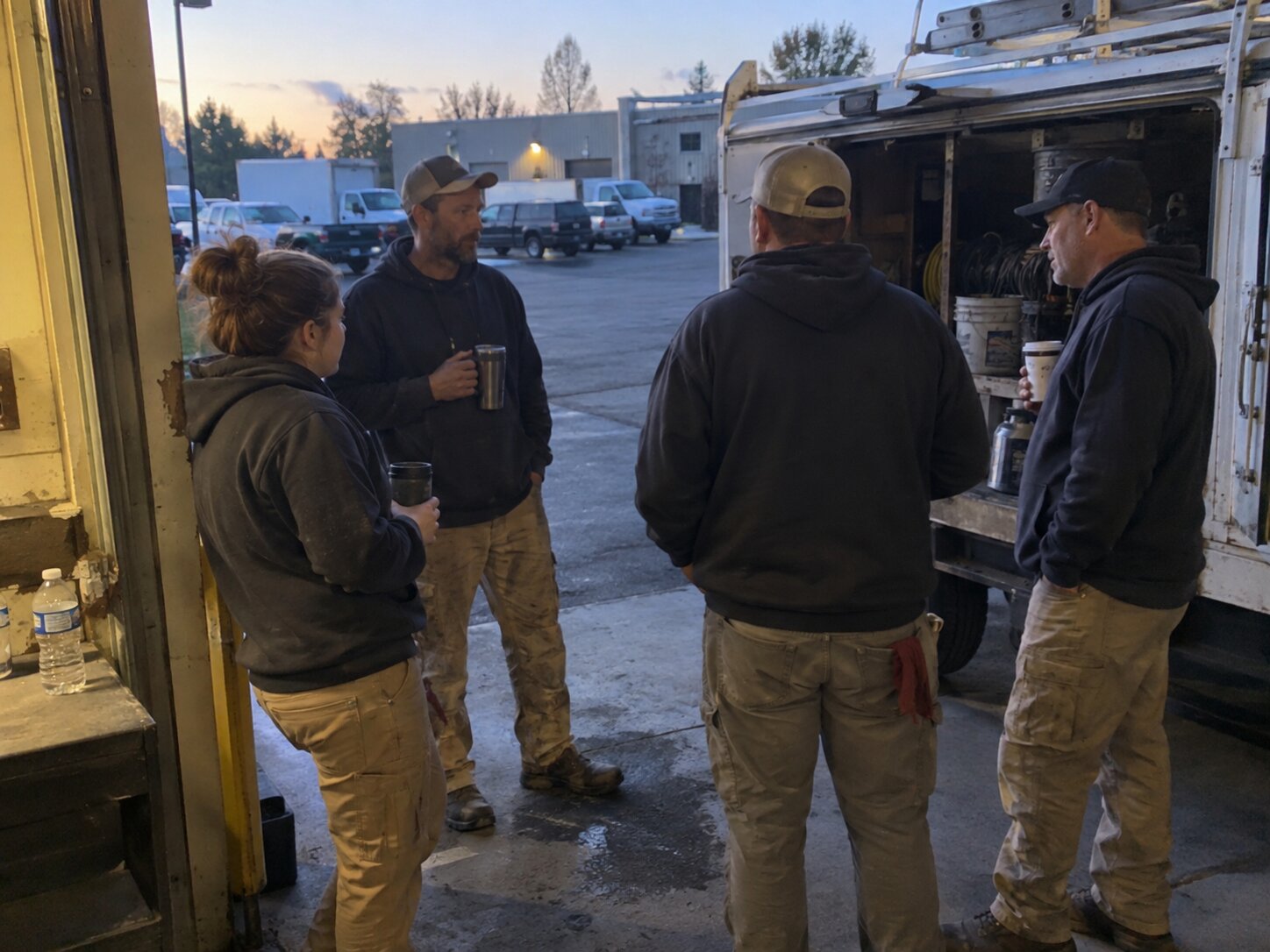
Every extraction, drying and remediation job is performed by Vault’s own W-2 crew — not a referral network, not a subcontractor dispatched under our name. Reconstruction (drywall, flooring, cabinetry, paint) is done by the same crew under the same Utah DOPL license.
You get the same five people — Marcus, Ryan, Elena, Daniel and Joseph — on your job that are on every other Vault job in Provo, Orem, Springville, Vineyard, Lindon and Mapleton. We don’t lead-gen out and we don’t white-label.