
Quick answers about Vault Mold Removal
- Who answers the phone? The Vault crew, 24/7, not a call center. If every tech is on a job, the call rolls to the owner’s cell.
- How fast is arrival? 45-minute guarantee inside Provo city limits, Monday–Saturday, 8 AM–5 PM. Elsewhere in Orem, Springville, Vineyard, Lindon and Mapleton, typically under 60 minutes.
- Who does the work? Vault’s own W-2 crew, IICRC WRT/ASD/AMRT/OCT, under Utah DOPL General Contractor License #11876543-5501. No subcontractors.
- Is it licensed and insured? Utah DOPL #11876543-5501, IICRC firm (AMRT #319482), EPA RRP firm #NAT-F187294-1, The Hartford GL + WC, bonded, BBB Accredited.
- What does it cost? Free written estimates. Water mitigation typically $3,500–$8,500. Reconstruction $4,500–$9,500. Mold inspection $99/$199/$349. Mold remediation from $500.
- Insurance? Scopes written in Xactimate, direct billing to State Farm, USAA, Allstate, Farmers and Bear River Mutual.
- Warranty? 24-month workmanship warranty on the rebuild and a 90-day mold warranty from post-remediation clearance. Transferable once.
- Financing? Wisetack, $500–$25,000 over 3–24 months, with a soft credit check.
- Where is Vault based? 1169 S 760 W, Provo, UT 84601, a staffed office with a shop and warehouse. Founded August 2020. Family-owned and veteran-operated.
Need help now? Call (385) 250-2825 · Water damage restoration · Mold remediation · Sewage cleanup · Credentials
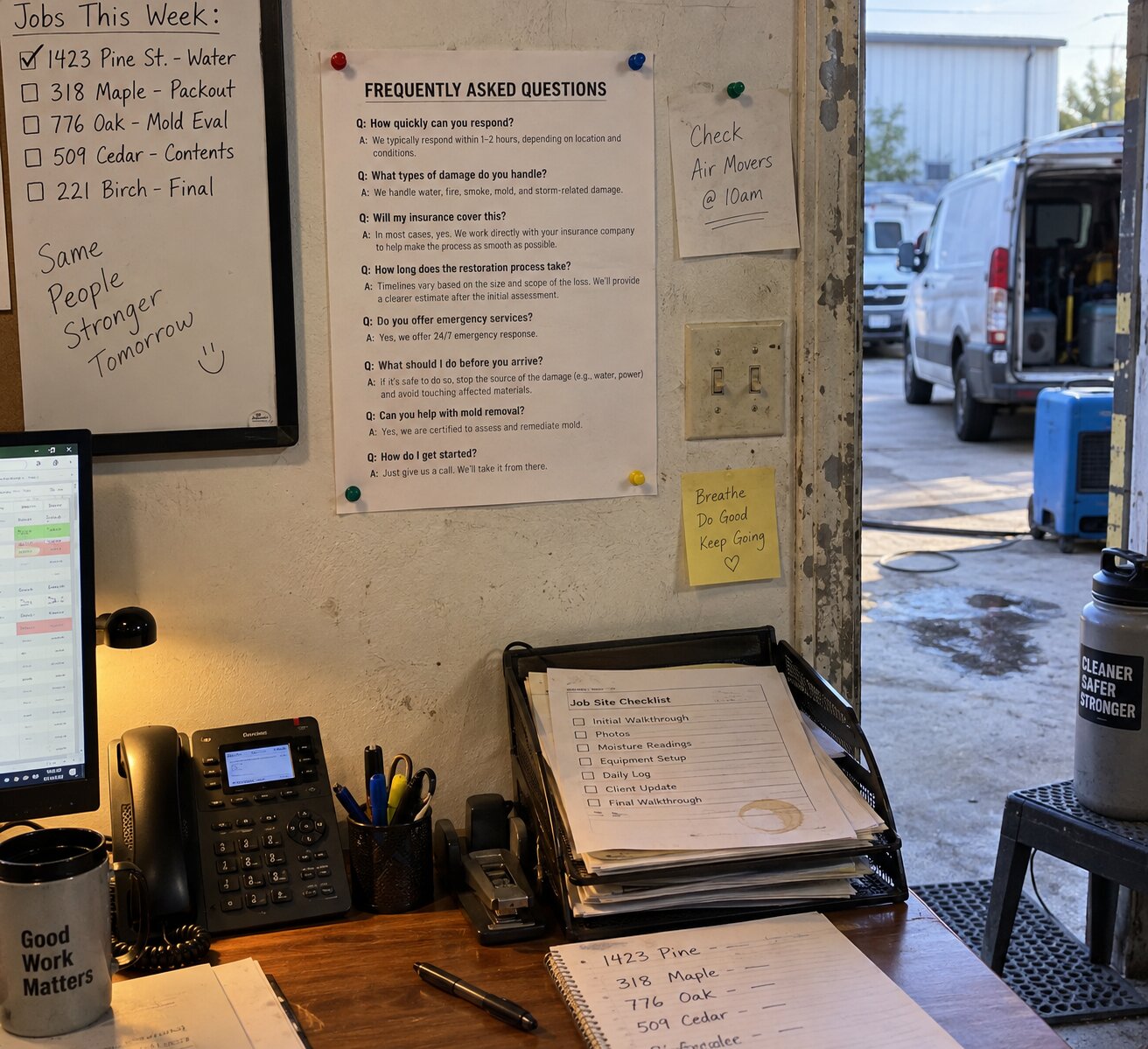
Vault Mold Removal — Utah County Water Damage & Mold FAQ
This page collects the questions we hear most often from Utah County property owners, insurance adjusters, real estate agents, and property managers. Answers are grouped into six categories: emergency response and initial actions, IICRC standards and technical methodology, mold and microbial remediation, insurance and claim coordination, Utah County-specific conditions, and cost and timeline expectations. Every answer draws on IICRC S500 and S520 industry standards, Utah regulatory requirements, and 2,400+ documented jobs from our Utah County archive.
Emergency Response and Initial Actions
- What should I do first when I discover water damage?
- Three actions, in this order. First, stop the water source if you can safely reach the shutoff — main water valve at the meter for supply line failures, appliance shutoff for dishwasher and washing machine issues, main breaker if there’s electrical hazard from the water. Second, document the damage with photos before touching anything else — wide shots of affected rooms, close-ups of water sources and standing water, and any visible damage to walls, floors, or ceilings. Third, call a licensed IICRC-certified restoration contractor to begin extraction. The 48-hour rule for microbial growth means every additional hour of standing water increases the eventual cost and complexity of the restoration.
- How quickly should water damage be addressed?
- Extraction and drying should begin within 24 hours whenever possible, and IICRC S500 defines a 48-hour threshold before Category 1 (clean) water losses can be reclassified to Category 2 (contaminated) simply due to elapsed time. Standing water past 48 hours typically means microbial amplification has begun, which changes PPE requirements, disinfection needs, and removal decisions. Utah County losses discovered later than 48 hours — typical for water heater failures during vacations, unattended supply line drips, and slow leaks behind fixtures — are treated as Category 2 or Category 3 depending on the specific circumstances.
- Should I try to dry out the water myself before calling a professional?
- Surface water can be extracted with a wet vac or absorbed with towels to prevent further migration while you’re waiting for professional response. What you shouldn’t do is assume that dry-looking surfaces mean the assembly is actually dry. Water migrates through wall cavities, under cabinet toe kicks, into subfloor assemblies, and across ceiling paths that are not visible from the room. Professional moisture mapping with pin meters and thermal imaging routinely finds hidden wet areas in cases where the homeowner has already “dried out” the visible water. The migration path is what causes secondary damage and mold, not the standing water.
- Is water damage restoration different from just cleaning up the water?
- Yes, materially so. Cleaning up water addresses the surface. Water damage restoration addresses the assembly. Restoration includes moisture mapping to identify all affected materials (visible and hidden), extraction of water from porous materials that hold it, structural drying to bring moisture content back to industry dry standards, targeted removal of materials that can’t be dried effectively, antimicrobial application in contaminated Category 2 and Category 3 cases, and documentation to support insurance claim resolution. Cleanup without professional restoration is what causes downstream mold problems that show up weeks or months later.
IICRC Standards and Technical Methodology
- What is IICRC S500 and why does it matter?
- IICRC S500 is the ANSI-recognized industry standard for professional water damage restoration, published by the Institute of Inspection, Cleaning and Restoration Certification. It defines water source categorization (Category 1 clean, Category 2 gray, Category 3 black), intrusion classification (Class 1 through Class 4), dry standard requirements, equipment specifications, and documentation practices. Restoration contractors operating below S500 standards are not just cutting corners — they’re producing work that insurance carriers, real estate attorneys, and municipal building departments may not accept as competent. Vault Mold Removal follows S500 on every job, and every scope of work references the applicable S500 category and class.
- What’s the difference between Category 1, 2, and 3 water?
- Category 1 is clean water from a sanitary source: supply line breaks, ice maker line failures, water heater tank ruptures. Category 2 is significantly contaminated water: dishwasher overflows with detergent residue, washing machine hose failures, aquarium leaks, HVAC condensate backups. Category 3 is grossly contaminated: sewage backups, main line failures, external floodwaters, and any Category 2 water that has aged past 48 hours. The category determines PPE requirements, extraction methodology, removal decisions for porous materials, and disinfection needs. Misclassification — typically treating Category 2 or 3 losses as Category 1 — is the most common quality issue we see in prior work performed by unlicensed contractors.
- What does Class 1, 2, 3, or 4 water intrusion mean?
- Class is a measure of the affected wet area and the amount of moisture in affected materials. Class 1 is the smallest wet perimeter with low-porosity materials (concrete, tile) predominating. Class 2 covers a larger perimeter with carpet, pad, and drywall wicking up to 24″ affected. Class 3 involves the greatest amount of water — saturation of ceiling, walls, insulation, and subfloor typical of overhead losses. Class 4 involves deeply saturated low-permeance materials (hardwood, plaster, brick, stone) requiring specialty drying with desiccant dehumidification, supplemental heat, or extended timelines. The class determines equipment sizing, drying strategy, and how the scope of work is priced.
- What are your dry standard moisture readings?
- Dry standard varies by material. For Utah County residential construction: wood framing reaches dry standard at 12% moisture content or below by pin meter. Gypsum drywall paper facing reaches dry standard at 1% or below. Concrete slab is under 4% by pin measurement, though variability by mix and age means we compare to a matched unaffected reference sample. OSB and plywood subfloor should hit 14% or below. Hardwood flooring should be within 2 percentage points of a matched dry sample from the same species and installation. IICRC S500 requires documented final readings at every measurement point established during initial assessment, not just spot-checks.
Mold and Microbial Remediation
- What is Stachybotrys chartarum and how dangerous is it?
- Stachybotrys chartarum, commonly called “black mold” in consumer press, is a slow-growing dark-pigmented fungus that requires sustained high moisture and cellulose-rich substrate to colonize. In Utah County properties, it typically shows up in chronic-moisture environments: crawlspaces with vapor intrusion, wall cavities with hidden slow leaks, attic assemblies with ice dam moisture accumulation. The health risk from Stachybotrys is real but complex — it produces mycotoxins that can trigger respiratory symptoms, particularly in immunocompromised individuals, infants, and people with pre-existing asthma or COPD. It’s not the immediate health emergency that consumer media often portrays, but it is a serious remediation project that requires IICRC S520 containment, HEPA air scrubbing, and post-remediation verification with third-party clearance testing.
- Do I need mold testing before remediation?
- Not always. IICRC S520 recognizes that visible mold in a defined area rarely requires species-level identification before remediation begins — the remediation approach is generally the same regardless of species. Testing is more valuable in specific scenarios: when you can’t find the source but suspect hidden mold from odor or health symptoms, when a real estate transaction requires documented clearance, when a warranty claim or subrogation matter depends on independent verification, or when tenant health concerns require documented species identification for medical evaluation. Vault Mold Removal offers both pre-remediation testing (visual inspection, moisture mapping, air sampling, surface swabs) and third-party post-remediation verification when the specific situation calls for it.
- What is post-remediation verification and why does it matter?
- Post-remediation verification (PRV) is the documented confirmation that a mold remediation project has been completed to industry standard. It includes visual clearance inspection, moisture verification, and typically third-party air sampling by an independent industrial hygienist. PRV matters because self-certified clearance carries an inherent conflict of interest — you can’t objectively verify your own work. Third-party PRV is what makes remediation defensible in real estate transactions, warranty claims, subrogation litigation, and tenant health concerns. Vault Mold Removal coordinates with independent industrial hygienists in the Wasatch Front region for PRV on all S520-tier remediation projects.
- How is mold different from just water damage?
- Water damage is a physical event with a defined start point. Mold is a biological process with a growth timeline. Effective water damage restoration — extraction, structural drying, and material dry-out within the 48-hour window — prevents most mold from developing. When mold does develop, the remediation process is different: it requires containment to prevent cross-contamination, negative air pressure with HEPA filtration to keep spores out of unaffected areas, physical removal of colonized materials (mold spores don’t die with cleaning — the substrate has to go), HEPA vacuuming and antimicrobial application on remaining surfaces, and post-remediation verification. The underlying moisture problem also has to be resolved permanently, or the mold will return.
Insurance and Claim Coordination
- Does homeowners insurance cover water damage restoration?
- Generally yes, with important exceptions. Sudden and accidental water damage — a burst pipe, a supply line failure, an ice maker line disconnect — is typically covered under standard homeowners policies from State Farm, USAA, Allstate, Farmers, Bear River Mutual, and other Utah-market carriers. Gradual leaks that developed over weeks or months are often excluded or subject to reduced coverage under the “long-term seepage” exclusion. Flooding from external sources (rising water, storm surge) requires separate flood insurance under the National Flood Insurance Program (NFIP). Sewage backups typically require a specific sewer backup endorsement. Vault Mold Removal can help you understand which coverage applies before a claim is filed, and can produce documentation formatted for adjuster review.
- Do you work directly with my insurance carrier?
- Yes. We produce Xactimate-format scopes of work priced to current regional pricing tables and coordinate directly with adjusters at State Farm, USAA, Allstate, Farmers, Bear River Mutual, Progressive, and other Utah-market carriers. Every job includes a full documentation package — loss photos, moisture map with grid readings, daily drying logs, psychrometric data, and final clearance readings — delivered to the adjuster within 24 hours of job initiation. This coordination is what enables most claims to resolve without disputes, delayed payments, or scope reduction. We are not owned by, contractually bound to, or captive under any specific insurance carrier, which means we work for the property owner, not for the carrier’s cost-management objectives.
- What should I do before the insurance adjuster arrives?
- Document, don’t disturb. Take extensive photos of the loss before any restoration work begins — the adjuster’s initial assessment is based on what they see, and photos taken after emergency extraction has already occurred can under-represent the original damage. Keep the water source visible and identifiable if possible, and collect any evidence of the failure (a photo of the burst pipe, the failed appliance, the source of the leak). Compile a list of affected personal property with approximate values, purchase dates, and photos where available. Contact a licensed restoration contractor at the same time you contact your carrier — the adjuster and the restoration contractor should coordinate on scope, and getting one without the other creates gaps that slow claim resolution.
- Can the insurance adjuster reduce or reject my claim?
- Adjusters can reduce claim payment for a number of legitimate reasons: work outside the scope of the policy, failure to mitigate ongoing damage (the “insured’s duty to mitigate” doctrine), unpermitted reconstruction work, pre-existing conditions unrelated to the current loss, and coverage limits or deductibles. Full claim rejection is less common but occurs in cases of policy exclusions (flooding without flood insurance, long-term seepage under most policies), fraud allegations, or failure to comply with policy conditions. When claims are reduced or rejected, professional documentation from the restoration contractor is often the difference between accepting the adjuster’s decision and successfully disputing it. Every documentation package we produce is built with that scenario in mind.
Utah County-Specific Conditions
- Why do pipes burst so often in Utah County during January?
- Three factors combine. First, elevation between 4,551 feet in Provo and 5,200+ feet on the Wasatch bench, which produces ASHRAE 99% winter design temperatures of 7°F for the valley floor. Second, plumbing installation practices in homes built between 1975 and 1998 — supply lines run through unconditioned crawlspaces, exterior wall cavities without insulation cavity fill, and attic spaces where the current R-38 code minimum wasn’t yet required. Third, the freeze-thaw cycle itself: pipes don’t split when they freeze; they split when they thaw and the ice expands during the phase change. A single overnight drop to 3°F, which Utah County sees every January and most Februaries, is enough to trigger the failure. During the January 2023 freeze event, we logged 87 emergency calls in four days, and the Utah Farm Bureau reported average per-household losses of $27,400.
- Does hard water make water damage worse in Utah County?
- Yes, in two specific ways. Provo River water hardness measures 22–26 grains per gallon per Central Utah Water Conservancy District laboratory reports, driven by mineral loading from Wasatch snowpack and Deer Creek Reservoir. First, hard water accelerates supply line failures: the rubber inner liners of appliance hoses are attacked by carbonate deposition, and crimp collars corrode via calcium-driven electrolytic action. Braided stainless supply lines don’t solve the problem; they move the failure point to the crimp. Second, hard water feeds microbial growth after a leak: the mineral load creates ideal biofilm substrate on drywall paper facings and OSB subfloors, which means Stachybotrys chartarum colonization occurs faster in Provo than in soft-water regions. What would be a manageable Aspergillus colony in Denver becomes a serious remediation project inside 96 hours in a Provo crawlspace.
- What’s the deal with Utah inversions and mold remediation?
- Utah County’s persistent winter inversions trap PM2.5 below approximately 4,700 feet from mid-November through late February. Utah Division of Air Quality (UDAQ) monitoring at Lindon and Spanish Fork records 24-hour PM2.5 concentrations above the EPA NAAQS 35 µg/m³ threshold on 12 to 18 days per inversion season. That elevated background PM2.5 matters for mold remediation because standard HEPA air scrubbing has to overcome ambient contamination that’s already elevated. Air changes per hour (ACH) inside the containment have to be sized against the ambient PM load, not just the containment volume. We correct our ACH calculations by roughly 30% during inversion season to account for background contamination that’s constantly being pulled in through the makeup air pathway.
- Are there parts of Utah County more prone to water damage?
- Yes, in patterns driven by housing age and infrastructure. Older Provo neighborhoods — Franklin, Joaquin, Downtown, Provost — have higher rates of cast iron drain failures, galvanized supply line pinhole leaks, and historic-home moisture issues. Newer construction areas — Vineyard, southern Utah County developments, post-2015 tract housing — see higher rates of push-fit fitting failures, slab-penetration leak discovery, and builder-warranty-period defects. Riverbottoms and Rivergrove neighborhoods in Provo have Provo River floodplain considerations. Mapleton and semi-rural areas east of the main residential grid have private well and septic system failures unique to those properties. Every neighborhood has a characteristic loss profile, which is one reason we’ve published neighborhood-specific pages for our Provo service area.
Cost and Timeline Expectations
- How much does water damage restoration cost in Utah County?
- Cost varies widely based on category, class, materials, and reconstruction scope. Representative ranges from our documented Utah County job archive: a Category 1 supply line failure with dry-in-place drying and no reconstruction typically runs $2,500–$6,000. A Category 2 basement flood requiring carpet pad removal and selective drywall replacement runs $6,000–$18,000. A Category 3 sewage backup with full removal and reconstruction runs $12,000–$47,000. Mold remediation adds $1,500–$8,000 depending on scope and whether post-remediation clearance is required. These are billed scopes, not competitor quotes — we routinely see comparable losses quoted at 40–60% above these numbers by contractors using the “maximum tear-out” approach.
- How long does water damage restoration take?
- The drying phase typically runs 3–5 days for Category 1 losses reached within 48 hours, 4–7 days for Category 2 losses, and 5–10 days for Category 3 losses depending on the amount of removal and disinfection required. Reconstruction adds additional time based on scope: drywall replacement is typically 3–5 days, flooring reinstallation 5–10 days, and full room reconstructions with cabinets, trim, and paint can extend 3–6 weeks. Mold remediation adds 5–10 days for containment, physical removal, and post-remediation verification. These are ranges — specific timelines depend on the specific job, ambient conditions, and material availability for reconstruction.
- Can water damage restoration be started before insurance approval?
- Yes, and often it should be. Emergency mitigation — stopping the water source, extraction, and initial drying setup — is a policyholder duty under most homeowner insurance policies. “Duty to mitigate” is a standard insurance contract provision: property owners must take reasonable steps to prevent additional damage, and insurance carriers can reduce claim payment for damage that resulted from failure to mitigate. This means emergency response should not wait for insurance approval. The written scope of work is what requires adjuster review before major reconstruction begins, but emergency mitigation is expected to proceed immediately regardless of the claim status.
- Do you offer free estimates?
- Yes, for water damage and mold assessment. Timothy Ellis provides written scopes of work at no cost to the property owner, priced in Xactimate format for direct submission to the insurance adjuster. What we don’t do is guess estimates over the phone without a site visit, which is what unlicensed operators sometimes do to book jobs. Every legitimate scope requires on-site moisture mapping, category and class determination, and material assessment. If you’re calling for a specific loss, we can typically schedule a same-day assessment during business hours for Provo, Orem, and Lindon calls received before 3 PM.
Contact Vault Mold Removal — Provo, UT
Our office at 1169 S 760 W in south-central Provo is three blocks from I-15, positioned for rapid dispatch across Utah County. If your question isn’t answered on this page, contact our office directly and we’ll walk through your specific situation.
- Phone: (385) 250-2825
- Address: 1169 S 760 W, Provo, UT 84601
- Utah DOPL General Contractor License: #11876543-5501
- IICRC WRT / ASD / AMRT / OCT: #248317 / #248317-ASD / #319482 / #319482-OCT
Office Hours
- Monday – Saturday: 9:00 AM – 5:00 PM
- Sunday: Closed
Vault-specific questions
Who shows up when I call at 2 a.m.?
A live Vault technician answers (385) 250-2825 24/7 — not an answering service. If every tech is on an active job, the call rolls to the owner’s cell. One of Marcus, Ryan, Elena, Daniel or Joseph will dispatch.
What’s the real 45-minute guarantee cover?
Provo city limits (ZIPs 84601, 84604, 84606), 24/7, 365 days. Clock starts when we answer; clock stops at the property address. If we miss, the first on-site visit is free (moisture mapping + IICRC category/class determination).
Can I verify your license and certifications?
Yes. Utah DOPL licensee lookup for #11876543-5501 at secure.utah.gov/llv/search; IICRC Certified Technician Search for #248317 and #319482 at iicrcnetforum.com; EPA RRP firm #NAT-F187294-1 at epa.gov/lead/find-certified-lead-based-paint-firm.
Will you bill my insurance directly?
Yes, for State Farm, USAA, Allstate, Farmers and Bear River Mutual. For other carriers, we still handle the claim and scope in Xactimate; you pay us and get reimbursed. You pay only the deductible and anything the policy doesn’t cover.
Is Vault itself insured and bonded?
Yes — general liability and workers’ compensation through The Hartford, plus a contractor bond on file as required for Utah DOPL licensure. Certificate of insurance available on request.