
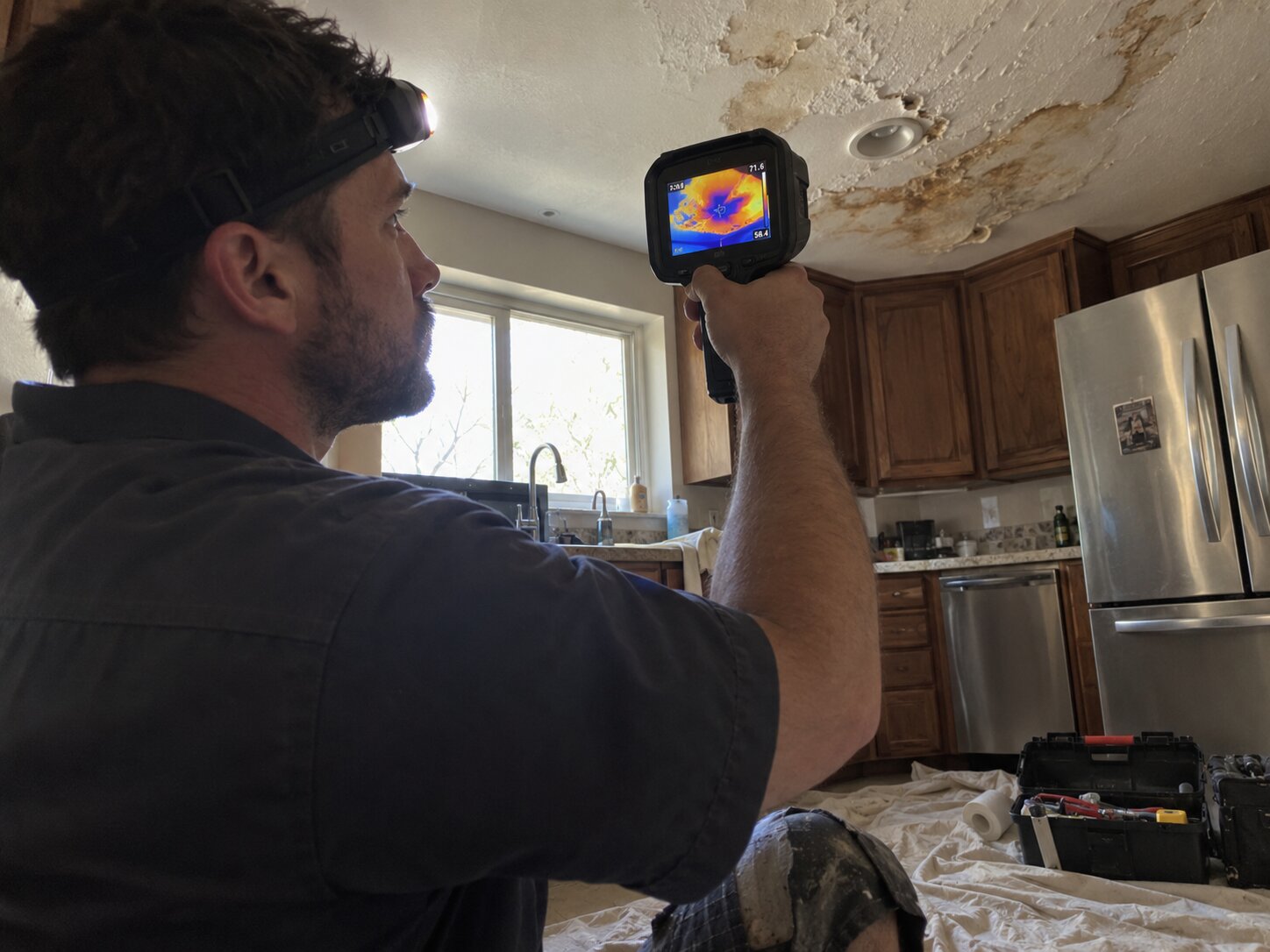
Vault Mold Removal — Utah County Restoration Case Studies
Every case study on this site documents a real job in the Vault Mold Removal archive: original loss photos, grid moisture mapping, drying strategy, scope development, and final clearance. Customer identifying details have been anonymized, but every technical measurement, timeline, cost figure, and outcome is drawn directly from the job file. The archive currently contains 30 published case studies across our six primary service cities — Provo, Orem, Springville, Vineyard, Lindon, and Mapleton — selected to cover the loss types Utah County property owners are most likely to encounter.
How to Use These Case Studies
Case studies serve three practical purposes for property owners evaluating a restoration situation. First, they illustrate the actual technical work involved — grid moisture mapping, containment builds, equipment placement, and drying trajectory — rather than the marketing-friendly abstractions that dominate most restoration company websites. Second, they document representative cost ranges for common loss types in the Utah County market, so property owners can calibrate expectations before insurance adjuster meetings or scope negotiations with alternative contractors. Third, they demonstrate the documentation package customers receive at job closeout, which is often the most valuable deliverable when the loss triggers an insurance claim, subrogation dispute, or real estate disclosure.
The case studies are not diagnostic. A published Rock Canyon supply line burst case study does not tell you what your specific supply line burst will require or cost — every loss is affected by water source category, materials involved, time-since-loss, ambient conditions, and dozens of other variables. What the case studies do show is the general shape of the work when it’s done to IICRC S500 and S520 standards.
Case Studies by City
Provo — Five Case Studies
Provo covers our largest range of loss types, driven by the city’s mix of pre-1940 historic housing (Franklin, Joaquin, Downtown), mid-century residential (Foothills, Grandview, Sherwood Hills), and newer construction (parts of Riverbottoms and East Bay). Case studies published:
- Rock Canyon supply line burst — 34-hour unattended Type M copper riser failure, grid-mapped drying of contained 14-foot span, $3,900 final cost against a competitor’s $18,400 quote.
- Joaquin student rental winter break flood — 10-day unattended Category 2 water loss with early biofilm growth, BYU housing insurance coordination.
- Franklin historic home mold remediation — 1912 home with cast iron drain issues and chronic moisture-driven Stachybotrys colonization requiring S520 containment and third-party clearance.
- Downtown Provo commercial sewage backup — Category 3 main line backup in a Center Street office building, after-hours response with regulated disposal.
- Grandview South second-floor supply line failure — upstairs bathroom supply line burst affecting ceiling assembly below, ceiling drying with negative pressure containment.
Orem — Five Case Studies
Orem case studies emphasize the city’s mixed residential and commercial character — single-family homes along the I-15 corridor, dense apartment complexes near Utah Valley University, and retail properties along State Street and University Parkway.
- Water heater bottom seam failure with basement flooding — 50-gallon gas water heater rupture during unoccupied period, extraction and finish basement restoration.
- Dishwasher supply line failure with hardwood damage — Category 2 water on 3/4″ solid oak flooring, cupping evaluation, and specialty drying to prevent replacement.
- Roof leak with attic mold colonization — failed roof-to-wall flashing feeding chronic attic moisture, ventilation correction combined with S520 mold remediation.
- State Street retail store rooftop unit backup — commercial property water loss during weekend closure, Monday-morning-opening completion.
- Finished basement carpet and drywall restoration — sump pump failure during spring runoff, selective demolition and reconstruction of a family room space.
Springville — Five Case Studies
Springville case studies focus on the established residential neighborhoods along Hobble Creek and the older housing stock along Main Street, plus agricultural properties on the city’s eastern edge.
- January freeze event whole-home pipe burst — power outage during subzero cold, multiple supply line failures, whole-home coordinated drying.
- Main line sewage backup Category 3 cleanup — roots-driven cast iron lateral failure with basement floor drain backflow.
- Chronic crawlspace moisture with mold discovery — dirt-floor crawlspace with hillside seep, encapsulation and mold remediation combined project.
- Washing machine hot water hose failure — 400-gallon Category 2 loss during weekday work hours, extraction and drying.
- Master bath shower pan slow leak with wall cavity mold — hidden pan liner failure feeding 18-month moisture buildup and Chaetomium colonization.
Vineyard — Five Case Studies
Vineyard case studies are dominated by new-construction loss types: hidden plumbing defects in post-2015 tract homes, builder warranty coordination, and slab-penetration leaks in ground-floor assemblies.
- Hidden slab-penetration leak in a 2019 tract home — long-term concealed leak feeding Chaetomium mold in an infant’s bedroom, builder warranty coordination.
- Townhome water heater emergency during weekend absence — HOA-managed loss with adjacent unit water migration considerations.
- Refrigerator ice maker line slow leak — six-month undetected 1/4″ push-fit fitting failure, subfloor and cabinet damage.
- Luxury home basement moisture with no visible source — thermal imaging investigation of unexplained musty odor, tracing to a hidden HVAC condensate line failure.
- Builder warranty water damage claim coordination — tract home warranty period defect discovered by owner, documentation package supporting builder responsibility.
Lindon — Five Case Studies
Lindon case studies represent the middle range of Utah County loss types: mid-density residential, mixed pre- and post-2000 housing stock, and common failure modes across the city’s typical property profile.
- Dishwasher supply line kitchen flood — braided stainless line crimp failure, extraction and cabinet toe-kick drying.
- Water heater failure with basement flooding — utility room water heater with slow drip evolving to catastrophic bottom failure.
- Toilet overflow bathroom extraction — Category 2 water loss with adjacent room migration through subfloor gaps.
- HVAC condensate overflow with ceiling collapse — clogged condensate line during peak AC operation, second-floor ceiling assembly failure.
- Crawlspace burst pipe emergency response — PEX supply line freeze-thaw failure in unheated crawlspace during January cold snap.
Mapleton — Five Case Studies
Mapleton case studies feature the semi-rural loss types that come with larger lots, well systems, and horse properties east of the main residential grid.
- Well pump pressure switch failure with basement flooding — property with private well, pressure tank rupture with continuous water discharge.
- Crawlspace moisture and mold remediation — dirt-floor crawlspace with combined ventilation and drainage issues, encapsulation project.
- Storm-driven roof leak with attic water damage — wind damage to roofing during summer monsoon storms, emergency roof tarp and interior restoration coordination.
- Horse property outbuilding water damage — supply line failure in unheated tack room during winter, specialty drying with limited utility infrastructure.
- Septic backup Category 3 basement cleanup — rural property with septic system failure, regulated waste stream disposal per Utah County health requirements.
What Every Case Study Documents
Regardless of city or loss type, every published case study includes the same set of documented elements:
- Property profile — construction era, general neighborhood, occupancy status at time of loss
- Loss circumstances — source of water, time of discovery vs. time of origin, ambient conditions
- Initial assessment — grid moisture map summary, category and class determination per IICRC S500
- Scope development — Xactimate line items, insurance coordination, alternative quotes if applicable
- Restoration execution — extraction method, drying equipment package, targeted removal decisions, containment builds for microbial jobs
- Documentation — daily drying logs, moisture trajectory, psychrometric data
- Outcome — final cost, timeline, insurance claim resolution, any post-completion issues
Case Study Selection Criteria
The 30 published case studies were selected from a larger archive of 2,400+ documented jobs. Selection criteria: representativeness of common Utah County loss types, willingness of the property owner to consent to anonymized publication, availability of complete documentation, and educational value for property owners evaluating similar situations. Cases involving unusual outcomes — failed insurance claims, disputed scopes, litigation — are included when the customer consents, because those cases often illustrate the value of documentation more clearly than routine successful jobs.
Frequently Asked Questions
- Are these case studies real jobs or marketing composites?
- Real jobs. Every published case study is drawn directly from a specific job file in our archive, with the property owner’s consent to anonymized publication. Customer names have been replaced with first name and last initial. Property addresses have been reduced to neighborhood or intersection references. All technical measurements, timelines, cost figures, and outcomes are unchanged from the original job documentation. Composite or fictional case studies are misleading — and increasingly, they’re a compliance risk under FTC advertising rules.
- Why do the cost figures in the case studies vary so widely?
- Water damage restoration costs depend on more than a dozen variables: water source category (Category 1 clean water versus Category 3 sewage), affected area class (Class 1 through Class 4), materials involved (drywall, hardwood, tile, cabinetry), time-since-loss (48-hour rule for many materials), ambient conditions (winter versus summer drying strategy), removal versus dry-in-place decisions, reconstruction scope, and insurance carrier pricing tables. A $2,800 Category 1 dishwasher supply line loss in Vineyard and a $47,000 Category 3 whole-home sewage backup in Franklin can both be routine jobs at their respective scales — the range reflects the actual variability of the work, not pricing inconsistency.
- Can I contact prior customers referenced in these case studies?
- References are available on request, at the discretion of former customers. If you’re evaluating us for a specific loss type — basement flood, mold remediation, sewage backup, commercial water damage, historic home restoration — contact our office and describe your situation. We can typically arrange a direct conversation with a prior customer who handled a similar loss, subject to their consent. This is more useful than reading a case study, but we don’t post customer contact information publicly for obvious privacy reasons.
- How current are the published case studies?
- The 30 published case studies span jobs completed between January 2023 and April 2026. We update the case study archive quarterly, adding recent representative jobs and rotating older cases as newer ones become available with customer consent. The oldest cases in the current archive remain published because they document loss types — specific freeze events, storm damage patterns, historic home restoration — that are still relevant to Utah County property owners today.
- Do the case studies cover jobs outside your primary service cities?
- The current 30 case studies are drawn from our six primary service cities: Provo, Orem, Springville, Vineyard, Lindon, and Mapleton. We also perform work in Pleasant Grove, American Fork, Spanish Fork, Payson, Salem, and Cedar Hills as extended service area, but published case studies are concentrated in the six core cities where our documented job volume is highest. If you’re calling from an extended service area city and want to see documentation from a similar loss in your specific city, contact our office and we can pull relevant unpublished job files (with customer identifying details redacted) for reference purposes.
Contact Vault Mold Removal — Provo, UT
Our office at 1169 S 760 W in south-central Provo is three blocks from I-15, positioned for rapid dispatch across Utah County. Whether you want to discuss a specific case study, request references from prior customers with similar losses, or initiate a new job, contact our office directly.
- Phone: (385) 250-2825
- Address: 1169 S 760 W, Provo, UT 84601
- Utah DOPL General Contractor License: #11876543-5501
- IICRC WRT / ASD / AMRT / OCT: #248317 / #248317-ASD / #319482 / #319482-OCT
Office Hours
- Monday – Saturday: 9:00 AM – 5:00 PM
- Sunday: Closed
Case studies by city
Real Vault jobs across Utah County, grouped by city.