
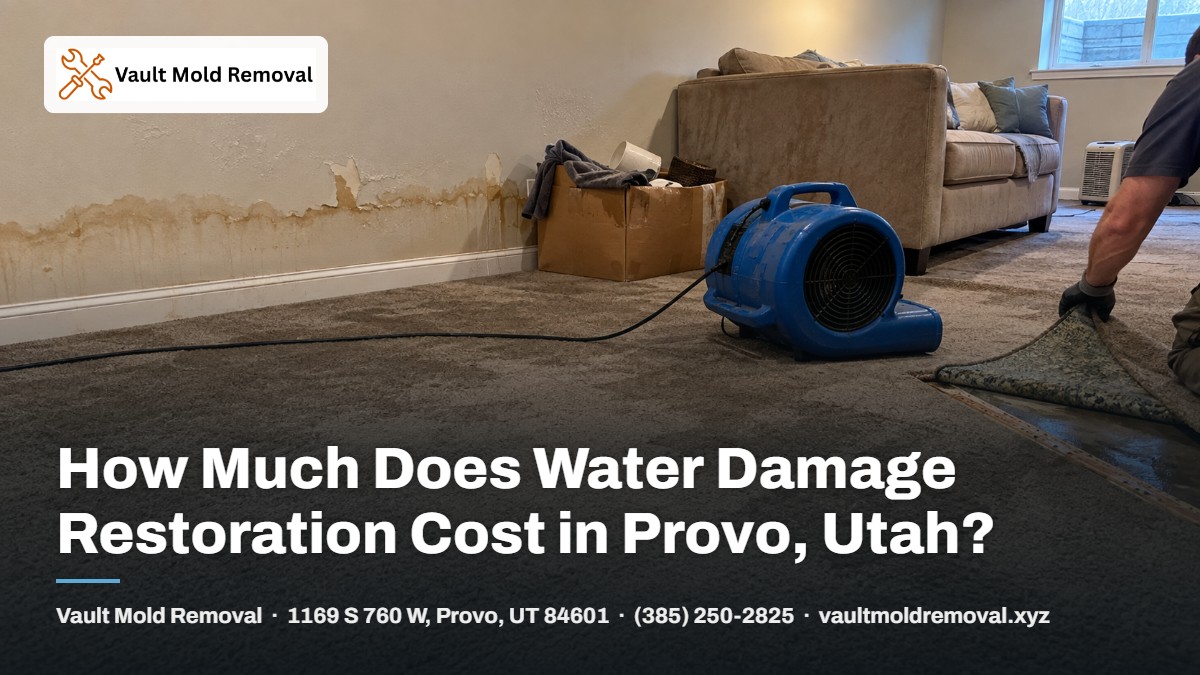
In Provo, Utah, water damage restoration typically costs $3,500 to $8,500 for water mitigation (extraction, drying and removal of wet materials) and $4,500 to $9,500 for reconstruction, based on typical ranges from Vault Mold Removal. The final cost depends on how much area got wet, the water category and the materials affected. On covered claims, insured homeowners usually pay only their deductible plus anything the policy excludes.
What affects the cost of water damage restoration?
The cost of water damage restoration depends mainly on the size of the wet area, the type of water, the materials that got wet and how long they stayed wet. Most jobs have two phases, and each is priced separately.
| Phase | What it covers | Typical range (Vault Mold Removal) |
|---|---|---|
| Water mitigation | Extraction, flood cuts, drying equipment, daily moisture monitoring | $3,500-$8,500 |
| Reconstruction | Drywall, flooring, cabinets, trim and paint | $4,500-$9,500 |
| Mold remediation (if needed) | Containment, removal, clearance testing | Starts at $500 |
These factors push a job toward the low or high end of those ranges:
- Water category. Clean water from a supply line costs less to handle than grey water from a drain or black water from a sewer backup. Contaminated water requires more material removal, antimicrobial treatment and protective procedures. See Category 1, 2 and 3 water damage for how each is defined.
- Affected area and number of rooms. More square footage means more extraction, more drying equipment and more materials to replace.
- Materials. Carpet pad, insulation, particleboard cabinets and laminate often have to be removed. Some hardwood, tile and framing can be dried in place.
- Time before mitigation starts. Water spreads into walls and subfloors, and mold can begin growing if materials stay wet. Faster response usually means less demolition.
- Hidden moisture. Water behind cabinets, under flooring or inside wall cavities has to be found and opened up. Vault uses Delmhorst and Protimeter moisture meters and FLIR thermal cameras to locate it.
- Home age. In pre-1978 homes, disturbing painted surfaces requires lead-safe work practices. Vault is EPA RRP firm certified for this work.
- Mold. If mold is already present, remediation under sealed containment with HEPA negative air adds to the scope.
Vault provides free written estimates for water damage, sewage and sewer line work, so the scope and price are on paper before work begins.
Does homeowners insurance cover water damage restoration?
Homeowners insurance usually covers water damage restoration when the damage is sudden and accidental, such as a burst supply line or a failed appliance hose. It usually does not cover damage from long-term leaks, poor maintenance or outside flooding. Sewer backup coverage often requires a separate endorsement. Every policy is different, so check your declarations page or ask your agent.
When a loss is covered, Vault Mold Removal documents the damage, records daily moisture readings, writes the scope in Xactimate and bills the insurance company directly. The homeowner pays the deductible plus anything the policy doesn’t cover. Vault bills State Farm, USAA, Allstate, Farmers and Bear River Mutual directly.
For deductibles, non-covered items or uninsured jobs, Vault offers financing through Wisetack from $500 to $25,000 over 3 to 24 months. Checking eligibility uses a soft credit check that does not affect your credit score, and financing is subject to credit approval. For more on the claims side, see Vault’s insurance claims page.
How long does water damage restoration take?
Water damage restoration usually happens in two stages: mitigation (extraction and drying) and reconstruction (rebuilding what was removed). The length of each stage depends on the size of the loss, the materials involved and insurance approval.
During mitigation, the crew extracts standing water, removes materials that can’t be saved, and sets up air movers and dehumidifiers. Drying typically takes [ADD: typical number of days for structural drying on a residential job]. Vault records moisture readings every day and stops drying only when materials reach dry standard, not on a set schedule.
Reconstruction can’t start until the structure is dry and the insurance scope is approved where a claim is involved. A typical rebuild takes [ADD: typical reconstruction duration for a residential job]. Jobs involving cabinets or specialty flooring can take longer if materials need to be ordered. Vault’s guide on how long water damage restoration takes explains each stage in more detail.
Is it cheaper to fix water damage yourself?
Fixing water damage yourself is cheaper upfront only for small, clean-water spills that you catch right away and that haven’t soaked into walls, insulation or subfloors. For anything larger, DIY often costs more over time.
The main risk is hidden moisture. Household fans and a shop vac can dry surfaces that look and feel dry while the wall cavity, the bottom plate or the subfloor stays wet. That trapped moisture can lead to mold, warped flooring and odors that show up weeks later and are more expensive to fix than the original leak.
DIY can also complicate an insurance claim. Insurers expect documentation such as photos, moisture readings and a written scope. Without it, it can be harder to show the extent of the loss.
If you aren’t sure whether a small leak dried completely, an inspection with a moisture meter and thermal camera can confirm it. Vault offers this for $199. Grey water, black water, sewage and any water in a finished basement are not DIY jobs.
Why do Provo homes get water damage, and does it change the cost?
Provo homes get water damage from cold winters, spring snowmelt and aging plumbing in older neighborhoods. Each cause changes the type and size of the job, which changes the cost.
Provo sits at the base of the Wasatch Range next to Utah Lake, with cold winters and a spring runoff season. Recent Vault jobs in Provo show the common patterns:
- Freeze damage. A frozen hose bib ruptured in North Park (Jan 2026), and an upstairs bath supply line burst in Wasatch (Jan 2026). Upstairs leaks often cost more because water travels down through ceilings and walls into lower floors.
- Ice dams. Snow and ice in a roof valley caused an ice dam leak in Rock Canyon (Feb 2026), which can wet attic insulation and ceilings.
- Basements. A sump pump failed in Rivergrove (Mar 2026), and a sewer backup hit a Franklin South basement (Mar 2026). Finished basements carry more drywall, carpet and trim to replace, and sewage means Category 3 cleanup.
- Aging pipes. A galvanized pipe developed a pinhole leak behind kitchen cabinets in Timp (Dec 2025), and a kitchen sink drain leak in Franklin (Dec 2025) led to mold. Slow leaks behind cabinets are often found late, which raises the cost.
Response time matters because damage spreads while water sits. Inside Provo city limits, Vault guarantees arrival within 45 minutes during daytime hours (Mon-Sat, 8 AM-5 PM). If the crew is late, the emergency inspection is free. Vault’s average response time in Provo is 34 minutes. The phone is answered 24/7 by the Vault crew, not a call center. For urgent help, see emergency water damage in Provo.
Frequently asked questions
Is the estimate for water damage restoration free?
Yes. Vault Mold Removal provides free written estimates for water damage, sewage and sewer line work. Mold remediation estimates are free after the initial assessment.
Does Vault use subcontractors?
No. Vault’s five technicians are all W-2 employees, and the company does not use subcontractors. The team includes specialists in water damage, drying, mold remediation, emergency response and contents cleaning.
What warranty comes with the work?
Vault provides a 24-month workmanship warranty and a 90-day mold warranty that starts at post-remediation clearance. Both warranties can be transferred once.
Is Vault licensed and insured?
Yes. Vault holds Utah DOPL General Contractor License #11876543-5501 and IICRC firm certifications WRT, ASD, AMRT and OCT. It carries general liability and workers’ compensation insurance through The Hartford, is bonded and is BBB Accredited.
Does Vault handle the sewer line problem that caused a backup?
Yes. Vault handles sewer line work in-house, including snaking, hydro-jetting, camera inspection, and repair or replacement.
How much does a mold inspection cost if water damage caused mold?
A basic visual inspection of one area is $99, an inspection with a moisture meter and thermal camera is $199, and an inspection with air sampling and lab analysis is $349. Mold remediation jobs start at $500.
Contact Vault Mold Removal
Vault Mold Removal 1169 S 760 W, Provo, UT 84601 (385) 250-2825
The phone is answered 24/7. Office hours are Monday through Saturday, 8 AM-5 PM.
Need help in Provo? See water damage restoration in Provo, with a free written estimate. Call (385) 250-2825.
Our Provo water damage restoration crew is an IICRC Certified Firm that bills your insurer directly. Call (385) 250-2825.
0 Comments