
Insurance claims support
Vault documents the damage with photos and daily moisture readings, writes the scope in Xactimate and bills your insurer directly. You pay only the deductible plus anything the policy doesn’t cover.
- Call any hour: (385) 250-2825 is answered live 24/7 by the Vault crew. 45-minute arrival inside Provo city limits (Monday–Saturday, 8 AM–5 PM); typically under 60 minutes elsewhere in our Utah County service area.
- In-house: damage photo documentation, daily moisture readings on your work order, Xactimate scopes, and direct billing to State Farm, USAA, Allstate, Farmers and Bear River Mutual.
- Who does the work: Vault’s own W-2 crew, IICRC certified in WRT, ASD, AMRT and OCT, under Utah DOPL General Contractor License #11876543-5501. No subcontractors. Meet the team
- Pricing: free written estimates. Water mitigation typically $3,500–$8,500; reconstruction $4,500–$9,500. 24-month workmanship warranty · Wisetack financing
- Family-owned and veteran-operated, based in Provo since 2020.
Water damage restoration · Mold remediation · Sewage cleanup · Reconstruction & repairs
Water Damage Insurance Claims Coordination — Utah County
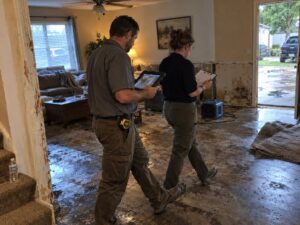
Insurance claim resolution is often the most stressful part of a water damage event for property owners — and it’s the part where competent restoration contractors add the most value beyond the physical work itself. The technical restoration is what dries the property; the documentation package is what gets the claim paid without disputes, delays, or scope reduction. Vault Mold Removal has produced Xactimate-format scopes and adjuster documentation for over 2,400 Utah County water damage jobs across State Farm, USAA, Allstate, Farmers, Bear River Mutual, Progressive, and other Utah-market carriers. This page describes how we coordinate the claim process, what documentation gets produced, and how the property owner’s role fits into the workflow.
The Property Owner’s Position in the Claim
Understanding the relationship structure matters. The insurance policy is a contract between the property owner and the insurance carrier. The restoration contractor works for the property owner, not for the carrier. Even when the carrier pays the restoration bill directly (which is the typical arrangement), the property owner remains the ultimately responsible party and the contract counterparty for the restoration work. This structure has three practical implications:
- The customer owns the claim decisions. We can advise on scope, documentation strategy, and adjuster negotiation approaches, but decisions about how to respond to carrier positions belong to the customer.
- The customer is responsible for the deductible. Standard water damage deductibles at Utah-market carriers typically range from $500 to $2,500. The deductible is paid to the restoration contractor, not to the carrier.
- The customer is responsible for any scope elements the carrier doesn’t cover. If the carrier denies coverage for specific line items (typically mold remediation without a specific endorsement, or reconstruction items outside the covered peril), the customer either pays out-of-pocket or negotiates alternate approaches with the carrier.
The Adjuster Documentation Package
Every water damage job we perform produces a documentation package designed for direct submission to the insurance adjuster. The package is delivered within 24 hours of on-site assessment for the initial scope, and updated daily during the drying phase.
Initial Assessment Documentation (Delivered Day 1)
- Loss condition photos: wide shots of affected rooms, close-ups of water sources and standing water, damage to specific materials
- Water source identification and category/class determination with IICRC S500 reasoning
- Grid moisture map with numbered measurement points and Day 0 baseline readings
- Xactimate-format scope of work with line-item pricing
- Estimated drying and reconstruction timeline
- Certificate of insurance and additional insured endorsements if requested
Daily Drying Phase Documentation
- Daily grid moisture readings at every measurement point
- Psychrometric data (ambient temperature, relative humidity, GPP inside/outside)
- Equipment operational status and any equipment changes
- Photos of drying progress
- Delivered as evening summary email to adjuster and customer
Final Documentation Package (Delivered Within 24 Hours of Completion)
- Complete daily drying log with all readings
- Final clearance photos and dry standard verification readings
- Any change orders from the original scope, with reasoning
- Final Xactimate scope reflecting the actual work performed
- Reconstruction documentation with permit records and material warranties
Utah-Market Insurance Carriers
Residential Carriers
- State Farm — largest residential market share in Utah County. Adjusters typically request Xactimate scopes with photo documentation. Deductibles typically $1,000–$2,500 for water damage.
- USAA — strong presence in Utah County due to military service population. Streamlined claim process, typically faster payment cycles than average.
- Allstate — common in Utah County. Adjusters review Xactimate documentation carefully; complete documentation resolves most scope disputes.
- Farmers — regional variation in claim processing; Provo office typically responsive to well-documented scopes.
- Bear River Mutual — Utah-based carrier with significant Utah County market share. Local claim handlers familiar with regional restoration practices.
- Progressive — growing residential presence in Utah. Standard Xactimate documentation processing.
- Nationwide, Liberty Mutual, American Family, and smaller regional carriers — each handled per their specific claim procedures.
Commercial Carriers
- The Hartford — commercial property, business interruption
- Travelers
- Zurich North America
- CNA
- Chubb
- Bear River Mutual Commercial
- State Farm Business Insurance for USAA member commercial policies
What’s Typically Covered vs. Not Covered
Typically Covered Under Standard Homeowner Policies
- Sudden and accidental water damage from covered perils (burst pipe, water heater failure, appliance supply line failure, ice maker line disconnect)
- Emergency mitigation work under the “duty to mitigate” policyholder obligation
- Water extraction and structural drying to IICRC S500 standards
- Reconstruction of damaged materials (drywall, flooring, cabinetry, paint) to pre-loss condition
- Additional Living Expense (ALE) coverage for hotel or alternate housing during restoration when the property is uninhabitable
- Personal property replacement for items damaged by covered water event
Typically Excluded or Requires Specific Endorsement
- Long-term seepage. Slow leaks that developed over weeks or months are often excluded under the “gradual damage” or “seepage” exclusion. Documentation of the specific event date matters.
- Flood from external sources. Rising water, storm surge, and external groundwater flooding require separate flood insurance under the National Flood Insurance Program (NFIP).
- Sewage backup. Standard policies typically exclude sewage backup unless a specific sewer backup endorsement is added. Endorsement limits vary by policy.
- Sump pump failure. Often excluded from standard policies; may be covered under a specific sump pump endorsement.
- Foundation crack seepage. Chronic seepage from foundation issues is typically excluded as a maintenance issue.
- Mold remediation. Coverage varies significantly by carrier and policy. Some policies exclude mold entirely, others limit coverage to specific dollar amounts, and others cover mold only when caused by a covered water event.
- Upgrades beyond pre-loss condition. Insurance covers restoration to pre-loss condition, not improvements. Customer-elected upgrades are billable separately.
The Xactimate Standard
Xactimate is the industry-standard software for property insurance scope documentation. It’s used by essentially all major insurance carriers for claim assessment and by professional restoration contractors for scope development. Xactimate maintains regional pricing tables that update monthly based on local material and labor costs; the Provo/Utah County pricing region reflects current local market rates.
Every scope we produce is Xactimate-formatted with line items priced to current regional tables. This produces three benefits:
- Adjuster acceptance. Carriers accept Xactimate scopes with minimal negotiation because the format and pricing are what their internal review process expects.
- Predictable customer billing. The customer knows what the scope costs before work begins. No time-and-materials surprises at the end of the job.
- Dispute defensibility. When scope disputes arise, Xactimate pricing tables provide the objective reference point for negotiations rather than “our estimate vs. your estimate” arguments.
Managing Scope Disputes
Scope disputes between restoration contractors and insurance adjusters happen occasionally — typically not on the total scope, but on specific line items where the carrier believes lower-cost alternatives are available or the adjuster interprets policy coverage differently than the customer expects. Common dispute types and our approach:
Removal vs. Dry-in-Place Disputes
Adjusters sometimes push for dry-in-place approach on materials that IICRC S500 criteria call for removal. Our position: we follow S500 removal criteria based on category, class, and material condition. Supplemental documentation typically resolves these disputes.
Equipment Duration Disputes
Adjusters sometimes question extended drying timelines. Our position: drying continues until dry standard is achieved per IICRC S500, verified by documented moisture readings. Daily readings tell the story and typically resolve duration questions.
Scope Reduction Requests
Adjusters may request scope reduction for specific line items to bring total claim cost below the carrier’s target range. Our position: we don’t reduce scope below S500 standards to accommodate carrier cost targets. If the carrier’s position holds, the customer can dispute through the carrier’s appeal process or engage a public adjuster.
Reconstruction Scope Disputes
Adjusters sometimes dispute reconstruction line items (specific finish materials, cabinet replacement vs. cabinet refinishing, extent of paint work). Our position: reconstruction returns the property to pre-loss condition, documented with photos of the pre-loss condition where available. Customer-elected upgrades are separately billable and clearly noted in the scope.
Public Adjusters and Legal Counsel
When claim disputes escalate beyond what documentation alone can resolve, property owners have options for additional advocacy:
- Public adjusters. Licensed professionals who represent the property owner (not the insurance carrier) in claim negotiations. Public adjusters typically charge 10–20% of the recovery, so they’re most useful for larger disputed claims. Utah requires public adjusters to be licensed by the Utah Insurance Department.
- Utah Insurance Department complaint. The Utah Insurance Department accepts complaints against insurance carriers for claim handling practices. The complaint process is free and doesn’t require legal representation.
- Legal counsel. For significant disputed claims or apparent bad-faith claim handling, engaging an insurance coverage attorney may be appropriate. Utah has several attorneys who specialize in first-party property insurance claims.
We can provide referrals to public adjusters and attorneys when customer situations warrant that level of advocacy, though we don’t have a formal financial relationship with any specific third-party representative.
Frequently Asked Questions
- Do you file the insurance claim on my behalf?
- No. The claim is filed by the property owner directly with the insurance carrier — that’s a policyholder obligation under the policy contract, not a service that restoration contractors can perform. What we do is prepare the documentation the adjuster needs to process your claim, communicate directly with the adjuster on scope questions, and support the negotiation process. The property owner initiates the claim (typically by calling the carrier’s claim line or using their app), and the adjuster is assigned within 24–48 hours. From there, we coordinate directly with the adjuster on the scope while keeping the property owner informed at every step.
- Do I have to use your Xactimate scope, or can I get competing bids?
- You can absolutely get competing bids — and we recommend doing so if you have any concerns about our scope or pricing. Most Utah County homeowner policies allow the property owner to select the contractor of choice for restoration work. Some carriers have preferred contractor programs that offer expedited claim handling if you use one of their preferred contractors; our position is that we’ll work with any Utah-market carrier regardless of preferred contractor status. If you get competing bids that are meaningfully lower than our scope, we’re happy to discuss the specific line items where prices differ — sometimes the difference is legitimate market variation, other times it reflects one contractor’s scope being under IICRC S500 requirements.
- What happens if my claim is denied?
- You have several options depending on the reason for denial. First, understand exactly why the claim was denied — carriers must provide written explanation. If the denial is based on a policy exclusion, verify that the exclusion actually applies to your specific loss circumstances. Common misapplied exclusions include “wear and tear” (applied to sudden failures) and “seepage” (applied to specific water events). If you believe the denial is incorrect, appeal through the carrier’s internal appeal process using the documentation we’ve produced. If the appeal fails, file a complaint with the Utah Insurance Department or engage a public adjuster or coverage attorney. We can support you through all of these steps with the documentation package from your job. We don’t handle claim denials on a “no coverage means no payment” basis — the restoration work is billable to you directly if the carrier ultimately doesn’t cover it.
- How long does the claim payment process typically take?
- Varies significantly by carrier and claim complexity. Standard Category 1 residential water damage claims typically resolve within 30–60 days from filing to final payment. Category 2 and 3 losses, mold-involved claims, and larger commercial claims can extend to 60–120 days. Utah Code § 31A-26-301.5 requires insurance carriers to acknowledge claims within 15 days and either pay or deny within 30 days of receiving complete documentation. Delays beyond these statutory requirements can be raised as claim handling complaints with the Utah Insurance Department. We accept payment through the carrier’s normal claim payment cycle; we don’t require the customer to pay us out-of-pocket while awaiting insurance payment on covered scope items.
- Can I use my insurance settlement money for something other than restoration?
- Depends on how the settlement is structured. If the payment is made jointly to you and the restoration contractor (a common arrangement for insurance-coordinated jobs), the funds are required to be used for the restoration work. If the payment is made solely to you (typically when you’ve already paid the contractor out-of-pocket, or when the settlement covers scope elements you elected to handle differently), Utah law doesn’t restrict how you use the funds — though mortgage-lender arrangements may require repair completion, and if you sell the property before completing restoration, the disclosure requirements come into play. Our recommendation is straightforward: use insurance settlement money for the restoration work it was paid for. Diverting settlement money to other purposes creates downstream problems with lenders, buyers, and future insurance claims that far exceed any short-term benefit.
Contact Vault Mold Removal — Provo, UT
For insurance-coordinated water damage restoration, scope disputes with prior contractors, or questions about specific carrier claim procedures, contact our office directly.
- Phone: (385) 250-2825
- Address: 1169 S 760 W, Provo, UT 84601
- Utah DOPL General Contractor License: #11876543-5501
- IICRC WRT / ASD / AMRT / OCT: #248317 / #248317-ASD / #319482 / #319482-OCT
Office Hours
- Monday – Saturday: 9:00 AM – 5:00 PM
- Sunday: Closed
Written warranty
24-month workmanship warranty on drying, structural repairs, drywall, flooring, cabinetry and paint done by Vault. 90-day mold warranty from post-remediation clearance for recurrence from the same moisture source. Both are transferable once to a new homeowner, in writing on the work order.
We bill your carrier directly
Direct-billing with State Farm, USAA, Allstate, Farmers and Bear River Mutual. Every scope is written in Xactimate; you pay only your deductible plus anything the policy doesn’t cover. Not on this list? We still handle the claim.
Helpful guides: Your deductible, explained · ACV vs replacement cost · Documenting damage for insurance