
Dehumidification in Mapleton, Utah
Getting the water out of a Mapleton home is the first hour. Getting the moisture out — bringing framing lumber to 12% MC, drywall paper to 1%, slab to 4% — is the next three to ten days. Dehumidification is what closes that gap, and how it’s engineered for a specific building envelope determines whether affected materials get saved or replaced. Mapleton’s construction range is wide: pre-1940 lath-and-plaster over dimensional lumber, mid-century slab-on-grade, foothills custom builds with engineered floors and spray foam. Each of these dries differently, and each requires a specific equipment mix.
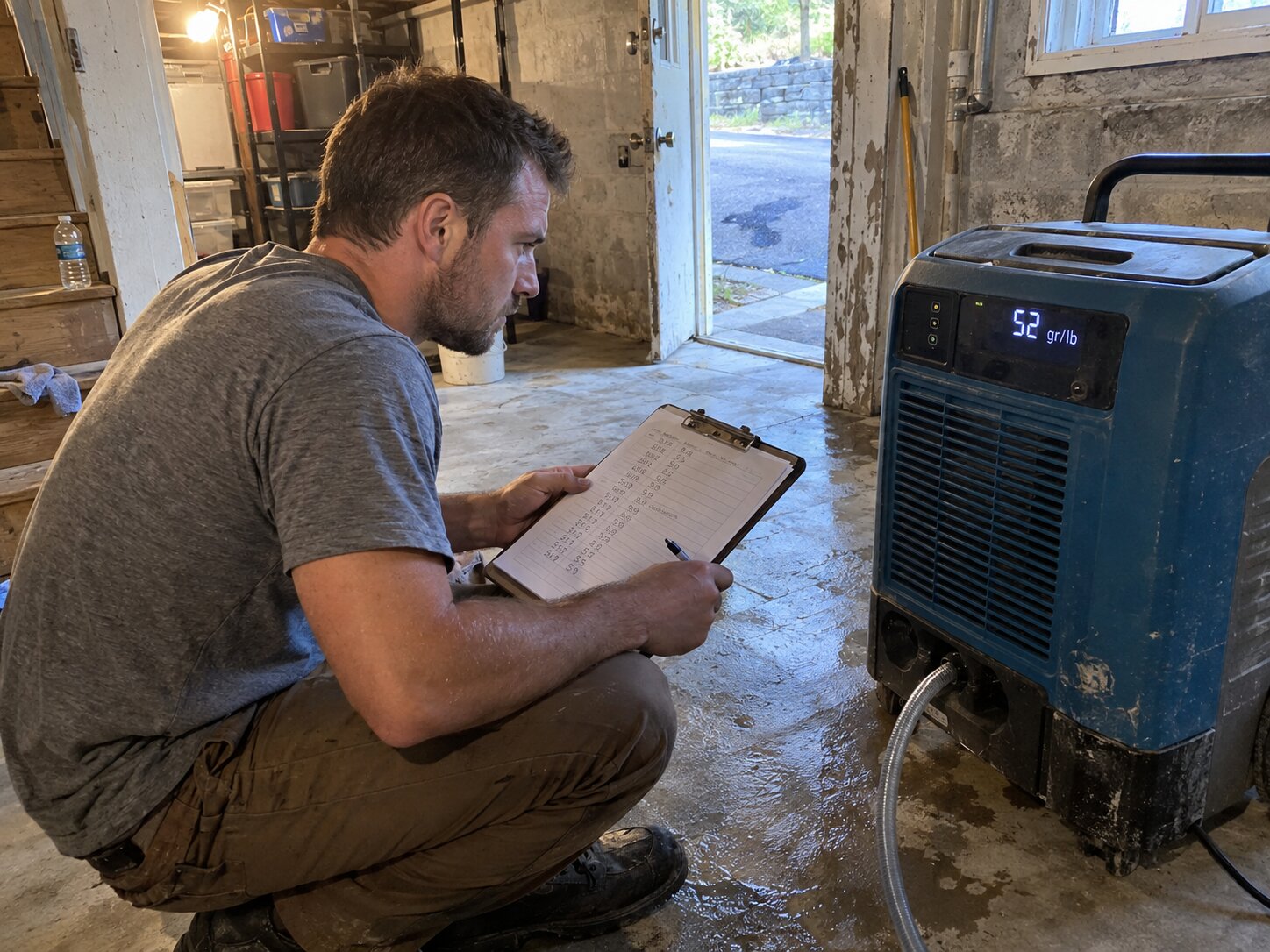
Vault Mold Removal deploys two dehumidifier families depending on structure and drying goal. Low-Grain Refrigerant (LGR) units — Phoenix R150, Dri-Eaz LGR 6000Li, Phoenix DryMax XL — pull moisture from air by condensation and work most efficient in the 70°F to 90°F, 40% to 60% RH operating envelope. Desiccant units — Phoenix 200 MAX, Dri-Eaz DriTec 5000i — use silica gel wheels to pull moisture chemically and work in the low-temperature, low-humidity environments where LGR efficiency drops. Which unit goes where is not guesswork; it’s calculated from affected volume, current grains-per-pound reading, and drying goal for the specific material.
Dehumidification Strategy by Property Type
Historic Main Street farmhouses. Lath-and-plaster walls hold moisture longer than drywall and release it slower — the plaster acts as a moisture reservoir even after the framing behind reaches drying goal. Drying strategy: LGR primary units for ambient reduction, supplemental desiccant units for the residual plaster moisture in the final drying phase, extended monitoring period (often 7 to 10 days versus 3 to 5 for drywall). Crawlspace drying runs parallel with above-grade drying — separate equipment for the crawl, monitored independently.
Mid-century tract housing. Standard drywall over 2×4 framing, slab-on-grade or shallow crawl. LGR units handle the bulk of drying with predictable material response. Slab moisture (usually retained from below-slab absorption) requires desiccant supplementation in the final drying phase. Typical drying period: 3 to 5 days for above-grade, 5 to 7 for slab-influenced.
Farmstead and equestrian properties. Multi-structure drying with separate equipment deployments per building. Primary residence gets standard LGR deployment. Outbuildings — barns, shops, hay storage — often have larger open volumes with minimal insulation, which changes the equipment calculus. High-volume desiccant units are more efficient in these environments than multiple LGR units, and we deploy accordingly. Well-fed water systems require Category 2 protocols throughout drying if contamination is confirmed.
Maple Mountain foothills custom builds. Engineered floor systems, PEX manifold plumbing, spray foam insulation. Drying strategy: LGR primary, aggressive cavity ventilation through drilled ports, and pre-planned demolition scope where spray foam is confirmed wet (foam doesn’t dry through vapor transfer). Engineered I-joist webs dry slower than solid framing — typical drying period 5 to 7 days versus 3 to 5 for standard construction.
What Determines Drying Time
- Material type and thickness
- Drywall dries in 24-72 hours if paper hasn’t delaminated. Solid dimensional framing dries in 3-5 days. Engineered I-joist webs dry in 3-5 days with proper cavity ventilation. Concrete slab dries in 5-10 days depending on thickness and vapor barrier. Plaster dries in 5-10 days, sometimes longer for thick applications. Solid hardwood dries in 5-14 days.
- Airflow across surfaces
- Phoenix Focus centrifugal air movers directed at low angles across wet surfaces create the shear velocity that carries surface moisture into ambient air where dehumidifiers capture it. Without airflow, dehumidification stalls at the moisture layer immediately adjacent to the equipment.
- Ambient conditions
- LGR units run efficient at 70-90°F, 40-60% RH. Below 60°F efficiency drops sharply. Above 80% RH they can stall. Coordinating with the home’s HVAC to keep drying chamber in optimal range makes a measurable difference — 24 to 48 hours off total drying time in many cases.
- Cavity access
- Wall cavity moisture needs airflow access through drilled ventilation ports at the base plate or through removed baseboards. Cavity air movement is the hardest variable to control and the most common reason drying stalls.
- Category and salvageability
- Category 1 clean water losses dry fastest. Category 2 adds antimicrobial and porous material removal. Category 3 requires extensive demolition and containment, which slows drying but ensures the affected materials that remain are salvageable.
Documentation During Drying
Every 12 hours during active drying we log ambient temperature, RH, and grains per pound in each affected space; moisture readings on framing at grid coordinates (target 12% MC); readings on drywall or plaster (target 1% in paper facing, longer target for plaster); readings on concrete (target 4% by weight); equipment status; and any scope changes. This log goes to your adjuster with the initial scope of loss. Under Utah Code 31A-26-301.5, the carrier acknowledges the claim within 15 days and determines coverage within 30 — comprehensive drying documentation is what determines both timeline and scope.
Mapleton Coverage Zones
- Main Street Historic Center
- Plaster drying, extended monitoring, crawlspace drying parallel. Response: 52 min daytime.
- Western Flats / Agricultural
- Multi-structure drying, high-volume desiccant for outbuildings. Response: 55 min daytime.
- Central Residential
- Standard LGR deployment, slab supplementation as needed. Response: 50 min daytime.
- Eastern Foothills / Maple Mountain
- Engineered floor cavity drying, spray foam considerations. Response: 58 min daytime.
- Southern Fill-In / Post-2010
- Standard drying, predictable material response. Response: 50 min daytime.
Frequently Asked Questions
- How long will you leave equipment running in my house?
- Until drying goals are met. Typical clean-water loss with responsive materials: 3 to 5 days. Complicated losses with slab moisture or cavity involvement: 5 to 10 days. Plaster or crawlspace involvement: 7 to 10 days. Multi-structure farmstead losses: variable depending on structure count and category. We monitor at 12-hour intervals and pull equipment only when three consecutive readings show the drying goal met.
- What’s the difference between LGR and desiccant dehumidifiers, and when do you use each?
- LGR (Low-Grain Refrigerant) units pull moisture from air by condensation on a cold coil. They work best at 70-90°F and 40-60% RH. Desiccant units use a silica gel wheel to pull moisture chemically — they work at any temperature and can pull moisture below LGR reach. We use LGR for most drying, desiccant supplementation for slab moisture, plaster drying, low-temperature conditions, and the final phase of any drying where residual moisture is stubborn.
- What if my property is on a well and drying is happening in an outbuilding with no HVAC?
- Outbuilding drying without HVAC uses larger dehumidifier deployments and often desiccant primary rather than LGR, because the ambient conditions (unheated, potentially cold, variable humidity) are outside LGR optimal range. We deploy Phoenix 200 MAX or Dri-Eaz DriTec 5000i desiccant units for these applications and monitor closely because material response in unheated spaces can be slower and less predictable than in climate-controlled residential.
- Won’t the equipment run my electric bill up?
- Additional electric cost for a typical 5-day dehumidifier deployment in a Mapleton home runs $40 to $80 depending on unit count and rate class. Rocky Mountain Power residential rates in the Mapleton service area produce total drying-period increases in that range. This is billable to your insurance claim as part of the emergency service scope.
- Can I run my heat or AC while drying is happening?
- Yes, and we prefer that you do. HVAC helps stabilize ambient conditions in the drying chamber and moves air across affected surfaces that our fans might not reach. Exception: when we have containment set up with negative air pressure, running HVAC can pull dust and airborne particulate into the return, contaminating the coil and ductwork. We tell you specifically what to run and what to shut off during containment.
Contact Vault Mold Removal
Phone: (385) 250-2825
Address: 1169 S 760 W, Provo, UT 84601
Hours: Monday–Saturday, 9:00 AM – 5:00 PM
Service Area: Mapleton, Provo, Orem, Springville, Vineyard, Lindon, and surrounding Utah County communities.
Water damage in Mapleton?
Call (385) 250-2825 — answered live 24/7 by the Vault crew, not a call center. Typical arrival is under 60 minutes from our Provo office.
Helpful guides: LGR dehumidifiers · Why so many fans?
Guides related to this job
Have a job like this in Mapleton? See water damage restoration in Mapleton, or call (385) 250-2825 for a free written estimate.