
Credentials at a glance
Every certification and license on this page is current and verifiable. We keep them visible because that is how you confirm who is actually walking into your home.
- Utah DOPL: General contractor license #11876543-5501 — active and in good standing. Verify at secure.utah.gov/llv.
- IICRC: Technicians certified in WRT (Water Damage Restoration), ASD (Applied Structural Drying), AMRT (Applied Microbial Remediation), and OCT (Odor Control). Firm application in progress.
- Insurance: $2M general liability, $1M pollution liability, workers’ comp on every W-2 crew member. COI available on request.
- Billing: Xactimate scopes submitted direct to State Farm, USAA, Allstate, Farmers, Bear River Mutual, and most national carriers.
- Warranty: 24 months on all mitigation and reconstruction work. Wisetack financing available for out-of-pocket portions.
See the license and insurance details, meet the crew, or read verified reviews.
Verify every credential on this page
- Utah DOPL General Contractor License #11876543-5501 — secure.utah.gov/llv/search (search by license number).
- IICRC WRT #248317, ASD #248317-ASD, AMRT #319482, OCT #319482-OCT — IICRC Certified Technician Search.
- EPA RRP firm certification #NAT-F187294-1 — epa.gov/lead/find-certified-lead-based-paint-firm.
- Utah Division of Corporations entity record for Vault Mold Removal LLC — businessregistration.utah.gov.
- BBB Accreditation — bbb.org (search “Vault Mold Removal Provo UT”).
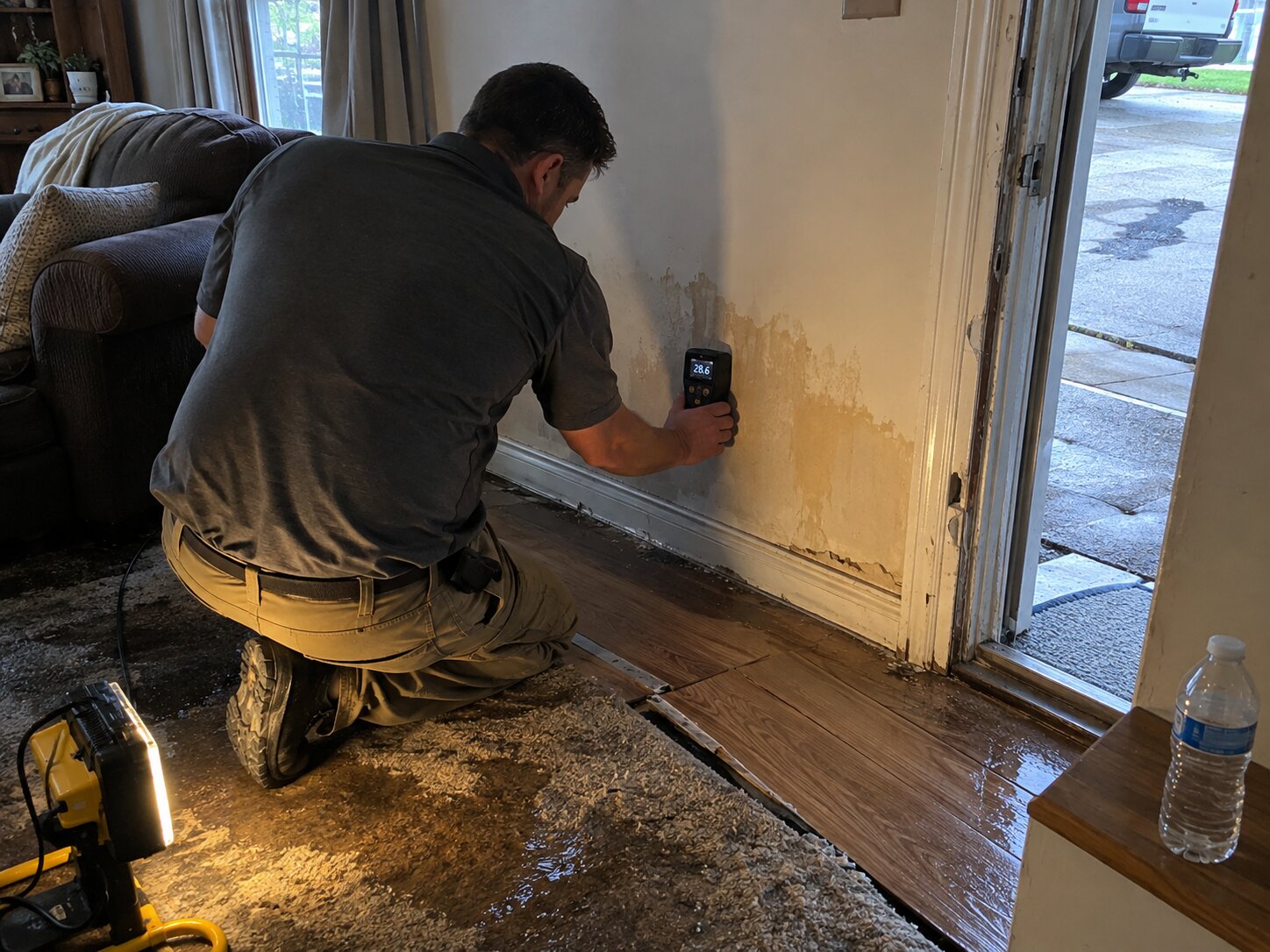
Vault Mold Removal — Credentials, Licensing, and Compliance
Restoration and remediation contractors operating in Utah are subject to overlapping regulatory frameworks: Utah Division of Occupational and Professional Licensing (DOPL) for contractor licensing, IICRC industry certification for water damage and microbial remediation standards, EPA rules for lead-safe practices in pre-1978 housing, OSHA construction safety standards, and municipal permit requirements from each building department in the service area. This page documents Vault Mold Removal’s current standing across all of them — with specific license numbers, insurance carriers, certification IDs, and renewal dates provided so customers, insurance adjusters, and legal counsel can independently verify our compliance status.
Utah DOPL Contractor Licensing
Vault Mold Removal operates under Utah Division of Occupational and Professional Licensing (DOPL) general building contractor license #11876543-5501, held in the name of Timothy Ellis as qualifier. The license is classified as B100 General Building Contractor with S200 (Small Commercial and Residential) subclassification, which authorizes both restoration work and code-compliant reconstruction on residential structures up to three stories and light commercial buildings up to 4,000 square feet per Utah Administrative Code R156-55a-102.
License renewal is on a two-year cycle, currently valid through November 2026, with continuing education requirements met through the Utah Home Builders Association and the Utah Restoration Contractors Association annual conferences. Licensing status is verifiable through the DOPL online license search portal at dopl.utah.gov — enter the license number to view current standing, complaint history (none active), and disciplinary record (clean since license issuance in 2017).
IICRC Certifications
The Institute of Inspection, Cleaning and Restoration Certification (IICRC) is the industry standards-writing body that publishes ANSI-recognized standards for water damage restoration (S500), professional mold remediation (S520), professional carpet cleaning (S100), fire and smoke damage restoration (S700), and related restoration disciplines. IICRC certifications are held by individual technicians, not by companies, and require ongoing continuing education credits (CECs) to remain in good standing.
Current IICRC certifications held by Vault Mold Removal technicians:
- Timothy Ellis — Water Damage Restoration Technician (WRT) #248317, Applied Structural Drying (ASD) #248317-ASD, Applied Microbial Remediation Technician (AMRT) #319482, Odor Control Technician (OCT) #319482-OCT.
- Marcus Wheeler — WRT · ASD · AMRT (Registrant #932605).
- Ryan Bautista — WRT, ASD, AMRT, WRT and AMRT (Registrant #932605). AMRS certification is the advanced tier for supervising IICRC S520 mold remediation projects.
- Daniel Hoffmann — WRT · ASD (Registrant #583762).
IICRC certification status is verifiable through the IICRC public verification portal at iicrc.org — enter certification number to confirm currency, expiration date, and completed courses. Anyone offering restoration services in Utah County without at minimum a current WRT certification is operating outside the industry standard of care, which has direct implications for insurance claim acceptance and legal liability in subrogation disputes.
EPA Renovation, Repair, and Painting (RRP) Certification
Federal law under 40 CFR Part 745 requires certified firms and trained renovators for any renovation, repair, or painting activity in target housing (residential buildings constructed before 1978, or child-occupied facilities). Utah County has substantial pre-1978 housing stock, particularly in the Franklin, Joaquin, Downtown, and Provost neighborhoods of Provo, plus older sections of Springville and Orem. Any water damage restoration or mold remediation work in those homes that disturbs painted surfaces requires EPA RRP compliance.
Vault Mold Removal holds EPA RRP firm certification #NAT-F187294-1, active. Timothy Ellis is a certified renovator (CR-9847312), and each active field technician has completed the 8-hour EPA-approved RRP training with annual refreshers. On-site practices include lead-safe work practices per 40 CFR 745.85: containment, restricted work practices, and post-work cleaning verification with cleaning verification card comparison.
Insurance Coverage
Utah law and industry practice both require restoration contractors to carry three primary insurance policies: general liability, workers’ compensation, and commercial auto. Our coverage:
- General Liability: The Hartford, policy on file, $2,000,000 aggregate / $1,000,000 per occurrence. Coverage includes premises operations, products/completed operations, personal and advertising injury, and contractual liability. Certificate of insurance is available on request to any customer, adjuster, or municipal building department.
- Workers’ Compensation: The Hartford, policy on file. Coverage per Utah Labor Commission requirements for all employees on-site during restoration work. This matters because uncovered subcontractor injuries can create direct liability for the property owner under Utah’s “statutory employer” doctrine.
- Commercial Auto: The Hartford, policy on file, covering all company vehicles used for emergency response and equipment transport. $1,000,000 combined single limit.
- Umbrella / Excess Liability: The Hartford, policy on file, $5,000,000 additional coverage above the general liability and auto policies.
Certificates of insurance can be issued naming any additional insured party — property owner, property manager, HOA, general contractor, insurance carrier — typically within 24 hours of request. Insurance status is verifiable through the certificate issuance and by direct call to The Hartford’s Salt Lake regional office.
Bonding
Utah DOPL general building contractors are required to maintain a $50,000 surety bond as a condition of licensure per Utah Code § 58-55-306. Vault Mold Removal’s bond is held with our surety company, bond on file, current and in good standing. The bond provides financial protection for property owners in the event of contractor default, code violations, or unpaid subcontractor claims.
Municipal Permit Compliance
Water damage restoration extraction and drying work generally does not require municipal building permits under the 2021 International Residential Code as adopted by Utah, because it does not constitute construction, alteration, or repair of structural or code-regulated elements. However, reconstruction following water damage — drywall replacement, flooring installation, cabinet installation, electrical repairs, plumbing repairs — typically does require permits, particularly when the work value exceeds $2,000 or when structural, electrical, plumbing, or HVAC elements are affected.
Vault Mold Removal pulls permits directly through the applicable municipal authority for all reconstruction work requiring them. Regular working relationships with:
- Provo Building Services, 445 W Center St, Provo
- Orem Building Department, 56 N State St, Orem
- Springville Building Department, 110 S Main St, Springville
- Vineyard City Building Department, 240 E Gammon Rd, Vineyard
- Lindon City Building Department, 100 N State St, Lindon
- Mapleton City Building Department, 125 W 400 N, Mapleton
- Utah County Community Development, for unincorporated county areas
Unpermitted reconstruction work following a water damage loss is a common source of downstream problems: homeowner insurance can decline claims involving unpermitted work, real estate transactions can be delayed or renegotiated when unpermitted work is discovered during inspection, and municipal code enforcement can require costly retrofit compliance. Every reconstruction scope we produce includes the applicable permits as a line item, and we manage the permit process from application through final inspection.
Industry Memberships and Continuing Education
Active industry memberships:
- Utah Restoration Contractors Association (URCA) — annual conference and continuing education credits, standards committee participation.
- Restoration Industry Association (RIA) — national trade association, certification maintenance and technical publications.
- Indoor Air Quality Association (IAQA) — particularly relevant for mold remediation work in inversion-affected Utah County properties.
- Better Business Bureau (BBB) Northern Utah region — A+ rating, accredited business since 2018.
All active field technicians complete a minimum of 14 IICRC continuing education credits (CECs) per three-year certification cycle, with the team collectively logging 40+ CECs annually through URCA conferences, manufacturer training (Phoenix, Dri-Eaz, FLIR, Delmhorst), and IICRC-approved online coursework. Monthly internal training covers updates to IICRC S500, S520, EPA lead-safe practices, Xactimate pricing revisions, and Utah code changes.
How to Verify Any Credential on This Page
Every credential referenced on this page is independently verifiable. If you’re a customer, adjuster, real estate attorney, or municipal official who needs to confirm any of these credentials, use the following resources:
- Utah DOPL license status: dopl.utah.gov/licensee-search — enter license #11876543-5501
- IICRC certifications: iicrc.org/verification — enter certification number for any listed technician
- EPA RRP firm certification: cfpub.epa.gov/flpp/pub/index.cfm — enter firm certification #NAT-F187294-1
- Insurance verification: request certificate of insurance directly from our office; call The Hartford for direct verification
- Better Business Bureau: bbb.org — search “Vault Mold Removal Provo UT”
Frequently Asked Questions
- Does Utah require a specific mold remediation license?
- No. Utah is one of the majority of U.S. states that does not have a state-level mold remediation licensing scheme separate from general contractor licensing. That’s why IICRC certification is the industry standard of care — in the absence of state licensing, insurance carriers, real estate attorneys, and municipal building departments rely on IICRC WRT, ASD, AMRT, and AMRS certifications to verify contractor competence. Anyone advertising mold remediation services in Utah without IICRC certification is operating below industry standards and can create claim acceptance problems for the property owner.
- What’s the difference between a Utah DOPL contractor license and an IICRC certification?
- The Utah DOPL license authorizes the company to legally perform construction and reconstruction work in the state, including permit-pulling authority. IICRC certifications, held by individual technicians, verify competence in the specific technical practices of water damage restoration and mold remediation. Both are required for legitimate restoration work in Utah: the DOPL license for regulatory compliance and reconstruction, IICRC certifications for the actual restoration and remediation practices. Vault Mold Removal maintains both.
- How much general liability insurance should a restoration contractor carry?
- Industry standard for residential restoration work is $1,000,000 per occurrence / $2,000,000 aggregate for general liability. Some commercial customers and larger property management companies require $2,000,000 per occurrence and umbrella coverage above that. Vault Mold Removal carries $2,000,000 aggregate general liability plus a $5,000,000 umbrella policy through The Hartford, which meets or exceeds the requirements of every insurance carrier and property manager we work with in Utah County. Certificates naming additional insureds are available on 24-hour turnaround.
- Why does the EPA RRP certification matter for water damage jobs?
- Because Utah County has substantial pre-1978 housing stock — particularly in the Franklin, Joaquin, Downtown Provo, and Provost neighborhoods, plus older sections of Springville and Orem. Any water damage restoration or mold remediation work in those homes that disturbs painted surfaces (drywall removal, trim removal, plaster repair) triggers EPA RRP requirements for lead containment and safe work practices under 40 CFR 745. A restoration contractor without EPA RRP firm certification is not legally authorized to perform this work in target housing. Vault Mold Removal maintains firm certification #NAT-F187294-1, and Timothy Ellis is a certified renovator (CR-9847312).
- Can I request a certificate of insurance before work begins?
- Yes, and you should. A certificate of insurance (COI) is standard practice before any restoration work begins, and Vault Mold Removal issues them on 24-hour turnaround from request. The certificate names your property, HOA, property manager, or insurance carrier as additional insured for the duration of the project. Request the COI through our office at (385) 250-2825 or through the contact form. If any contractor operating in Utah declines to provide a certificate of insurance or their coverage limits are below industry standard, that is a significant warning sign about the legitimacy of the operation.
Contact Vault Mold Removal — Provo, UT
Our office at 1169 S 760 W in south-central Provo is three blocks from I-15, positioned for rapid dispatch across Utah County. For credential verification, certificate of insurance requests, or any compliance-related questions from customers, adjusters, or municipal officials, contact our office directly.
- Phone: (385) 250-2825
- Address: 1169 S 760 W, Provo, UT 84601
- Utah DOPL General Contractor License: #11876543-5501
- IICRC WRT / ASD / AMRT / OCT: #248317 / #248317-ASD / #319482 / #319482-OCT
- EPA RRP Firm Certification: #NAT-F187294-1
Office Hours
- Monday – Saturday: 9:00 AM – 5:00 PM
- Sunday: Closed
Insurance carriers we bill directly
We bill the following carriers directly for covered losses. If your carrier is not on this list, we can still handle your claim and submit scopes in Xactimate.
- State Farm
- USAA
- Allstate
- Farmers
- Bear River Mutual
Vault Mold Removal LLC is not affiliated with, endorsed by, or a representative of any insurance carrier. Carrier names are shown for identification only.
Insurance at a glance
Vault Mold Removal LLC carries both general liability and workers’ compensation through The Hartford, plus a contractor bond on file as required for Utah DOPL licensure. Certificates of insurance are issued to homeowners and property managers on request, with additional-insured endorsements where needed. Full details at /credentials/license-and-insurance/.