
How a Vault job runs — at a glance
Same process whether it is a leaking dishwasher or a flooded basement. Here is the chain from your phone call to the final walk-through.
- Call: (385) 250-2825 answered live by a Vault employee, 24/7. We take the address and dispatch while still on the phone.
- Arrive: 45-min guarantee Provo (Mon-Sat 8-5), under 60 min elsewhere in Utah County. Owner Timothy Ellis is on scene for most initial assessments.
- Scope: moisture mapping, infrared imaging, air quality readings as applicable. Xactimate estimate sent to you and your insurer within 24 hours.
- Work: containment first, then extraction/drying/demo/remediation. Daily moisture readings logged. Sporecyte lab clearance on mold jobs.
- Finish: reconstruction (drywall, flooring, paint, trim) with the same crew. Final walk-through with you before we invoice.
- Warranty: 24 months on mitigation and reconstruction. Wisetack financing available for the out-of-pocket portion.
IICRC-certified crew, Utah DOPL #11876543-5501, $2M liability + $1M pollution. See credentials, the team, or reviews.
Our Process — From First Call to Final Clearance
Every water damage restoration and mold remediation job at Vault Mold Removal follows a defined nine-stage process. The stages are the same whether the loss is a $2,800 Category 1 kitchen supply line failure in Vineyard or a $180,000 commercial multi-unit sewage backup in downtown Provo. What varies is the scale, the equipment package, and the number of technicians on-site — not the methodology or the documentation standard. This page walks through the entire process, stage by stage, with the specific instruments, standards, and decision criteria we use at each step.
Stage 1 — Initial Call and Triage
The first call is always answered live during business hours (Monday–Saturday, 9 AM to 5 PM) and routed through our after-hours on-call rotation for calls outside those windows. Whoever picks up gathers eight pieces of information in the first two minutes:
- Property address and access constraints (gate codes, occupancy status, pets)
- Water source (supply line, drain line, appliance, external, unknown)
- Approximate time of discovery vs. approximate time of loss origin
- Affected areas (floors, rooms, materials)
- Whether the water is actively flowing or has been shut off
- Current occupancy and any vulnerable occupants (infants, elderly, immunocompromised)
- Insurance carrier if applicable
- Anything already done by the customer or a plumber
Based on those answers, the call is triaged into one of three response tiers. Tier 1 (active water, occupied structure) gets a technician dispatched immediately — average arrival 47 minutes during business hours across Provo, Orem, and Lindon. Tier 2 (contained loss, no active water) is scheduled for same-day assessment if called before 3 PM. Tier 3 (dry-out completed, secondary concerns like odor or mold discovery) is scheduled for next-business-day assessment.
Stage 2 — On-Site Assessment and Moisture Mapping
On arrival, the first assessment step is instrument-driven moisture mapping, not visual walkthrough. The technician establishes a grid on the affected floor plan using a 4-foot spacing baseline, tightened to 2-foot spacing at suspected water migration paths. Each grid point gets three readings:
- Substrate moisture content using Delmhorst BD-2100 pin meter for wood framing and Delmhorst BD-10 for drywall
- Non-invasive surface scan using Tramex Moisture Encounter Plus for wall and floor readings without penetrating finished surfaces
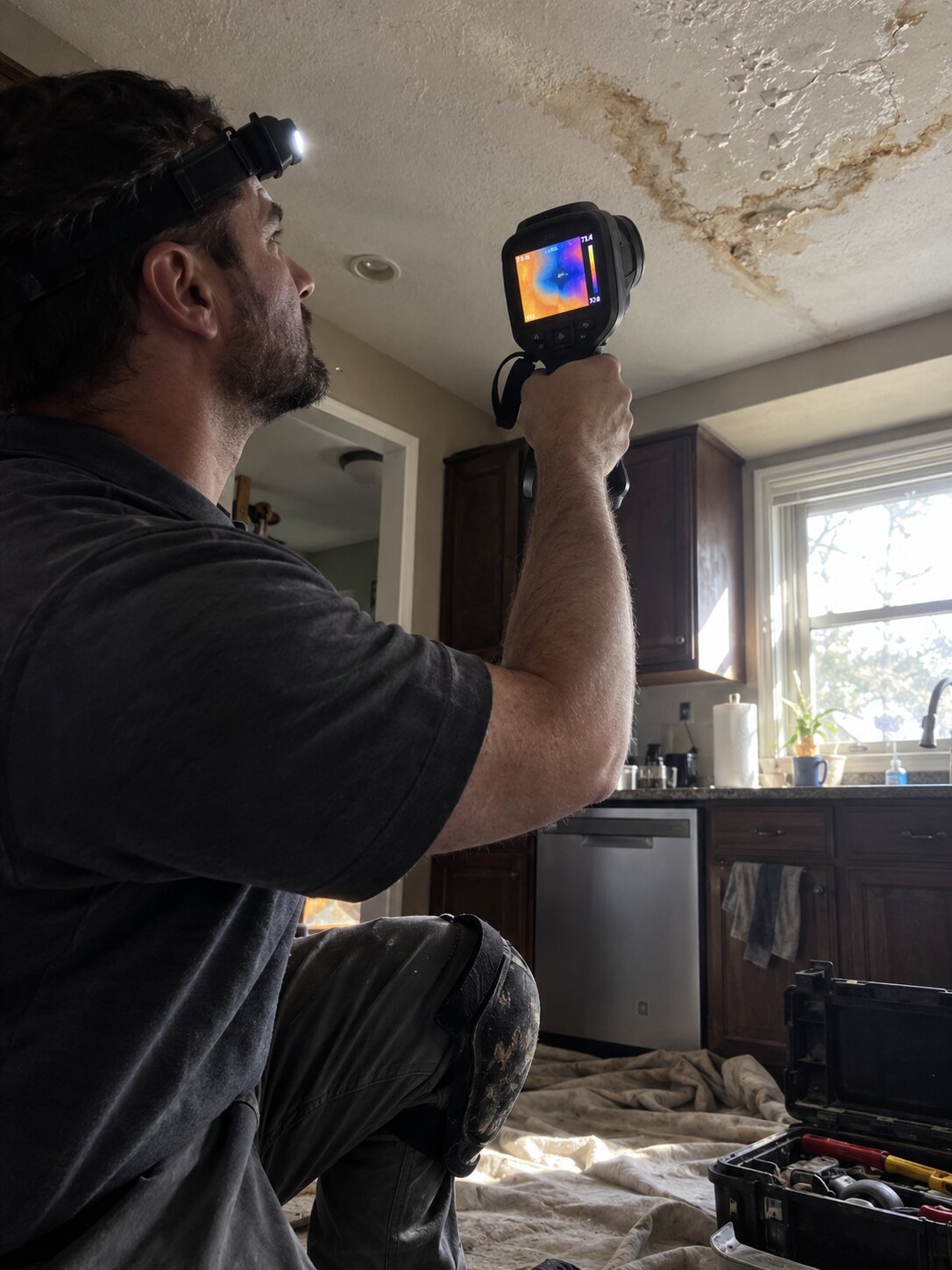
- Thermal imaging using FLIR E60 or E75 for tracing water migration behind cabinets, into wall cavities, and across ceiling assemblies
Every reading is photographed with the instrument display visible in-frame and logged to the specific grid coordinate. Ambient conditions — dry-bulb temperature, relative humidity, grains per pound (GPP) — are measured with a Kestrel psychrometer and recorded for the affected area, the unaffected interior baseline, and the outdoor conditions. This baseline data is what drives every subsequent decision on drying strategy.
Stage 3 — Category and Class Determination
IICRC S500 requires classification of every water loss by both source category and intrusion class. The category determines contamination level; the class determines the equipment package required for effective drying.
Category determination:
- Category 1 — clean water from a sanitary source (supply line, ice maker, water heater tank)
- Category 2 — significantly contaminated (dishwasher discharge, washing machine hose, aquarium)
- Category 3 — grossly contaminated (sewage backup, main line, external floodwater, or Category 2 that has aged past 48 hours)
Class determination based on the affected wet surface area and the amount of moisture the affected materials hold:
- Class 1 — smallest wet perimeter, low porosity materials (concrete, tile) predominate
- Class 2 — larger perimeter, carpet and pad affected, water absorbed into wall assemblies up to 24″
- Class 3 — greatest amount of water, saturation of ceiling, walls, insulation, subfloor
- Class 4 — deeply saturated low-permeance materials (hardwood, plaster, brick, stone) requiring specialty drying
The classification determines everything downstream — PPE, extraction method, structural drying equipment package, and whether porous materials can be dried in place or must be removed.
Stage 4 — Scope Development and Estimate
Before any demolition or drying equipment placement, Timothy Ellis develops a written Xactimate scope of work priced to current State Farm, USAA, Allstate, Farmers, and Bear River Mutual regional pricing tables. The scope breaks out:
- Extraction (per square foot of affected area, by material type)
- Equipment rental (per unit per day, by equipment class)
- Labor (by hour, by technician certification tier)
- Materials for containment, PPE, antimicrobial application
- Removal and disposal of affected porous materials
- Reconstruction line items (drywall, flooring, cabinet reset, trim, paint, permits)
- Documentation and clearance testing
The written scope is presented to the customer for signature before work begins. For insurance-covered losses, the scope is also delivered to the adjuster within 24 hours of job initiation. This is the point in the process where transparency matters most — the customer sees exactly what work is planned, at what price, before we make any decisions that can’t be undone.
Stage 5 — Water Extraction
Extraction removes standing water and water absorbed into porous materials that can be recovered. Method depends on volume and material:
- Truck-mounted extraction for high-volume losses affecting large areas — pulls water at up to 200 gallons per minute through 1.5″ or 2″ hose lines
- Portable weighted extractors (Rover, Hydro-X) for carpet and pad extraction where the extractor’s weight compresses the pad to release absorbed water
- Wet vacs for hard surface pooling on tile, LVP, hardwood, or concrete
- Submersible pumps for standing water depths greater than 2″ in basements or crawlspaces
Post-extraction moisture readings are taken at the same grid points established in Stage 2 to verify extraction effectiveness before drying equipment is deployed. Water absorbed into materials that can’t be effectively extracted — drywall paper facing, wet insulation, saturated OSB — is targeted for removal in Stage 6.
Stage 6 — Targeted Removal (When Required)
Not every wet material is removed. IICRC S500 recognizes that many materials can be dried in place when appropriate equipment is deployed within the effective drying window. Removal is targeted rather than reflexive:
- Category 1 loss, Class 2 or lower, reached within 48 hours: most materials dry in place. Carpet pad is generally removed but carpet is dried in place. Drywall is typically dried in place with wall cavity ventilation.
- Category 1 loss, Class 3 or 4, or reached after 48 hours: selective drywall removal (typically the lower 24″ of wall, corresponding to wick height in gypsum), insulation removal in wet cavities, subfloor evaluation.
- Category 2 loss: carpet pad removal is standard; carpet may be dried in place or removed depending on age, condition, and post-drying disinfection. Drywall removal is common in the wet perimeter.
- Category 3 loss: all porous materials that contacted the water are removed per S500 Chapter 12. This includes carpet, pad, drywall to at least 24″ above the water line, insulation, and cabinetry with wet base cabinets. Structural materials that dry to standard remain in place after antimicrobial treatment.
Removed materials are documented photographically before removal, bagged in appropriate polyethylene sheeting, and disposed of per local Utah County waste stream requirements. Category 3 materials require regulated disposal due to biological contamination.
Stage 7 — Structural Drying and Daily Monitoring
The drying phase deploys air movement and dehumidification equipment sized to the affected area’s cubic footage per IICRC S500 calculation. Equipment mix varies by ambient conditions:
- LGR (low-grain refrigerant) dehumidifiers — Phoenix R150, Dri-Eaz LGR 6000Li — effective in warm humid conditions (Utah County summer losses, indoor conditions above 75°F)
- Desiccant dehumidifiers — Phoenix 200 MAX, Dri-Eaz DriTec 5000i — deployed when ambient temperature drops below 55°F or when the affected area has high absorbed water in low-permeance materials (hardwood, plaster, concrete)
- Air movers — Phoenix Focus centrifugal, B-Air Vent axial — positioned per IICRC S500 airflow calculations at approximately one air mover per 10–16 feet of wet wall
- Supplemental heat when ambient temperature is below the operating range of standard equipment — particularly relevant during January and February losses in unheated basements or crawlspaces
Every day of the drying phase, the technician on the job returns to log grid moisture readings, verify equipment operation, adjust equipment placement or add units if drying is not progressing as projected, and photograph the day’s readings for the file. Daily logs are delivered to the customer and the adjuster on an evening summary email.
Stage 8 — Verification of Dry Standard
Drying is complete when materials reach the dry standard equilibrium moisture content, verified by a documented final reading — not by calendar or by “we ran fans for three days.” Dry standards in Utah County:
- Wood framing: 12% moisture content or below by pin meter
- Gypsum drywall paper facing: 1% or below
- Concrete slab: under 4% by pin measurement (varies by mix and age)
- OSB and plywood subfloor: 14% or below
- Hardwood flooring: within 2 percentage points of a matched dry sample from the same species and installation
Final readings are taken at every grid point established in Stage 2 and compared against the initial readings and dry standard. When all points hit standard, equipment is pulled and the drying phase is documented as complete. When readings don’t hit standard, we adjust — more air movement, additional dehumidification capacity, targeted removal of materials that won’t dry in place — and continue.
Stage 9 — Post-Remediation Verification (Mold Jobs) and Documentation Package
For mold remediation jobs specifically, an additional step follows structural drying: post-remediation verification (PRV). Ryan Bautista coordinates with an independent third-party industrial hygienist for air sampling, surface sampling, and visual clearance inspection. Third-party verification matters because self-verification of your own remediation work carries an inherent conflict of interest — and independent clearance is what makes documentation defensible in real estate transactions, warranty claims, or subrogation litigation.
The final documentation package delivered to the customer and insurance adjuster within 24 hours of job completion includes:
- Initial loss photos with timestamp and grid reference
- Complete grid moisture map with all readings from initial assessment through final clearance
- Daily drying progress log with photographic evidence of each day’s readings
- Psychrometric charts showing temperature, RH, and GPP inside and outside the affected area over the drying period
- Equipment placement diagrams for each phase
- Photos of all removed materials before disposal
- Antimicrobial application records with product name, EPA registration number, and application area
- Post-remediation verification (PRV) results for mold jobs, including third-party industrial hygienist report
- Final clearance photos and readings
- Xactimate scope of work with final line items and pricing
- Reconstruction permit records (if applicable)
How Our Process Differs From Standard Practice
Three specific practices differentiate our approach from the standard-issue Utah County restoration playbook. First, grid moisture mapping across at least 20 points per affected area, rather than the common “three-point spot check” that produces inflated tear-out scopes. Second, Xactimate scope development with adjuster-visible pricing before demolition, rather than time-and-materials billing that produces surprise invoices after the fact. Third, third-party PRV for mold remediation, rather than self-certified clearance that carries no independent verification.
Each of these adds cost to the job. Grid mapping takes 30–60 additional minutes at initial assessment. Xactimate scope development takes 2–4 hours per job. Third-party PRV adds $300–$650 for the industrial hygienist visit. On net, our billed jobs are typically 40–60% lower than competitors’ quotes because grid mapping reveals that most losses affect a smaller area than a visual inspection suggests, and Xactimate scope development eliminates the reflexive maximum-tear-out approach.
Frequently Asked Questions
- How is your process different from other Utah County restoration companies?
- Three specific differences. First, grid moisture mapping across 20+ measurement points at initial assessment instead of the industry-common three-point spot check. Second, Xactimate scope development with adjuster-visible pricing before demolition begins, rather than time-and-materials billing that produces variable invoices. Third, third-party industrial hygienist post-remediation verification for mold jobs rather than self-certified clearance. These practices add roughly 2–4 hours of documentation time per job but typically result in billed scopes that are 40–60% below competitor quotes on comparable losses.
- What determines whether materials can be dried in place versus removed?
- IICRC S500 Category and Class classification, combined with the time-since-loss and the specific material’s ability to dry to standard. Category 1 (clean water) losses reached within 48 hours generally support drying most materials in place, including drywall, carpet, and hardwood. Category 2 losses require carpet pad removal at minimum and typically involve selective drywall removal. Category 3 losses require removal of all porous materials that contacted the water, per S500 Chapter 12. Beyond the category rule, the classification (Class 1–4) determines whether the material’s assembly (wall cavity depth, insulation type, air space) supports effective in-place drying with available equipment.
- Why do you photograph every stage of the job?
- Because insurance adjusters and legal proceedings both require dated, contextualized visual evidence of loss conditions and restoration steps. A grid moisture map with 20 readings is more defensible than a written summary; photos of removed materials before disposal are more defensible than a line-item on an invoice; daily drying progress captures document that the equipment was operating and readings were being tracked. When an adjuster from State Farm, USAA, Allstate, Farmers, or Bear River Mutual reviews the claim, the photo record answers questions before they’re asked. When a subrogation dispute arises months or years later, the documentation is the case.
- What happens if drying doesn’t hit standard by the expected timeline?
- We adjust. IICRC S500 doesn’t set a fixed timeline for drying — it sets a fixed endpoint (dry standard equilibrium moisture content) and requires that the drying strategy achieve that endpoint. If daily monitoring shows we’re not on trajectory to hit standard by day 4, we add air movement or dehumidification capacity, switch from LGR to desiccant dehumidification, remove materials that aren’t drying (particularly wet insulation, saturated carpet pad, or drywall paper facing that’s holding moisture), or apply supplemental heat if ambient temperature is below equipment operating range. The customer and adjuster are notified of any scope changes before we execute them.
- Do you always recommend third-party clearance testing after mold remediation?
- For visible mold colonization greater than 10 square feet, and any mold job where a real estate transaction, warranty claim, subrogation matter, or tenant health concern is involved, yes. Third-party post-remediation verification (PRV) by an independent industrial hygienist is the industry standard for defensible clearance, and it’s what protects the property owner from downstream challenges to the completeness of the work. For smaller cosmetic mold cleanup jobs (a bathroom ceiling stain, a small closet corner) where no external verification is required, we complete the work with our own visual clearance and photograph documentation. Ryan Bautista makes the recommendation on each job based on the specifics.
Contact Vault Mold Removal — Provo, UT
Our office at 1169 S 760 W in south-central Provo is three blocks from I-15, positioned for rapid dispatch across Utah County. To initiate a job, request an initial assessment, or discuss your specific loss situation with a technician who can walk through the process stages relevant to your case, contact our office directly.
- Phone: (385) 250-2825
- Address: 1169 S 760 W, Provo, UT 84601
- Utah DOPL General Contractor License: #11876543-5501
- IICRC WRT / ASD / AMRT / OCT: #248317 / #248317-ASD / #319482 / #319482-OCT
Office Hours
- Monday – Saturday: 9:00 AM – 5:00 PM
- Sunday: Closed
Every stage in detail: the nine stages of water damage restoration.
In Provo? See water damage restoration in Provo or call (385) 250-2825.