
Toilet Overflow Cleanup — Utah County
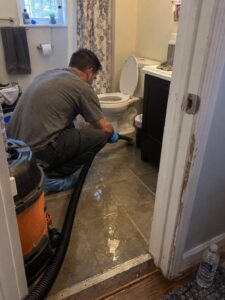
Toilet overflows produce water damage that requires different handling than most residential water events. The water source determines category classification: a supply line failure at the toilet base produces Category 1 clean water, while an overflow that includes bowl contents is Category 3 regardless of visible contamination. The overflow location produces distinctive migration patterns: bathroom floor water flows under baseboards and cabinet toe kicks, migrates through the subfloor into ceiling assemblies below on multi-story properties, and travels along baseboard paths into adjacent hallways and bedrooms. Vault Mold Removal responds to toilet overflow situations across Utah County with the category-appropriate protocol, subfloor migration mapping, and documented cleanup under IICRC S500 standards.
Category Determination for Toilet Overflows
Not every toilet overflow is Category 3. The specific water source determines the category:
Category 1 — Clean Water Toilet Overflows
- Toilet supply line failures (line between the wall shutoff and the toilet tank) — clean water from the property’s supply line
- Fill valve failures where the tank overflows without any bowl water involvement
- Tank cracks allowing tank water to escape before mixing with bowl contents
Category 1 toilet events are handled with standard water damage protocol: extraction, drying, and reconstruction. No sewage-specific PPE or removal requirements.
Category 2 — Gray Water Toilet Situations
- Toilet overflow with bowl water containing only urine (no fecal matter) is Category 2 under IICRC S500 — contaminated but not grossly so
- Cases where separation of the contamination source is verifiable (rare in practice; Category 2 designation requires specific evidence that no fecal matter is present)
Category 2 toilet events use enhanced PPE, antimicrobial disinfection of hard surfaces, and typically porous material removal for saturated items, though less extensive than full Category 3 protocol.
Category 3 — Black Water Toilet Overflows
- Any toilet overflow with fecal matter or unknown bowl contents (which is most toilet overflows in practice)
- Overflows caused by drain line blockage where bowl water backs up during flush
- Toilet overflows aged past 24 hours regardless of original source (microbial amplification reclassifies to Category 3)
- Overflows affecting properties with immunocompromised occupants, infants, or elderly residents where the health risk threshold favors Category 3 protocol conservatism
Category 3 toilet events require full IICRC S500 Chapter 12 protocol: complete PPE, containment, removal of all porous materials that contacted the water (carpet, pad, drywall, insulation), EPA-registered antimicrobial application, and regulated waste disposal.
Migration Patterns Specific to Toilet Overflows
Bathroom Floor Migration
Bathroom floors are typically tile or vinyl over a wood subfloor. Water flows quickly across the finish surface but penetrates to the subfloor through grout lines, edge gaps at fixtures, and floor drain openings. Once in the subfloor, water migrates along the grain of subflooring and along the natural low points of the floor system.
Adjacent Room Migration Through Subfloor
Water in the bathroom subfloor doesn’t stay in the bathroom. It migrates under wall base plates into adjacent rooms — hallways, bedrooms, and closets on the same floor. Visible surface water may be limited to the bathroom, but moisture in the subfloor can extend 15–25 feet from the overflow source in typical residential framing. Moisture mapping is essential to identify the actual affected area rather than the visible affected area.
Ceiling Assembly Migration on Multi-Story Properties
For toilet overflows on upper floors, water penetrates the bathroom subfloor and migrates into the ceiling assembly of the floor below. The ceiling below the bathroom typically shows water staining, sagging drywall, or visible drip through light fixtures. But hidden migration through the ceiling assembly can extend beyond the visible damage — water travels along joists and can drip down inside wall cavities several feet from the original overflow location.
Fixture and Cabinet Migration
Bathroom vanities, cabinets, and fixtures with floor contact provide migration pathways. Water flows under cabinet toe kicks into subfloor spaces beneath cabinets that then may not be accessible without cabinet removal. Vanity backs and side panels wick water upward, and MDF cabinet construction (common in most modern bathrooms) is essentially unrestorable once saturated.
Grout Line and Tile Migration
Bathroom tile floors have grout lines that provide the primary water penetration pathway to the subfloor. Old or deteriorated grout allows extensive water penetration; newer, well-sealed grout limits penetration to areas of extended contact. Tile floor moisture assessment requires Tramex non-invasive scanning across the entire affected area, since visible water may already have penetrated below tile that appears dry on the surface.
Our Toilet Overflow Response Process
Initial Assessment
- Category determination based on water source and contamination status
- Grid moisture mapping across the bathroom and adjacent areas (typically 15–30 measurement points depending on the extent of migration)
- Subfloor migration assessment using pin meter and Tramex scanning
- Ceiling assembly assessment on floor below for upper-floor overflows
- Cabinet toe-kick moisture verification via inspection or targeted removal
Extraction (First Hour)
- Surface water extraction with truck-mounted vacuum or portable extraction
- Grout-line and edge-detail extraction using specialty attachments
- Cabinet toe-kick access for extraction of migrated water
- Ceiling assembly extraction from below for upper-floor overflows (typically requires drywall removal to access)
Category-Appropriate Removal
Removal decisions follow IICRC S500 criteria based on category, class, and material condition:
- Category 1 (supply line failure): Carpet in adjacent rooms may be dried in place; drywall wetting can typically be dried without removal; insulation may need replacement if saturated.
- Category 2 (urine only, verified): Enhanced disinfection, porous material removal for saturated items, drywall base course removal in wetted areas.
- Category 3 (bowl contents involved): Complete removal of all porous materials that contacted the water — carpet, pad, drywall, insulation, MDF cabinetry. Wood subfloor is assessed for surface contact vs. saturation and treated accordingly.
Disinfection
Category 2 and 3 events require EPA-registered antimicrobial application on all remaining hard surfaces after cleaning. Product selection depends on the specific pathogen spectrum expected; quaternary ammonium products cover typical toilet overflow pathogens, with peroxide-based products used for enhanced spectrum situations.
Structural Drying
Standard structural drying with LGR or desiccant dehumidification, air movers, and daily monitoring. Bathroom drying often requires ceiling assembly ventilation for upper-floor overflows, cabinet toe-kick access for subfloor drying, and subfloor drying that can extend beyond the bathroom into adjacent affected areas.
Reconstruction
Reconstruction returns the bathroom and any affected adjacent areas to pre-loss condition: drywall replacement, flooring reinstallation, cabinet reinstallation or replacement, plumbing coordination with licensed plumbers for the underlying cause resolution, paint, and trim work.
Underlying Cause Resolution
Restoration addresses the water damage; it doesn’t fix the underlying plumbing issue that caused the overflow. Common underlying causes:
- Toilet clog. Simple clogs resolved with plunger or auger; recurring clogs suggest drain line issues.
- Drain line blockage. Cast iron drain line with root intrusion (common in older Utah County properties), belly (sag) collecting solids, or complete failure.
- Municipal sewer backup. Blockage or failure on the city sewer main causing backup into multiple properties.
- Fill valve failure. Toilet tank fill valve stuck open, causing tank overflow through the tank rim.
- Supply line failure. Braided stainless supply line crimp failure, plastic supply line brittle failure, or shutoff valve leakage.
We coordinate with local licensed plumbers for underlying cause resolution but don’t perform plumbing repair ourselves. The plumbing repair is typically done during the drying phase so the property is ready for reconstruction as soon as materials arrive.
Frequently Asked Questions
- Is every toilet overflow considered sewage?
- No. The category classification depends on the specific water source. Toilet supply line failures (line between the wall shutoff and the toilet tank) produce Category 1 clean water — the same water category as any other supply line burst. Toilet overflows that include only urine are Category 2 gray water. Toilet overflows that include fecal matter or where bowl contents are unknown are Category 3 black water. In practice, most toilet overflows we respond to are Category 3 because the property owner can’t verify that no fecal matter was involved, and IICRC S500 favors conservative classification when contamination source is uncertain. Category 3 protocol is used unless the source can be specifically identified as clean water.
- Why do you need to check rooms adjacent to the bathroom?
- Because water migrates. Toilet overflow water penetrates through bathroom tile grout lines and edge gaps into the subfloor, then travels along the grain of subflooring and under wall base plates into adjacent rooms. Visible water may be limited to the bathroom, but moisture in the subfloor can extend 15–25 feet from the overflow source. Skipping adjacent room assessment means missing hidden moisture that will produce downstream drywall damage, hardwood cupping, carpet mold growth, or subfloor rot months after the visible cleanup is complete. Grid moisture mapping across the bathroom and adjacent rooms is essential for identifying the actual affected area.
- Do I need to replace my bathroom tile after a toilet overflow?
- Usually not, though grout condition matters. Ceramic and porcelain tile itself is non-porous and doesn’t hold contamination. Grout lines are porous and can hold contamination, but they can typically be cleaned and disinfected without removal. Tile floors that are structurally sound and have grout in good condition can typically be preserved during Category 3 cleanup. Tile floors with deteriorated grout, hollow-sounding tiles (indicating loss of thin-set bond), or visible damage often need replacement anyway, in which case the tile removal is part of the restoration scope. Vinyl or LVP flooring is essentially always replaced in Category 3 toilet overflows because the seams and edges can’t be verifiably disinfected.
- Can I use my bathroom during the cleanup?
- Depends on the extent of the loss and whether the affected bathroom is the only bathroom in the property. For localized toilet overflows in properties with multiple bathrooms, the affected bathroom is closed off during cleanup and drying while other bathrooms remain in normal use. For properties with only one bathroom, we work to complete the extraction and disinfection phases quickly enough that limited use can resume while drying continues, though this depends on the specific situation. For the underlying plumbing issue, coordination with a licensed plumber typically restores toilet function within 1–3 days of the initial event, which addresses the practical need even if bathroom finishes aren’t yet reinstalled.
- Will my homeowner insurance cover a toilet overflow?
- Depends on the source and your policy. Toilet supply line failures (Category 1) are typically covered under standard homeowner policies as sudden and accidental water damage. Toilet overflows that trace to bowl content backup (Category 3) may or may not be covered depending on whether you have a sewer backup endorsement — a common Utah-market endorsement that covers backups through toilets, floor drains, and other fixtures. Without the endorsement, Category 3 toilet overflow cleanup is often not covered by the standard policy. State Farm, USAA, Allstate, Farmers, and Bear River Mutual all offer sewer backup endorsements. Reviewing your policy with your insurance agent for sewer backup coverage is a worthwhile step, particularly if you own a property with older plumbing or a history of drain issues.
Contact Vault Mold Removal — Provo, UT
For toilet overflow response, non-emergency assessment of prior overflow cleanup, or questions about specific bathroom water damage scenarios, contact our office directly. Business-hours calls answered live; after-hours calls route to on-call rotation.
- Phone: (385) 250-2825
- Address: 1169 S 760 W, Provo, UT 84601
- Utah DOPL General Contractor License: #11876543-5501
- IICRC WRT / ASD / AMRT / OCT: #248317 / #248317-ASD / #319482 / #319482-OCT
Office Hours
- Monday – Saturday: 9:00 AM – 5:00 PM
- Sunday: Closed
Helpful guides: Toilet leaking at the base · Bathtub overflow