
Dehumidification & drying
Vault’s crew sets up the right size and type of dehumidifiers for the space, with air movers aimed at wet materials. Moisture readings every day confirm drying progress.
- Call any hour: (385) 250-2825 is answered live 24/7 by the Vault crew. 45-minute arrival inside Provo city limits (Monday–Saturday, 8 AM–5 PM); typically under 60 minutes elsewhere in our Utah County service area.
- In-house: LGR and desiccant dehumidification, air movers, drying chambers for faster drying, and daily moisture readings written to your work order.
- Who does the work: Vault’s own W-2 crew, IICRC certified in WRT, ASD, AMRT and OCT, under Utah DOPL General Contractor License #11876543-5501. No subcontractors. Meet the team
- Insurance: Xactimate scopes, daily moisture readings on file, direct billing to State Farm, USAA, Allstate, Farmers and Bear River Mutual.
- Pricing: free written estimates. Water mitigation typically $3,500–$8,500; reconstruction $4,500–$9,500. 24-month workmanship warranty · Wisetack financing
- Family-owned and veteran-operated, based in Provo since 2020.
Water damage restoration · Mold remediation · Sewage cleanup · Reconstruction & repairs
Dehumidification — Utah County Water Damage Restoration
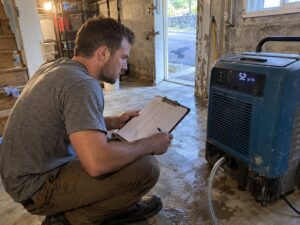
Dehumidification is the engine of structural drying. Air movement disrupts the boundary layer at wet material surfaces and moves water vapor into the room air. Dehumidifiers pull that vapor back out, keeping the room air’s grain load low enough that continued evaporation from wet materials remains thermodynamically favorable. Without effective dehumidification, air movement just recirculates moisture inside the affected space. Vault Mold Removal deploys IICRC-standard dehumidification equipment sized to the specific loss, with LGR (low-grain refrigerant) units as our workhorse and desiccant units for winter conditions, Class 4 losses, and high-load specialty drying. Every dehumidifier deployment is documented with equipment model, placement location, and daily performance readings.
Understanding the Grain-Load Concept
Grains per pound (GPP) is a measurement of specific humidity — the number of grains of water contained in one pound of dry air. There are 7,000 grains in one pound of water, so a room air reading of 65 GPP means each pound of air is carrying 65/7,000 of a pound of water. For structural drying to work, the room air GPP needs to be significantly lower than the moisture content of the wet materials, so vapor moves out of the materials into the air rather than the other direction.
Typical GPP targets during structural drying:
- Class 1 loss: Room GPP under 50 grains at 70°F (equivalent to roughly 40% relative humidity at that temperature)
- Class 2 loss: Room GPP under 40 grains at 70°F (roughly 32% RH)
- Class 3 loss: Room GPP under 35 grains at 70°F (roughly 28% RH)
- Class 4 loss: Room GPP under 25 grains at 70°F (roughly 20% RH), often requiring desiccant dehumidification to achieve
Dehumidifier “output grain” is the GPP of the dry air leaving the unit. Lower output grain means the unit is more effective at pulling the room down to target GPP.
LGR (Low-Grain Refrigerant) Dehumidification
LGR technology is standard refrigerant dehumidification with enhanced coil design and pre-cooling that allows the unit to achieve much lower output grain than conventional refrigerant dehumidifiers. Standard refrigerant units bottom out at 55–65 grain output; LGR units can push to 30 grain output at 80°F, 65% RH. That difference matters — a 30-grain output means the unit is producing air roughly half as moisture-loaded as standard refrigerant output, which pulls the room GPP down faster and holds it lower.
LGR Units
- Standard LGR units. Standard workhorse for typical Utah County residential losses. Sized to the cubic footage and class of the loss. Deployed 1 per 500–1,500 cubic feet of affected space depending on class.
- Larger LGR units. Larger capacity with integrated pump-out for automatic condensate removal. Preferred for jobs where manual condensate management would be difficult.
- High-capacity LGR units. Higher-capacity LGR for larger cubic footage losses.
When LGR Works Best
- Ambient temperatures between 60°F and 90°F
- Relative humidity between 40% and 85%
- Class 1, Class 2, and most Class 3 losses in typical conditions
- Summer and shoulder-season Utah County losses (April–October)
LGR Limitations
- Efficiency drops significantly below 55°F ambient temperature
- Cannot achieve output grain below approximately 30 at typical conditions
- Not effective for Class 4 low-permeance materials that require deeper drying
- Requires standard 120V electrical service (residential compatible)
Desiccant Dehumidification
Desiccant technology uses a rotating moisture-adsorbing wheel (typically silica gel or lithium chloride) that captures water vapor from the process airstream, then rotates through a heated regenerating airstream that releases the captured moisture and exhausts it outside the affected space. Unlike refrigerant-based dehumidifiers, desiccants work effectively at cold temperatures and can achieve much lower output grain — some units push below 10 grain output, which is dry enough for specialty applications that LGR can’t touch.
Desiccant Units
- Medium-capacity desiccants. Medium-capacity desiccant for winter residential losses and moderate Class 4 applications.
- Larger-capacity desiccants. Larger-capacity desiccant for commercial and multi-room deployment. Requires three-phase electrical service or generator support.
- Extended deployments. For very large commercial losses or extended-duration deployments where the desiccant runs continuously from an external staging area.
When Desiccants Are Deployed
- Winter losses with ambient temperature below 55°F
- Class 4 losses involving hardwood, plaster, dense concrete, or other low-permeance materials
- Extended-duration drying where deep material moisture requires sustained low grain output
- Commercial and industrial losses with high cubic footage or challenging psychrometric conditions
- Utah County winter freeze events — during the January 2023 freeze week, we deploy desiccants when ambient temperatures drop below 30°F
Desiccant Limitations
- Requires exterior air pathway for regenerating airstream exhaust
- Higher power consumption than equivalent LGR capacity
- Requires three-phase electrical or generator support for larger units
- More complex installation than plug-and-play LGR units
Sizing Dehumidification to the Loss
IICRC S500 provides a calculation methodology for dehumidification sizing based on affected area cubic footage, water source category, intrusion class, and ambient conditions. The basic formula:
For refrigerant/LGR dehumidification: Divide affected cubic footage by a factor based on class (Class 1: 1,500 ft³ per unit; Class 2: 900; Class 3: 600; Class 4: 500). Adjust for ambient conditions and material types.
For desiccant dehumidification: Calculate the total grain load (grains of water in the room air plus grains being released from wet materials) and match to the desiccant’s rated grain removal capacity, typically expressed in grains per hour or pounds of water per day.
Undersized dehumidification is one of the most common quality issues in prior work by non-IICRC-certified contractors. A single LGR in a 3,000-cubic-foot Class 3 basement doesn’t have the capacity to pull the room GPP down to target, which means the wet materials don’t dry to standard, which means the drying phase either extends indefinitely or ends with materials that never hit dry standard. Documented daily readings expose this failure mode when it happens.
Daily Monitoring and Adjustment
Dehumidifier performance is monitored daily as part of the drying log. Each unit’s operating status, condensate output volume, and effect on room GPP is documented. When performance falls short of the drying trajectory:
- Verify the unit is operating within its temperature and RH range
- Check condensate drainage — a blocked drain stops operation
- Verify air movement in the space is adequate to bring wet material moisture to the dehumidifier
- Add capacity (more LGR units or a desiccant addition)
- Transition from LGR to desiccant if ambient conditions are limiting LGR effectiveness
- Add supplemental heat if ambient temperature is below dehumidifier operating range
Adjustments are documented in the drying log with the reasoning and the specific change made. The insurance adjuster and customer are notified of any equipment changes before they’re executed.
Utah County-Specific Dehumidification Considerations
Winter Season (November – March)
Ambient conditions in Utah County during winter regularly drop below LGR effective operating range. Basement losses in particular often have ambient temperatures below 55°F even during heating season, because basements are colder than main-floor spaces. Standard winter approach: transition to desiccant dehumidification, add supplemental heat if the customer’s HVAC can’t maintain temperature, and monitor for freeze risk on drying equipment condensate lines.
Summer Season (June – September)
Summer conditions favor LGR dehumidification. Ambient temperatures in the 75–95°F range and elevated relative humidity from Utah Lake evaporation are exactly where LGR units operate near peak efficiency. The concern in summer is the outdoor ambient becomes a load on the affected space rather than a source of dry air — ventilation-based drying doesn’t work when the outdoor GPP is close to the target indoor GPP.
Shoulder Seasons (April – May, October)
Shoulder seasons in Utah County are variable. Spring snowmelt runoff creates high-humidity conditions that require LGR. Fall dry periods can approach desiccant-favorable conditions. Equipment selection depends on the specific ambient forecast for the drying phase, adjusted as conditions change.
Frequently Asked Questions
- How many dehumidifiers does my job need?
- It depends on the affected cubic footage, intrusion class, and ambient conditions. IICRC S500 provides a calculation methodology: Class 1 losses typically need one LGR per 1,500 cubic feet, Class 2 losses one LGR per 900 cubic feet, Class 3 losses one per 600 cubic feet, and Class 4 losses one per 500 cubic feet plus additional desiccant capacity for deep material drying. A typical Utah County Class 2 basement flood affecting a 1,500-square-foot finished basement with 8-foot ceilings (12,000 cubic feet total) would need approximately 13 LGR units, or fewer higher-capacity units plus desiccant support depending on the specific conditions. Undersized dehumidification is a common quality issue in low-cost restoration work.
- Why do you sometimes use desiccants and sometimes use LGR?
- The choice depends on ambient conditions and material types. LGR (low-grain refrigerant) units are our default for typical Utah County losses in ambient conditions between 60°F and 90°F. LGR is more energy-efficient, simpler to deploy, and matches most residential electrical service. Desiccant dehumidifiers are deployed when ambient temperature drops below 55°F (which limits LGR effectiveness), when the loss involves low-permeance materials like hardwood or plaster (which require deeper drying than LGR can achieve), or when the drying load exceeds what LGR alone can handle. During the January 2023 Utah County freeze event, desiccants are needed when ambient temperatures drop below 30°F.
- Will the dehumidifiers make my house uncomfortable to live in?
- Yes, to varying degrees. The affected space during active drying is designed to be dry and warm — typically 70–85°F with relative humidity below 40%. That’s outside the comfortable range for most people (comfort range is roughly 68–75°F, 30–60% RH). If you’re occupying the property during drying, plan for the affected areas to be closed off from occupied areas, or plan for the occupied areas to also be dry and warm during the drying phase. For particularly disruptive drying situations (whole-home losses, extended timelines, sensitive occupants), Additional Living Expense coverage under your homeowner insurance policy may cover hotel or short-term rental costs during the drying phase.
- How much electricity do dehumidifiers use during drying?
- Meaningful but manageable amounts. A typical LGR dehumidifier draws roughly 1 kW while running. Running 4 LGR units continuously for a 5-day drying phase would consume roughly 480 kWh of electricity, adding perhaps $50–$70 to your electric bill for the drying period at Utah’s typical residential rates. Larger commercial-scale desiccant deployments have higher consumption. Insurance coverage typically includes reasonable utility costs for restoration equipment operation, though carriers handle this differently and reimbursement is not automatic. Discuss with your adjuster if utility cost reimbursement is important.
- Can I turn off the dehumidifiers at night or when I’m not home?
- No. Structural drying is a continuous process that depends on maintained low ambient GPP throughout the drying phase. Turning off dehumidifiers — even for a few hours — allows the room GPP to climb back toward equilibrium with the wet materials, which effectively pauses drying and can even reverse progress if wet materials re-absorb moisture from the humid air. Continuous operation is essential. If you have concerns about noise, safety, or utility costs during drying, discuss with our technician on-site rather than turning off equipment; there are usually alternatives that don’t compromise the drying trajectory.
Contact Vault Mold Removal — Provo, UT
For water damage requiring professional dehumidification, second opinions on prior drying work, or questions about specific dehumidification challenges, contact our office directly.
- Phone: (385) 250-2825
- Address: 1169 S 760 W, Provo, UT 84601
- Utah DOPL General Contractor License: #11876543-5501
- IICRC WRT / ASD / AMRT / OCT: #248317 / #248317-ASD / #319482 / #319482-OCT
Office Hours
- Monday – Saturday: 9:00 AM – 5:00 PM
- Sunday: Closed
Written warranty
24-month workmanship warranty on drying, structural repairs, drywall, flooring, cabinetry and paint done by Vault. 90-day mold warranty from post-remediation clearance for recurrence from the same moisture source. Both are transferable once to a new homeowner, in writing on the work order.
We bill your carrier directly
Direct-billing with State Farm, USAA, Allstate, Farmers and Bear River Mutual. Every scope is written in Xactimate; you pay only your deductible plus anything the policy doesn’t cover. Not on this list? We still handle the claim.
Helpful guides: LGR dehumidifiers · Dehumidifier settings for basements · Moisture meter readings