
Smoke & soot damage cleanup at a glance
- Call any hour: (385) 250-2825 is answered live 24/7 by the Vault crew, not a call center. 45-minute arrival guarantee inside Provo city limits (Monday–Saturday, 8 AM–5 PM); typically under 60 minutes elsewhere in our Utah County service area.
- Who does the work: Vault’s own W-2 crew, IICRC certified in WRT, ASD, AMRT and OCT, working under Utah DOPL General Contractor License #11876543-5501. The same license covers structural cleaning and reconstruction. No subcontractors. Meet the team
- Insurance: we document the damage, write the scope in Xactimate and bill State Farm, USAA, Allstate, Farmers or Bear River Mutual directly.
- Warranty: 24-month workmanship warranty on the rebuild, plus a 90-day mold warranty from post-remediation clearance where mold work was done. Warranty details
- Financing: through Wisetack, $500–$25,000 over 3–24 months, soft credit check. Financing
- Smoke & odor: Vault’s crew is IICRC OCT (Odor Control) certified. We clean smoke and soot deposits on interior surfaces, address HVAC smoke penetration and remove odor at the source.
- Family-owned and veteran-operated, based in Provo since 2020.
Water damage restoration · Mold remediation · Sewage cleanup · Reconstruction & repairs
Smoke Damage Cleanup — Utah County Residue Characterization
Smoke damage cleanup is not one process — it’s several processes, and the specific approach depends on the type of smoke residue involved. IICRC S700 recognizes distinct smoke residue categories that behave differently, require different cleaning methods, and produce different challenges. Applying the wrong cleaning method to a specific residue type either fails to remove the residue or actively spreads and drives it deeper into substrates. Vault Mold Removal characterizes smoke residue type during initial assessment and applies the appropriate cleaning methodology for each specific residue category we encounter across Utah County fire jobs. This page explains the residue categories, cleaning approaches for each, and what property owners should understand about the cleaning process.
The Four Primary Smoke Residue Categories
Dry Smoke Residue
Dry smoke residue comes from fast-burning, high-temperature fires that consumed materials completely. The residue is fine, powdery, dry, and typically light gray to black in color. It sits on surfaces without adhering strongly and can typically be removed with dry cleaning methods without wetting the substrate.
Common sources of dry smoke:
- Structural fires involving paper, wood, and cotton textiles at high combustion temperatures
- Fast-burning attic fires where fuel loads are typically light and combustion temperatures are high
- Vehicle fires within an attached garage
Cleaning approach for dry smoke:
- HEPA vacuuming of all affected surfaces to remove loose residue without disturbance
- Dry chemical sponge cleaning — special vulcanized rubber sponges that lift smoke residue without smearing
- Dry cleaning of textiles and hard-goods where appropriate
- Wet cleaning only for surfaces where dry methods aren’t fully effective (typically for residual staining after dry cleaning)
Wet Smoke Residue
Wet smoke residue comes from slow-burning, low-temperature fires with incomplete combustion. The residue is greasy, smeary, dark, and pungent-smelling. It adheres aggressively to surfaces and readily smears if wiped — wet smoke cleaned with dry methods spreads the contamination rather than removing it.
Common sources of wet smoke:
- Fires involving plastics, rubber, and synthetic materials at moderate temperatures
- Smoldering fires that didn’t fully develop into open flames
- Fires that were extinguished quickly, before full combustion of available fuel
Cleaning approach for wet smoke:
- Initial HEPA vacuuming (limited effectiveness on adhered residue but removes some loose material)
- Wet cleaning with degreasing solvents matched to the specific substrate
- Multiple cleaning passes typically required — wet smoke rarely comes off in a single application
- Encapsulating sealers may be applied to surfaces where cleaning cannot fully remove staining but residue is neutralized
- Complete replacement is often necessary for porous materials where wet smoke has penetrated substrate
Protein Smoke Residue
Protein smoke residue comes specifically from cooking fires involving animal protein (meat, poultry, fish, grease). It’s often invisible or nearly invisible — unlike dry or wet smoke, protein smoke doesn’t produce dark deposits on surfaces. What it produces is a distinctive, persistent odor, subtle discoloration of paint and finishes (often yellowing), and an oily residue that’s difficult to detect but easy to smell.
Common sources of protein smoke:
- Kitchen fires involving cooking oils, meat, or dairy products
- Range hood or stove fires that didn’t spread beyond the cooking area
- Extended cooking events (overheated food) that didn’t reach open flame
Cleaning approach for protein smoke:
- Aggressive wet cleaning with enzyme-based cleaners specifically formulated for protein residue
- Multiple cleaning passes on all surfaces, since visible residue is minimal but pervasive
- Odor treatment (thermal fogging, hydroxyl generator, or ozone depending on situation)
- HVAC decontamination is often essential — protein smoke readily migrates through ductwork and creates persistent odor throughout the property
- Repainting of affected surfaces is often required because protein smoke penetrates paint and continues off-gassing odor even after cleaning
Fuel Oil Smoke Residue
Fuel oil smoke residue comes from furnace puff-back events, oil-fired equipment failures, and fires involving petroleum-based fuels. It’s dark, oily, adherent, and typically has a distinctive petroleum odor. Utah County has limited exposure to this type since natural gas dominates residential heating, but occasional oil-fired equipment (heating oil systems in older properties, oil-fired boilers in commercial buildings) can produce these events.
Cleaning approach for fuel oil residue:
- Similar to wet smoke but with petroleum-appropriate solvents
- Extended odor treatment because fuel oil residue produces persistent hydrocarbon odor
- Equipment inspection and typically service or replacement of the source equipment
- HVAC decontamination essential
Substrate-Specific Cleaning Considerations
Beyond residue type, cleaning approach also depends on the substrate being cleaned:
Painted Drywall
Latex-painted drywall is porous enough to absorb wet and protein smoke residue, often making complete cleaning impossible even with aggressive methods. Standard approach: wet cleaning to remove surface residue, then priming with stain-blocking primer (typically alcohol-based or shellac-based) before repainting. For dry smoke on drywall, dry chemical sponge cleaning followed by touch-up painting is often sufficient.
Wood Surfaces
Finished wood (cabinets, trim, flooring) responds to cleaning based on the finish condition. Polyurethane-finished wood can typically be cleaned with wet methods without damage. Oil-finished or shellac-finished wood requires gentler solvent selection to avoid finish damage. Unfinished wood readily absorbs smoke residue and often requires sanding, cleaning, and refinishing.
Textiles
Textiles (carpet, upholstery, curtains, clothing) typically require professional restoration cleaning at specialized facilities. Dry-cleanable items go to appropriate facilities; water-safe items may be handled by restoration companies with textile processing capabilities. Category assessment determines whether items are cleanable, restorable with intensive processing, or non-salvageable.
Electronics
Electronics with smoke exposure require specialized restoration because smoke residue contains conductive particles that can cause short-circuits and corrosive compounds that can damage circuit boards over time. Standard approach: HEPA vacuuming of exterior surfaces, followed by professional electronics restoration for interior cleaning. Some electronics are non-salvageable due to combustion product penetration into circuit board interiors.
Hard Goods
Hard, non-porous surfaces (metal, ceramic, glass, sealed stone) are the easiest to clean because residue doesn’t penetrate the substrate. Wet cleaning with appropriate solvents typically restores these items completely.
Concrete and Masonry
Concrete and masonry surfaces absorb smoke residue depending on porosity. Sealed concrete cleans readily; unsealed concrete may require abrasive blasting or extensive cleaning to remove absorbed residue.
Odor Removal — The Persistent Challenge
Even after visible smoke residue is removed, odor typically persists. Smoke odor comes from volatile compounds (VOCs) trapped in porous materials, absorbed into finishes, and lingering in HVAC systems. Odor removal is a separate cleaning phase that follows visible residue cleaning:
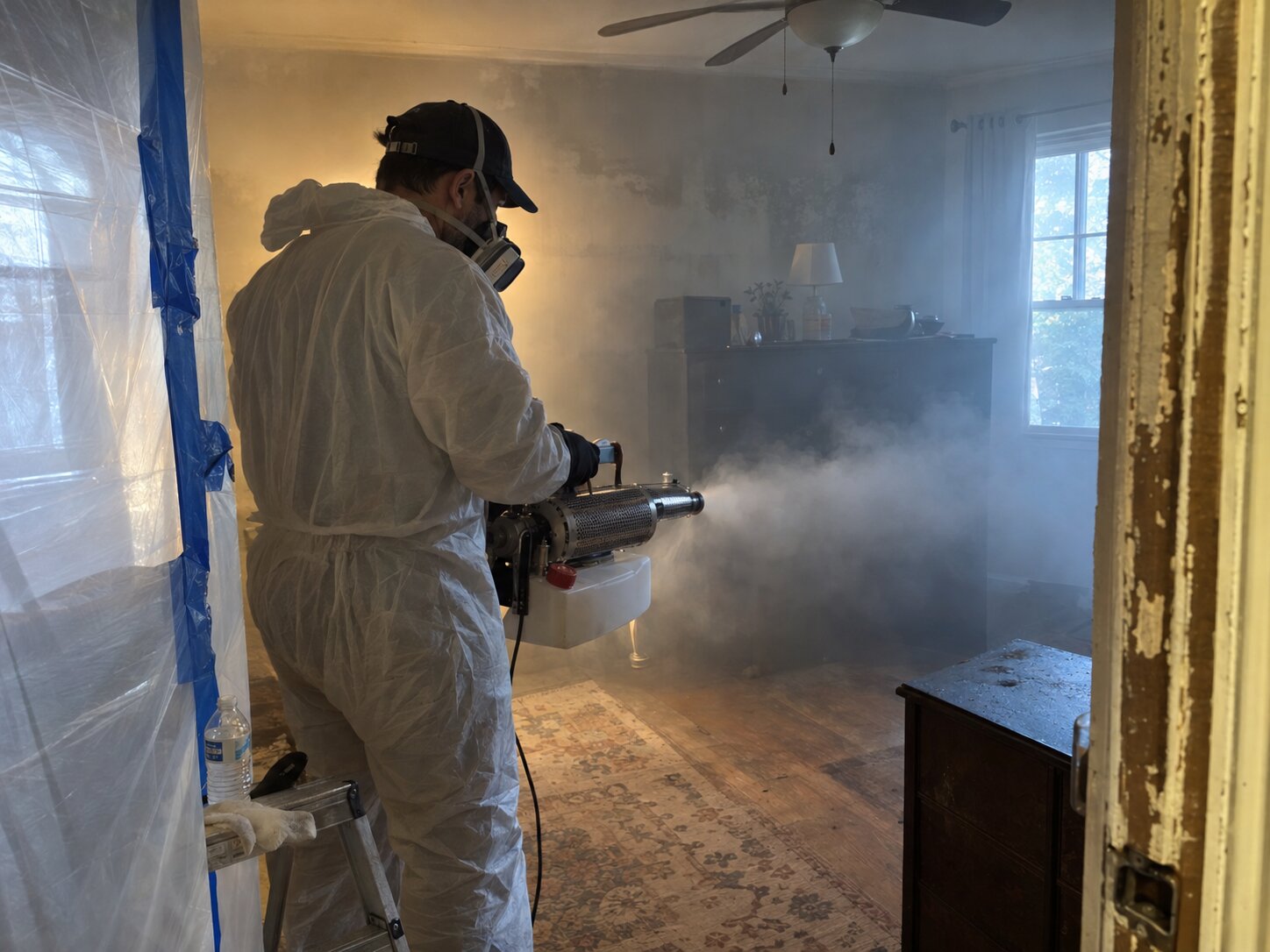
Thermal Fogging
Thermal fogging uses heated deodorizing solution vaporized into fog form that penetrates porous materials, ductwork, and hidden spaces. The vapor combines with odor molecules at the chemical level, neutralizing rather than masking the odor. Thermal fogging is applied after cleaning, with the property closed for 4–8 hours during and after treatment, then ventilated before reoccupation.
Hydroxyl Generators
Hydroxyl generators produce hydroxyl radicals (a naturally occurring atmospheric oxidizer) that break down odor molecules. Unlike ozone, hydroxyl generators can operate in occupied spaces since the hydroxyl radicals are safe for people, pets, and plants. Treatment typically runs 24–96 hours depending on the extent of odor loading.
Ozone Treatment
Ozone generators produce high concentrations of ozone (O₃) that aggressively oxidize odor compounds. Ozone treatment is highly effective but requires vacant space during treatment (ozone is harmful to people, pets, and plants at treatment concentrations) and can damage certain materials (rubber, some plastics, some paint finishes). Post-treatment ventilation is essential before reoccupation.
Encapsulating Sealers
Some smoke odor comes from residue that has penetrated substrates too deeply for cleaning to fully remove. Encapsulating sealers (typically shellac-based or specialty smoke odor blocking primers) seal the substrate surface, trapping any residual residue and preventing ongoing off-gassing. Applied under new paint or finish, encapsulating sealers provide long-term odor control when cleaning alone can’t achieve full removal.
Frequently Asked Questions
- Why can’t I just wipe off the smoke with household cleaners?
- Two reasons. First, most household cleaners are water-based and are ineffective (or actively counterproductive) on wet smoke and protein smoke residue — water-based cleaning on wet smoke often smears and drives the residue deeper into porous surfaces. Second, “wiping off” smoke residue with the wrong technique often spreads contamination to previously unaffected areas — smoke residue that was on one wall ends up on your cleaning cloth, then on the next wall you wipe, then on your hands, then on any surface you touch. Professional smoke cleaning uses substrate-appropriate solvents, single-use cleaning materials that don’t recirculate residue, and systematic approach that prevents cross-contamination. For very small localized smoke residue on non-porous surfaces (a candle mishap, small stovetop mishap), DIY cleaning may be adequate. For anything larger, professional cleaning is worth the cost.
- Do you always need to repaint after smoke damage?
- Often but not always. Dry smoke on latex-painted walls can often be cleaned without repainting if the residue is fully removable with dry chemical sponge and cleaning doesn’t leave staining. Wet smoke and protein smoke almost always require repainting because these residues penetrate paint film to some degree, and even successful surface cleaning leaves ongoing off-gassing potential. Fuel oil smoke essentially always requires repainting with stain-blocking primer beneath. The specific decision depends on the substrate condition after cleaning, the visible result, and the presence of any lingering odor after odor treatment. Sometimes selective repainting (walls only, not ceilings, for example) is appropriate; other times full repainting of the affected area is warranted.
- How do you know if the HVAC system needs cleaning?
- By inspection during assessment. If the HVAC system operated during or immediately after the fire, it almost certainly needs cleaning because it drew smoke and combustion products through the ductwork throughout the property. If the system was off during the fire but the building has interior smoke damage, ductwork inspection determines whether smoke entered through return openings, floor registers, or other paths. Visual inspection through accessible openings, borescope inspection for hidden ductwork, and residue sample testing when needed all inform the decision. When HVAC cleaning isn’t performed on a smoke-affected system, the ductwork continues distributing residue and odor throughout the property whenever the system operates, effectively re-contaminating cleaned spaces.
- Is ozone treatment safe? I’ve heard mixed things about it.
- Ozone treatment is safe when applied correctly and dangerous when applied incorrectly. Ozone at concentrations used for smoke odor treatment (typically 5–20 ppm) is harmful to humans, pets, plants, and some materials during treatment. Correct application requires vacant space during treatment, sealed openings to prevent ozone escape to occupied areas, adequate treatment duration for the specific odor loading, and post-treatment ventilation before reoccupation. When applied incorrectly (occupants remaining in the space, inadequate ventilation, treatment of materials that ozone damages), ozone can cause respiratory issues, damage rubber and some plastic materials, and produce disappointing odor results. Our approach: hydroxyl generators for occupied spaces or smaller odor issues, ozone only when appropriate for the specific situation and always with vacancy during treatment. If you’re offered ozone treatment for a smoke odor situation, verify that vacancy procedures are appropriate before agreeing.
- How long does smoke cleanup take separately from full fire restoration?
- Depends on scope. Small kitchen protein smoke event (contained cooking incident, one room significantly affected) typically takes 3–7 days from initial cleaning through completion. Medium smoke event (multi-room smoke damage from limited fire) typically takes 1–3 weeks. Whole-property smoke damage from significant fire typically takes 3–8 weeks just for the cleaning phase. Odor treatment adds 1–7 days depending on method used. These timelines are for smoke cleaning specifically; total fire restoration timeline including structural work, contents restoration, and reconstruction is longer.
Contact Vault Mold Removal — Provo, UT
For smoke damage cleanup, small-scale smoke events (protein smoke from cooking, minor fires), or persistent odor from prior smoke damage, contact our office directly.
- Phone: (385) 250-2825
- Address: 1169 S 760 W, Provo, UT 84601
- Utah DOPL General Contractor License: #11876543-5501
- IICRC WRT / ASD / AMRT / OCT: #248317 / #248317-ASD / #319482 / #319482-OCT
Office Hours
- Monday – Saturday: 9:00 AM – 5:00 PM
- Sunday: Closed
Helpful guides: Kitchen fire smoke damage · Wildfire smoke
Frequently asked questions
Can smoke smell really be removed?
Yes, with the right process: cleaning the residue off surfaces, cleaning the HVAC system, and odor neutralization. Shortcuts like fogging alone usually fail — the residue has to come off.
How is kitchen grease smoke different?
Grease and protein smoke leaves a sticky, often invisible film that reacts to the wrong cleaner by smearing deeper. Dry soot sponges first, then degreasers chosen for the residue.
Will insurance cover smoke damage without a fire on my property?
Sometimes. Some policies cover smoke damage from a nearby fire or wildfire. Check your policy wording.
Questions we didn’t cover? Call (385) 250-2825.