
Soot removal after fire & smoke damage
Soot deposits on walls, ceilings and HVAC need the right method for the type of smoke. Vault handles wet-smoke, dry-smoke and protein residues under IICRC S700.
- Call any hour: (385) 250-2825 is answered live 24/7 by the Vault crew. 45-minute arrival inside Provo city limits (Monday–Saturday, 8 AM–5 PM); typically under 60 minutes elsewhere in our Utah County service area.
- In-house: dry-chem sponge, HEPA vacuuming, chemical cleaning for each smoke type, and HVAC system cleaning before the home is returned to service.
- Who does the work: Vault’s own W-2 crew, IICRC certified in WRT, ASD, AMRT and OCT, under Utah DOPL General Contractor License #11876543-5501. No subcontractors. Meet the team
- Insurance: Xactimate scopes, direct billing to State Farm, USAA, Allstate, Farmers and Bear River Mutual.
- Warranty: 24-month workmanship warranty on the rebuild. Warranty details · Financing
- Family-owned and veteran-operated, based in Provo since 2020.
Water damage restoration · Mold remediation · Sewage cleanup · Reconstruction & repairs
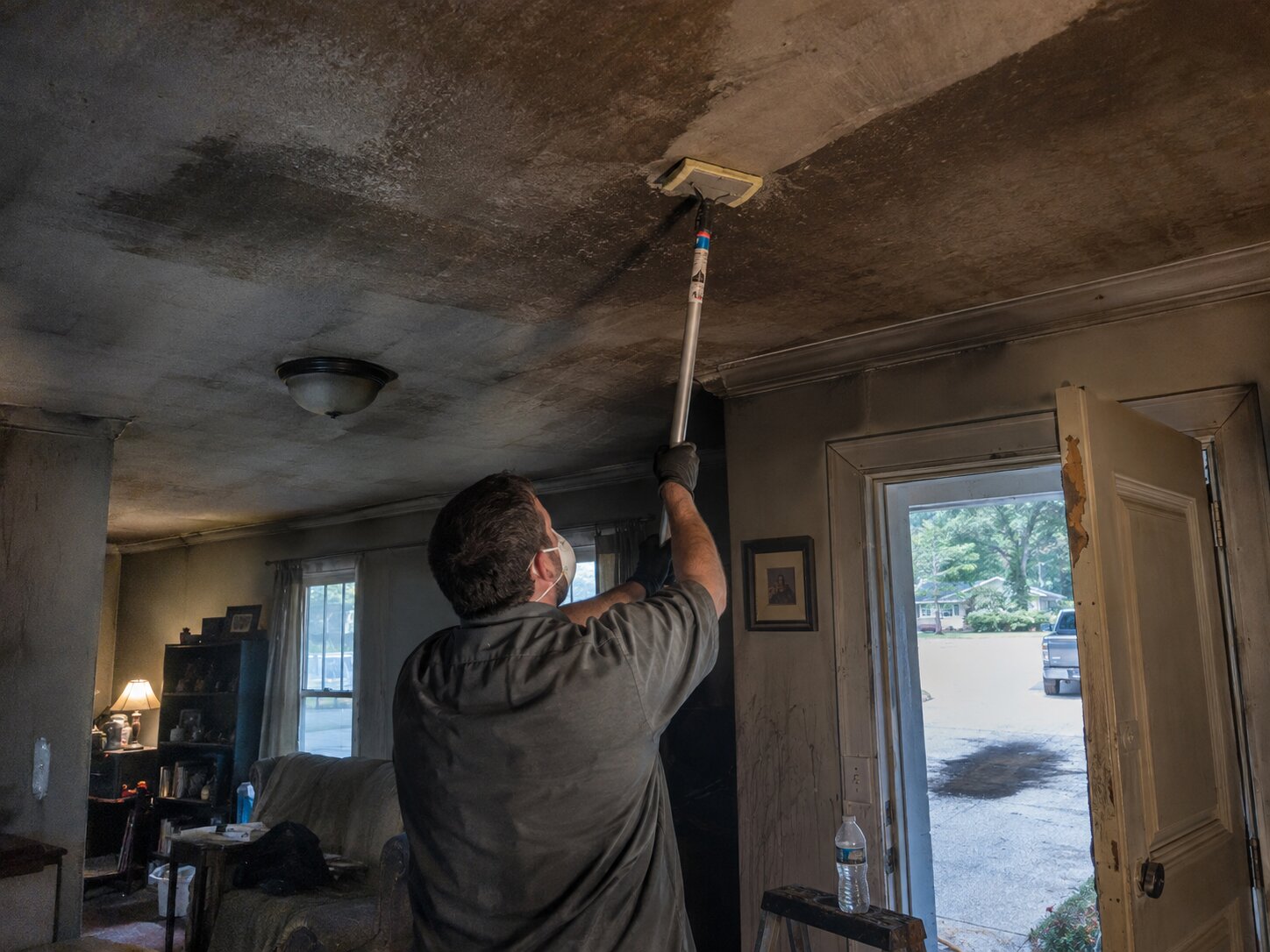
Soot Removal — Utah County Puff-Back and Fire Residue
Soot is the fine, black particulate matter produced by incomplete combustion. Unlike smoke residue that can range from dry powder to greasy film, soot specifically refers to the solid carbon particulate deposition that appears after fires, furnace malfunctions, fireplace overflow events, and other combustion accidents. Utah County properties encounter soot situations from several distinct causes — furnace puff-backs are particularly common during cold seasons when heating equipment sees maximum operation. Effective soot removal requires characterizing the specific soot type, matching the cleaning approach to the substrate, and preventing the common mistake of spreading soot deeper into surfaces through inappropriate cleaning methods. Vault Mold Removal handles soot cleanup across Utah County using IICRC S700 methodology adapted to the specific soot situation.
What Soot Actually Is
Soot is primarily elemental carbon (typically 60–90%) with variable amounts of unburned hydrocarbons, tar compounds, mineral ash, and other combustion byproducts. The specific composition depends on what burned, at what temperature, and under what oxygen conditions. Physical characteristics:
- Fine particulate size — typically 0.1 to 5 microns, small enough to remain airborne for extended periods and penetrate deep into HVAC systems and porous materials
- Static electricity affinity — soot particles carry electrical charge that causes them to adhere to surfaces, particularly synthetic materials, and to migrate along HVAC airflow patterns
- Oil-based binding — the tar and hydrocarbon components create adhesion to substrates that resists simple wiping
- Distinctive black or dark gray coloration on affected surfaces
Common Soot Sources in Utah County
Furnace Puff-Backs
Puff-backs happen when a furnace’s ignition doesn’t fire properly, allowing unburned fuel (typically natural gas in Utah County; occasionally oil in older systems) to accumulate in the combustion chamber. When ignition finally occurs, the accumulated fuel combusts explosively, blowing soot back through the HVAC system and out of every supply register in the property. A single puff-back event can distribute soot throughout an entire residence within minutes.
Causes of puff-back:
- Faulty ignition system (bad igniter, weak spark)
- Improper burner adjustment producing incomplete combustion
- Clogged burner ports affecting flame pattern
- Cracked heat exchanger allowing improper airflow
- Chimney or flue blockage preventing proper venting
- Aging equipment that has developed control system issues
Puff-backs are most common during the first heating cycles of the season (October–November in Utah County) as systems ramp up from summer inactivity, and during the heaviest cold-weather operation (January–February) when equipment runs at maximum capacity. Property owners with older gas furnaces (15+ years) or oil-fired equipment are at highest risk.
Fireplace and Wood Stove Overflow
Fireplaces and wood stoves can produce soot deposition beyond the immediate fire area under several conditions:
- Backdraft events where wind pressure reverses chimney flow, pushing smoke and soot back into the property
- Chimney fires where creosote accumulation ignites, producing intense soot production
- Poor combustion conditions (wet wood, insufficient draft) producing smoky operation
- Damper problems allowing smoke escape into the room
- Chimney blockage from bird nests, debris, or structural collapse
Fireplace soot has slightly different characteristics than furnace puff-back soot — wood combustion produces different hydrocarbon compounds and typically more oily/tarry residue.
Post-Fire Soot Deposition
Any structural fire produces soot deposition throughout the affected area and often beyond. Post-fire soot is typically the heaviest and most complex situation because it involves multiple soot sources (structural combustion, contents combustion, plastics and synthetic materials) with different chemistry.
Candle and Cooking Fires
Minor combustion events (candle mishaps, small cooking flames, brief appliance issues) can produce localized soot deposition. These situations are typically limited in scope but still benefit from proper cleaning to prevent staining and odor.
Vehicle Fires in Attached Garages
Vehicle fires in attached garages produce distinctive soot deposition — automotive combustion involves petroleum products, synthetic interior materials, and vehicle-specific components (batteries, wiring insulation) that produce oily, chemically-complex soot. The garage-to-home connection typically transfers significant soot into the residence even without direct fire penetration.
Why DIY Soot Cleaning Often Fails
Property owners attempting to clean soot without proper equipment and technique typically make the situation worse. Common mistakes:
Water-Based Cleaning on Fresh Soot
Fresh soot with active oil content smears aggressively when water is applied. The soot spreads across the surface rather than lifting off, and the water drives soot particles deeper into porous substrates. What appeared to be limited surface deposition becomes wall-wide staining after ineffective cleaning attempts.
Household Cleaning Sprays
Standard household cleaners don’t have the solvent chemistry to break down soot’s oil binding. Application typically produces limited results while spreading contamination through the cleaning cloth to previously unaffected areas.
Vacuum Cleaning with Standard Equipment
Standard household vacuums (even good ones) don’t provide HEPA filtration adequate for soot’s fine particle size. Vacuuming soot with inadequate filtration recirculates the particles through the exhaust, producing airborne redistribution throughout the property.
Ignoring HVAC Contamination
Soot events invariably distribute particulate through HVAC systems that then continues recirculating soot throughout the property whenever the system operates. Property owners cleaning visible soot without addressing HVAC contamination find that soot reappears within days of “completing” the cleanup.
Wrong Order of Operations
Effective soot cleanup follows a specific sequence: HVAC isolation, HEPA vacuuming, dry chemical sponge cleaning, wet cleaning where appropriate, sealing where needed, HVAC decontamination. Property owners often start with wet cleaning of visible areas, which drives soot deeper before the appropriate dry methods have had a chance to work.
Professional Soot Removal Process
Initial Response and HVAC Isolation
First action after arrival is HVAC system isolation — shutting off system operation and covering all supply and return registers to prevent additional soot circulation. If the puff-back caused the initial event, the equipment is inspected and typically red-tagged for professional service before restart.
Ceiling-Down Cleaning Sequence
Soot deposition follows air currents and settling patterns; ceiling and upper wall surfaces typically have the heaviest deposition. Cleaning proceeds from top down, so that soot dislodged from upper surfaces during cleaning doesn’t re-contaminate cleaned lower surfaces.
HEPA Vacuuming
Every surface receives initial HEPA vacuuming before any wet or dry cleaning. HEPA vacuuming removes loose soot particulate that would otherwise smear or spread during subsequent cleaning steps. Multiple passes with slow, deliberate movement.
Dry Chemical Sponge Cleaning
Specialty vulcanized rubber sponges (dry chemical sponges) lift soot from painted surfaces without wetting the substrate or smearing the residue. Sponge is dragged across the surface in one direction, then rotated to a clean face for the next pass. Loaded sponges are disposed rather than washed and reused — the soot loading is what removes soot from surfaces, so cleaned sponges lose effectiveness.
Wet Cleaning for Remaining Residue
After HEPA vacuuming and dry sponge work, remaining residue is addressed with wet cleaning using appropriate solvents for the specific soot type and substrate. Furnace puff-back soot typically responds to alkaline cleaners; wood-burning soot often requires solvent-based cleaners.
Encapsulating Sealer Where Needed
Surfaces where soot has penetrated the substrate beyond cleaning reach (typically porous drywall paper with heavier deposition, unsealed wood) receive encapsulating primer (shellac-based typically) to seal in residual residue before repainting.
HVAC Decontamination
HVAC decontamination is essential for any soot event that involved system operation during or after the event. Standard scope: filter replacement, blower cleaning, evaporator coil cleaning, duct cleaning throughout the accessible system, and antimicrobial application to duct interior after cleaning. Filter changes at more frequent intervals (30 days) for 3–6 months after event to capture any residual soot that migrates from difficult-to-reach system components.
Frequently Asked Questions
- My furnace had a puff-back. Should I turn it back on to keep warm while I figure out cleanup?
- No. Continued operation of a furnace after puff-back produces two problems. First, whatever caused the puff-back (ignition issue, combustion problem, venting issue) is still present, so additional puff-backs are likely. Second, operating the HVAC system continues distributing soot throughout the property whenever the blower runs. Standard immediate response: turn off the furnace, contact your HVAC contractor for service to diagnose and correct the underlying issue, and use temporary heat sources (space heaters if safe for your specific situation, or temporary lodging if the weather is severe) until the furnace is safely serviceable. Most Utah County HVAC contractors treat post-puff-back service as priority work and typically respond same-day or next-day. Restart the furnace only after professional inspection and repair.
- Will my insurance cover puff-back cleanup?
- Typically yes under standard homeowner insurance policies. Puff-backs are typically classified as “sudden and accidental” events that fall under standard policy coverage. Coverage typically includes both the cleanup work and any HVAC equipment repair or replacement needed. Some policies have specific “puff-back” or “soot” coverage limits; standard limits typically cover most residential puff-back situations. State Farm, USAA, Allstate, Farmers, and Bear River Mutual all typically cover puff-back events in Utah under standard policies. Report the event to your insurance carrier promptly — the same day if possible — and coordinate the cleanup as an insurance-covered claim if the scope warrants it.
- How long does soot cleanup take?
- Depends on the extent of the event. Localized puff-back with soot in a limited area typically takes 2–4 days for physical cleaning plus HVAC decontamination. Whole-property puff-back with significant soot distribution typically takes 5–10 days. Post-fire soot cleaning as part of larger fire restoration is included in the overall fire restoration timeline. HVAC decontamination adds 1–2 days on top of surface cleaning. Follow-up work over the next few months (frequent filter changes, secondary cleaning if any migration is discovered) is typically included in the initial project scope without additional charge.
- Can you clean soot off my white carpet, or does it need replacement?
- Depends on carpet type, soot loading, and how quickly the cleanup begins. Light soot deposition on synthetic carpet with quick response (24–48 hours after the event) can often be cleaned by professional carpet cleaning with specialty soot-treatment products. Heavier soot loading, aged deposition (days or weeks after the event), or wool carpet often produces limited results even with aggressive cleaning. Replacement decisions consider: cleaning cost vs. replacement cost, cosmetic acceptability of any residual staining, health considerations if residue chemistry is significant, and insurance coverage limits. For higher-end carpet in significant soot situations, cleaning trial can be performed on a hidden area before final decision. Fully-installed high-quality carpet often justifies attempted cleaning; older or lower-grade carpet often justifies replacement.
- My property owner had the furnace serviced last spring. Why did we still have a puff-back?
- Regular service reduces but doesn’t eliminate puff-back risk. Puff-backs can occur due to conditions that develop between service intervals: ignition components that fail without warning, control systems that develop intermittent issues, chimney blockages that develop over time (bird nests, debris accumulation), and combustion chamber issues that progress gradually. Newer high-efficiency systems have puff-back risk reduction features (better ignition, pressure sensing, combustion monitoring) but aren’t puff-back proof. Older systems, particularly those approaching 15–20 year age, have significantly elevated puff-back risk regardless of service quality. If your furnace had a puff-back after recent service, the specific cause should be identified during post-event inspection and might indicate that replacement is more appropriate than continued repair. Utah County HVAC contractors can provide the specific diagnostic assessment.
Contact Vault Mold Removal — Provo, UT
For furnace puff-back cleanup, fireplace and wood stove soot events, or questions about specific soot situations, contact our office directly.
- Phone: (385) 250-2825
- Address: 1169 S 760 W, Provo, UT 84601
- Utah DOPL General Contractor License: #11876543-5501
- IICRC WRT / ASD / AMRT / OCT: #248317 / #248317-ASD / #319482 / #319482-OCT
Office Hours
- Monday – Saturday: 9:00 AM – 5:00 PM
- Sunday: Closed
Helpful guides: Soot lines on walls · Furnace puff back