
Commercial water damage restoration at a glance
For a business, water damage means downtime as well as repairs. Vault’s crew works to remove water fast, dry the building properly and keep as much of the space usable as possible while work is done.
- Call any hour: (385) 250-2825 is answered live 24/7 by the Vault crew, not a call center. 45-minute arrival guarantee inside Provo city limits (Monday–Saturday, 8 AM–5 PM); typically under 60 minutes elsewhere in our Utah County service area.
- Who does the work: Vault’s own W-2 crew, IICRC certified in WRT, ASD, AMRT and OCT, working under Utah DOPL General Contractor License #11876543-5501. No subcontractors. Meet the team
- Insurance: we document damage daily, write the scope in Xactimate and bill State Farm, USAA, Allstate, Farmers or Bear River Mutual directly.
- Warranty: 24-month workmanship warranty on the rebuild, plus a 90-day mold warranty from post-remediation clearance where mold work was done. Warranty details
- Financing: through Wisetack, $500–$25,000 over 3–24 months, soft credit check. Financing
- Commercial scope: emergency extraction, carpet tile removal in sections, commercial dehumidification sized for open floor plans, drop-ceiling tile replacement, and documentation your insurer and landlord need.
- Real Vault commercial jobs: East Bay office supply-line burst, Downtown retail copper burst.
- Family-owned and veteran-operated, based in Provo since 2020.
Water damage restoration · Mold remediation · Sewage cleanup · How we contain the work area
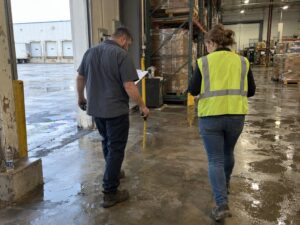 Commercial Water Damage Restoration — Utah County
Commercial water damage restoration is not just residential work performed on a larger property. The stakes are different: business continuity has direct revenue implications, commercial property insurance has different coverage structures than homeowner policies, tenant relationships require careful coordination, and post-loss documentation must satisfy commercial adjusters, corporate risk management, and often building code inspectors. Vault Mold Removal provides IICRC S500-compliant commercial water damage restoration across Utah County for retail, medical and dental, office, warehouse, restaurant, and light industrial properties. Every commercial engagement is structured around three priorities in order: safety, business continuity, and documentation defensibility.
Commercial Property Types We Serve
Retail Properties
Retail losses in Utah County commonly involve rooftop unit condensate line failures during summer AC operation, sprinkler system discharges (accidental or fire-triggered), and after-hours plumbing failures discovered on Monday morning openings. Retail restoration prioritizes minimizing days-closed and protecting inventory. State Street and University Parkway commercial corridors in Orem, Downtown Provo, and the Vineyard Grove development are our most common retail service areas. Inventory pack-out, textile restoration, and coordinated reconstruction that respects lease-mandated fit-out requirements are standard elements of the scope.
Medical and Dental Practices
Medical and dental water losses require enhanced coordination because of patient-care liability considerations and infection control standards. Bathroom overflows into treatment areas, sterilization equipment leaks, and HVAC condensate line failures over patient rooms are typical scenarios. Restoration in medical spaces requires containment that keeps affected areas isolated from operational treatment rooms, patient-care-grade cleaning protocols, and documented moisture clearance signed off before spaces return to clinical operation. N University Avenue in Orem, the Downtown Provo medical corridor, and the Riverwoods area are our regular medical service zones.
Office Buildings
Office building losses often involve upstairs bathroom overflows affecting downstairs tenants, roof leaks during monsoon storms, and after-hours pipe bursts discovered on Monday mornings. Office restoration typically requires coordination with property management, multiple tenants, IT departments (server room protection is often the first call after extraction), and building engineers. Highland Drive in Provo, the University Place development in Orem, and the mixed-use developments along South State Street in Orem are our common office service areas.
Warehouses and Light Industrial
Warehouse and light industrial water losses have different scale considerations. A dock area supply line failure can affect thousands of square feet before discovery. Rack-mounted inventory water exposure requires targeted extraction and drying that doesn’t damage products beyond the water event itself. Concrete slab moisture verification is different from residential subfloor verification. Vineyard’s Utah Lake shoreline light industrial park, Springville’s Main Street commercial-industrial corridor, and the American Fork commercial zones are typical service locations for this property type.
Restaurants and Food Service
Restaurant water damage involves specific complexities: grease line failures produce Category 3 water; commercial kitchen equipment leaks; grease-trap backups; refrigeration system water lines; and health department requirements for post-loss reopening. Restaurant restoration prioritizes rapid return to operational condition, ServSafe-compliant surface cleaning, and health department inspection support. The Downtown Provo restaurant district and University Parkway in Orem see most of our restaurant service calls.
Hospitality (Hotels, Short-Term Rentals)
Hospitality losses require coordination with property management, in-house maintenance staff, and often adjacent-guest impact management. Provo’s Center Street hotel district and Springville-area event properties are common service locations.
What Makes Commercial Restoration Different
Business Continuity Prioritization
Every day closed for a retail property represents lost revenue. Every day a dental practice loses treatment room capacity represents patient displacement and rescheduling costs. Every day a restaurant closes means lost sales and staff impact. Commercial restoration scopes are optimized for shortest defensible return-to-operational timeline — which is not the same as fastest work, and definitely not the same as cutting corners on documentation. It means careful sequencing of extraction, drying, and reconstruction to allow phased reopening of unaffected areas while completed work continues on affected areas.
Commercial Insurance Coordination
Commercial property insurance is structurally different from homeowner insurance. Coverage often includes business interruption (loss of income during closure), extra expense (costs of operating from alternate location during restoration), and specific commercial property coverages for inventory, tenant improvements, and equipment. Adjusters at commercial carriers — The Hartford, Travelers, Zurich, CNA, and Utah-market commercial specialists — expect Xactimate scopes formatted for commercial pricing tables, ACORD-format certificates of insurance from restoration contractors, and business interruption documentation that’s separate from the direct property damage scope.
Tenant and Multi-Party Coordination
Multi-tenant commercial properties introduce coordination complexity. A ceiling collapse in one tenant space caused by a plumbing failure in the tenant space above requires clear allocation of responsibility, insurance coordination between multiple carriers, and shared-cost negotiations for common-area affected work. Property management companies typically coordinate this on behalf of tenants, but restoration contractors need to work productively across the multi-party environment.
Building Code and Health Department Requirements
Commercial reconstruction often requires more extensive permit compliance than residential work. Restaurants have health department inspection requirements for post-loss reopening. Medical practices may have HHS or state health department requirements depending on the specific facility type. Utah County commercial permits are pulled through the applicable municipal building department, with additional coordination for health-related occupancy where relevant.
Our Commercial Restoration Process
Commercial engagements follow the same nine-stage IICRC S500 process as residential work, with additional commercial-specific elements:
- Emergency response. Business-hours calls answered live, after-hours calls route to on-call rotation. Commercial calls receive priority triage due to business-continuity implications.
- On-site assessment. Grid moisture mapping plus commercial-specific inventory documentation, tenant impact assessment, and building system evaluation.
- Category, class, and business impact assessment. Standard IICRC classification plus estimated closure duration, business interruption implications, and phased-reopening planning.
- Scope development. Xactimate scope priced to commercial regional pricing tables, submitted to the commercial adjuster with supplemental documentation for business interruption if applicable.
- Extraction. Scaled to commercial volume, often deploying multiple truck-mounted units simultaneously for large-square-footage losses.
- Targeted removal. Commercial materials removal considerations, including tenant-improvement documentation and any lease-specific requirements about material types.
- Structural drying. Commercial-scale equipment deployment with attention to production floor safety, tenant space impact, and utility management (some commercial spaces have industrial-grade three-phase electrical service that supports desiccant dehumidification more effectively than residential single-phase service).
- Verification of dry standard. Same IICRC S500 dry standards apply, with additional attention to commercial floor systems (raised access floors in office spaces, concrete slabs in warehouses, restaurant kitchen floors) that have specific dry standard nuances.
- Reconstruction and documentation. Coordination of subcontractor trades for tenant-improvement rebuild, permit management, health department coordination where relevant, and final documentation package delivery to the adjuster, property management, and any coordinating parties.
Commercial Insurance Carriers We Coordinate With
Regular commercial claim coordination with:
- The Hartford (commercial property, business interruption)
- Travelers
- Zurich North America
- CNA
- Chubb
- Nationwide Commercial
- Liberty Mutual Commercial
- Bear River Mutual (commercial property)
- State Farm Business Insurance
- USAA (for USAA member commercial policies)
- Smaller regional commercial specialists
Every commercial scope we deliver includes Xactimate-format pricing, ACORD-format certificate of insurance if requested, additional insured endorsements when the property management or landlord requires them, and supplemental business interruption documentation when applicable.
Emergency Response for Commercial Properties
Commercial emergency response follows the same rapid-dispatch protocol as residential, with two commercial-specific considerations. First, after-hours access coordination: many commercial properties have alarm systems, security services, or property management gatekeepers that need to be coordinated before a technician can enter. Building an access plan into the initial dispatch call speeds arrival. Second, utility management: commercial properties often have building automation systems, chilled water loops, and industrial electrical infrastructure that need to be considered before deploying restoration equipment.
Average commercial response times from our 1169 S 760 W Provo office:
- Downtown Provo, University Avenue corridor, Center Street: 28 minutes during business hours, 55 minutes after hours
- Orem State Street corridor, University Parkway: 38 minutes during business hours, 62 minutes after hours
- Springville commercial district, Main Street: 45 minutes during business hours, 70 minutes after hours
- Vineyard Grove and Utah Lake commercial: 42 minutes during business hours, 68 minutes after hours
- Lindon and Mapleton commercial: 44 minutes during business hours, 72 minutes after hours
Business Continuity Planning for Prospective Losses
Some commercial customers engage us before losses occur, to develop business continuity plans that include restoration contractor pre-engagement. Pre-engagement doesn’t obligate the customer to use us for a specific future loss — it just establishes access protocols, decision-maker contact information, insurance carrier relationships, and priority-response commitments that reduce triage time when an emergency occurs. Multi-location commercial customers particularly benefit from this arrangement. Contact our office to discuss.
Frequently Asked Questions
- What’s the difference between commercial and residential water damage restoration?
- Three key differences. First, commercial restoration prioritizes business continuity — sequencing work to allow phased reopening while restoration continues on affected areas — whereas residential restoration typically works to complete the entire scope before the space is fully returned to use. Second, commercial insurance has different coverage structures, including business interruption and extra expense coverage that don’t exist in homeowner policies. Third, commercial properties involve more parties: multiple tenants, property management, building engineers, health departments (for restaurants and medical practices), and multiple insurance carriers when losses cross tenant lines. The IICRC S500 technical work is similar; the operational coordination is very different.
- How quickly can you respond to a commercial water damage emergency?
- Business-hours response times range from 28 minutes in Downtown Provo to 45 minutes in Springville commercial district. After-hours response ranges from 55 to 75 minutes depending on the specific location and access considerations. Commercial calls receive priority triage due to business-continuity implications. For time-critical commercial losses (retail during business hours, medical practices during patient care, restaurants approaching service hours), we can typically dispatch a technician within 30–45 minutes of the initial call across our primary Utah County service area.
- Do you work with commercial insurance carriers on Xactimate scopes?
- Yes. Every commercial scope we produce is Xactimate-formatted with pricing calibrated to commercial regional tables, which differ from residential pricing on several line items. We regularly coordinate with commercial adjusters at The Hartford, Travelers, Zurich, CNA, Chubb, Nationwide Commercial, Liberty Mutual, Bear River Mutual, State Farm Business Insurance, and other Utah-market commercial carriers. Supplemental documentation for business interruption coverage is provided when applicable. ACORD-format certificates of insurance and additional insured endorsements are issued through The Hartford on 24-hour turnaround.
- Can you coordinate with health departments for restaurant or medical practice restoration?
- Yes. For restaurants, we coordinate with Utah County Health Department for post-loss reopening inspections, provide ServSafe-compliant surface cleaning documentation, and support the reopening process through certified moisture clearance. For medical practices, coordination depends on the specific facility type: standard medical offices typically require documented moisture clearance for infection control purposes, while facilities subject to enhanced regulatory oversight (surgical centers, specialty clinics) may require additional documentation. We’ve completed jobs at dental practices, urgent care facilities, physical therapy clinics, chiropractic offices, and general medical practices across Utah County.
- Do you offer pre-engagement or business continuity planning services?
- Yes. Multi-location commercial customers, larger single-location businesses, and property management companies often engage us before losses occur to develop restoration response protocols. Pre-engagement typically includes access coordination (alarm codes, key locations, after-hours contact tree), documented decision-maker authority for scope approval, insurance carrier relationship pre-established, and priority-response commitments that reduce triage time when an emergency occurs. There’s no obligation to use us for a specific loss under pre-engagement; the arrangement just streamlines the process when losses occur. Contact our office to discuss pre-engagement for your specific properties.
Contact Vault Mold Removal — Provo, UT
For commercial water damage emergencies, non-emergency commercial assessments, or business continuity pre-engagement discussions, contact our office directly. Commercial calls receive priority triage.
- Phone: (385) 250-2825
- Address: 1169 S 760 W, Provo, UT 84601
- Utah DOPL General Contractor License: #11876543-5501
- IICRC WRT / ASD / AMRT / OCT: #248317 / #248317-ASD / #319482 / #319482-OCT
Office Hours
- Monday – Saturday: 9:00 AM – 5:00 PM
- Sunday: Closed
Written warranty
24-month workmanship warranty on drying, structural repairs, drywall, flooring, cabinetry and paint done by Vault. 90-day mold warranty from post-remediation clearance for recurrence from the same moisture source. Both are transferable once to a new homeowner, in writing on the work order.
We bill your carrier directly
Direct-billing with State Farm, USAA, Allstate, Farmers and Bear River Mutual. Every scope is written in Xactimate; you pay only your deductible plus anything the policy doesn’t cover. Not on this list? We still handle the claim.
Helpful guides: Keeping your business open · Restaurant water damage · Fire sprinkler discharge