
About this job
A real Vault job in Provo. The crew that handled it was Vault’s own W-2 team — no subcontractors, no franchisee hand-off. Same crew answers the phone and shows up at the door.
- Call any hour: (385) 250-2825 answered live 24/7. 45-min guarantee Provo (Mon-Sat 8-5); under 60 min elsewhere in Utah County.
- Who did the work: Vault’s W-2 crew, IICRC WRT/ASD/AMRT/OCT, Utah DOPL #11876543-5501.
- Insurance: Xactimate scopes submitted direct to State Farm, USAA, Allstate, Farmers, Bear River Mutual, and most national carriers.
- Pricing: water mitigation $3,500-$8,500; reconstruction $4,500-$9,500. 24-month warranty, Wisetack financing.
- Family-owned and veteran-operated, based in Provo since 2020.
See Vault in Provo, all Provo case studies, or water damage services.
Real Vault job — Downtown, Provo
- Approximate location
- Near Center Street and University Avenue
- When
- February 2026
- What happened
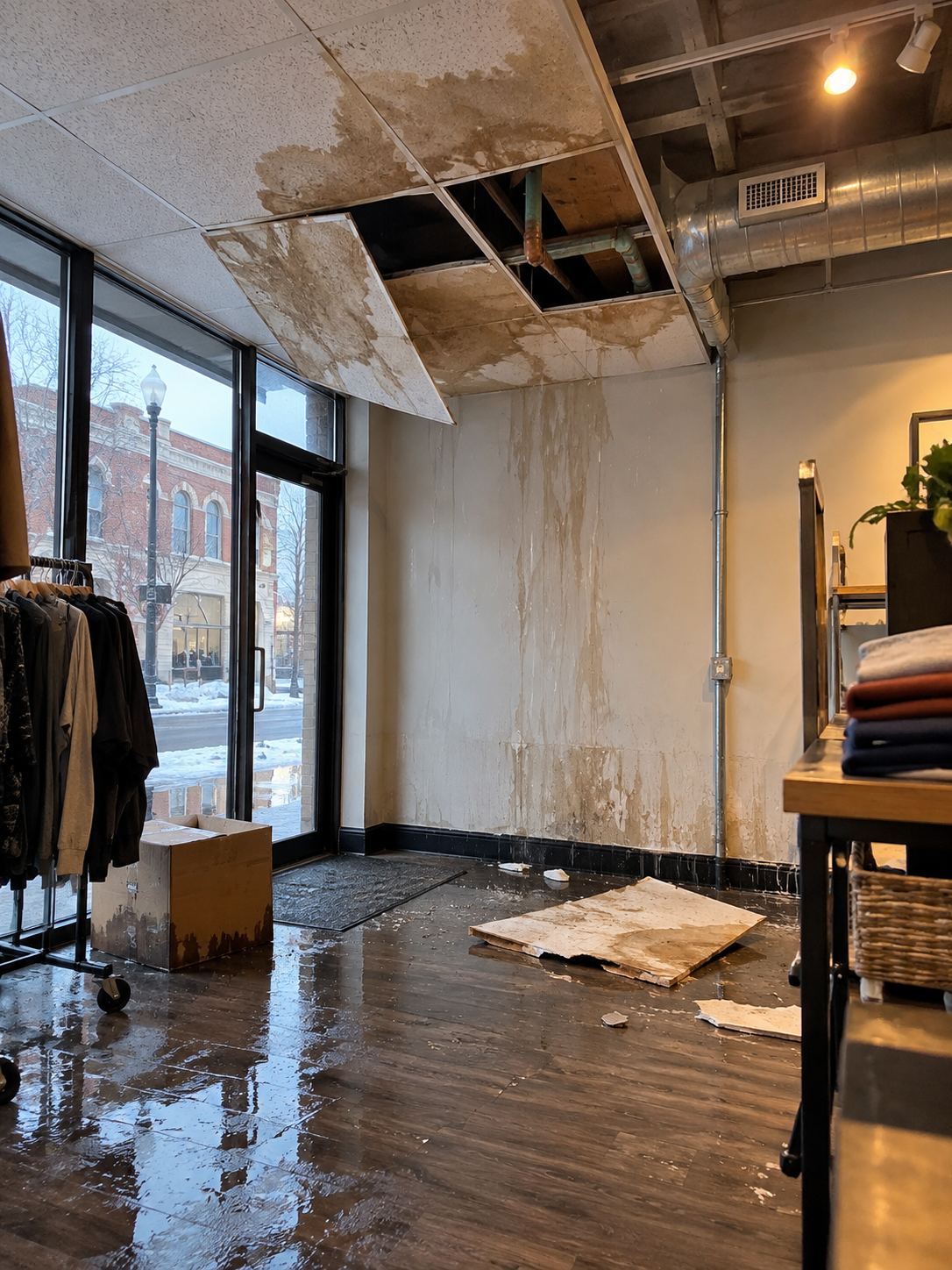
- Aging copper supply line burst above ground-floor retail space, soaking ceiling tiles, wall cavities, and commercial flooring.
- What Vault did
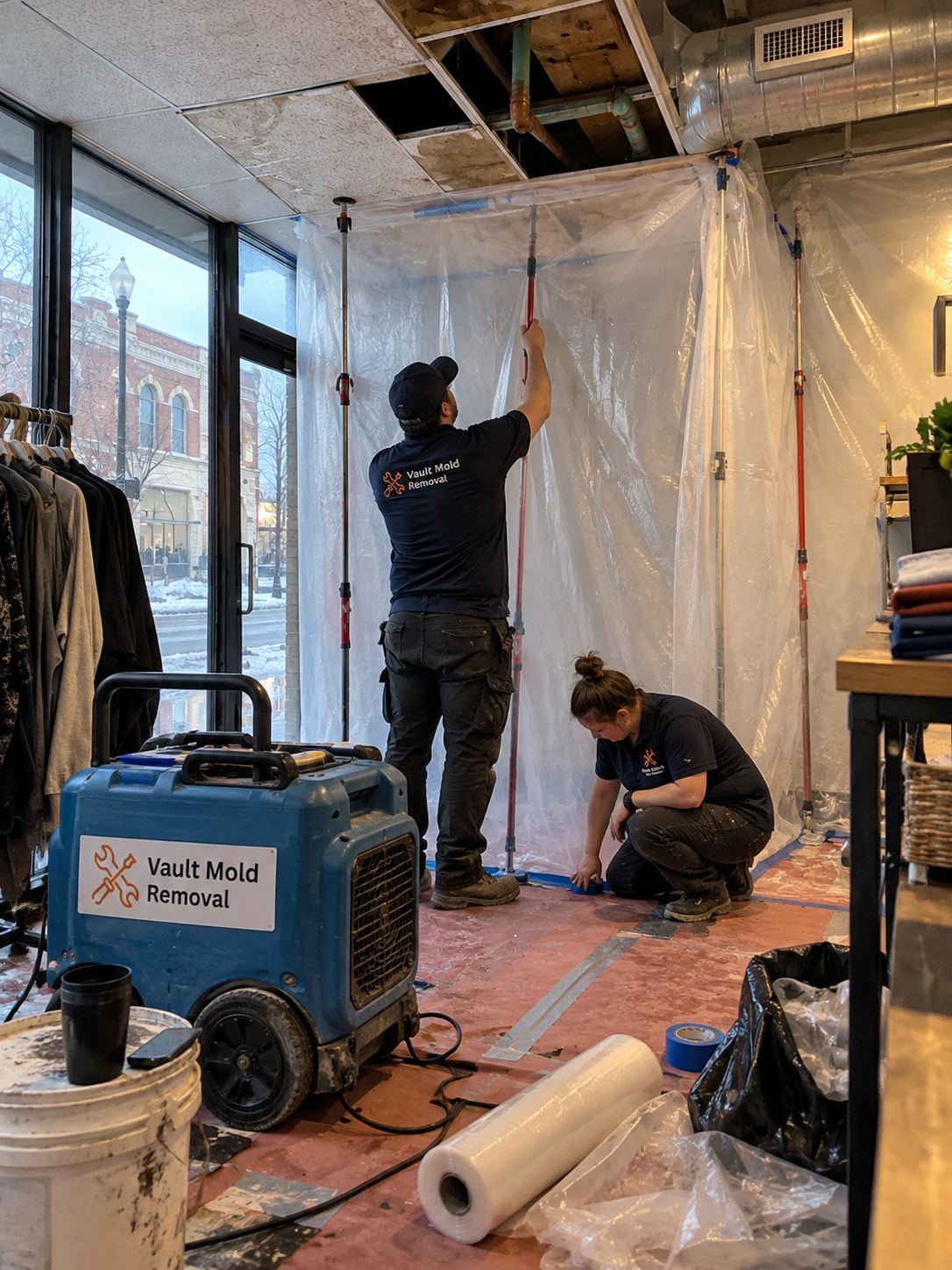
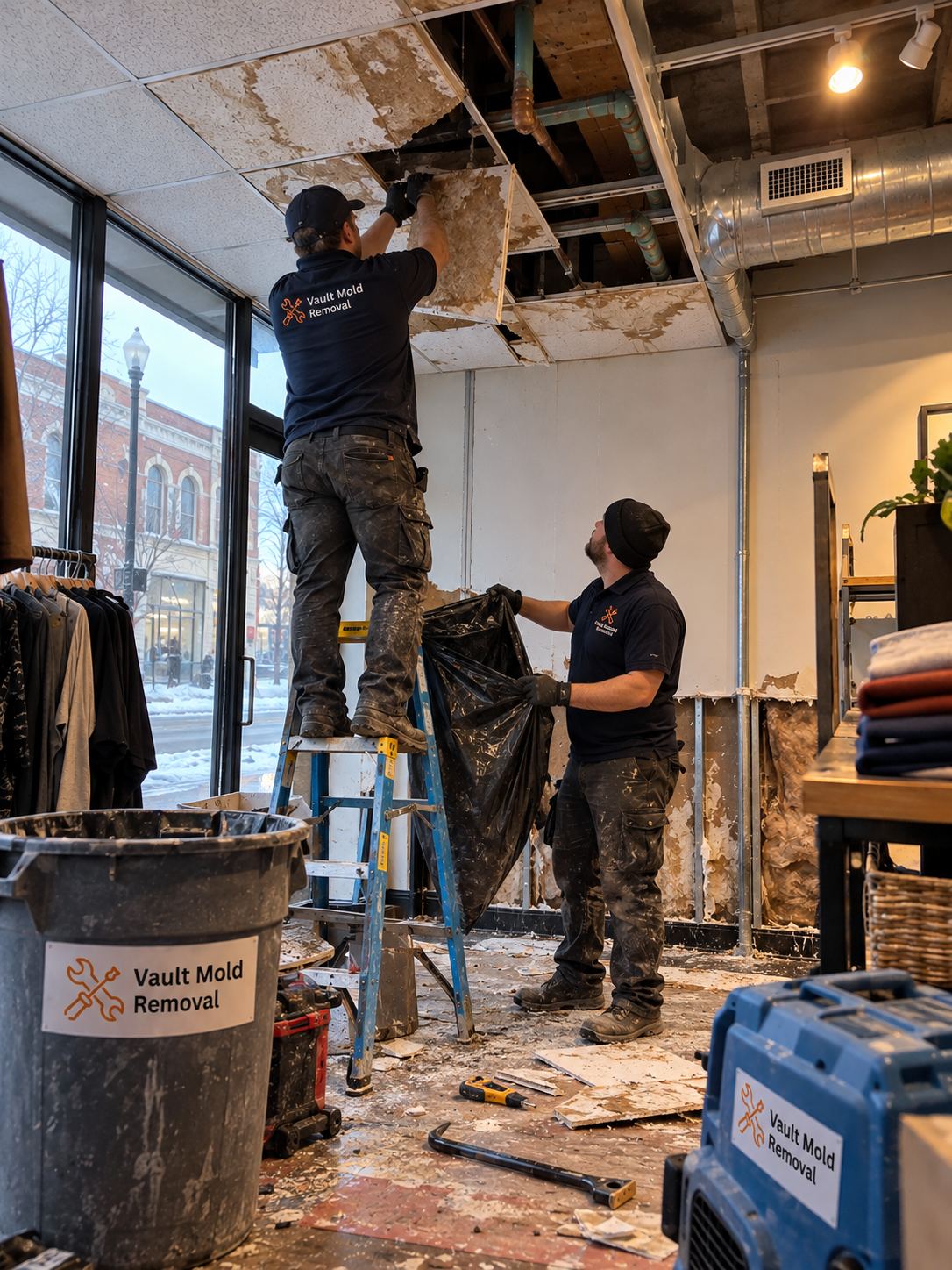
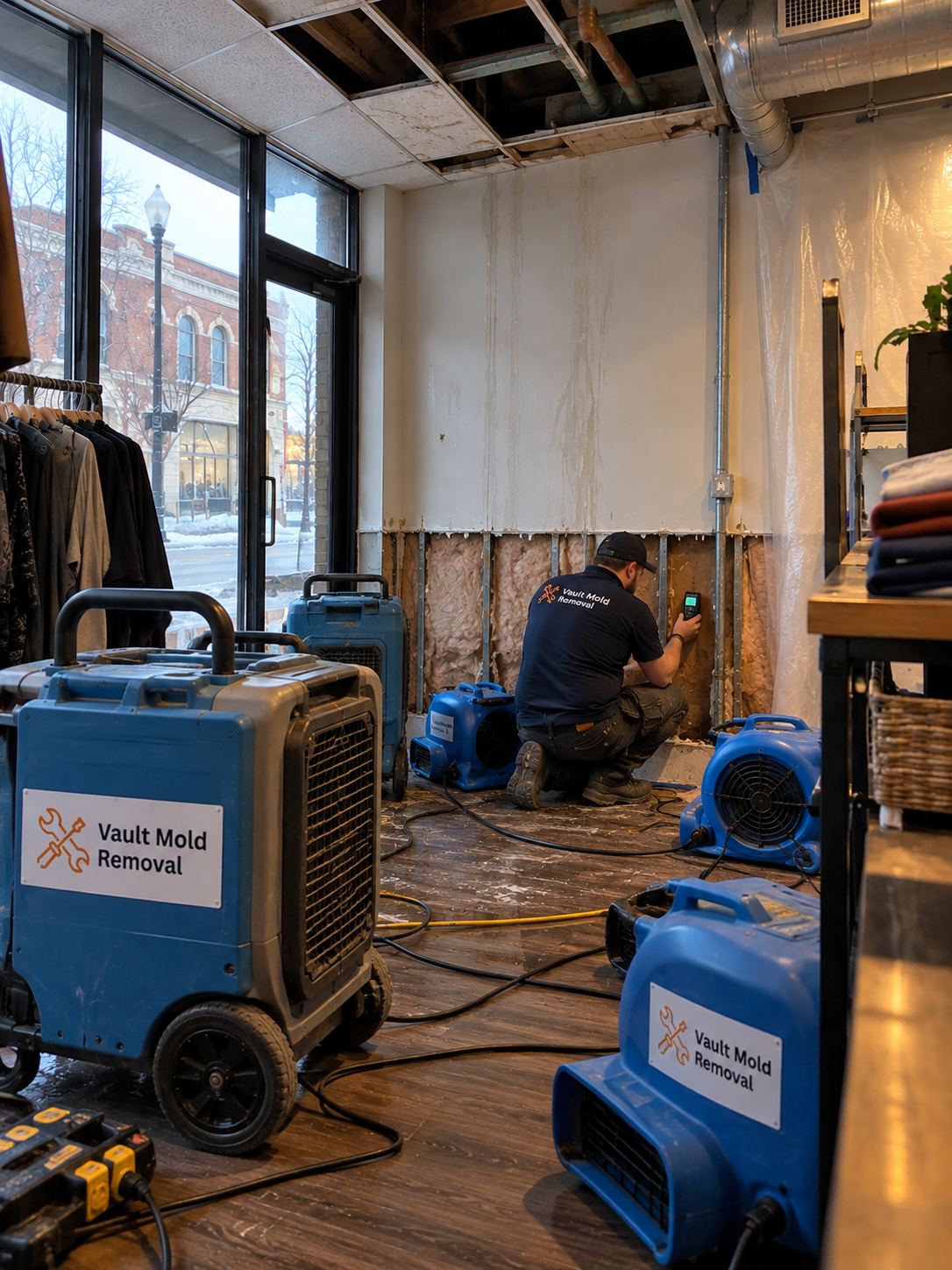
- Extraction and structural drying.
Water Damage Restoration in Downtown Provo
Downtown Provo runs along the Center Street and University Avenue corridors — a working commercial core mixed with converted upper-floor residential, some post-2000 mid-rise condos, and pockets of pre-1940 residential wedged between blocks of retail and restaurant. It’s the smallest of Provo’s neighborhoods by footprint but one of the most diverse by construction type. A water damage call here can mean a burst supply line in a 1908 brick-over-frame mixed-use building on Center Street, a mechanical room failure at a 2010 condo tower on 100 South, or a slow leak from a second-floor apartment above a first-floor restaurant on University Ave. Vault Mold Removal has worked all three profiles.
Response time from our Provo dispatch at 1169 S 760 W to a Downtown address averages 18 minutes daytime and 42 minutes overnight, logged over three years of dispatch records. Center Street runs tightest — often 15 minutes daytime. Blocks north and south of the commercial spine run 18 to 22 minutes.
Downtown Provo Construction Profiles
Pre-1940 mixed-use buildings on Center Street and adjacent blocks. Brick masonry exterior over dimensional lumber framing, often with mezzanine or upper-floor residential added or converted after the fact. Plumbing ranges from original galvanized supply (still in service in some buildings) to piecemeal upgrades layered over decades. Water damage in these buildings can travel through interstitial spaces between the original brick shell and modern interior finishes in ways that are hard to diagnose without thermal imaging and cavity access ports. We open inspection ports at strategic locations rather than large drywall sections, because interior finishes in these buildings are often historically significant and expensive to reproduce.
Post-2000 mid-rise condominium buildings. Modern envelope, PEX manifold plumbing, engineered floor systems between units, fire-rated wall assemblies with UL-listed penetrations. Water damage in these buildings has cross-unit implications — a supply-line failure in Unit 304 can affect Units 204, 203, and 205 in the same event. We coordinate with HOA management and neighboring unit owners as part of the response, and containment is often more elaborate than in single-family construction because of the shared-wall implications.
Converted upper-floor residential above ground-floor commercial. Older buildings retrofitted for apartment use. Cross-unit and cross-use implications (residential above restaurant, above retail, above office) mean water damage in one unit can affect commercial tenants below. Insurance coordination on these losses can involve multiple carriers — homeowner or renter policy for the residential unit, commercial general liability for the ground-floor tenant, and sometimes the building owner’s policy for common elements. We document accordingly to keep the claim clean for all parties.
Typical Downtown Failure Patterns
- Supply-line failures at fitting corrosion points
- Older galvanized supply in pre-1940 buildings; corrosion at threaded connections. Water can appear far from the source through interstitial space migration.
- Water heater tank ruptures in mid-rise mechanical rooms
- Common failure mode in older water heater installations. Volume can be substantial — 40 to 80 gallons — and drainage capacity of the mechanical room is often inadequate for full tank release.
- Fire sprinkler head failures or accidental discharge
- Commercial buildings with wet-pipe sprinkler systems can release substantial water volumes very quickly. Requires coordination with the fire marshal’s office and with the sprinkler service contractor for system reset.
- Rooftop HVAC condensate line failures
- Commercial rooftop HVAC systems drop condensate through interior chases. Line failures produce slow, sustained leaks that can affect multiple floors before discovery.
- Second-floor bathroom overflows in residential conversions
- Older buildings with retrofitted plumbing often have upper-floor bathrooms with limited overflow protection. Toilet overflows or tub overflows in upper units can flood ground-floor commercial in minutes.
Cross-Unit and Commercial Coordination
Downtown water damage often crosses ownership boundaries. A leak from a residential unit can affect a restaurant’s food service operation on the floor below. A supply line in one condo can damage two or three neighboring units through shared wall assemblies. We coordinate response across all affected parties, provide separate scope documentation for each affected space and each carrier, and manage containment to allow ongoing commercial operation where possible (partial containment, off-hours work scheduling, negative-air isolation to keep dust out of adjacent operations).
Insurance Documentation for Downtown Losses
Utah Code 31A-26-301.5 requires acknowledgment within 15 days and coverage determination within 30 days of proof of loss. For downtown cross-unit or cross-use losses, multiple claims often run in parallel. We provide unified documentation — photo series, moisture logs, category assignment, equipment inventory, daily reports — that each carrier’s adjuster can pull from without duplication or confusion. State Farm, USAA, Allstate, Farmers, and Bear River Mutual all have adjusters familiar with our reporting standards. Commercial carriers (The Hartford, Travelers, Zurich, CNA, Chubb, Nationwide, Liberty Mutual) receive comparable documentation for tenant business-interruption and property claims.
Frequently Asked Questions
- How fast can you actually get downtown?
- Center Street addresses typically see arrival in 15 minutes daytime. Blocks north and south of the commercial spine run 18 to 22 minutes. Overnight response adds roughly 25 minutes across all downtown addresses because dispatch has to reach the on-call tech before the truck rolls. These times are logged averages from three years of downtown Provo dispatch records.
- What if my leak is affecting the tenant below me?
- Standard in downtown work. We coordinate with the affected tenant on containment scheduling — most commercial tenants can operate around partial containment with negative-air isolation, though restaurants and food service sometimes need different arrangements. We document damage to the neighboring space, provide separate scope for that carrier’s adjuster, and manage the response as a unified restoration project even though the insurance claims run in parallel.
- Can you work in a historic building without damaging the historic finishes?
- Yes, and this is one of the specific reasons we lead with thermal imaging and cavity access ports rather than exploratory demolition. Pre-1940 downtown buildings often have original crown molding, plaster texture, brick face, and hardwood that would be expensive or impossible to reproduce with modern materials. We identify moisture with instruments first, open small inspection ports where cavity access is needed, and document historic finishes carefully so scope adjustments can be documented to your adjuster.
- What about fire sprinkler discharge — is that a water damage claim?
- Yes. Fire sprinkler discharge (whether from an actual fire, an accidental impact, or a system failure) is a Category 1 clean water loss for restoration purposes — the water in a wet-pipe system is potable at installation. The volume can be substantial (a single 5.6K-factor head at 15 psi discharges roughly 25 gallons per minute), and the water damage claim runs the standard IICRC S500 process. We coordinate with the sprinkler service contractor for system reset and with the fire marshal’s office where notification is required.
- Do you handle commercial water damage as well as residential downtown?
- Yes. Downtown Provo is roughly 50-50 commercial and residential by our claim history, and the equipment loadout and IICRC standards are the same for both. Commercial claims typically involve commercial general liability carriers rather than homeowner policies, and business interruption documentation is often part of the claim in addition to property damage. We provide documentation appropriate to whichever policy structure applies.
Contact Vault Mold Removal
Phone: (385) 250-2825
Address: 1169 S 760 W, Provo, UT 84601
Hours: Monday–Saturday, 9:00 AM – 5:00 PM
Service Area: Downtown Provo, all Provo neighborhoods, and surrounding Utah County communities.
Water damage in Provo?
Call (385) 250-2825 — answered live 24/7 by the Vault crew, not a call center. Inside Provo city limits, Monday–Saturday, 8 AM–5 PM, we guarantee arrival in 45 minutes — see the terms.
Real Vault jobs in Provo
Each of these is a real job done by Vault’s own W-2 crew. Call (385) 250-2825, answered live 24/7.
- Downtown — February 2026
- East Bay — July 2026
- Edgemont — June 2026
- Foothills — May 2026
- Franklin — December 2025
- Franklin South — March 2026
- Grandview North — September 2026
- Grandview South — August 2026
- Indian Hills — April 2026
- Joaquin — November 2025
- North Park — January 2026
- Oak Hills — July 2026
- Provost — June 2026
- Riverbottoms — May 2026
- Rivergrove — March 2026
- Rock Canyon — February 2026
- Sherwood Hills — April 2026
- Sunset — August 2026
- Timp — December 2025
- Wasatch — January 2026
- 1908 Joaquin Bungalow Galvanized Failure
- Downtown Mid-Rise Sprinkler Discharge
- Edgemont Hidden Crawlspace Pinhole
- Foothills Walkout Washer Cascade
- Franklin Sewer Backup Root Intrusion
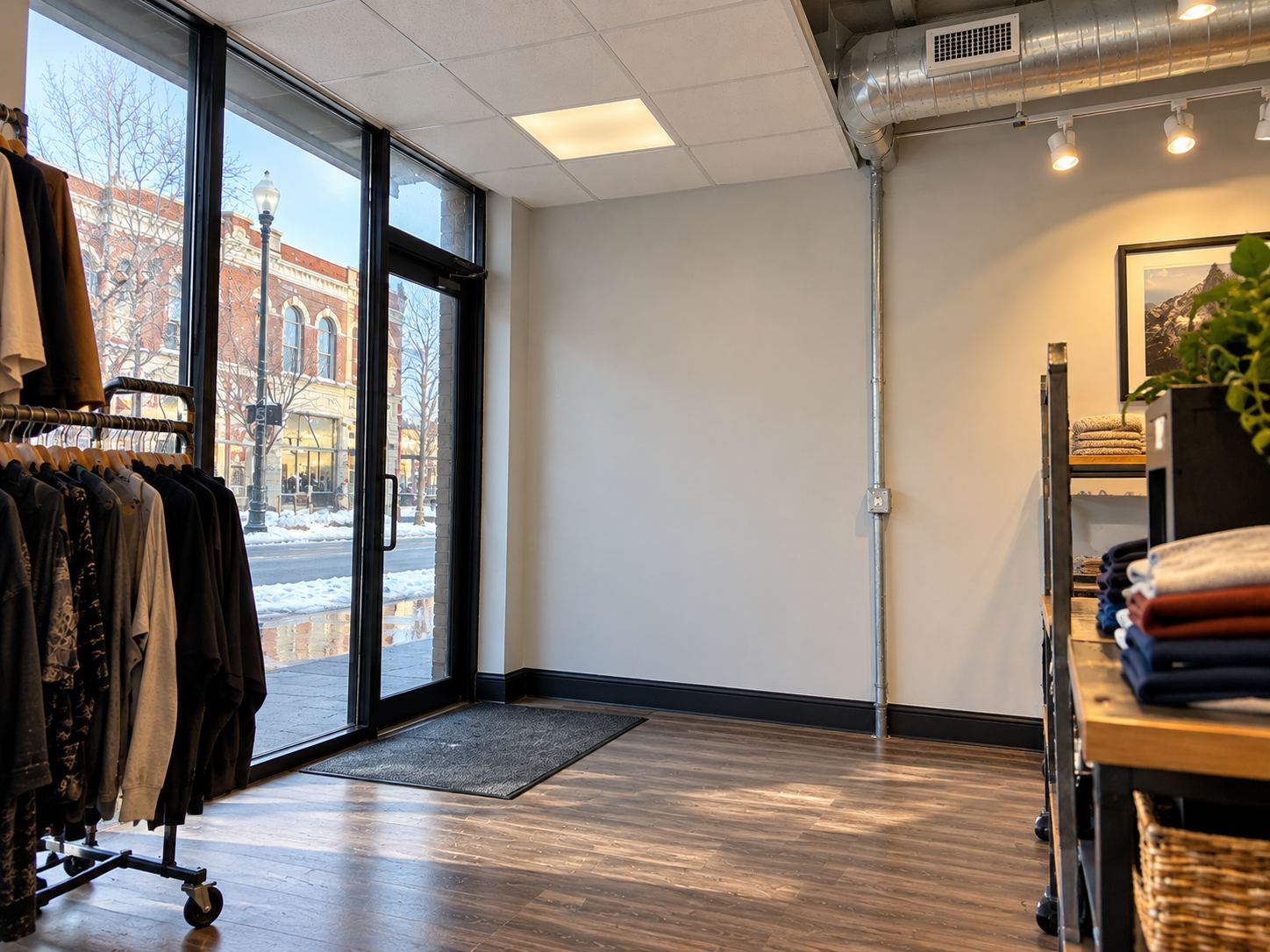
Photos from this Downtown job
Real photos taken by the Vault crew during this Downtown, Provo job in February 2026.
If a job like this is happening to you
Vault handles jobs like the one above every day across Utah County. Here’s what else is worth reading before you call:
- Why Vault — W-2 crew, 45-min Provo guarantee, in-house mold clearance, no franchise call center.
- Insurance claims — how we document the damage and bill State Farm, USAA, Allstate, Farmers, Bear River Mutual directly.
- 24-month warranty — what’s covered and how to open a claim.
- Wisetack financing — $500-$25,000 over 3-24 months, soft credit check.
- Service area — confirm your city is one of the 6 we cover.
- Water damage timeline — why every hour of head start cuts the final bill.
Call now: (385) 250-2825 — answered live 24/7 by the Vault crew.
Dealing with something similar?
This job started with a burst copper supply line above retail. If that sounds like what you’re facing, these guides cover what to do first:
Burst pipe — what to do in the first 15 minutes · Commercial restoration in Utah County
Or call (385) 250-2825 — answered live 24/7.
Helpful guides: What if water damage isn’t fixed? · Documenting damage for insurance
Need help with a job like this?
water damage restoration in Provo · emergency water damage restoration in Provo · sewage cleanup in Provo · mold remediation in Provo
Have a job like this in Provo? See emergency water damage in Provo, or call (385) 250-2825 for a free written estimate.