
Vault mold remediation at a glance
- Who does the work: Vault’s own W-2 crew, no subcontractors. Our mold lead is Ryan Bautista, Mold Remediation & Drying Specialist (IICRC WRT and AMRT). Meet the team
- Credentials: IICRC AMRT (Applied Microbial Remediation) firm certification #319482, plus WRT, ASD and OCT · Utah DOPL General Contractor #11876543-5501 · EPA RRP lead-safe firm #NAT-F187294-1 · The Hartford GL + WC · bonded · BBB Accredited. Verify our credentials
- Where we’re based: staffed office, shop and warehouse at 1169 S 760 W, Provo, UT 84601. Phone answered live 24/7 at (385) 250-2825.
Mold inspection and remediation pricing
| Service | Price | What’s included |
|---|---|---|
| Basic visual inspection | $99 | Visual inspection of one area |
| Inspection with moisture mapping | $199 | Visual inspection plus moisture meter and thermal camera |
| Inspection with air sampling | $349 | Moisture meter and thermal camera, plus air sampling analyzed by Sporecyte, an outside lab |
| Mold remediation | From $500 | Free written remediation estimate after the initial assessment |
Our 90-day mold warranty
Remediation is covered for 90 days from post-remediation clearance. If mold returns in that time, we reinspect within 7 business days and re-remediate at no charge. The warranty transfers once to a new owner with a signed transfer form. Warranty details
Paying for it
When mold is covered by your policy, we document it, write the scope in Xactimate and bill State Farm, USAA, Allstate, Farmers or Bear River Mutual directly. For deductibles, uncovered work or uninsured jobs, financing is available through Wisetack: $500–$25,000 over 3–24 months, with a soft credit check. Financing
Where we work
Provo, Orem, Springville, Vineyard, Lindon and Mapleton. See mold remediation in Provo, Orem, mold inspection and testing and black mold.
Mold Prevention — Utah County Moisture Source Control
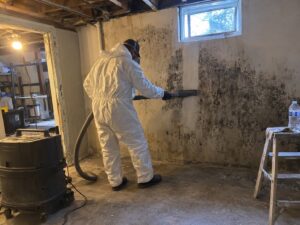
Mold prevention is fundamentally about moisture control. Every mold colony requires four elements to establish and grow: spores (present in essentially all indoor environments), a food source (organic material, which most building substrates provide), suitable temperature (roughly 40–100°F, which normal indoor temperatures fall within), and moisture. Of the four, moisture is the only element that property owners can practically control. Effective mold prevention isn’t about eliminating spores or preventing mold “from coming in” — it’s about identifying the specific moisture sources in your property and correcting them before sustained moisture creates the conditions for colonization. Vault Mold Removal provides mold prevention assessment and coordination across Utah County, whether following a completed remediation project or as preventive work for properties at elevated moisture risk.
Common Utah County Moisture Sources
Crawlspace Vapor Intrusion
Dirt-floor crawlspaces in older Provo, Springville, and Mapleton homes have chronic vapor intrusion from the exposed soil. Utah County soil holds substantial moisture year-round, and that moisture evaporates into the crawlspace air continuously. Vented crawlspaces exchange this humid air with outside air, which is often ineffective in humid summers and problematic in cold winters when it just adds cold to the moisture problem. Unvented, unconditioned crawlspaces hold the humid air indefinitely, feeding vapor migration into the framing and subfloor above.
The prevention approach is crawlspace encapsulation: 10–20 mil vapor barrier on the ground surface and up the foundation walls, sealed vents, and either dehumidification or conditioning of the crawlspace air. Encapsulation transforms a chronic moisture source into a controlled space that doesn’t feed moisture upward into the property.
Attic Assembly Moisture
Utah County winters produce ice dams on inadequately insulated or poorly ventilated roofs. Ice dams form when warm air escapes from the conditioned space into the attic, melting snow on the roof deck. Meltwater runs down the roof, refreezes at the cold eave, and forms an ice ridge that dams subsequent meltwater. The dammed water backs up under the shingles and eventually finds its way into the attic assembly, wall cavities, and ceiling below.
Prevention has three elements: air sealing at the attic floor (preventing warm air escape), adequate insulation (R-49 recommended for Utah’s Climate Zone 5B, though R-38 minimum is code), and proper attic ventilation (soffit vents plus ridge vents providing continuous airflow that keeps the roof deck cold). Bathroom exhaust fans terminating in the attic instead of at the exterior are a common Utah County problem that adds interior moisture directly to the attic assembly.
HVAC Condensate Drainage
Air conditioning systems produce condensate as a byproduct of cooling — typically 5–20 gallons per day during peak cooling operation. This condensate normally drains through a small line to a floor drain, exterior, or condensate pump. When the condensate line clogs (with mineral scale, biofilm, or debris), the drain pan overflows and produces water damage below the air handler, typically in ceiling assemblies beneath second-floor air handlers or in utility rooms with basement air handlers.
Prevention involves annual HVAC service that includes condensate line inspection and cleaning, secondary condensate pans with float switches that shut down the system when the primary drain fails, and awareness of the summer peak-demand period when condensate production is highest.
Foundation and Grade Drainage
Surface water directed toward the foundation produces basement moisture through wall cracks, floor slab defects, and around foundation penetrations. Common Utah County contributors:
- Downspouts discharging directly at the foundation rather than being routed at least 6 feet from the structure
- Negative grade (soil sloped toward the foundation) that channels surface water toward the basement
- Landscape irrigation zones close to the foundation, adding water throughout the growing season
- Missing or inadequate footer drains around the foundation perimeter
- Concrete flatwork (patios, sidewalks) that has settled toward the foundation over time
Prevention involves gutter and downspout maintenance, grade corrections that direct water away from the foundation, irrigation zone adjustments, and in more severe cases, foundation waterproofing and drainage system installation.
Plumbing Leak Prevention
Small ongoing leaks are one of the primary sources of hidden mold in Utah County properties. Preventive practices:
- Annual visual inspection of supply lines behind toilets, under sinks, and at washing machines
- Water alarm sensors under high-risk fixtures (water heater, washing machine, dishwasher, refrigerator ice maker)
- Prompt attention to any water stains, discoloration, or musty odors that suggest hidden leaks
- Whole-house water leak detection systems that shut off the main water supply when unusual flow patterns are detected
- Replacement of aging supply lines (braided stainless typically has 5–10 year lifespan under Provo water hardness; plastic lines vary by manufacturer)
Interior Humidity Control
Sustained interior humidity above 60% relative humidity creates conditions where mold can colonize even without a specific leak source. Common contributors to elevated indoor humidity:
- Bathrooms without adequate ventilation, particularly during and after showers
- Kitchen cooking without range hood ventilation
- Indoor drying of laundry
- Large numbers of houseplants in poorly ventilated spaces
- Aquariums, indoor pools, or hot tubs
- Basements without adequate ventilation or dehumidification
Prevention involves adequate bathroom and kitchen ventilation, range hood use during cooking, dehumidification in high-humidity spaces, and awareness of activities that add moisture to the indoor environment.
Property Assessment for Mold Prevention
Comprehensive mold prevention starts with property assessment identifying specific moisture sources that could support future colonization. Our preventive assessment includes:
Visual Inspection
- Exterior grade and drainage evaluation
- Gutter and downspout condition and discharge points
- Foundation crack survey
- Roof condition, particularly at flashings, penetrations, and eaves
- Attic inspection for ventilation adequacy, insulation coverage, and any moisture staining
- Crawlspace inspection for vapor barrier condition, ventilation, and standing water or moisture staining
- Interior inspection for visible water staining, musty odors, and material condition
Moisture Testing
- Ambient humidity measurement in multiple locations
- Moisture readings on framing, drywall, and finished surfaces in areas suspected of hidden moisture
- Thermal imaging survey to identify any hidden moisture patterns
- Psychrometric assessment of interior/exterior conditions
Systems Evaluation
- HVAC system condensate drainage inspection
- Bathroom exhaust fan operation and termination verification
- Kitchen range hood operation
- Dryer venting inspection
- Sump pump condition and operation (where applicable)
Written Assessment Report
The assessment produces a written report identifying moisture sources by priority, recommended corrections with estimated costs, and coordination with appropriate trade contractors (roofers, plumbers, waterproofing specialists, HVAC technicians) for corrections we don’t perform ourselves. The report is delivered typically within 3–5 business days of the on-site assessment.
Post-Remediation Prevention
Property owners who have completed mold remediation are in a specific position for prevention: they know they’ve had a moisture problem, they know the specific location and species involved, and they have the documentation from the remediation project. Post-remediation prevention focuses on:
- Verification that the underlying moisture source correction has been effective (typically 6–12 month follow-up assessment)
- Detection systems in areas at continued risk (water alarms, humidity sensors)
- Annual reassessment for properties with chronic moisture history
- Preventive coordination with trade contractors (annual HVAC service, gutter cleaning, roof inspection) that address the specific risks identified during remediation
Frequently Asked Questions
- How much does mold prevention assessment cost?
- The written assessment report costs $200–$400 for standard residential properties depending on size and complexity. Larger properties, commercial buildings, or assessments requiring specialty testing (air sampling, invasive investigation) have proportionally higher costs. The assessment is separate from any remediation or correction work — it’s an evaluation that identifies what needs to be done, not the doing of the work itself. Most property owners who commission preventive assessment do so because they’ve had prior water events, are experiencing musty odors without obvious source, are considering property purchase and want moisture status verification, or want proactive assessment as part of home maintenance planning. Return on assessment cost is significant — identifying and correcting a $500 moisture source before it causes $15,000 in mold remediation is a good tradeoff.
- Can I do mold prevention myself, or do I need professionals?
- Many prevention actions are property owner tasks that don’t require professionals: keeping gutters clean, maintaining grade slope away from the foundation, adjusting downspout discharge, running bathroom exhaust fans during and after showers, addressing visible water stains promptly, and monitoring humidity levels with a $20 hygrometer. What benefits from professional assessment: identifying moisture sources that aren’t visually obvious (hidden leaks, crawlspace vapor intrusion, attic ventilation adequacy), evaluating whether existing systems are performing adequately (HVAC condensate drainage, foundation drainage, exhaust ventilation), and coordinating specialty corrections that require trade expertise (waterproofing, HVAC modifications, structural moisture solutions). For properties with prior mold history or elevated risk indicators, professional assessment is worth the cost.
- Do dehumidifiers prevent mold?
- They can help maintain interior humidity below the 60% threshold where mold colonization becomes possible, but they don’t address underlying moisture sources. A dehumidifier running continuously in a basement with foundation seepage will control the room humidity but won’t stop the water intrusion — it just removes the water after it’s already entered the property. This produces high electricity bills, condensate management issues, and doesn’t actually solve the underlying problem. Dehumidification is appropriate when there’s no correctable moisture source (e.g., a basement in a naturally humid environment where source correction isn’t feasible), when it’s a temporary measure during pending correction, or when it supplements a corrected source to control residual humidity variations. As a stand-alone mold prevention strategy without addressing sources, dehumidification is expensive and ultimately unreliable.
- What humidity level should I maintain to prevent mold?
- Below 60% relative humidity is the standard recommendation, though 40–50% is the target range for optimal mold prevention (and human comfort). Utah County’s Climate Zone 5B naturally produces relatively dry indoor conditions in winter (heating dries the air, sometimes to below 20% RH which is uncomfortably dry for human occupants), and elevated humidity in summer (particularly during monsoon season when outdoor humidity climbs). Winter humidification with humidifiers can help occupant comfort but shouldn’t push above 40% in cold weather — higher humidity in winter creates condensation on cold surfaces (windows, exterior walls) that can support mold growth even without any liquid water event. Summer dehumidification is more common in Utah County, particularly in basements where naturally elevated humidity meets cool surfaces.
- How often should I have my property assessed for mold prevention?
- Depends on your property’s risk profile. Properties with no mold history and no elevated risk indicators may not need proactive assessment — annual homeowner-level attention to gutters, grading, plumbing, and ventilation may be sufficient. Properties with prior mold remediation should have 6–12 month follow-up assessment to verify moisture source correction remains effective, then annual assessment for the first 2–3 years post-remediation. Properties with elevated risk indicators (older construction, chronic wet basements, previous water events, health-sensitive occupants, or specific concerns) benefit from annual professional assessment. Commercial properties, particularly medical facilities and hospitality properties, typically have quarterly or semi-annual assessment as part of standard facility management practice.
Contact Vault Mold Removal — Provo, UT
For mold prevention assessment, post-remediation follow-up, or questions about specific moisture source concerns in your Utah County property, contact our office directly.
- Phone: (385) 250-2825
- Address: 1169 S 760 W, Provo, UT 84601
- Utah DOPL General Contractor License: #11876543-5501
- IICRC WRT / ASD / AMRT / OCT: #248317 / #248317-ASD / #319482 / #319482-OCT
Office Hours
- Monday – Saturday: 9:00 AM – 5:00 PM
- Sunday: Closed
Written warranty
24-month workmanship warranty on drying, structural repairs, drywall, flooring, cabinetry and paint done by Vault. 90-day mold warranty from post-remediation clearance for recurrence from the same moisture source. Both are transferable once to a new homeowner, in writing on the work order.
We bill your carrier directly
Direct-billing with State Farm, USAA, Allstate, Farmers and Bear River Mutual. Every scope is written in Xactimate; you pay only your deductible plus anything the policy doesn’t cover. Not on this list? We still handle the claim.
Helpful guides: Bathroom fans and mold · Mold or efflorescence?
In Provo? See mold remediation in Provo for local inspection pricing ($99, $199 or $349) and how our crew handles a job from containment to clearance.