
Water extraction
Standing water comes out before drying. Vault uses truck-mounted and portable extraction equipment, sized to the loss.
- Call any hour: (385) 250-2825 is answered live 24/7 by the Vault crew. 45-minute arrival inside Provo city limits (Monday–Saturday, 8 AM–5 PM); typically under 60 minutes elsewhere in our Utah County service area.
- In-house: truck-mounted and portable water extraction, carpet lifting where it can be saved, and moisture mapping to find hidden water the extraction missed.
- Who does the work: Vault’s own W-2 crew, IICRC certified in WRT, ASD, AMRT and OCT, under Utah DOPL General Contractor License #11876543-5501. No subcontractors. Meet the team
- Insurance: Xactimate scopes, daily moisture readings on file, direct billing to State Farm, USAA, Allstate, Farmers and Bear River Mutual.
- Pricing: free written estimates. Water mitigation typically $3,500–$8,500; reconstruction $4,500–$9,500. 24-month workmanship warranty · Wisetack financing
- Family-owned and veteran-operated, based in Provo since 2020.
Water damage restoration · Mold remediation · Sewage cleanup · Reconstruction & repairs
Water Extraction — Utah County Emergency Response
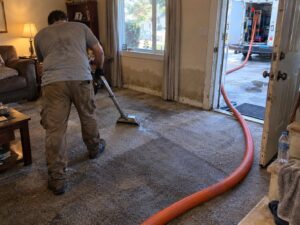
Water extraction is the first physical intervention in a water damage response. Before drying can begin, standing water and bulk water absorbed into carpet, pad, and porous materials must be physically removed. The volume, method, and speed of extraction directly determine the total scope of restoration downstream: aggressive extraction within the first few hours of a water event can prevent hundreds of square feet of drywall replacement, hardwood cupping, and subfloor saturation that inadequate extraction leaves behind. Vault Mold Removal deploys three extraction methodologies — truck-mounted vacuum extraction, weighted portable extraction, and submersible pump extraction — sized to the specific loss. Every extraction phase is documented with volumes removed, time-on-site, and post-extraction moisture readings.
Three Extraction Methods
Truck-Mounted Vacuum Extraction
Our primary method for medium and large residential losses. Truck-mounted systems use vacuum blowers powered by the truck’s engine, delivering suction through 2- and 4-inch hose runs from the truck to the affected area. Suction is dramatically stronger than any portable unit — up to 200 gallons per minute at peak capacity — which means extraction of large standing water volumes is a matter of minutes rather than hours. Truck-mounts also extract absorbed water from carpet and pad more effectively than portable units, which reduces downstream drying time.
Truck-mounted deployment considerations:
- Access requirements. The truck needs a parking position within roughly 200 feet of the affected area, with clear hose paths. Most Utah County residential losses accommodate this; larger commercial and industrial losses sometimes require multiple truck positions or hose extensions.
- Weather. Truck-mounts operate in most Utah County weather. Sub-zero winter conditions can freeze hose runs, requiring insulated hose or interior staging.
- Waste water volume. Truck tanks hold 100–200 gallons of extracted water; larger losses require offload cycles to a legal discharge point (municipal sanitary sewer, not storm drain).
Weighted Portable Extraction
Portable extractors (Rotovac 360 XL, Hydramaster, Sapphire Scientific) are wheeled units with vacuum motors and recovery tanks that can be positioned directly on affected carpet. The unit’s weight (typically 200–400 pounds when fully staged) creates compression on the carpet that helps release absorbed water into the extraction path. Weighted extraction is often the more effective choice for saturated carpet on pad, where truck-mount suction alone would leave significant residual water in the pad.
Portable deployment considerations:
- Access. Portable units fit through standard 32-inch doorways and can navigate residential interiors. Multi-floor situations require stair navigation, which is manageable but slower.
- Capacity. Portable recovery tanks are smaller than truck-mounts (typically 15–25 gallons), requiring more frequent emptying for large losses.
- Complement to truck-mount. Often deployed alongside truck-mount — truck handles bulk water, weighted portable handles carpet and pad.
Submersible Pump Extraction
For losses with standing water depths beyond what vacuum extraction can handle efficiently (typically anything over 1 inch of standing water), submersible pumps handle bulk water removal before vacuum extraction begins. Submersibles pump water out at 30–60 gallons per minute for standard units, directly to a discharge point (garden hose to sump pump discharge line, sanitary sewer cleanout, or driveway if the source is clean water only).
Submersible deployment considerations:
- Category matters. Category 1 (clean) water can be discharged to a driveway or landscape area with less restriction. Category 2 (gray) water requires discharge to sanitary sewer. Category 3 (black) water requires containment and regulated waste disposal.
- Basement losses. Submersibles are essential for basement floods where standing water depth may reach several inches or more.
- Electrical safety. Basement standing water often means potentially compromised electrical service in the affected area; power must be safely secured before submersibles are placed in the water.
The Extraction Decision Tree
What extraction method is deployed depends on the specific loss characteristics:
- Standing water depth over 1 inch. Submersible pump first for bulk water, then vacuum extraction for residual and absorbed water.
- Standing water below 1 inch but saturated carpet and pad. Truck-mount for bulk water plus weighted portable for pad extraction.
- No standing water but wet carpet and pad. Truck-mount or weighted portable depending on affected area size and access.
- Wet drywall and wall assemblies without carpet saturation. Vacuum extraction of any residual surface water, then transition directly to structural drying without further extraction.
- Category 3 water regardless of depth. Full PPE deployment, containment established, extraction directly to regulated disposal, with all extraction equipment decontaminated after use.
Response Times Across Utah County
Extraction is time-critical. The longer standing water sits, the more materials become saturated, the wider the affected area migrates, and the higher the eventual restoration cost. Our average response times from the 1169 S 760 W Provo office to primary Utah County cities:
- Provo: 34 minutes business hours, 62 minutes after hours
- Orem: 41 minutes business hours, 68 minutes after hours
- Springville: 48 minutes business hours, 74 minutes after hours
- Vineyard: 45 minutes business hours, 71 minutes after hours
- Lindon: 44 minutes business hours, 69 minutes after hours
- Mapleton: 52 minutes business hours, 82 minutes after hours
These are averages, not guarantees. High-demand events (freeze weeks, storm response) extend response times, and we’re transparent about it when it happens.
Post-Extraction Assessment
Extraction isn’t complete when the visible water is gone. IICRC S500 requires post-extraction moisture assessment to determine what remains: is the carpet pad still saturated (requiring additional weighted extraction or pad removal)? Are wall assemblies wet requiring cavity treatment (drilled vent holes, wall cavity ventilation, or drywall removal)? Are subfloors below the level of surface extraction still wet?
Post-extraction moisture readings are documented at the same grid points established during initial assessment. Extraction is considered complete when residual moisture is at a level that structural drying equipment can address within reasonable timelines. If material moisture remains above equipment’s practical drying capacity, additional targeted extraction or removal is documented in a change order before proceeding.
What Extraction Doesn’t Do
Extraction removes bulk water. It doesn’t dry materials to standard. The gap between “extraction complete” and “dry standard achieved” is the drying phase — typically 3–10 days depending on class and materials, using structural drying equipment. Some homeowners mistakenly believe that once the visible water is extracted, the job is done and the drying equipment isn’t necessary. That belief is what causes downstream mold problems in the 48–96 hours after extraction, when residual moisture in materials feeds microbial growth.
Extraction also doesn’t address contamination. Category 2 and 3 water sources introduce contamination that persists in materials even after physical water removal. Disinfection and antimicrobial application are separate steps in the restoration process, following extraction and preceding drying for contaminated losses.
Common Utah County Extraction Scenarios
Basement Flooding During Spring Runoff
Utah County snowpack runoff during March through May regularly overwhelms residential sump pumps, particularly during power outages. Basement floods produce standing water that requires submersible pump extraction, often through inches of water across finished or unfinished basement spaces. Extraction typically runs 2–6 hours depending on volume and area.
Water Heater Bottom Seam Rupture
50-gallon water heaters hold roughly 400 pounds of water, and rupture during vacation absences means all of that plus continued incoming supply until the shutoff is closed. Extraction of these losses often involves 500–2,000 gallons of extracted water across floor levels, requiring submersible plus truck-mount coordination.
Second-Story Bathroom Overflow
Toilet overflows or supply line failures on second floors migrate to first-floor ceiling assemblies. Extraction happens on both floors: the second-floor bathroom itself, and the first-floor ceiling and floor below where water accumulated during the migration path.
Kitchen Dishwasher and Sink Supply Failures
Kitchen losses typically involve Category 2 water (detergent-contaminated dishwasher water, or Category 1 clean water from sink supply lines that reclassifies to Category 2 after prolonged exposure). Cabinet toe-kicks and subfloor beneath cabinets require targeted extraction, often needing partial cabinet removal to reach affected areas.
Storm-Driven External Water Intrusion
Utah County monsoon storms during July and August drive water through building envelope failures — window seal leaks, door threshold failures, roof-to-wall flashing issues. Category 1 initially, though external water can carry contaminants that reclassify it to Category 2 depending on the specific source path.
Frequently Asked Questions
- How quickly can water extraction begin after I call?
- Business-hours calls receive average dispatch response between 34 minutes in Provo and 52 minutes in Mapleton, with extraction beginning immediately on arrival. After-hours calls receive average dispatch response between 62 and 82 minutes across the same range. Extraction of standing water typically begins within 5–10 minutes of arrival while the technician also completes initial assessment. During high-demand events (freeze weeks, storm response) response times extend, and we’re transparent with the customer at the time of the call. For time-critical situations where our response time isn’t fast enough, we can activate partner IICRC-certified contractors through the Wasatch Front mutual-aid network for faster dispatch.
- What’s the difference between truck-mounted and portable extraction?
- Suction power and access. Truck-mounted extraction uses the truck’s engine to power a vacuum blower that produces up to 200 gallons per minute of suction — dramatically more powerful than any portable unit. Portable extractors are wheeled units with self-contained vacuum motors, delivering 20–40 gallons per minute of suction. Truck-mounted is more effective for bulk water removal and pad extraction; portables are more useful for tight spaces where truck-mount hose access is difficult and for weighted extraction that presses water out of saturated carpet. Most residential jobs use both: truck-mount for the bulk of extraction and portable for targeted work in bathrooms, closets, and stair spaces.
- Does extraction alone dry my home?
- No. Extraction removes bulk water — standing water on floors and absorbed water in carpet and pad. It does not dry materials to industry dry standard. After extraction, materials still contain moisture at levels that will support microbial growth if not further dried. Structural drying equipment (LGR dehumidifiers, air movers, sometimes desiccant units) runs for typically 3–10 days after extraction is complete to bring materials back to documented dry standard. Homeowners who assume the job is done after extraction and remove drying equipment prematurely are the primary source of downstream mold problems we see 6–18 months after prior water events.
- Where does the extracted water go?
- Depends on the water category. Category 1 (clean) water can be discharged to sanitary sewer, driveway, or landscape area with less restriction. Category 2 (gray) water is discharged to sanitary sewer under most local municipal codes. Category 3 (black) water requires containment during extraction and regulated waste disposal, typically via licensed waste hauler to appropriate treatment facility. Utah County requirements match state and federal standards for Category 3 disposal, and we document disposal for every job involving contaminated water. Discharge to storm drains is never appropriate for any category and is prohibited under Provo and other Utah County municipal codes regardless of water category.
- Can I extract water myself with a wet-dry vacuum?
- For very small losses on hard surface flooring, yes. Standing water on tile or sealed hardwood from a limited-volume Category 1 source (dropped water container, small ice maker line drip) can be extracted with a wet-dry shop vacuum in a way that prevents further migration. For anything beyond that — carpet saturation, drywall wetting, subfloor migration, any Category 2 or 3 water — consumer-grade wet-dry vacuums lack the suction, capacity, and pad-extraction capability to prevent downstream damage. If you’ve already used a wet-dry vacuum for initial cleanup and want a professional assessment to verify complete moisture removal, that’s a common non-emergency call that we’re happy to schedule.
Contact Vault Mold Removal — Provo, UT
For active water damage requiring emergency extraction, non-emergency assessment of prior extraction work, or questions about specific extraction challenges, contact our office directly. Business-hours calls answered live; after-hours calls route to on-call rotation.
- Phone: (385) 250-2825
- Address: 1169 S 760 W, Provo, UT 84601
- Utah DOPL General Contractor License: #11876543-5501
- IICRC WRT / ASD / AMRT / OCT: #248317 / #248317-ASD / #319482 / #319482-OCT
Office Hours
- Monday – Saturday: 9:00 AM – 5:00 PM
- Sunday: Closed
Written warranty
24-month workmanship warranty on drying, structural repairs, drywall, flooring, cabinetry and paint done by Vault. 90-day mold warranty from post-remediation clearance for recurrence from the same moisture source. Both are transferable once to a new homeowner, in writing on the work order.
We bill your carrier directly
Direct-billing with State Farm, USAA, Allstate, Farmers and Bear River Mutual. Every scope is written in Xactimate; you pay only your deductible plus anything the policy doesn’t cover. Not on this list? We still handle the claim.
Helpful guides: Finished basement water damage · Why so many fans? · Laminate and vinyl floor water damage