
Basement flooding cleanup
Standing water in a basement needs to come out fast. Vault extracts the water, removes carpet pad and lower drywall that can’t be dried, and dries the structure with air movers and dehumidifiers.
- Call any hour: (385) 250-2825 is answered live 24/7 by the Vault crew. 45-minute arrival inside Provo city limits (Monday–Saturday, 8 AM–5 PM); typically under 60 minutes elsewhere in our Utah County service area.
- In-house: truck-mounted and portable extraction, carpet pad removal, flood cuts in drywall, structural drying with LGR dehumidifiers, and reconstruction.
- Who does the work: Vault’s own W-2 crew, IICRC certified in WRT, ASD, AMRT and OCT, under Utah DOPL General Contractor License #11876543-5501. No subcontractors. Meet the team
- Insurance: Xactimate scopes, daily moisture readings on file, direct billing to State Farm, USAA, Allstate, Farmers and Bear River Mutual.
- Pricing: free written estimates. Water mitigation typically $3,500–$8,500; reconstruction $4,500–$9,500. 24-month workmanship warranty · Wisetack financing
- Family-owned and veteran-operated, based in Provo since 2020.
Water damage restoration · Mold remediation · Sewage cleanup · Reconstruction & repairs
Basement Flooding Restoration — Utah County
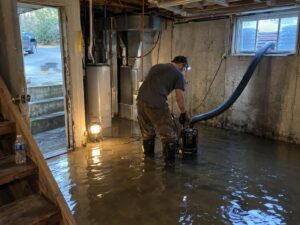
Basement flooding is a distinct category of water damage with distinct causes and response requirements. Basements are below-grade spaces where water accumulates gravitationally — every water source in the property, from a second-floor bathroom overflow to a supply line burst on the main floor, eventually finds its way to the basement if not intercepted. Basements also have their own primary water sources: sump pump failures during spring snowmelt runoff, foundation crack seepage under hydrostatic pressure, floor drain backups from municipal sewer issues, and hot water heater failures that are usually located in basement utility spaces. Vault Mold Removal responds to basement floods across Utah County with equipment sized to the specific loss: submersible pumps for standing water, truck-mounted extraction for bulk water and saturated materials, and LGR or desiccant dehumidification for the extended drying phase that basement losses typically require.
Why Basement Floods Are Different
Three structural characteristics make basement floods different from above-grade water damage:
Gravitational Water Accumulation
Water from any source in the property flows toward the basement. A supply line burst on the second floor doesn’t just affect the second-floor bathroom — it migrates through wall assemblies and floor penetrations into the basement below. This means basement floods often involve multi-floor water paths that require assessment beyond the basement itself.
Below-Grade Ambient Conditions
Basements are colder than main-floor spaces year-round. During the heating season, basement temperatures often run in the low 60s or even 50s despite the main floor being at 70°F. This ambient temperature is often below the effective operating range of standard LGR dehumidifiers (which prefer 60–90°F), which means basement drying frequently requires desiccant dehumidification or supplemental heat to achieve dry standard within reasonable timelines.
Concrete Slab and Foundation Wall Materials
Basement floor slabs and foundation walls are low-permeance materials that hold moisture differently than the drywall-and-wood-frame construction above. Concrete has significant thermal mass and holds moisture at depth for extended periods. Slab moisture verification requires pin measurement at multiple depths, comparison to matched dry reference samples, and often extended drying timelines. Foundation walls (poured concrete or CMU block) can wick moisture from surrounding soil, adding an ongoing water source during and after the acute event.
Primary Basement Flood Sources in Utah County
Sump Pump Failure During Spring Runoff
Utah County snowpack drives significant spring runoff between March and May. Wasatch snowpack of 130% or more of normal (a common measurement in above-average precipitation years) produces sustained groundwater elevation that keeps sump pumps running continuously. During this period, sump pump failures — from stuck float switches, worn impellers, tripped GFCI outlets, or power outages — produce rapid basement flooding. Failed sump pump events often produce 2–8 inches of standing water within hours.
Sump pump failures are largely preventable: annual inspection, backup battery systems, secondary sump pumps, and water alarm sensors provide layered protection. For customers who’ve experienced sump pump failure once, we recommend and can coordinate with local plumbers to install redundant systems that prevent recurrence.
Freeze-Thaw Pipe Bursts in Basement Utility Areas
Basement utility areas contain concentrated plumbing: water heaters, water softeners, hose bibs, laundry connections, and supply lines running to main-floor fixtures. During winter freeze events, these lines are exposed to cold ambient temperatures and are common failure points. During the January 2023 Utah County freeze event, 41% of the 87 emergency calls were basement pipe bursts.
Water Heater Failures
Most Utah County water heaters are located in basement utility spaces, which means water heater failures produce basement floods directly. 50-gallon tank ruptures release approximately 400 pounds of water plus continued supply until the shutoff is closed. Water heater failures during vacation absences can produce whole-basement flooding by the time the property is inspected.
Foundation Crack Seepage
Basement wall and floor slab cracks allow groundwater seepage under hydrostatic pressure, particularly during spring runoff periods and after heavy precipitation events. Seepage may present as slow moisture accumulation along foundation walls, damp floor slab patches, or persistent musty odors even without visible standing water. Chronic seepage often requires foundation waterproofing correction beyond just restoration.
Floor Drain Backups
Basement floor drains connect to the property’s main drain line. When main line failures occur — often from root intrusion in cast iron laterals common in older Provo neighborhoods (Franklin, Joaquin, Downtown, Provost) — sewage backs up through the floor drain into the basement. Floor drain backups are Category 3 losses requiring full PPE, containment, and regulated waste disposal.
Overhead Migration from Main-Floor Losses
Bathrooms, kitchens, and laundry rooms on the main floor above the basement can drop water through ceiling assemblies into basement spaces below. Ceiling assembly damage may or may not be visible; hidden migration through wall cavities is common. Grid moisture mapping determines the actual extent of water migration into the basement below.
Response Sequence for Basement Floods
Initial Response (First Hour)
- Electrical safety. Basement standing water requires immediate electrical assessment. If water has reached outlets, the water heater, the furnace, or the electrical panel, main breaker shutoff is the first action.
- Water source identification and shutoff. Determine whether the source is ongoing (active supply line failure, sewage backup, foundation seepage) and secure it if possible.
- Category and class determination. Basement floods with clean water source (supply line, water heater) are Category 1 initially. Sewage backup, floor drain backup, or aged Category 1 water are Category 3. Groundwater from foundation seepage is Category 2 (contains soil bacteria).
- Submersible pump deployment. For standing water over 1 inch depth, submersible pumps begin bulk water removal within 5–10 minutes of arrival, discharging to an appropriate discharge point.
- Content assessment. Basement finished spaces often contain items with significant emotional or monetary value (family photos, stored belongings, home office setups, home theater equipment). Rapid triage on what can be saved and what requires removal is part of the first hour.
Extraction and Removal (Hours 2–6)
- Truck-mounted vacuum extraction of remaining water and saturated carpet
- Carpet pad removal (pads that have been saturated cannot effectively be dried in place)
- Base course drywall removal in Category 2 and 3 losses (2–4 feet up from the floor, depending on water level)
- Wet insulation removal in exterior wall cavities where wall assemblies were affected
- Furniture and content removal — either to on-site staging for cleaning or to off-site pack-out for restoration or storage
- Antimicrobial application for Category 2 and 3 losses per IICRC S500
Structural Drying (Days 2–10)
- Air mover deployment sized to cubic footage and material types
- Dehumidification — LGR for typical summer conditions, desiccant for winter conditions or Class 4 loss with concrete slab drying
- Supplemental heat during winter drying to bring basement ambient temperature into equipment operating range
- Daily grid moisture readings tracking drying trajectory
- Slab moisture verification with pin meter comparison to matched dry reference sample
- Foundation wall moisture verification through pin measurement of the wall face and framing furring where present
Verification and Reconstruction (Days 10+)
- Dry standard verification: 24-hour stable readings across all grid points
- Equipment removal and final documentation
- Reconstruction: drywall replacement, baseboard installation, carpet and pad replacement, paint touch-up
- Foundation waterproofing coordination if seepage was a contributing cause
Content Handling in Basement Floods
Basement content losses are often the most emotionally difficult part of a flood event. Basements typically hold items that have been stored precisely because they’re not needed for daily use but have long-term value: family photos and documents, seasonal items, stored furniture from previous residences, sports and hobby equipment, tools, and archived business records.
Our content approach follows IICRC S500 and industry-standard triage:
- Documents and photos. Wet paper documents can be air-dried or freeze-dried at professional recovery facilities. Rapid response within 24–48 hours dramatically improves recovery outcomes. We coordinate with regional document recovery specialists.
- Textiles and upholstery. Category 1 water exposure typically allows cleaning and drying with recovery. Category 2 and 3 exposure often requires disposal, though some high-value textiles can be professionally restored.
- Electronics. Water-exposed electronics require professional evaluation. Some electronics can be recovered with rapid drying and professional cleaning; others are total losses. Digital storage devices with irreplaceable data receive priority handling.
- Wood furniture. Solid wood can typically be dried and refinished. Particleboard and MDF (common in stored office furniture and shelving) usually cannot be effectively restored after saturation.
- Family photos and archival items. High-priority salvage. If freeze-drying is required, we coordinate with regional facilities that can accept material within 24 hours of the loss.
Frequently Asked Questions
- Does homeowner insurance cover basement flooding?
- Depends on the water source. Sudden and accidental water damage from a covered peril — burst pipe, water heater failure, appliance supply line failure — is typically covered under standard homeowner policies from State Farm, USAA, Allstate, Farmers, Bear River Mutual, and other Utah-market carriers. Sump pump failures may be covered under a specific sump pump endorsement, though many standard policies exclude sump pump losses unless specifically added. Sewage backup from floor drains typically requires a specific sewer backup endorsement. Groundwater seepage from foundation cracks is often excluded as a maintenance issue rather than a covered peril. External flooding requires separate flood insurance under the National Flood Insurance Program (NFIP). Every basement flood claim depends on the specific policy terms and the specific water source.
- How long does basement flood restoration typically take?
- Extraction and initial mitigation typically takes 4–8 hours on the first day. Structural drying typically runs 5–10 days, longer than main-floor drying because basements have below-grade ambient conditions that slow drying and often involve concrete slab drying that has inherent time requirements. Reconstruction — drywall replacement, carpet and pad replacement, paint, baseboards — adds another 1–3 weeks depending on scope. Total timeline from loss to full restoration typically runs 3–5 weeks for standard finished-basement Category 1 or 2 losses. Category 3 losses and Class 4 losses (involving hardwood, plaster, or dense concrete) can extend to 6–8 weeks or longer.
- Should I replace my sump pump after a failure?
- Typically yes, plus consideration of layered protection. A sump pump that failed once has likely reached the end of its useful life — most residential sump pumps last 7–10 years, and failure is often preceded by declining pumping capacity that gradually reduces the pump’s ability to keep up with peak flow events. Replacement plus layered protection (backup battery system, secondary sump pump, water alarm sensors, and annual professional inspection) is the standard recommendation. Vault Mold Removal doesn’t sell or install sump pumps, but we coordinate with several local licensed plumbers who provide these services, and we’re happy to make an introduction after the restoration is complete.
- Can I finish my basement again after a flood, or should I keep it unfinished?
- Depends on your specific situation. Basements that flooded due to a one-time acute event (water heater failure, upstairs bathroom overflow, specific supply line burst) can typically be refinished with confidence after the underlying cause is resolved. Basements that flooded due to chronic issues (recurring sump pump strain, foundation crack seepage, floor drain backup pattern) require the underlying cause to be permanently resolved before refinishing makes sense. Some property owners in flood-prone situations elect to keep basement finishing minimal — painted concrete floors instead of carpet, moisture-resistant wall materials, elevated storage — to reduce exposure in future events. This is a personal decision that depends on your specific property and risk tolerance.
- What’s the difference between a flooded basement and basement seepage?
- Acute versus chronic. A flooded basement is a specific water event with a defined start point: burst pipe, sump pump failure, water heater rupture, or floor drain backup. Basement seepage is chronic moisture intrusion, usually from groundwater through foundation cracks or floor slab defects, occurring gradually over weeks or months. The restoration approach is different: acute flood response focuses on extraction, drying, and reconstruction; chronic seepage response focuses on identifying and correcting the underlying moisture source (foundation waterproofing, exterior drainage improvement, sump pump adequacy) before restoration makes sense. Chronic seepage that has produced hidden mold requires IICRC S520 remediation in addition to the moisture source correction.
Contact Vault Mold Removal — Provo, UT
For active basement flooding, non-emergency basement moisture concerns, or evaluation of prior basement flood restoration work, contact our office directly. Business-hours calls answered live; after-hours calls route to on-call rotation.
- Phone: (385) 250-2825
- Address: 1169 S 760 W, Provo, UT 84601
- Utah DOPL General Contractor License: #11876543-5501
- IICRC WRT / ASD / AMRT / OCT: #248317 / #248317-ASD / #319482 / #319482-OCT
Office Hours
- Monday – Saturday: 9:00 AM – 5:00 PM
- Sunday: Closed
Written warranty
24-month workmanship warranty on drying, structural repairs, drywall, flooring, cabinetry and paint done by Vault. 90-day mold warranty from post-remediation clearance for recurrence from the same moisture source. Both are transferable once to a new homeowner, in writing on the work order.
We bill your carrier directly
Direct-billing with State Farm, USAA, Allstate, Farmers and Bear River Mutual. Every scope is written in Xactimate; you pay only your deductible plus anything the policy doesn’t cover. Not on this list? We still handle the claim.
Helpful guides: Finished basement water damage · Foundation cracks and leaks · Sprinkler leaks and basements