
Water-damaged flooring removal & replacement
Carpet pad, laminate and tile that can’t be dried are removed. Hardwood is dried first and often saved. Replacement flooring is installed by the same crew.
- Call any hour: (385) 250-2825 is answered live 24/7 by the Vault crew. 45-minute arrival inside Provo city limits (Monday–Saturday, 8 AM–5 PM); typically under 60 minutes elsewhere in our Utah County service area.
- In-house: carpet and pad removal, laminate and tile tear-out, hardwood drying and refinishing where it saves the floor, and replacement installation.
- Who does the work: Vault’s own W-2 crew, IICRC certified in WRT, ASD, AMRT and OCT, under Utah DOPL General Contractor License #11876543-5501. No subcontractors. Meet the team
- Insurance: Xactimate scopes, direct billing to State Farm, USAA, Allstate, Farmers and Bear River Mutual.
- Warranty: 24-month workmanship warranty on the rebuild. Warranty details · Financing
- Family-owned and veteran-operated, based in Provo since 2020.
Water damage restoration · Mold remediation · Sewage cleanup · Reconstruction & repairs
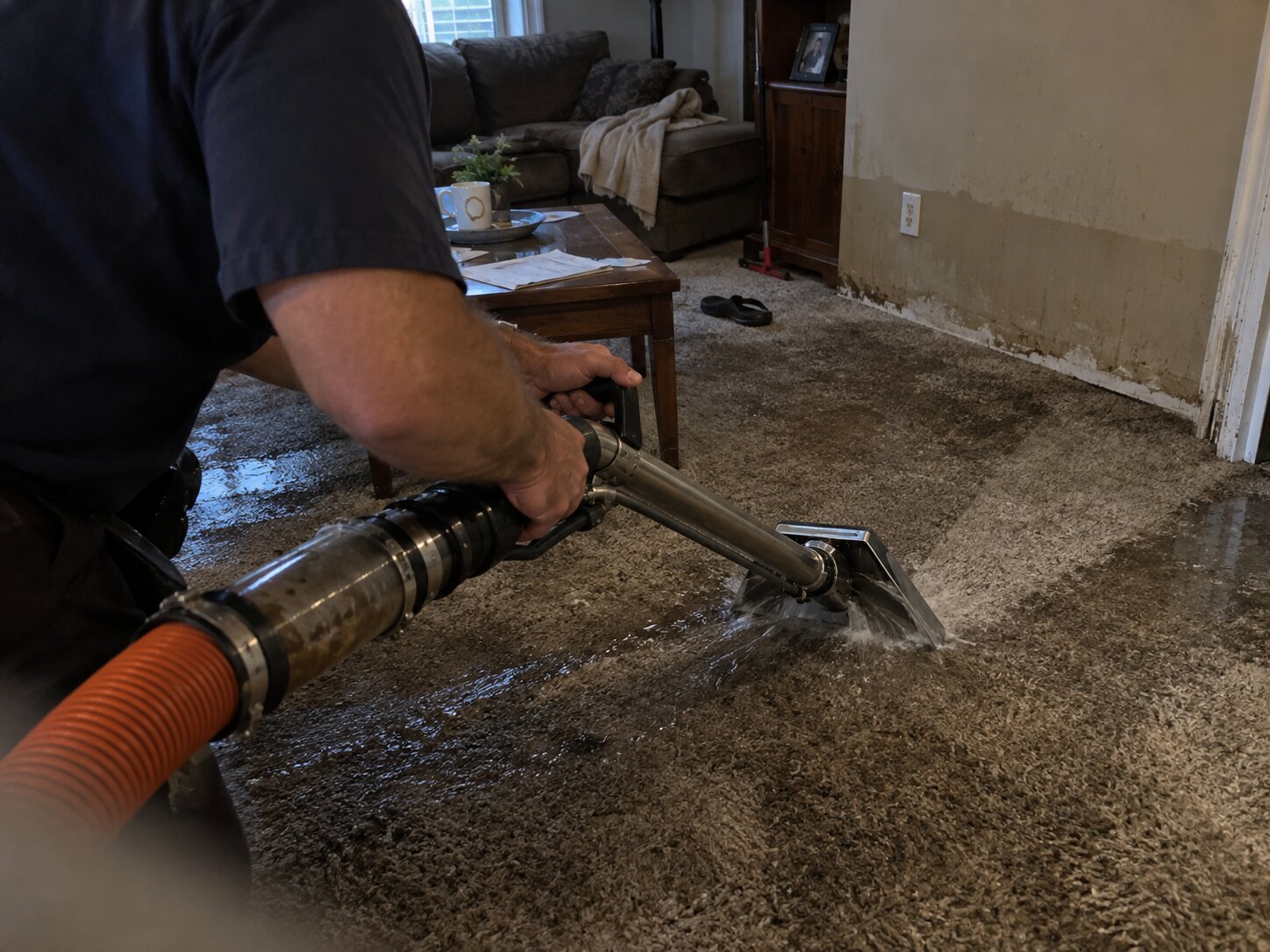
Flooring Removal and Replacement — Utah County Water Damage
Flooring decisions after water damage are among the most consequential parts of restoration scope, both for cost and for the visible outcome of the completed work. Every flooring material responds differently to water exposure, has different salvage potential depending on the specific water event conditions, and requires different technical approach for removal and replacement. The decision framework isn’t just about visible damage — it’s about substrate assessment, moisture verification, and match considerations for adjacent areas that weren’t damaged. Vault Mold Removal handles flooring assessment and replacement across Utah County as part of standard water damage restoration, applying IICRC S500 criteria while accounting for the practical realities of specific flooring types and homeowner preferences.
Flooring Type — Salvage Potential and Approach
Solid Hardwood Flooring
Solid hardwood is more forgiving of water exposure than most property owners assume, but salvage depends on specific conditions:
- Category 1 clean water with quick response: Standing water removal within 24–48 hours followed by aggressive drying often saves the floor. Cupping (raised board edges from moisture absorption) may appear during drying but often resolves as the floor equilibrates over 30–90 days.
- Extended exposure or Category 2 water: Assessment for buckling, permanent cupping, or crowning determines salvage. Refinishing (sand and reseal) can address surface issues if the wood structure is sound. Floor drying mats and specialty drying equipment accelerate the process.
- Category 3 water: Removal is typically required regardless of visible condition because contamination penetrates between boards and cannot be verifiably decontaminated.
- Structural damage (buckling, delamination from subfloor): Replacement required regardless of category.
Hardwood matching for repairs is often the challenging part — older hardwood has aged coloring that new matching material won’t have. Solutions: refinishing the entire room to unify aging, using reclaimed hardwood matched to the original age, or accepting some visible transition at threshold boundaries.
Engineered Hardwood
Engineered hardwood (a hardwood veneer over plywood or HDF core) has less water tolerance than solid hardwood. The core layers are typically not water-resistant and can delaminate with any significant water exposure. Standard approach:
- Minor surface water with quick response and unaffected core: sometimes salvageable
- Any significant water penetration to the core: replacement required due to core delamination
- Category 2 or 3 water: replacement required regardless of visible damage
Luxury Vinyl Plank (LVP) and Luxury Vinyl Tile (LVT)
Luxury vinyl products are marketed as waterproof, and the vinyl material itself is essentially waterproof — but the flooring system as installed isn’t. Water penetration occurs through:
- Seams between planks, where minor gaps allow water passage over time
- Wall edges where the flooring meets baseboards or transitions
- Floor drains and any penetrations in the flooring system
Once water reaches the subfloor beneath LVP, the underlying substrate can develop moisture damage and mold even though the flooring surface remains intact. Assessment approach:
- Category 1 water with quick response: subfloor moisture testing at multiple locations; if subfloor is dry, LVP can remain
- Category 2 or 3 water, or subfloor moisture detected: partial or complete LVP removal for subfloor drying and decontamination
- Subfloor requiring extensive treatment: LVP typically comes out to allow proper subfloor work
LVP has an advantage for restoration: it’s typically installed as floating floor without adhesive, which allows removal and reinstallation of undamaged sections after subfloor drying is complete.
Laminate Flooring
Laminate flooring has the lowest water tolerance of common residential flooring:
- Fiberboard core swells and disintegrates with any significant water exposure
- Interlocking seams fail once boards begin to swell
- Even minor water events can produce widespread visible damage
Assessment approach is typically simple: any significant water exposure to laminate requires replacement. Salvage attempts on affected laminate typically fail visually and structurally.
Ceramic and Porcelain Tile
Tile is highly water-resistant and typically salvageable after water damage:
- Non-porous ceramic and porcelain tile itself doesn’t hold contamination
- Grout lines can hold contamination but typically clean and disinfect effectively
- Cement backer board or mortar bed beneath tile is generally water-tolerant
Tile replacement is typically needed only when: individual tiles show cracks or damage from the water event, thin-set bond has failed (hollow-sounding tiles), or extensive damage to underlying substrate warrants full removal. Category 3 water on tile floors typically involves grout line cleaning and disinfection but not tile replacement.
Carpet and Carpet Pad
Carpet is the flooring type most commonly requiring replacement after water damage:
- Carpet pad is essentially unrestorable after any significant water exposure — the padding absorbs and retains contamination that cannot be effectively cleaned
- Carpet fibers may be salvageable in Category 1 events with prompt professional cleaning
- Category 2 water: carpet is typically discarded even if the fibers appear cleanable, because contamination reaches the backing and pad
- Category 3 water: mandatory removal per IICRC S500
Even in Category 1 salvage scenarios, replacing the carpet pad and reinstalling the cleaned carpet is often the practical approach — carpet cleaning without pad replacement leaves contamination in the padding.
Vinyl Sheet Flooring
Vinyl sheet (older-style resilient flooring) has variable water tolerance depending on age and condition:
- Newer, well-maintained sheet vinyl: relatively water-tolerant, seams may allow some water penetration
- Older, brittle sheet vinyl: seams and cracks allow extensive water penetration to subfloor
- Adhesive failure from water exposure can produce lifting and bubbling
Assessment typically requires lifting sections to check subfloor condition. Replacement is common because sheet vinyl matching for repairs is difficult, and asbestos-containing older sheet vinyl (installed before 1980) requires specialty removal procedures.
Subfloor Assessment
Beneath every flooring material is the subfloor — typically OSB or plywood over floor joists, or concrete slab for slab-on-grade construction. Subfloor assessment matters because subfloor damage may require repair or replacement regardless of what happens with the finish flooring.
Wood Subfloor Moisture Standards
- OSB and plywood: 14% moisture content target (drying to that level allows finish flooring installation without moisture-related issues)
- Solid hardwood subflooring (rare in newer construction, common in older Provo homes): 12% moisture content target
- Sistered wood joists or repair: matched moisture content to existing framing
Concrete Slab Considerations
Concrete slab as subfloor (typical in slab-on-grade construction and basement floors) has different considerations:
- Concrete drying is slow — target 4% moisture content, but achieving that after significant water exposure can take weeks
- Calcium chloride tests or relative humidity probes verify concrete moisture status
- Some flooring installations require specific concrete moisture and pH conditions
- Vapor emissions from wet concrete can affect adjacent flooring installations for months
Subfloor Damage Assessment
- Delamination (OSB/plywood layers separating) requires replacement
- Structural weakness (soft spots, deflection) requires structural repair
- Mold growth on subfloor surfaces requires cleaning and antimicrobial treatment; extensive mold may require replacement
- Water staining without structural or biological damage is typically acceptable after drying
Removal and Replacement Process
Preparation
- Furniture removal or protection
- Baseboard removal (to allow full-perimeter access and clean edge finishing after new flooring)
- Door removal or trimming where new flooring height differs from original
- Transition assessment at adjacent flooring boundaries
Removal
- Adhered flooring (glue-down LVP, adhered vinyl): mechanical removal with scrapers, careful subfloor preservation
- Floating flooring (click-lock LVP, laminate): typically lifts without damage to the boards themselves
- Carpet: tack strips retained where possible for reuse, padding removed and discarded
- Tile: mechanical removal with disposal of tile and thin-set as construction waste
- Hardwood: extraction with nail claws and pry bars, board-by-board disposal or salvage as appropriate
Subfloor Repair and Drying
- Subfloor drying verification per IICRC S500 standards
- Damaged subfloor section replacement
- Antimicrobial treatment for Category 2 or 3 situations
- Structural repair for any framing damage discovered during subfloor work
New Flooring Installation
- Material selection matched to property owner preferences and insurance scope allowances
- Installation per manufacturer specifications
- Coordination with adjacent flooring for transition treatment
- Trim reinstallation (baseboards, quarter round, transitions)
- Final cleaning and inspection
Insurance Coverage Considerations
Insurance coverage for flooring replacement typically follows the “like kind and quality” standard — replacement with materials of similar quality to the pre-loss flooring. Property owners frequently ask about upgrading during replacement (higher-quality LVP replacing standard laminate, hardwood replacing carpet). Approach:
- Insurance covers the value of replacing like-with-like
- Property owners can upgrade by paying the difference between insurance-covered replacement and desired upgrade cost
- Downgrading (choosing lower-cost replacement) is possible but doesn’t typically reduce out-of-pocket cost significantly — the labor is the largest portion of installation cost regardless of material choice
Matching considerations sometimes drive scope decisions. If flooring in an adjacent room isn’t affected by water damage but the same material can’t be sourced for the replacement, insurance may cover replacement of the entire connected flooring to maintain visual consistency. This is called “matching coverage” and varies by carrier and policy.
Frequently Asked Questions
- My hardwood is cupping after the water event. Will it flatten out, or do I need replacement?
- Depends on the specific conditions. Minor cupping (raised edges up to 1/16″) from Category 1 water with prompt drying response often equilibrates over 30–90 days as the wood’s internal moisture stabilizes. Moderate cupping (1/8″–1/4″) may equilibrate but is more likely to require sanding and refinishing to restore flat surface. Severe cupping (over 1/4″), buckling, crowning (raised centers instead of edges), delamination from the subfloor, or dark staining that penetrates the wood typically indicates replacement is needed. Assessment can only be definitive after drying is complete and equilibration has occurred, which takes weeks to months. Insurance claim scope typically accommodates this uncertainty by including monitoring during the equilibration period and finalizing the flooring scope after enough time has passed to determine the actual outcome.
- Can I keep my carpet if it was just clean water?
- Sometimes, though pad replacement is essentially always required. Category 1 clean water with prompt professional wet extraction and immediate drying can produce salvageable carpet with fresh pad installation. The key factors: response time (within 24 hours ideal, within 48 hours generally required), water exposure duration (limited standing time), professional wet extraction (not just letting the carpet air-dry), and complete pad replacement (padding absorbs and retains contamination even from clean water events). Carpet salvage sometimes costs approximately what replacement would cost when you factor in professional cleaning, pad replacement, and the risk that the salvage attempt fails. Many property owners opt for full replacement even in Category 1 situations for simplicity and confidence in the outcome.
- Do I need to replace flooring in rooms that weren’t directly affected by the water event?
- Not typically for the flooring itself — unaffected rooms retain their original flooring. Where the question comes up is matching: if the affected room’s flooring can’t be sourced in matching condition (discontinued products, aging color differences on natural materials), replacement of the entire connected flooring area may be needed for visual consistency. Insurance policies handle this differently — some carriers cover matching replacement broadly, others limit coverage to the specifically damaged area. This is worth discussing with the insurance adjuster during scope development. In many situations, small transitions at doorways make single-room replacement acceptable even when perfect matching isn’t possible; in other situations (open floor plans, large connected spaces), matching considerations require broader scope.
- How long does subfloor drying take before new flooring can be installed?
- Depends on the substrate and moisture load. Wood subfloor (OSB or plywood) typically dries to 14% moisture content within 5–10 days after standing water is removed, with proper drying equipment and airflow. Concrete slab is much slower — achieving 4% moisture content after significant water exposure often takes 2–6 weeks depending on slab thickness and drying conditions. New flooring installation on undried subfloor produces problems: wood floor cupping from continued moisture release, vinyl adhesive failure from vapor emission, and mold growth in the substrate. Waiting for verified dry standard is worth the delay even when property owners are eager to complete restoration.
- Can you match my existing hardwood if only part needs replacement?
- Sometimes, depending on the hardwood species, age, and availability. Common species (oak, maple, hickory) in standard board widths can typically be sourced for repair; matching becomes more difficult with exotic species, wide-plank installations, or hardwood that’s aged for decades with distinctive coloring. Even with matching new material, some visible transition typically remains between old and new sections due to color aging in the original material. Solutions: sourcing reclaimed hardwood aged to approximate the existing floor, refinishing the entire connected floor area to unify aging (sanding and refinishing removes the age color differences), or accepting some visible transition at threshold or feature boundaries. The right approach depends on your specific flooring, the extent of repair needed, and your visual expectations for the completed work.
Contact Vault Mold Removal — Provo, UT
For flooring assessment after water damage, second opinions on prior flooring work, or questions about specific flooring situations in your Utah County property, contact our office directly.
- Phone: (385) 250-2825
- Address: 1169 S 760 W, Provo, UT 84601
- Utah DOPL General Contractor License: #11876543-5501
- IICRC WRT / ASD / AMRT / OCT: #248317 / #248317-ASD / #319482 / #319482-OCT
Office Hours
- Monday – Saturday: 9:00 AM – 5:00 PM
- Sunday: Closed
Helpful guides: Laminate and vinyl floor water damage · Hardwood floor water damage