
Water damage restoration in Lindon, Utah, by Vault, a licensed, family-owned IICRC Certified Firm. Our water damage restoration crew answers live 24/7 and gives free written estimates.
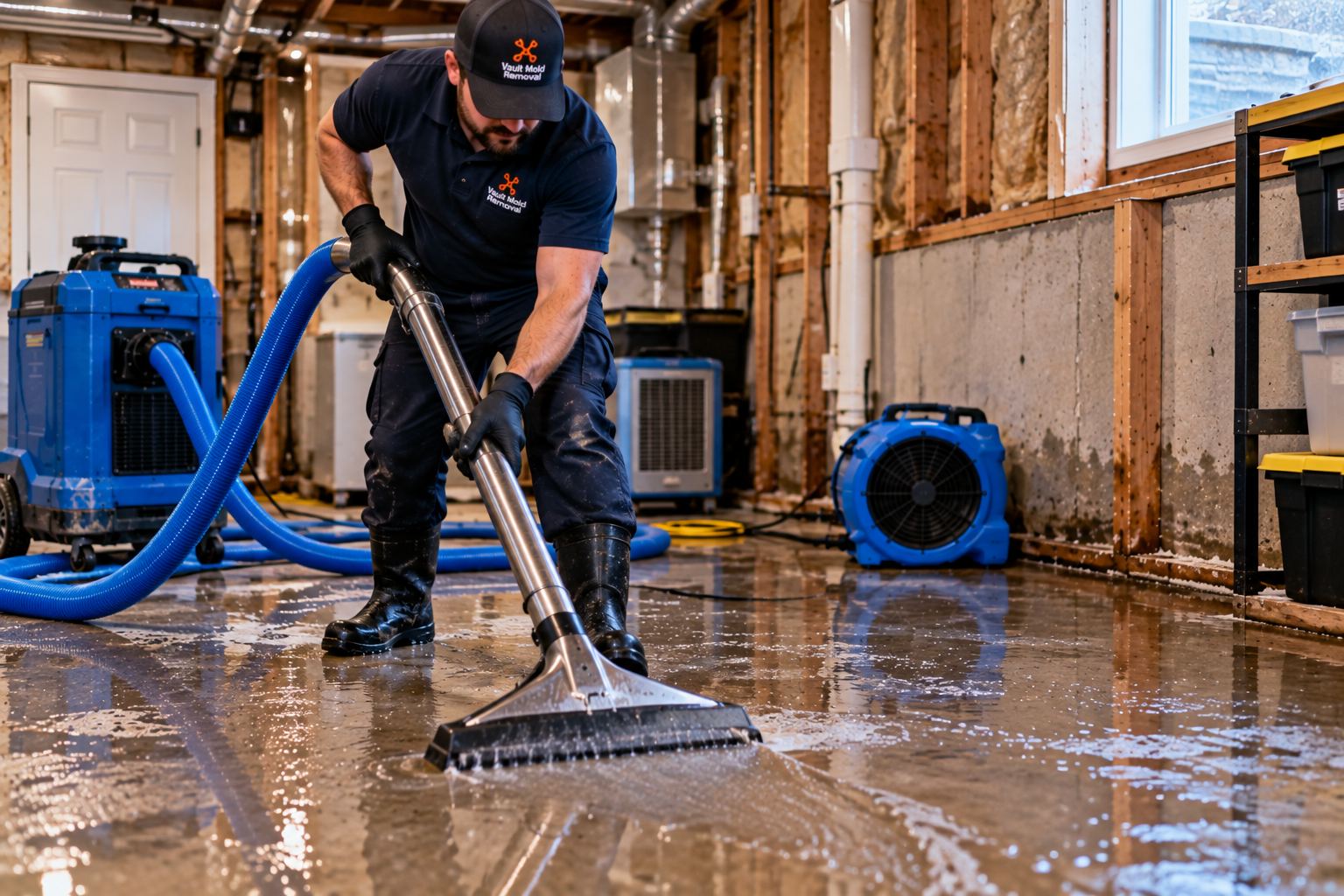
Homeowners in Lindon call Vault for everything from drying out a soaked basement to rebuilding the drywall, flooring and cabinets afterward. Our water damage restoration covers both halves of the job with one crew, so you deal with one company and one written estimate.
Typical water mitigation runs $3,500–$8,500 and reconstruction $4,500–$9,500. Every job starts with a free written estimate, so there are no surprises before work begins.
Vault Mold Removal provides water damage restoration in Lindon, Utah, from our office and shop at 1169 S 760 W in Provo. Arrival to Lindon averages about 44 minutes from our Provo office. Our own W-2 crew, IICRC certified in WRT, ASD, AMRT and OCT, handles the whole job: water extraction, structural drying with daily moisture readings, mold prevention, and the rebuild of drywall, flooring and cabinets. Every water damage restoration job starts with a free written estimate, and on insured losses we scope the work in Xactimate and bill your carrier directly. Call (385) 250-2825; the phone is answered live 24/7.
Water damage restoration in Lindon at a glance
- Call any hour: (385) 250-2825 is answered live 24/7 by the Vault crew. Arrival to Lindon is typically under 60 minutes.
- Who does the work: Vault’s own W-2 crew, IICRC certified in WRT, ASD, AMRT and OCT, working under Utah DOPL General Contractor License #11876543-5501. No subcontractors. Meet the team
- Insurance: we document the damage, log daily moisture readings, write the scope in Xactimate and bill State Farm, USAA, Allstate, Farmers or Bear River Mutual directly.
- Warranty: 24-month workmanship warranty on drying, drywall, flooring, cabinetry and paint, plus a 90-day mold warranty from post-remediation clearance. Warranty details
- Financing: through Wisetack, $500–$25,000 over 3–24 months, soft credit check. Financing
- Family-owned and veteran-operated, based in Provo since 2020.
Pricing
| Service | Typical range |
|---|---|
| Mitigation (extraction, flood cuts, drying) | $3,500–$8,500 |
| Reconstruction (drywall, flooring, cabinetry, paint) | $4,500–$9,500 |
| Written estimate | Free |
Sewage cleanup · Mold remediation · How we contain the work area · Sewer line services
Water Damage Restoration in Lindon, Utah
Lindon runs about 4 square miles between Orem and Pleasant Grove — small city, roughly 11,000 residents, a housing stock that layers seventy years of construction technique across a few concentrated square miles. The original Lindon plats from the 1940s and 1950s still stand as farmhouses along 200 East and 400 North. The 1970s and 1980s tract housing built out the central flats between State Street and 1600 East. The post-2000 fill-in development took the remaining orchard land east of 1200 East, running up toward the Timpanogos foothills. Each layer fails differently under water damage, and each requires a different restoration approach. Vault Mold Removal has worked all three.
Response time from our Provo dispatch to a Lindon address averages 44 minutes daytime and 69 minutes overnight, logged over three years of loss records. Central Lindon between 700 North and 400 South runs tighter, often 40 to 42 minutes daytime. Foothills addresses east of 1200 East run longer, 48 to 52 minutes daytime. Agricultural properties along the Provo River corridor run longest, up to 55 minutes.
What Failed and What You Do About It
Restoration in the technical sense is not extraction and drying — that’s the emergency response. Restoration is the full arc from initial dispatch through reconstruction: extraction, moisture mapping, structural drying to IICRC S500 goals, demolition of unsalvageable materials, mold remediation if timing or category warrants it, reconstruction of affected assemblies, and content restoration. In Lindon, the specific mix of what you do depends on which layer of construction you’re working in.
Original Lindon farmhouses — pre-1960 construction along the older plats — run galvanized supply, cast-iron drain, lath-and-plaster walls, and often plank or shiplap subfloor over dimensional joists. Water damage in these homes tends to be complicated by material replacement questions: modern drywall doesn’t match plaster, standard trim doesn’t match original millwork, and the cost of period-appropriate restoration can outrun the insurance scope quickly. We coordinate with your adjuster early on scope determinations for historically significant assemblies.
Mid-century tract housing — the 1970s and 1980s central Lindon flats — runs copper supply, cast-iron and later ABS drain, drywall on 2×4 stud framing, and slab-on-grade or shallow crawlspace foundations. This is the most common Lindon restoration case: predictable failure points, standard material replacement, and clean insurance scope. Response tends to be routine unless the failure has been running for days before discovery.
Post-2000 foothills construction — engineered floor systems, PEX manifold plumbing, spray foam insulation, walkout basements — presents the modern challenges: hidden cavity moisture in I-joists, complex isolation of PEX runs during diagnosis, and vapor-impermeable insulation that traps water in the wall assembly. We handle these differently, with thermal imaging and cavity ventilation as standard practice rather than optional add-ons.
Our Restoration Process
- Hour 0 to 2: Emergency response and documentation
- Dispatch, arrival, source containment, photo documentation, moisture mapping, category assignment under IICRC S500, written scope of work delivered to homeowner and adjuster.
- Hour 2 to 8: Extraction and equipment placement
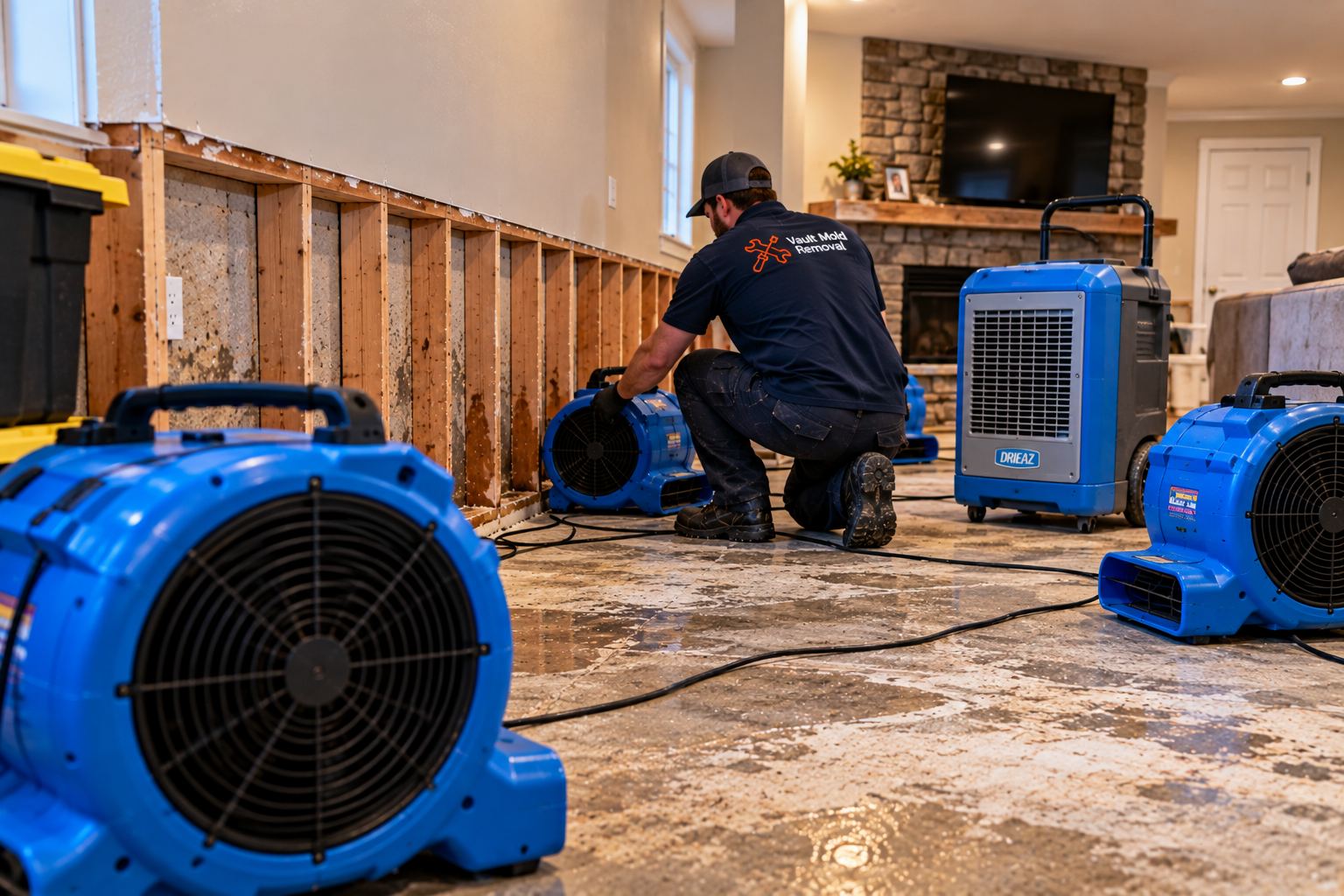
- Truck-mounted extraction at 180 GPM, weighted wand extraction for carpet and pad, submersible pumps for basement depth, dehumidifier and air mover deployment based on affected volume and material response.
- Day 1 to 7: Structural drying with monitoring
- 12-hour monitoring intervals with moisture readings logged at grid coordinates. Framing to 12% MC, drywall paper to 1%, concrete to 4%. Cavity access ports opened as needed. Daily reports to adjuster.
- Day 3 to 10: Demolition and mold response
- Removal of unsalvageable materials (soaked insulation, delaminated engineered wood, Category 2 or 3 porous materials). Mold containment and remediation under IICRC S520 if visible growth is present or if drying was delayed beyond 48 hours.
- Week 2 to 6: Reconstruction
- Drywall replacement, flooring installation, cabinetry and trim, paint and finish. Coordinated with your adjuster on scope; matched to existing finishes and grade wherever the insurance scope allows.
Insurance Documentation for Lindon Losses
Utah Code 31A-26-301.5 requires the carrier to acknowledge your claim within 15 days of first notice of loss and to make a coverage determination within 30 days of proof of loss. What actually happens in that 30-day window depends on documentation quality. We produce the packet your adjuster needs: photo series with EXIF timestamps, moisture logs at 12-hour intervals through drying, category and class determination with S500 citation, equipment inventory with model and serial numbers, and daily monitoring reports. All of it built to Xactimate line-item scope structure so the review process runs efficiently.
Bear River Mutual, State Farm, USAA, Allstate, and Farmers are the dominant residential carriers we work with in Utah County. Each has documentation preferences, and we understand them. Bear River runs Xactimate scope reviews out of their Salt Lake office and expects native scoping. State Farm claim reviewers focus on category assignment and cause-of-loss documentation. USAA emphasizes daily monitoring compliance. We build to whichever carrier is on the policy.
Lindon Coverage Zones
- Original Lindon Center
- 200 East to 400 East, 200 North to 400 North. Pre-1960 farmhouses, galvanized supply, lath-and-plaster. Response: 44 min daytime.
- Central Flats
- State Street to 1200 East, 700 North to 400 South. Mid-century tract housing, copper supply, standard drywall. Response: 42 min daytime.
- Foothills East
- 1200 East and higher, running up toward Timpanogos. Post-2000 construction, engineered systems, PEX manifold. Response: 48 min daytime.
- State Street / Commercial
- I-15 corridor, Lindon Marketplace area, retail and light industrial. Response: 44 min daytime.
- Provo River Corridor / Agricultural
- Western Lindon, farm and outbuilding structures, older well systems. Response: 55 min daytime.
Frequently Asked Questions
- Do you handle the whole restoration, or just the emergency water response?
- Full restoration under one contract, from initial dispatch through reconstruction. We hold contractor licensing under Utah DOPL for the demolition and rebuild work, IICRC certification for water and mold remediation, and EPA RRP certification for lead-safe work practices in pre-1978 homes (which includes the original Lindon farmhouses). You have one point of contact through the entire process.
- How long does full restoration take?
- Small clean-water loss with responsive materials — one room, contained scope: 2 to 4 weeks total, including reconstruction. Medium loss affecting multiple rooms with some demolition and moderate reconstruction: 4 to 8 weeks. Large loss with structural involvement, whole-floor demolition, and full reconstruction: 8 to 16 weeks. Category 3 losses (sewage) add time for containment and material handling.
- Can I stay in my home during the work?
- Depends on scope. Emergency response and drying: usually yes, though the equipment is noisy and the affected rooms may be unusable. Demolition and containment for mold work: often requires the affected zone to be sealed off from occupied space, and depending on scope may require temporary relocation of adjacent rooms. Reconstruction: back in occupancy of unaffected zones, with active work zones isolated. Additional living expense (ALE) coverage on your homeowners policy covers temporary lodging when displacement is required.
- What about matching my existing finishes during reconstruction?
- Insurance scope typically covers “like kind and quality” — meaning replacement at comparable grade, not necessarily identical product. For original Lindon farmhouses with period-specific finishes (crown molding profiles, plaster texture, hardwood species), matching often requires custom milling or specialty sourcing that goes beyond standard scope. We identify those requirements early and help you document the matching cost to your adjuster; scope adjustments happen in most cases when the documentation is clear.
- What if you find mold during the demolition?
- Visible mold growth changes the scope from IICRC S500 water restoration to IICRC S520 mold remediation, which means containment barriers with negative air pressure, HEPA air scrubbing, and personal protective equipment for the crew. This is documented as a scope expansion and submitted to your adjuster with supporting photos and moisture history. Most standard homeowners policies cover mold remediation up to a sub-limit — typically $10,000 to $25,000 depending on policy — when the mold results directly from a covered water loss.
Contact Vault Mold Removal
Phone: (385) 250-2825
Address: 1169 S 760 W, Provo, UT 84601
Hours: Monday–Saturday, 8:00 AM – 5:00 PM
Service Area: Lindon, Provo, Orem, Springville, Vineyard, Mapleton, and surrounding Utah County communities.
Written warranty
24-month workmanship warranty on drying, structural repairs, drywall, flooring, cabinetry and paint done by Vault. 90-day mold warranty from post-remediation clearance for recurrence from the same moisture source. Both are transferable once to a new homeowner, in writing on the work order. Full terms at /warranty/.
We bill your carrier directly
Direct-billing with State Farm, USAA, Allstate, Farmers and Bear River Mutual. Every scope is written in Xactimate; you pay only your deductible plus anything the policy doesn’t cover. Not on this list? We still handle the claim.
Who shows up on your job
You get Vault’s W-2 crew — Marcus, Ryan, Elena, Daniel and Joseph — not a lead-gen handoff and not a franchise sub. Reconstruction (drywall, flooring, cabinetry, paint) is done by the same crew under Utah DOPL License #11876543-5501.
Water damage guides for Lindon homeowners
- Burst pipe — what to do
- Frozen pipe — before it bursts
- Finding your main water shut-off
- Sump pump failure
- Window well flooding
- Water damage on your ceiling
- Drywall — repair or replace?
- Structural drying explained
- Insurance claim timeline
- How long restoration takes
All guides: resources library · Or call (385) 250-2825
More Lindon services: Basement flooding cleanup · Dehumidification
Helpful guides: What if water damage isn’t fixed? · How long drywall takes to dry · Your deductible, explained
All our services in Lindon
Water damage restoration in Lindon: find us and quick answers
Vault’s licensed and insured crew handles water damage restoration in Lindon: water extraction, structural drying, mold prevention and rebuild, all documented for your insurance.
Where we are
1169 S 760 W, Provo, UT 84601
Phone: (385) 250-2825 (answered live 24/7)
Email: info@vaultmoldremoval.xyz
Office: Monday–Saturday, 8 AM–5 PM
Getting to you
Arrival to Lindon averages about 44 minutes.
Quick answers
How much does water damage restoration in Lindon cost?
Typical water mitigation (extraction, flood cuts and drying) runs $3,500–$8,500 and reconstruction runs $4,500–$9,500. The written estimate is free, and on insured losses Vault bills State Farm, USAA, Allstate, Farmers or Bear River Mutual directly.
How fast can Vault get to Lindon?
Arrival to Lindon averages about 44 minutes. The phone is answered live 24/7 by the Vault crew, and if every technician is on a job the call rolls to the owner’s cell, not voicemail.
Who does the work?
Vault’s own W-2 crew, IICRC certified in WRT, ASD, AMRT and OCT, under Utah DOPL General Contractor License #11876543-5501. No subcontractors, and the work carries a 24-month workmanship warranty.
Check our license in the Utah DOPL license lookup; our crew works to IICRC standards.
Need water damage restoration in Lindon? Call (385) 250-2825 and the crew will walk you through shutting off the water while a truck is on the way.
Call (385) 250-2825Get a free estimate More about Vault in Lindon
Related services in Lindon
Vault serves Lindon homeowners, landlords and businesses with the same licensed, insured W-2 crew for every service:
- Emergency water damage
- Water extraction
- Structural drying
- Basement flooding
- Fire damage restoration
- Commercial water damage
Fire, smoke and storm damage in Lindon
Water damage often comes with something else. Vault also handles fire damage restoration, including the water left behind by firefighting, and storm damage such as roof and window leaks after wind-driven rain. Same W-2 crew, same insurance documentation.
Water damage restoration in nearby cities
Serving Lindon and the surrounding Utah County areas from our Provo office:
- Water damage restoration in Provo
- Water damage restoration in Orem
- Water damage restoration in Springville
- Water damage restoration in Vineyard
- Water damage restoration in Mapleton
Questions about water damage restoration in Lindon? Call (385) 250-2825; the phone is answered live 24/7.
Water damage repair and flood cleanup in Lindon
Water damage restoration in Lindon is more than drying the carpet. Standing water wicks into drywall, insulation, subfloors and framing within hours, and anything left wet for a few days can start growing mold. Vault handles the full job: emergency water extraction, structural drying, mold prevention and the damage repair afterward, with one licensed W-2 crew and no subcontractors. Arrival to Lindon averages about 44 minutes from our Provo office.
Common causes of water damage
- Frozen and burst pipes during Lindon winters, especially in exterior walls, crawl spaces and garages (burst pipe: what to do)
- Water heater leaks and ruptures in basements and utility rooms (water heater leak: what to do)
- Washing machine, dishwasher, ice maker and toilet supply line failures
- Roof, window and attic leaks after storms and ice dams
- Spring snowmelt, sprinkler line breaks and sump pump failures that flood Lindon basements (sump pump failure: what to do)
- Slow leaks hidden behind showers, under sinks and inside walls
Signs of hidden water damage
Stains or bubbling paint on ceilings and walls, warped or cupping wood floors, soft drywall at the baseboard, a musty odor, or a water bill that jumps for no reason. Our crew finds the extent of the leak with FLIR thermal cameras and Delmhorst and Protimeter moisture meters, so we remove only what has to go. See moisture detection.
How restoration works
- Emergency response: the phone is answered live 24/7 and a crew is dispatched to your Lindon property.
- Water extraction: standing water is pumped out and extracted from carpet, pad and floors. See water extraction.
- Moisture mapping: every wet wall, floor and cabinet is measured and recorded.
- Containment and flood cuts: ZipWall and 6-mil plastic containment with a HEPA air scrubber, then wet drywall is cut above the water line.
- Structural drying: air movers and dehumidifiers in drying chambers, with daily moisture readings until the materials meet the dry standard. See structural drying.
- Mold prevention: affected areas are cleaned and treated so mold does not start while materials are open.
- Damage repair: drywall, insulation, baseboards, flooring, cabinets and paint rebuilt under our Utah DOPL General Contractor license. See reconstruction and repairs.
Typical water damage restoration costs
Typical Utah water mitigation (extraction, drying, flood cuts) runs $3,500–$8,500, and reconstruction typically runs $4,500–$9,500. Your exact price is on a free written estimate before work starts. Wisetack financing is available from $500 to $25,000 over 3–24 months, subject to approval.
Working with your insurance company
Yes. Vault documents the water damage with photos and daily moisture readings, writes the scope in Xactimate and bills your insurer directly, including State Farm, USAA, Allstate, Farmers and Bear River Mutual. You pay your deductible and any non-covered items. See insurance claims help. This is general information, not insurance advice.
Jobs we have done here
Real projects our crew documented in Lindon:
- Case study: frozen spigot burst in a detached workshop
- Case study: radiant floor heat leak
- Case study: water softener discharge line disconnection
Water in your Lindon home right now? Call (385) 250-2825 for emergency water damage restoration and flood cleanup. Every repair carries our 24-month workmanship warranty.
More questions
Do you also handle the rebuild?
Yes. Repairs and reconstruction are done under our Utah DOPL General Contractor license, by the same company that dried the house. See reconstruction and repairs.
Is the work guaranteed?
Workmanship carries a 24-month warranty, transferable once if you sell the home. See our warranty.
Services and service area
Vault provides water damage restoration services for Lindon homeowners and commercial property owners: emergency water extraction, structural drying, mold remediation, and the damage repair and reconstruction afterward. One local company handles the whole process, from the first call to the final walkthrough.
When water is still spreading, a fast response matters, so the phone is answered live 24/7 and our average arrival in Lindon is about 44 minutes. Our professional crew dries the structure with daily moisture readings, removes what cannot be saved, and restores the property under our Utah DOPL General Contractor license.
We also handle flood cleanup, fire damage and smoke cleanup, storm damage and sewage cleanup. Service areas: Lindon and the surrounding communities we serve — Provo, Orem, Springville, Vineyard and Mapleton. Every water damage job starts with a free written estimate; see typical pricing or our blog for homeowner guides.
Call (385) 250-2825Free estimateFinancingOur processAll local services
More questions from homeowners
Do you bill my insurance company directly?
Yes. We document the damage, take daily moisture readings, write the scope in Xactimate and bill the insurer directly — State Farm, USAA, Allstate, Farmers, Bear River Mutual and others. You pay the deductible and anything not covered.
How do you find water hidden behind walls?
With a FLIR thermal camera and Delmhorst and Protimeter moisture meters, so wet areas behind drywall and under flooring are found without tearing things open first.
How do you know when my home is dry?
Moisture readings are taken every day and logged until they are back to normal. The log is shared with you and your adjuster.
Will you need to cut out drywall?
Only when wet drywall can’t be dried in place. Flood cuts are made inside ZipWall containment with 6-mil plastic, a zipper door and a HEPA air scrubber.
Can I pay for the repairs over time?
Yes — Wisetack financing covers $500–$25,000 over 3–24 months, with a soft credit check, subject to approval.
Can water damage lead to mold?
It can. The EPA advises drying wet materials within 24–48 hours to keep mold from starting, which is why drying is checked with meters every day.
Do you handle commercial water damage in Lindon?
Yes. We take commercial jobs in all six cities we serve. See commercial water damage.
What should I do before the crew arrives?
Shut off the main water valve if the leak is on a supply line, turn off power to wet rooms only from a dry spot, take photos for your claim and move valuables out of the water.
Do you also clean and restore belongings?
Yes. Contents are handled by Joseph Miles, our Contents Cleaning & Restoration Specialist.
Need water damage restoration in Lindon? Average arrival in Lindon is 44 minutes. Call (385) 250-2825, answered live 24/7.