
Vault mold remediation at a glance
- Who does the work: Vault’s own W-2 crew, no subcontractors. Our mold lead is Ryan Bautista, Mold Remediation & Drying Specialist (IICRC WRT and AMRT). Meet the team
- Credentials: IICRC AMRT (Applied Microbial Remediation) firm certification #319482, plus WRT, ASD and OCT · Utah DOPL General Contractor #11876543-5501 · EPA RRP lead-safe firm #NAT-F187294-1 · The Hartford GL + WC · bonded · BBB Accredited. Verify our credentials
- Where we’re based: staffed office, shop and warehouse at 1169 S 760 W, Provo, UT 84601. Phone answered live 24/7 at (385) 250-2825.
Mold inspection and remediation pricing
| Service | Price | What’s included |
|---|---|---|
| Basic visual inspection | $99 | Visual inspection of one area |
| Inspection with moisture mapping | $199 | Visual inspection plus moisture meter and thermal camera |
| Inspection with air sampling | $349 | Moisture meter and thermal camera, plus air sampling analyzed by Sporecyte, an outside lab |
| Mold remediation | From $500 | Free written remediation estimate after the initial assessment |
Our 90-day mold warranty
Remediation is covered for 90 days from post-remediation clearance. If mold returns in that time, we reinspect within 7 business days and re-remediate at no charge. The warranty transfers once to a new owner with a signed transfer form. Warranty details
Paying for it
When mold is covered by your policy, we document it, write the scope in Xactimate and bill State Farm, USAA, Allstate, Farmers or Bear River Mutual directly. For deductibles, uncovered work or uninsured jobs, financing is available through Wisetack: $500–$25,000 over 3–24 months, with a soft credit check. Financing
Where we work
Provo, Orem, Springville, Vineyard, Lindon and Mapleton. See mold remediation in Provo, Orem, mold inspection and testing and black mold.
Mold Removal — Utah County IICRC S520 Physical Removal
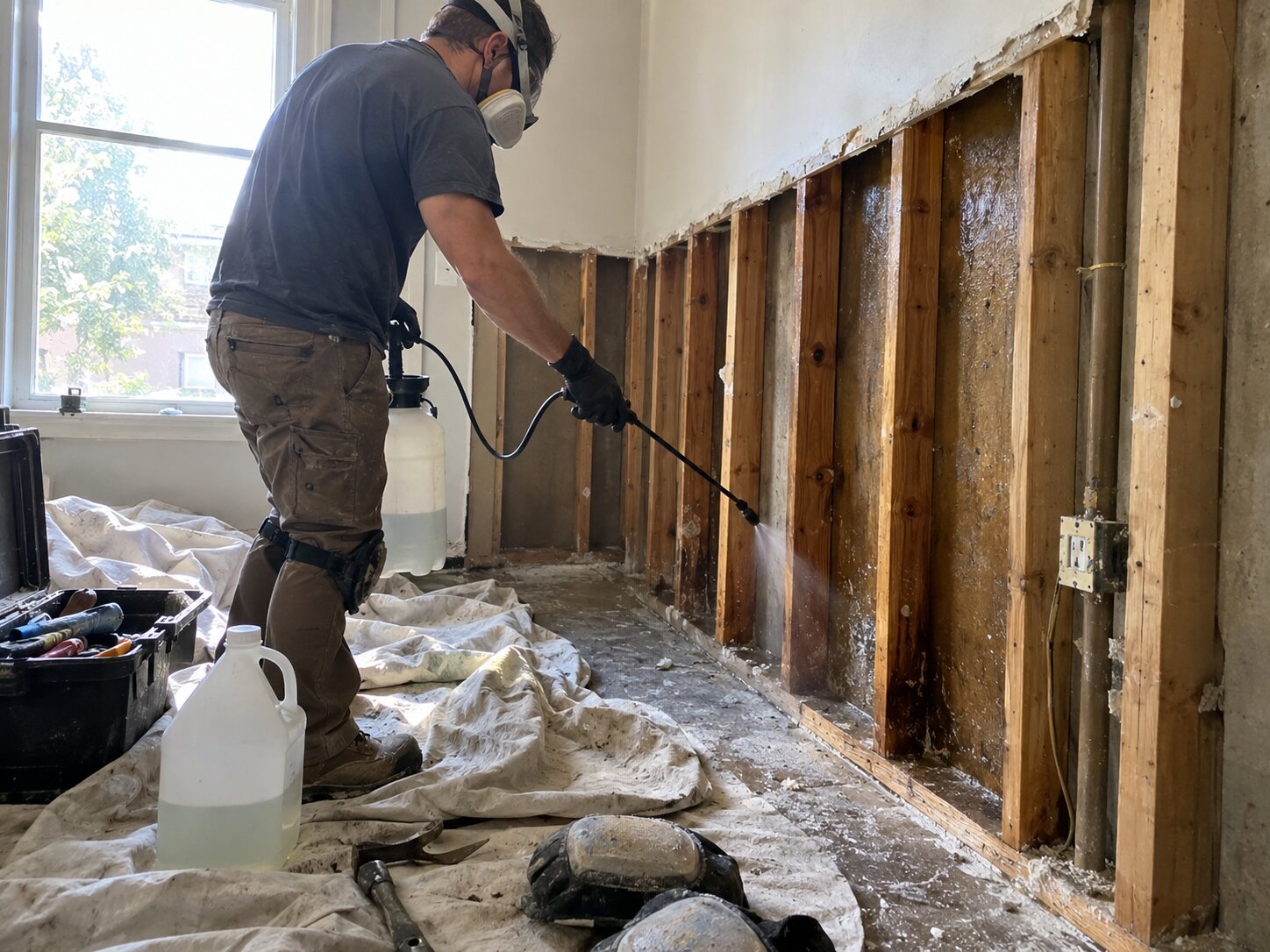
Mold removal is the physical demolition and disposal phase within the larger remediation process. It’s the part where visible mold and mold-colonized materials come out of the property — the middle stage between initial containment setup and post-remediation verification. Under IICRC S520, mold removal follows specific criteria: what materials must be removed vs. treated in place, how removal is sequenced to prevent cross-contamination, what PPE and equipment are required, and how removed materials are disposed. Vault Mold Removal performs mold removal across Utah County as part of complete S520-compliant remediation projects, not as a standalone service. This page describes the technical work involved in the removal phase specifically, for property owners who want to understand what’s happening inside the containment during their remediation project.
What Gets Removed vs. What Gets Treated
The removal-vs.-treatment decision follows IICRC S520 criteria based on material porosity, extent of colonization, and structural function. Rough classification:
Always Removed
- Carpet and pad with visible mold colonization — the substrate is impossible to effectively decontaminate
- Drywall with visible mold on the paper facing — typically removed to the nearest structural stud beyond the visible growth (accounting for hidden hyphae extension)
- Insulation in wall cavities where colonization is present — fiberglass and cellulose insulation cannot be effectively decontaminated once colonized
- Ceiling tiles with visible growth
- MDF and particleboard cabinetry with saturation or visible growth — the engineered wood substrate is essentially unrestorable
- Upholstered furniture with visible growth — effective decontamination through porous fabric and padding is generally not possible
- Mattresses and box springs with any mold contact
- Paper materials (books, files, cardboard) with visible growth — may be salvageable with freeze-drying and professional decontamination for high-value items only
- Textiles and clothing with visible growth — some may be salvageable with professional cleaning; others must be discarded
Case-by-Case Assessment
- Wood framing with surface mold contact but no structural compromise — may be sanded and treated rather than replaced. Framing with deep hyphae penetration or structural degradation is replaced.
- Wood flooring with surface mold on finished surfaces — may be sanded, refinished, and treated. Deeper penetration requires replacement.
- Solid wood furniture — may be professionally cleaned and refinished. Antique or high-value pieces sometimes justify specialty restoration.
- Hard-goods personal property (electronics, tools, glass, ceramics) — typically cleaned and salvaged with HEPA vacuuming and appropriate antimicrobial treatment.
Treated in Place
- Concrete and CMU block foundation walls with surface mold — cleaned, HEPA vacuumed, and treated with antimicrobial. Deep or extensive contamination may require blast cleaning.
- Structural steel — cleaned and treated
- Non-porous fixtures (tile, ceramic, glass, sealed metal) — cleaned and decontaminated
- Sealed hardwood floors with surface contamination only — cleaned and refinished
The Removal Sequence Inside Containment
Physical removal of mold-colonized materials disturbs the colony significantly, releasing spores at concentrations far higher than baseline. Containment integrity and appropriate sequencing prevent spore migration to unaffected areas of the property.
Pre-Removal Preparation
- Containment integrity verification (visual inspection of all barrier seals, manometer readings confirming negative pressure)
- HEPA air scrubbers activated at appropriate air-change-per-hour (ACH) rate for the containment volume
- PPE deployment (Tyvek Level D, P100 respirators, gloves, boot covers)
- Wetting of surfaces before demolition to reduce dust and spore aerosolization
Removal Sequence
- Personal property first. Any contents that will be removed are containerized and removed before demolition begins — this prevents demolition dust and additional contamination on removed items.
- Loose material removal. Ceiling tiles, hanging insulation, and any loose materials with mold contact are removed and containerized.
- Drywall removal. Colonized drywall is removed in sections, HEPA-vacuumed before removal to reduce disturbance, and immediately containerized in sealed disposal bags.
- Insulation removal. Once drywall is out, exposed wall cavity insulation is removed. Fiberglass and cellulose insulation are contained during removal since both readily aerosolize spores.
- Substrate assessment. With drywall and insulation removed, the underlying framing and back-side surfaces are inspected for the extent of hidden colonization.
- Substrate cleaning and treatment. Framing lumber is HEPA-vacuumed to remove surface debris, then sanded where visible growth was present, then treated with EPA-registered antimicrobial.
Waste Handling
All removed material is containerized in sealed heavy-duty disposal bags inside the containment before exiting through the decontamination airlock. Larger materials (drywall sheets, cabinet sections, subfloor portions) are wrapped in 6-mil polyethylene before removal from containment. Disposal is through licensed waste haulers to appropriate landfill facilities. Documentation of disposal path is retained in the job file.
HEPA Vacuuming
HEPA vacuuming is essential throughout the removal phase and after. HEPA-filtered vacuums capture particles down to 0.3 microns at 99.97% efficiency — effective for mold spores, which typically range from 2 to 20 microns depending on species. Standard shop vacuums or household vacuums are inadequate for mold work because they exhaust captured particles back into the air, effectively spreading the contamination rather than containing it.
HEPA vacuuming timing:
- Before removal: Surface HEPA vacuuming on materials to be removed, to reduce disturbance during demolition
- During removal: HEPA vacuuming of dust and debris as demolition progresses
- After removal: HEPA vacuuming of all remaining surfaces — framing, substrate, hard finishes — before antimicrobial application
- Before containment removal: Final HEPA vacuuming of the entire containment area to reduce spore loading before verification testing
Antimicrobial Application
After physical removal and HEPA vacuuming, remaining surfaces receive EPA-registered antimicrobial application. Product selection depends on the specific pathogen spectrum, substrate material, and post-remediation reconstruction plans:
- Quaternary ammonium products — broad-spectrum antimicrobial suitable for most mold species and general disinfection needs. Effective, cost-efficient, and compatible with most substrates.
- Hydrogen peroxide-based products — enhanced spectrum for particularly resistant contamination. More expensive but effective for Chaetomium, Stachybotrys, and mycotoxin-producing species.
- Encapsulating primers — applied after cleaning and antimicrobial treatment on wood framing, particularly when visible staining remains after sanding. Encapsulants provide additional barrier against any residual growth and prepare the surface for reconstruction finish.
Application is documented with product name, EPA registration number, coverage area, and dwell time. Product Material Safety Data Sheets (MSDS) are retained in the job file for warranty and regulatory documentation.
Framing Assessment and Treatment
Wood framing exposed after drywall removal receives specific attention. Framing decisions:
Surface Contact Only
Visible surface mold with no penetration into wood grain. Treatment: HEPA vacuum, light sanding to remove surface growth and any staining, antimicrobial application, encapsulant application if warranted.
Shallow Penetration
Mold hyphae penetrating up to 1/8 inch into wood grain. Treatment: aggressive sanding to remove penetrated material (down to sound wood), HEPA vacuuming of dust, antimicrobial and encapsulant application.
Deep Penetration or Structural Compromise
Mold penetration beyond 1/8 inch, or wood with structural degradation from prolonged moisture exposure. Treatment: framing member replacement. Selective removal of affected members with structural sister-boarding or full replacement depending on the extent.
Chronic Wet-Rot with Structural Failure
Framing that has failed structurally due to sustained saturation. Treatment: full replacement with proper engineering review for load-bearing members. This scenario is beyond standard mold remediation and requires structural repair.
Frequently Asked Questions
- Why does so much drywall get removed even when the visible mold is small?
- Mold hyphae extend beyond visible surface growth. What appears as a 6-inch patch of visible mold on drywall paper facing is typically the visible portion of a much larger colony that has extended through the paper into the drywall core and often onto the back of the drywall in the wall cavity. IICRC S520 standard practice is removal to the nearest structural stud beyond visible growth — typically 12 inches minimum from visible growth boundary — to ensure that hidden hyphae extension is captured. Cutting closer to visible growth often leaves residual colonization that re-establishes within weeks of reconstruction. The “excessive” drywall removal that property owners sometimes question is actually the S520-compliant approach; the alternative is remediation failure and re-emergence of the problem.
- Can wet insulation be dried and reused instead of removed?
- Rarely, and generally not for mold work. Fiberglass batt insulation that has been wet loses R-value permanently, even after drying — the fiber structure collapses under water weight and doesn’t fully recover. Cellulose insulation absorbs water and retains it indefinitely; it also becomes an excellent substrate for mold growth after wetting. Spray foam insulation is more variable — closed-cell foam sometimes recovers with drying, though visible growth on the foam surface requires removal. The general rule for mold remediation is complete removal of insulation from affected wall cavities, since the small cost savings from attempting to salvage insulation is dwarfed by the failure risk if colonization persists in retained insulation.
- What happens to my belongings during mold removal?
- Depends on the specific item and its condition. Contents evaluation happens at the start of the remediation project, before physical removal begins. Items with visible mold growth are typically categorized for disposal (porous items) or professional cleaning (hard-goods). Items in the affected area without direct mold contact are moved out of containment for HEPA vacuuming and treatment as needed, then returned after remediation. High-value or irreplaceable items (photos, documents, artwork, antiques, some electronics) receive priority handling and may be routed to specialty restoration facilities for professional decontamination. Insurance coverage varies for contents mold cleaning; check your specific policy.
- Can you tell what species the mold is just by looking at it?
- Sometimes, but visual identification is not reliable enough to base remediation decisions on. Some species have characteristic appearance — Stachybotrys chartarum’s dark black color and slimy texture, Aspergillus/Penicillium species’ typical dusty green appearance, Cladosporium’s dark olive coloring — but color and texture vary by growth conditions, substrate, and colony age. Visual “identification” without sampling is educated guess at best. Species identification requires either surface swab culture or air sample analysis by an accredited lab. That said, IICRC S520 remediation methodology is essentially the same regardless of species — the removal, HEPA vacuuming, antimicrobial application, and PRV clearance protocol don’t change based on species. Species identification is more relevant for medical evaluation of health-affected occupants than for remediation methodology.
- Is one round of removal enough, or does mold typically come back?
- One thorough round of IICRC S520 removal is typically enough — when done correctly and when the underlying moisture source has been resolved. Mold recurrence after complete remediation happens in two scenarios: (1) the moisture source wasn’t actually resolved, so new moisture supports new growth on new materials; or (2) the initial remediation missed hidden colonization that eventually spread to visible areas. Both scenarios are avoidable with proper work: verified moisture source resolution before starting remediation, and thorough investigation of hidden areas during remediation using thermal imaging and exploratory openings. Third-party post-remediation verification (PRV) is what confirms that both scenarios have been addressed. Our S520 remediation with third-party PRV is warrantied against recurrence on the same materials for one year, subject to permanent moisture source resolution.
Contact Vault Mold Removal — Provo, UT
For mold remediation involving significant removal work, second opinions on incomplete prior removal, or questions about specific material removal scenarios, contact our office directly.
- Phone: (385) 250-2825
- Address: 1169 S 760 W, Provo, UT 84601
- Utah DOPL General Contractor License: #11876543-5501
- IICRC WRT / ASD / AMRT / OCT: #248317 / #248317-ASD / #319482 / #319482-OCT
Office Hours
- Monday – Saturday: 8:00 AM – 5:00 PM
- Sunday: Closed
How we contain the work area
Containment keeps mold spores, dust and contamination in the work area and out of the rest of the house. What we set up depends on the job:
| Type of job | How Vault contains the work area |
|---|---|
| Clean-water pipe leak | Plastic sheeting, ZipWall poles, floor protection |
| Basement flooding | Floor protection, plastic barriers where needed |
| Drywall flood cuts | ZipWall, 6-mil plastic, zipper door, HEPA air scrubber |
| Mold remediation | Sealed containment, HEPA negative air machine, zipper entry |
| Sewage backup | Sealed containment, negative air equipment where appropriate, PPE |
| Structural drying | Temporary barriers or drying chambers to control the drying environment |
Clearance: when remediation is finished, Vault’s AMRT-certified crew performs the post-remediation clearance with a visual inspection and moisture readings. Air samples are analyzed by Sporecyte, an outside laboratory. Your 90-day mold warranty starts from that clearance. See our full containment process
Helpful guides: Negative air containment · Mold on drywall
What our Provo customers say
“We discovered mold around the baseboards in our laundry room after moving the washing machine. The technicians inspected the surrounding area, explained what needed to be removed, and used containment to keep dust from spreading. They were professional, kept the area organized, and walked us through the cleanup process before finishing.”
— Rebecca S., Provo, Utah
Frequently asked questions
How is mold removal different from remediation?
Remediation is the full process – contain, remove, clean, dry, and verify with clearance. 'Removal' is a looser term; make sure the company is doing all of those steps, not just taking out visible growth.
Can moldy drywall or carpet be saved?
Rarely. Drywall paper and carpet pad are porous and feed mold; both are usually removed. Hard, non-porous materials can be cleaned.
Do you offer a warranty?
Yes. Vault includes a 90-day mold warranty from clearance, transferable once, with air samples analyzed by Sporecyte.
Questions we didn’t cover? Call (385) 250-2825.
This is part of our mold remediation in Provo service: inspection, sealed containment with HEPA negative air, removal and clearance by our AMRT-certified crew. Call (385) 250-2825.