
Biohazard cleanup at a glance
- Call any hour: (385) 250-2825 is answered live 24/7 by the Vault crew, not a call center. 45-minute arrival guarantee inside Provo city limits (Monday–Saturday, 8 AM–5 PM); typically under 60 minutes elsewhere in our Utah County service area.
- Who does the work: Vault’s own W-2 crew, IICRC certified in WRT, ASD, AMRT and OCT, working under Utah DOPL General Contractor License #11876543-5501. The same license covers sealed containment, PPE, cleaning and disposal. No subcontractors. Meet the team
- Insurance: we document the damage, write the scope in Xactimate and bill State Farm, USAA, Allstate, Farmers or Bear River Mutual directly.
- Warranty: 24-month workmanship warranty on the rebuild, plus a 90-day mold warranty from post-remediation clearance where mold work was done. Warranty details
- Financing: through Wisetack, $500–$25,000 over 3–24 months, soft credit check. Financing
- Biohazard scope: sealed containment, PPE for the crew, EPA-registered disinfectants and bagged disposal, with insurance documentation.
- Family-owned and veteran-operated, based in Provo since 2020.
Water damage restoration · Mold remediation · Sewage cleanup · Reconstruction & repairs
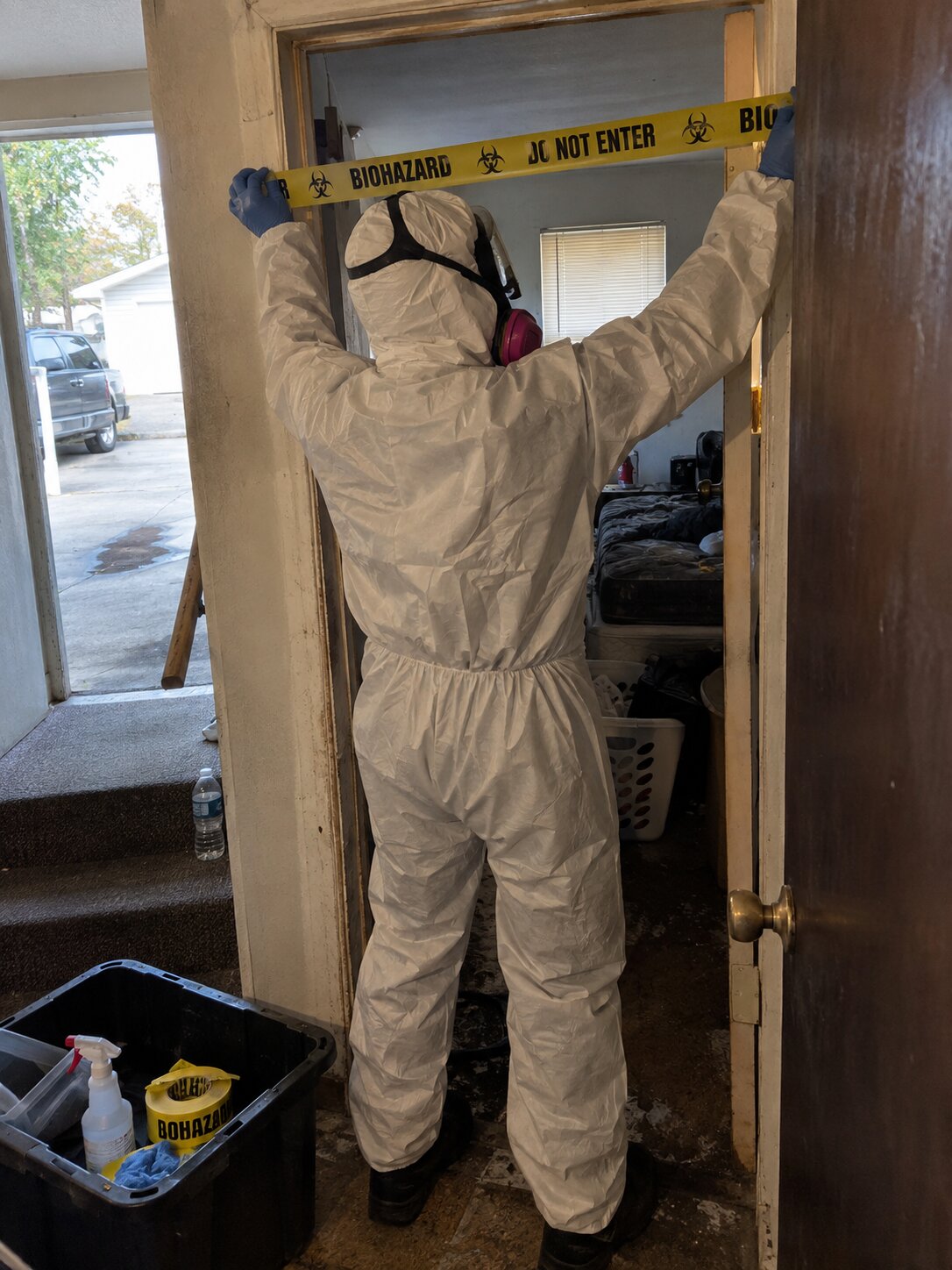
Biohazard Cleanup Services — Utah County
Biohazard cleanup addresses some of the most difficult situations property owners, family members, and property managers ever face. Trauma scenes following accidents or violent events, unattended death situations, blood cleanup after medical events or injuries, and biological contamination from various sources all require professional response with specific training, equipment, and disposal protocols. The work is regulated under federal (OSHA 29 CFR 1910.1030 — Bloodborne Pathogens Standard), state (Utah Department of Health regulations), and local health department requirements. Vault Mold Removal provides biohazard cleanup services across Utah County with the discretion, empathy, and professionalism these situations require. This page describes the types of situations we address, the technical work involved, and what families and property owners should understand about the process.
Types of Biohazard Situations
Trauma Scene Cleanup
Trauma scenes following accidents, violent events, or acute medical emergencies typically involve blood and other bodily fluid contamination on multiple surfaces. Our response is coordinated with law enforcement release timing — we don’t enter scenes until investigators have completed their work and the property is released for cleanup. The work involves systematic removal of visible contamination, disinfection of all affected surfaces, decontamination of adjacent areas that may have received aerosolized contamination, and appropriate disposal of contaminated materials.
Unattended Death Cleanup
Unattended deaths — deaths that aren’t discovered for hours, days, or longer — produce distinctive contamination and odor situations. Decomposition begins immediately after death and progresses through predictable stages that produce increasing biological contamination and severe odor loading. Depending on the discovery timeframe, temperature conditions, and location, the affected area may involve visible decomposition fluids, insect activity, and heavy odor absorption into surrounding materials. Effective cleanup involves biological contamination removal, thorough decontamination of all affected surfaces and materials, structural odor treatment, and often removal and replacement of porous materials that can’t be adequately decontaminated.
Blood Cleanup from Medical Events
Blood cleanup situations include medical emergencies at home (falls, injuries, dialysis mishaps, medication reactions), animal-related injuries, and post-surgery home care complications. These situations may involve limited surface area but require the same OSHA-compliant handling as larger trauma scenes because bloodborne pathogens (HIV, hepatitis B, hepatitis C) can be present in any blood contamination regardless of the source event.
Suicide Scene Cleanup
Suicide scenes are among the most emotionally difficult biohazard situations for surviving family members. Our response is coordinated with law enforcement, mental health support resources when family members request, and the family’s timing preferences for beginning cleanup. We work with the family’s chosen funeral home and other post-event service providers, and provide space for the family to complete any personal recovery of belongings before final cleaning.
Homeless or Illicit Activity Cleanup
Properties that have been used as illicit drug production sites, illicit drug use locations, or unauthorized homeless occupancy sometimes require biohazard cleanup after property owners regain access. These situations often involve drug residue, needles and other sharps, human waste, and various biological contamination. Meth lab remediation specifically follows Utah Department of Environmental Quality protocols that go beyond standard biohazard cleanup.
Hoarding Cleanup with Biohazard Components
Some hoarding situations include biohazard components: human or animal waste accumulation, decomposed food waste, dead animals within the property, and biological contamination from prolonged inadequate sanitation. Hoarding cleanup with biohazard elements requires coordination between the property occupant (often with mental health support), family members, and social services in addition to the physical cleanup work.
Sewage-Related Biohazard
Sewage cleanup includes biohazard elements, though standard Category 3 sewage cleanup protocols cover most residential situations. Sewage situations with additional biological contamination (unattended sewage that has aged extensively, sewage combined with other contamination) may warrant biohazard-level response beyond standard S500 sewage protocol.
The Regulatory Framework
OSHA Bloodborne Pathogens Standard (29 CFR 1910.1030)
Federal OSHA regulation governs occupational exposure to bloodborne pathogens. The standard applies to any worker who could reasonably be expected to have contact with blood or other potentially infectious materials (OPIM). Requirements:
- Written exposure control plan for the specific work
- Personal protective equipment appropriate to the specific hazards
- Engineering controls and work practice controls to minimize exposure
- Hepatitis B vaccination available to workers (we ensure our team is fully vaccinated)
- Post-exposure evaluation and follow-up if exposure occurs
- Bloodborne pathogen training for all workers
- Hazard communication and labeling
Utah Department of Health Regulations
State health department regulations cover disposal of medical waste and biological contamination. Requirements include appropriate containment for transport, labeling of biohazard containers, and disposal through licensed medical waste haulers.
Local Health Department Coordination
Utah County Health Department has jurisdiction over specific local health issues. Complex situations (meth lab remediation, significant public health impacts) involve health department coordination in addition to standard biohazard protocols.
Our Response Process
Initial Response and Family Coordination
Biohazard situations typically involve family members or property owners who are dealing with acute distress. Our first response is empathetic communication about what needs to happen, timing options that accommodate the family’s needs, and clear explanation of the process without overwhelming detail. We coordinate with any law enforcement, medical examiner, funeral home, insurance carrier, or other parties who need to be part of the response.
Site Assessment
Assessment establishes the scope of contamination, affected materials, and treatment plan. Assessment typically involves:
- Visual inspection of the affected area with photo documentation
- Contamination boundary mapping (which surfaces and materials are directly contaminated, which may have aerosolized or migration contamination)
- Materials assessment (which items can be decontaminated, which require removal)
- Odor and secondary contamination assessment (decomposition situations)
- Development of scope of work and cost estimate
Physical Cleanup
Cleanup proceeds systematically with full PPE (Tyvek Level D coveralls, respiratory protection appropriate to the specific hazards, chemical-resistant boots and gloves, face shields):
- Removal of visible contamination and heavily contaminated materials
- Cleaning of all affected surfaces with hospital-grade disinfectants
- Multiple cleaning passes for heavily contaminated surfaces
- Removal of porous materials that can’t be adequately decontaminated (carpet, upholstery, mattresses, drywall in extensive contamination cases)
- Substructure decontamination (subflooring, framing, wall cavity assessment)
- ATP testing verification of cleaning effectiveness on hard surfaces
Odor Treatment
Biohazard situations, particularly unattended deaths, typically require significant odor treatment beyond just the biological cleanup. Odor treatment is scaled to the specific situation and typically involves thermal fogging, hydroxyl generator treatment, and sometimes ozone treatment.
Regulated Waste Disposal
All contaminated materials are containerized in appropriate biohazard containers, labeled per regulations, and disposed through licensed medical waste haulers. Documentation of disposal path is retained for regulatory records.
Post-Cleanup Assessment and Reconstruction
After cleanup and decontamination, remaining reconstruction work returns the property to habitable condition. This can range from simple drywall patching and painting to extensive structural repair depending on the scope of the situation.
Insurance Coordination
Biohazard cleanup coverage under homeowner insurance varies significantly by carrier and situation:
- Trauma scenes and unattended deaths — typically covered under standard homeowner policies as a covered peril, though coverage limits vary. Some carriers have specific biohazard cleanup coverage limits (the dollar limit varies by policy, so check yours).
- Blood cleanup from medical events — typically covered under standard homeowner policies.
- Homeless occupancy or illicit activity — coverage varies; some situations may be covered under specific policy provisions (vandalism, unauthorized entry), others may not.
- Meth lab remediation — typically not covered under standard homeowner insurance; may be covered under specific rider policies or through separate claims processes.
Utah has victims compensation programs that may cover biohazard cleanup costs following certain criminal events; we can help families identify and access these resources when applicable.
Frequently Asked Questions
- How quickly can you respond to a biohazard situation?
- Depends on the specific situation and legal circumstances. Scenes requiring law enforcement or medical examiner clearance can’t be entered until those parties release the scene — timing is typically 12 hours to several days after the initial event. Once released, we can typically begin cleanup within 24–48 hours of family authorization. For situations without law enforcement involvement (medical events, minor accidents), response is typically same-day or next-day during business hours. Business-hours calls are answered live; after-hours calls route to on-call rotation for situations that need same-day communication.
- Do family members typically stay at the property during cleanup?
- Not usually, and generally we recommend against it. Being present during biohazard cleanup is emotionally difficult, and property occupancy during cleanup is complicated by the containment, chemical usage, and disposal work in progress. Most families arrange alternate accommodations during cleanup, either through insurance Additional Living Expense coverage or personally. If family members need to recover specific personal belongings before cleanup begins, we accommodate that scheduling — belongings can be retrieved with appropriate PPE and support from our team. Some family members choose to be present at specific decision points (item assessment for potential preservation) but not during physical cleanup work.
- What happens to belongings that are contaminated?
- Assessed individually based on contamination level and item characteristics. Non-porous items with limited surface contamination (some hard-goods, sealed electronics, metal fixtures) can often be professionally cleaned and preserved. Porous items with significant contamination (upholstered furniture, mattresses, carpet, textiles that can’t be professionally cleaned) typically require disposal. Sentimental items (photos, letters, jewelry, personal documents) receive priority handling for potential preservation whenever possible — sometimes items that would otherwise be discarded can be individually cleaned and preserved because of their sentimental value. We work with families to identify items with special significance and make every reasonable effort to preserve those items when preservation is possible.
- Are your employees vaccinated for hepatitis and other pathogens?
- Yes. OSHA’s Bloodborne Pathogens Standard requires employers to offer hepatitis B vaccination to any employee with potential exposure to bloodborne pathogens; we ensure all field team members complete the vaccination series before assignment to biohazard work. Additional vaccinations (tetanus, common industrial exposures) are also standard for our team. Post-exposure evaluation protocols are in place for any exposure incidents. This is protection for our workers, but it also matters for customers — a properly-vaccinated, trained team is significantly less likely to have exposure incidents that could result in delayed work, medical complications, or workers compensation claims that affect service continuity.
- Will the property be safe to occupy after cleanup?
- Yes, when cleanup is properly completed. Post-cleanup verification (ATP testing on high-contact surfaces, visual clearance inspection, air quality assessment for decomposition situations) confirms that the property has returned to safe occupancy condition. Documentation of the completed cleanup and verification results is provided for family records, insurance claim documentation, and future property transfer disclosure requirements. For situations involving property sale or rental after biohazard cleanup, some jurisdictions require specific disclosure — Utah’s disclosure requirements are moderate and typically don’t require specific disclosure of biohazard cleanup completed to professional standards, though property owners should consult with real estate attorneys for specific transaction guidance.
Contact Vault Mold Removal — Provo, UT
For biohazard cleanup, coordination with law enforcement for scene release, or questions about specific biohazard situations, contact our office directly. Business-hours calls answered live; after-hours calls route to on-call rotation. We work with discretion and appropriate empathy for the difficult circumstances these situations involve.
- Phone: (385) 250-2825
- Address: 1169 S 760 W, Provo, UT 84601
- Utah DOPL General Contractor License: #11876543-5501
- IICRC WRT / ASD / AMRT / OCT: #248317 / #248317-ASD / #319482 / #319482-OCT
Office Hours
- Monday – Saturday: 9:00 AM – 5:00 PM
- Sunday: Closed
Sewage backup in Provo? Call (385) 250-2825
Answered live 24/7 by the Vault crew. We clean up the sewage inside sealed containment, remove what can’t be saved and sanitize, then fix the cause with in-house sewer line work: snaking, hydro-jetting, camera inspection and repair. Free written estimates. Direct billing to State Farm, USAA, Allstate, Farmers and Bear River Mutual.
Sewage cleanup in Provo · Sewage backup cleanup · Real Provo sewage job
Helpful guides: Sewage health risks · Antimicrobial treatment
Frequently asked questions
What jobs are considered biohazard?
Sewage backups, trauma or unattended death scenes, hoarding cleanups, and anywhere bodily fluids or infectious materials are present. These need PPE, containment, and EPA-registered disinfectants — not household cleaners.
Is the work discreet?
Yes. Vault’s crew uses unmarked vehicles on request, works quietly, and keeps the scope between the property owner and the people who need to know.
Does insurance cover it?
Many homeowners and commercial policies cover biohazard cleanup when it’s tied to a covered loss. Check your policy; we document for the claim.
Questions we didn’t cover? Call (385) 250-2825.