
Vault mold remediation at a glance
- Who does the work: Vault’s own W-2 crew, no subcontractors. Our mold lead is Ryan Bautista, Mold Remediation & Drying Specialist (IICRC WRT and AMRT). Meet the team
- Credentials: IICRC AMRT (Applied Microbial Remediation) firm certification #319482, plus WRT, ASD and OCT · Utah DOPL General Contractor #11876543-5501 · EPA RRP lead-safe firm #NAT-F187294-1 · The Hartford GL + WC · bonded · BBB Accredited. Verify our credentials
- Where we’re based: staffed office, shop and warehouse at 1169 S 760 W, Provo, UT 84601. Phone answered live 24/7 at (385) 250-2825.
Mold inspection and remediation pricing
| Service | Price | What’s included |
|---|---|---|
| Basic visual inspection | $99 | Visual inspection of one area |
| Inspection with moisture mapping | $199 | Visual inspection plus moisture meter and thermal camera |
| Inspection with air sampling | $349 | Moisture meter and thermal camera, plus air sampling analyzed by Sporecyte, an outside lab |
| Mold remediation | From $500 | Free written remediation estimate after the initial assessment |
Our 90-day mold warranty
Remediation is covered for 90 days from post-remediation clearance. If mold returns in that time, we reinspect within 7 business days and re-remediate at no charge. The warranty transfers once to a new owner with a signed transfer form. Warranty details
Paying for it
When mold is covered by your policy, we document it, write the scope in Xactimate and bill State Farm, USAA, Allstate, Farmers or Bear River Mutual directly. For deductibles, uncovered work or uninsured jobs, financing is available through Wisetack: $500–$25,000 over 3–24 months, with a soft credit check. Financing
Where we work
Provo, Orem, Springville, Vineyard, Lindon and Mapleton. See mold remediation in Provo, Orem, mold inspection and testing and black mold.
Mold Inspection and Testing — Utah County
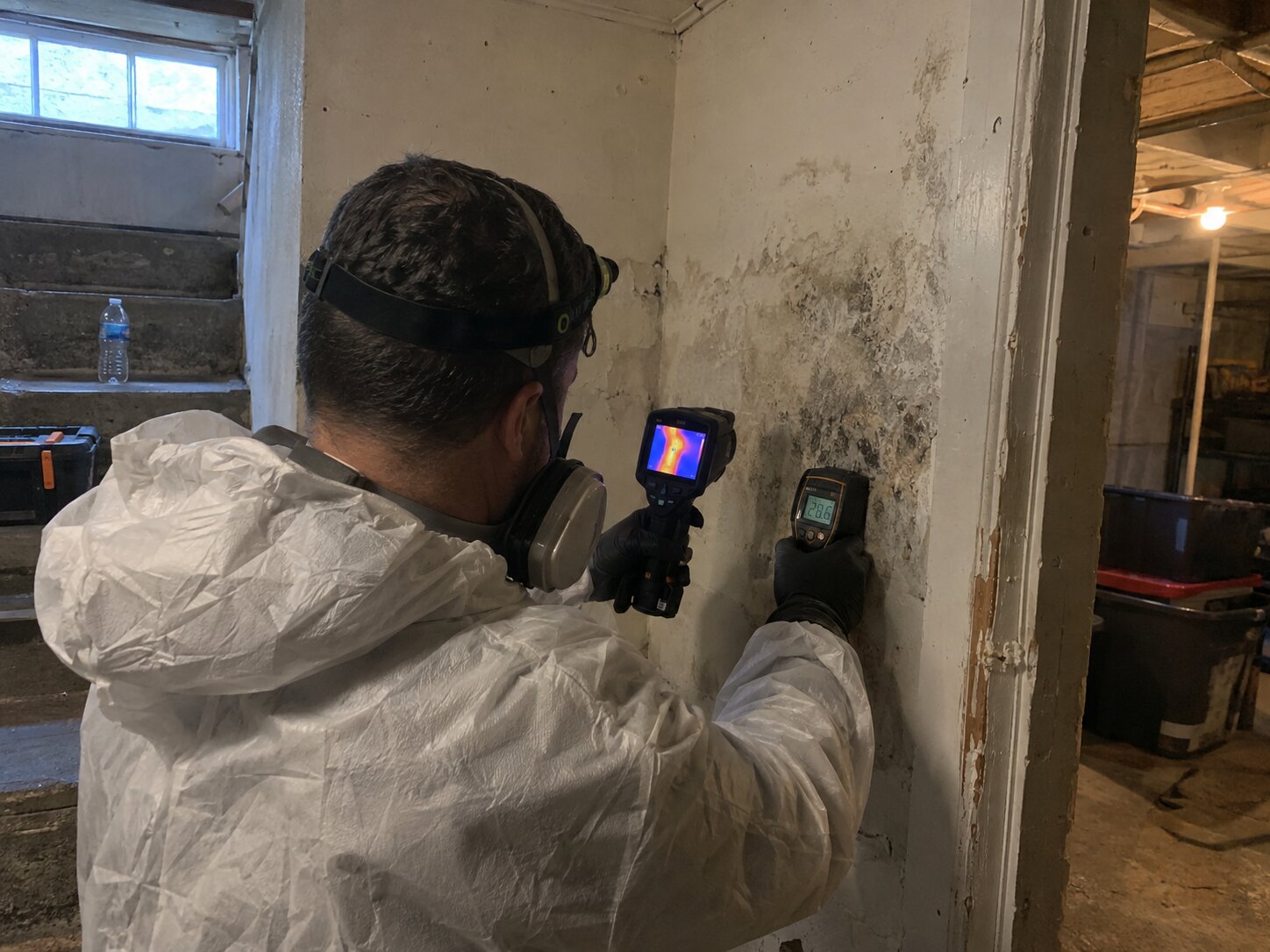
Mold inspection and testing establish what’s actually present in a property, where colonization is located, and what species are involved. It’s the assessment phase that precedes remediation planning, provides post-remediation verification, and supports real estate transactions, insurance claims, health documentation, and landlord-tenant disputes. Vault Mold Removal provides mold inspection services across Utah County using visual assessment, moisture mapping, thermal imaging, air sampling with cassette spore traps, surface swab testing, and accredited third-party laboratory analysis. This page describes what inspection actually involves, what test types are available, and when each type of assessment is appropriate.
What Mold Inspection Actually Involves
Inspection is more than just testing. A complete mold inspection is a multi-stage assessment that combines visual observation, environmental measurement, and sampling in an integrated approach. The stages:
Visual Assessment
The inspection starts with systematic visual observation of the property:
- Interior surfaces — walls, ceilings, floors, and any visible framing for signs of mold growth, water staining, or material degradation
- Fixture areas — behind and beneath sinks, toilets, appliances, and any plumbing penetrations
- HVAC systems — supply and return grilles, accessible ductwork, air handler drain pans, and evaporator coils
- Attic space — roof deck, insulation condition, ventilation adequacy, and any visible moisture or growth
- Crawlspace — vapor barrier condition, framing, and any moisture indicators
- Basement — foundation walls, floor slab, wall-floor intersections, and any visible seepage
- Exterior — grade slope, gutter and downspout condition, roof surface condition, and drainage patterns
Moisture Assessment
Since mold requires moisture, moisture assessment is central to inspection:
- Grid moisture readings across suspected affected areas using pin meters (Delmhorst BD-2100, Protimeter Surveymaster) and non-invasive scanning (Tramex Moisture Encounter Plus)
- Ambient humidity and temperature measurement in multiple property locations with psychrometric analysis
- Thermal imaging survey using FLIR E60/E75 cameras to identify hidden moisture patterns
- Assessment of moisture across HVAC condensate drains, plumbing penetrations, and any specific concern areas
Sampling and Laboratory Analysis
Sampling collects material for laboratory identification and quantification of mold. Sample types depend on the inspection purpose (discussed in detail below).
Written Report
The inspection produces a written report documenting findings: visual observations with photos, moisture data with grid maps, laboratory results with lab identification and analyst credentials, interpretation of the findings, and recommendations for any warranted response. Report delivery typically 5–10 business days after on-site work depending on lab turnaround times.
Sample Types and When Each Is Used
Air Sampling with Cassette Spore Traps
Air samples measure airborne mold spore concentrations. Most common method uses cassette spore traps (Air-O-Cell, Allergenco-D, or similar) that draw a known volume of air across an adhesive-coated sampling surface, capturing airborne spores for microscopic identification and counting at the laboratory.
Air sampling is appropriate when:
- Occupants report health symptoms without visible mold source
- Musty odor is present without obvious visible growth
- Post-remediation verification is needed to confirm remediation success
- Real estate transactions require documented indoor air quality assessment
- Comparison of interior spore levels to exterior baseline is needed to identify indoor amplification
Air sampling limitations:
- Provides snapshot at time of sampling, not continuous monitoring
- Non-viable spores are identified by morphology alone, not species-specific culture
- Cannot distinguish between actively growing colonization and settled dust from prior events
- Comparison to exterior baseline is essential — indoor spore levels are meaningful only relative to outdoor levels of the same species
Surface Swab Sampling
Surface swab samples collect material directly from suspected mold growth for laboratory identification. Sterile swab is drawn across a defined surface area, then submitted for either direct microscopy or culture-based identification.
Surface swab sampling is appropriate when:
- Visible mold growth is present and species identification is needed
- Suspicious material warrants determination of whether it’s actually mold or something else (efflorescence, dust, discoloration)
- Health documentation requires species identification of specific colonization
- Insurance claims require documentation of specific species
Bulk Sample Analysis
Bulk samples are physical pieces of material submitted to the laboratory for direct microscopy and species identification. Used when:
- Extensive colonization on a specific material warrants thorough species characterization
- Building material samples are needed for specific analysis
- Substrate assessment beyond surface identification is required
Tape Lift Sampling
Tape lift samples use adhesive tape pressed against a surface to lift growth material for microscopy. Used when:
- Non-destructive sampling is preferred over swab (which can disturb the surface)
- The material characteristics (dry, powdery growth) are better suited to tape lift than swab
- Multiple small samples are needed across an assessment area
When Testing Is Warranted vs. Not Warranted
Testing Is Warranted When
- Health documentation is needed for occupants experiencing potential mold-related symptoms
- Post-remediation verification (PRV) is required to confirm remediation success
- Real estate transactions require documented indoor air quality baseline
- Insurance claim disputes require third-party evidence of species and extent
- Landlord-tenant disputes require documented conditions
- Hidden mold is suspected based on odor or health indicators without visible source
- Large-scale remediation projects require baseline documentation before work begins
Testing Is Not Necessarily Warranted When
- Small visible mold with obvious moisture source and clear remediation path (just remediate)
- Property owner considering DIY cleaning of small visible growth (guidance and threshold matter more than testing)
- General “peace of mind” testing without specific concerns (results are hard to interpret without specific reason for testing)
The EPA’s official position on mold testing: “Standards or thresholds for acceptable, tolerable, or normal quantities of mold have not been established.” Test results are most meaningful when there’s a specific question being answered, such as comparison to exterior baseline or verification of post-remediation status.
Accredited Laboratory Analysis
Test samples are only as reliable as the laboratory analyzing them. We work with AIHA-accredited environmental microbiology laboratories that provide:
- Environmental Microbiology Laboratory Accreditation Program (EMLAP) accreditation
- Analysis by credentialed mycologists (typically minimum M.S. degree in relevant field)
- Standard turnaround times (24-hour rush, standard 3–5 day, extended culture 7–14 day)
- Documented QA/QC procedures
- Chain of custody protocols for sample integrity
AIHA-accredited results carry weight in insurance disputes, real estate transactions, and legal proceedings that results from non-accredited labs typically don’t.
Utah County Inspection Situations
Real Estate Transaction Inspections
Utah real estate disclosure requirements mandate seller disclosure of known material defects, including mold. Pre-listing inspections identify any mold issues before they become transaction complications. Buyer’s inspections during due diligence identify any conditions that warrant disclosure or remediation requirements as part of the purchase. Coordination with real estate agents, both buyer’s and seller’s, is often part of the inspection scope.
Post-Remediation Verification
Remediation projects require PRV to confirm that the work was successful. Third-party PRV (inspector not affiliated with the remediation contractor) is an option some owners choose. Vault performs PRV itself, with air samples analyzed by Sporecyte, an outside laboratory. PRV typically includes visual clearance, moisture verification, and air sampling with comparison to exterior baseline.
Health-Motivated Inspections
Occupants experiencing symptoms that could be mold-related sometimes commission inspection to determine whether mold is present in their environment. The interpretation of results in health contexts benefits from coordination with the occupant’s healthcare provider, since environmental data alone doesn’t establish causation of specific symptoms.
Landlord-Tenant Disputes
Utah’s Fit Premises Act (Utah Code § 57-22) establishes landlord obligations for maintaining safe rental conditions. Mold in rental properties can constitute a habitability issue depending on extent, species, and impact on occupants. Third-party inspection documents conditions for either party’s use in dispute resolution.
Insurance Claim Support
Insurance disputes over mold coverage sometimes require third-party documentation of species, extent, and cause. Inspection reports with laboratory analysis provide the evidentiary basis for these disputes.
Frequently Asked Questions
- How much does mold inspection and testing cost?
- Depends on scope. A basic visual inspection with moisture assessment (no sampling) costs $199 at Vault (a visual-only check of one area is $99). Air sampling with lab analysis is Vault’s $349 inspection tier, which also includes the moisture meter and thermal camera check. Surface swab sampling adds $75–$150 per sample. Comprehensive inspection with visual assessment, moisture mapping, thermal imaging, and multiple sample types is Vault’s $349 tier: moisture meter, thermal camera and air sampling with lab analysis. Larger properties, commercial buildings, and complex situations have proportionally higher costs. The inspection is separate from remediation costs — it’s an assessment that identifies what’s present, not the correction of what’s found.
- Do I really need testing, or can I just have visible mold remediated?
- Depends on your specific situation. Small visible mold with obvious moisture source and clear remediation path typically doesn’t require testing — the remediation contractor identifies the growth, addresses the moisture source, and remediates under IICRC S520 protocol. Testing adds cost without changing the remediation approach in these straightforward situations. Testing becomes valuable when documentation is important (real estate transactions, insurance disputes, health claims), when hidden mold is suspected without visible source, when species identification affects health decisions, or when post-remediation verification is required. For most straightforward residential mold, remediation without pre-testing is a reasonable approach — but PRV after remediation is worth the cost for documentation.
- What do “normal” air sample results look like?
- There’s no universally accepted “normal” — the EPA has explicitly declined to establish acceptable thresholds because indoor mold levels naturally vary by season, geography, and property characteristics. Meaningful interpretation compares indoor levels to outdoor baseline of the same species. Typical result patterns: outdoor Cladosporium and Aspergillus/Penicillium levels are usually higher than indoor levels (outdoor air is full of mold spores from natural decay); Stachybotrys, Chaetomium, and Fusarium should generally not be present indoors at meaningfully higher concentrations than outdoors (their presence typically indicates indoor amplification from a moisture problem). Total spore counts can range from a few hundred per cubic meter to tens of thousands, with interpretation always relative to outdoor comparison and specific species patterns. A qualified interpreter is essential — raw numbers without context are hard to make useful decisions from.
- Should I use consumer mold test kits from the hardware store?
- Generally not. Consumer test kits typically use petri dish cultures exposed to indoor air — a fundamentally unreliable method because indoor air always contains mold spores, so every kit will produce growth regardless of whether an actual indoor mold problem exists. The kits typically don’t provide meaningful interpretation, don’t compare to outdoor baseline, and don’t identify species reliably. The $10–$40 kits produce results that either falsely reassure (mold “wasn’t found” when the sampling method wouldn’t have found it) or falsely alarm (growth in the petri dish that would occur in any indoor environment). For meaningful assessment, professional inspection with cassette spore trap air sampling analyzed by accredited laboratory is the appropriate approach. The cost difference is significant, but the difference in reliability is much larger.
- How quickly can I get inspection results?
- On-site inspection typically takes 2–4 hours for standard residential properties, longer for larger or more complex situations. Laboratory analysis turnaround depends on the specific tests and lab: standard air sample analysis typically 3–5 business days, culture-based analysis 7–14 business days for definitive species identification, and rush analysis available at premium cost for time-sensitive situations (24-hour turnaround for real estate transactions and similar urgent needs). Written report delivery typically 2–3 business days after receiving all laboratory results. Total timeline from initial call to complete written report is typically 7–14 business days for standard inspection, faster with rush processing when needed.
Contact Vault Mold Removal — Provo, UT
For mold inspection and testing, post-remediation verification, or real estate transaction assessment, contact our office directly.
- Phone: (385) 250-2825
- Address: 1169 S 760 W, Provo, UT 84601
- Utah DOPL General Contractor License: #11876543-5501
- IICRC WRT / ASD / AMRT / OCT: #248317 / #248317-ASD / #319482 / #319482-OCT
Office Hours
- Monday – Saturday: 8:00 AM – 5:00 PM
- Sunday: Closed
Helpful guides: Mold air sampling · Post-remediation clearance
What our Provo customers say
“We kept noticing a musty smell in our upstairs bathroom but couldn’t see any obvious mold. The inspector checked around the shower, under the sink, and along the walls with moisture detection equipment. Everything was explained in plain language, including which areas needed further testing. I appreciated the thorough inspection and clear recommendations.”
— Melissa T., Provo, Utah
Frequently asked questions
What does a mold inspection include?
Visual inspection, moisture readings with Delmhorst and Protimeter meters, and thermal imaging with FLIR cameras to find hidden moisture. Vault's inspections start at $99; the $349 tier adds air sampling analyzed by Sporecyte.
Do I always need air testing?
No. Air sampling helps when mold may be hidden, when you want pre-purchase documentation, or for post-remediation clearance. Many visible mold problems can be scoped and remediated based on inspection alone.
How long does the inspection take?
Most residential inspections take about 1-2 hours on site. Air sample results from Sporecyte come back in a few business days.
Questions we didn’t cover? Call (385) 250-2825.
This is part of our mold remediation in Provo service: inspection, sealed containment with HEPA negative air, removal and clearance by our AMRT-certified crew. Call (385) 250-2825.