
Water damage emergency guide: Provo, UT
What to do in the first hour, how to document for your insurer, and how to get Vault on the way.
- Call any hour: (385) 250-2825 is answered live 24/7 by the Vault crew. 45-minute arrival inside Provo city limits (Monday–Saturday, 8 AM–5 PM); typically under 60 minutes elsewhere in our Utah County service area.
- In-house: emergency extraction, moisture mapping, structural drying setup within the first visit, Xactimate documentation and direct insurance billing.
- Who does the work: Vault’s own W-2 crew, IICRC certified in WRT, ASD, AMRT and OCT, under Utah DOPL General Contractor License #11876543-5501. No subcontractors. Meet the team
- Insurance: Xactimate scopes, daily moisture readings on file, direct billing to State Farm, USAA, Allstate, Farmers and Bear River Mutual.
- Pricing: free written estimates. Water mitigation typically $3,500–$8,500; reconstruction $4,500–$9,500. 24-month workmanship warranty · Wisetack financing
- Family-owned and veteran-operated, based in Provo since 2020.
Water damage restoration · Mold remediation · Sewage cleanup · Reconstruction & repairs
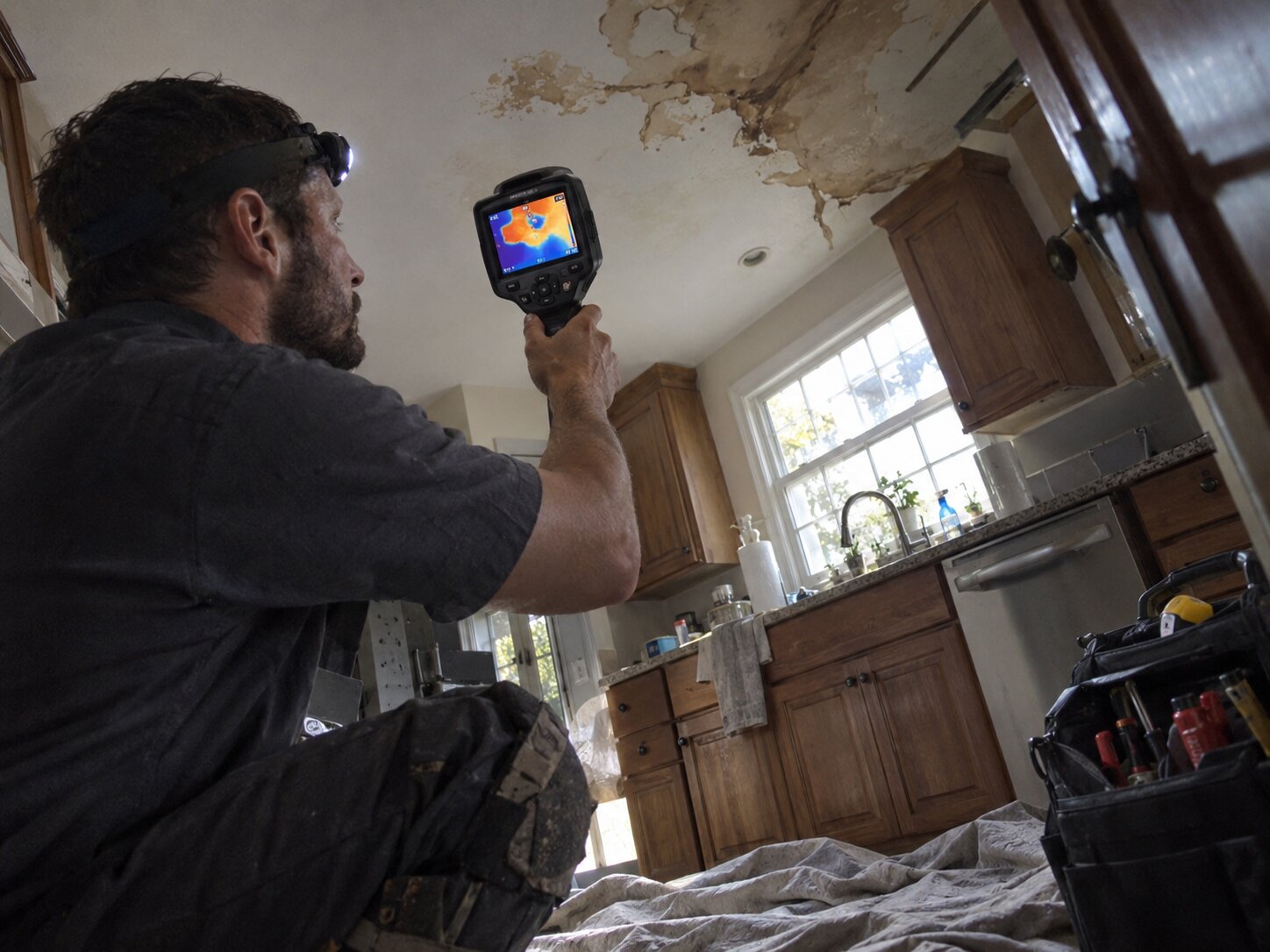
Water Damage Emergency Guide — Provo, Utah
What you do in the first hour after discovering water damage significantly affects both the total damage extent and the eventual cost of restoration. This guide walks through the practical steps for the first hours after a water event, in the order they typically make sense to address. It’s written for the situation where you’ve just discovered water damage and are figuring out what to do next — not a comprehensive restoration guide but a practical action guide for the immediate response. Different water events warrant different specific approaches, but the general framework applies broadly across Utah County residential and commercial situations. If your specific situation involves any of the safety hazards mentioned below, professional response is essential; DIY approaches don’t produce adequate results for events beyond the property owner’s technical capability.
Immediate Safety Assessment (First 5 Minutes)
Electrical Hazards
Water and electricity create serious injury and fire risks. Before doing anything else:
- Check for standing water near electrical outlets, appliances, or panels: Any water contact with energized electrical equipment is a shock and fire hazard.
- Turn off circuits serving the affected area at the electrical panel if you can safely reach the panel without walking through standing water.
- Don’t enter standing water in unfamiliar areas without knowing the electrical status — even shallow water can pose lethal shock hazard if contacting energized electrical equipment.
- Call an electrician if uncertain — the electrical status assessment before continuing is worth the delay.
Structural Hazards
Water can compromise structural integrity in ways that aren’t immediately obvious:
- Ceiling sagging from water accumulation above — potentially catastrophic collapse hazard
- Floor weakening from extended water contact in older or lightweight construction
- Weakened stair treads or landings
- Any visible cracking, bulging, or unusual deformation of walls or ceilings
Areas with any visible structural concern should be evacuated and inspected by professionals before further use.
Water Contamination Assessment
Determine what kind of water you’re dealing with:
- Clean water: Supply lines, water heater failures, faucet overflow. Direct exposure is generally low-risk.
- Grey water: Washing machine, dishwasher, aquarium water, non-fecal toilet overflow. Wear gloves; wash after any contact.
- Black water: Sewage, floodwater, or fecal-contaminated water. Avoid direct contact; keep children and pets away; wear full protection for any necessary contact.
Family and Pet Safety
- Move children and pets away from affected areas until professional cleanup for Category 3 events
- Consider temporary relocation if the affected area is extensive or contains contamination
- Address any medical concerns (respiratory symptoms, skin contact reactions) with medical professionals rather than DIY approaches
Stop the Water Source (First 15 Minutes)
Locate and Shut Off the Source
Standard shutoff locations for common water sources:
- Fixture shutoff valves: Under sinks, behind toilets, at appliance connections. Turn clockwise to close.
- Water heater shutoff: On the cold water inlet at the top of the water heater. Turn clockwise to close.
- Main water shutoff: Where the water service enters the house. Turn clockwise to close. Typical locations: near the front foundation for single-family homes, in a utility room or basement, or at the water meter for older properties.
- Washing machine shutoff: Behind the washing machine at the wall connections.
- Ice maker shutoff: Behind the refrigerator or at a saddle valve on the supply line.
What to Do If You Can’t Locate the Shutoff
If you can’t locate the fixture shutoff or if it isn’t working:
- Close the main water shutoff to the whole property
- If you can’t locate the main shutoff, contact your water utility for shutoff at the meter
- Provo residents: Provo City Water at (801) 852-6120
- Orem residents: Orem Water Utilities at (801) 229-7500
- Other Utah County municipalities: check with your local utility department
Special Situations
- Broken pipe with active flow: Main shutoff for immediate action; targeted repair after
- Sewer backup: Don’t flush toilets or use drains that connect to the backup line until the backup is addressed
- Roof leak during rain: Buckets or containers to capture ongoing water; move contents away from the affected area; temporary tarping arrangements as feasible
- Sump pump failure: If safe, verify power and pump operation; call for professional response for active flooding
Document Everything (Ongoing from Discovery)
Photo and Video Documentation
Comprehensive documentation supports insurance claims and provides record for restoration scope development:
- Photos of all affected areas including wide views and close-ups
- Photos of specific damaged items and their locations
- Video walkthrough of the affected areas
- Timestamped documentation (most modern phones include this automatically)
- Documentation of the water source and any visible cause
Written Documentation
- Time and date of discovery
- How the damage was discovered
- Actions taken (in the order taken, with times)
- Any observations about the water source or cause
- List of affected items and rooms
Insurance Claim Preparation
- Contact your insurance carrier promptly (most policies require prompt notification)
- Provide the initial claim information (what happened, when, extent)
- Get the claim number for reference in all subsequent communications
- Ask about your specific policy provisions for water damage (deductible, coverage limitations, ALE if the property is uninhabitable)
Immediate Mitigation Actions (First 1–3 Hours)
Standing Water Removal
DIY steps for standing water removal (Category 1 events only; leave Category 3 water for professional response):
- Wet vacuum equipment (rented from home improvement stores if not owned) for larger volumes
- Buckets and towels for smaller volumes
- Squeegees or brooms to move water to drainage points if the floor drains toward specific locations
- Discharge to sanitary drain or to the outside where practical
Contents Protection
Move at-risk contents out of the affected area:
- Furniture with wooden legs off wet flooring (aluminum foil or plastic wrap around legs prevents finish staining while water dries)
- Books, papers, and other paper items to dry locations
- Electronics that could be damaged by ongoing exposure
- Rugs and cushions off wet flooring where practical
- Photographs and irreplaceable items to safe locations
Air Circulation
Increase air movement to begin drying:
- Open windows if outdoor humidity is lower than indoor humidity (typical during Utah County dry periods)
- Run fans (any fans available — ceiling fans, portable fans, box fans) to increase air movement
- Turn on air conditioning if outdoor temperature warrants it (AC reduces humidity as well as moving air)
- Turn on ventilation systems (bathroom fans, kitchen exhaust) to help remove moist air
Contents Sorting
Begin sorting affected items:
- Non-porous items that can be dried and cleaned (metal, glass, plastic)
- Porous items that may or may not be salvageable (upholstered furniture, carpet, mattresses)
- Items likely to be non-salvageable (paper products, extensively contaminated soft goods)
- Photographs and documents that need immediate attention to prevent further damage
Call Professional Response (First 2–4 Hours)
When Professional Response Is Essential
Situations that warrant professional response regardless of DIY inclination:
- Category 3 water (sewage, floodwater, contaminated)
- Extensive damage across multiple rooms
- Water damage from unknown source that needs investigation
- Electrical or structural concerns
- Standing water that can’t be practically removed with available DIY equipment
- Damage that may involve insurance claim submission
- Damage in areas that will require specialty work (finished flooring, cabinetry, drywall)
What to Expect from Professional Response
- Initial call: Response coordination, arrival estimate, immediate guidance for any actions to take before arrival
- On-site assessment: Damage extent evaluation, category determination, scope development
- Insurance coordination: Documentation and communication with your insurance carrier
- Emergency mitigation: Extraction, initial drying setup, temporary protection
- Extended response: Continued drying, disinfection, material removal as needed, reconstruction planning
Response Timing
Standard response times for professional water damage response in Utah County:
- Provo: Business-hours response typically within 34–62 minutes; after-hours response typically within 2–4 hours
- Orem: 41–68 minutes business hours; 2–4 hours after-hours
- Springville: 48–74 minutes business hours; extended for after-hours
- Vineyard, Lindon, Mapleton: 45–82 minutes business hours; 2–5 hours after-hours
During major storm events or regional water damage situations, response times can extend beyond standard estimates due to demand across the market.
What NOT to Do
Common Mistakes
- Don’t wait to see if it dries on its own: Delay typically increases scope and cost significantly
- Don’t apply heat to accelerate drying without proper equipment: Space heaters or high heat can produce moisture problems elsewhere in the property
- Don’t try to save extensively contaminated items: Cost of proper decontamination often exceeds replacement value
- Don’t turn off electrical service to unaffected areas: Just turn off circuits specifically affected by water contact
- Don’t attempt DIY response for Category 3 water: Health risks and technical complexity warrant professional response
- Don’t wait to call your insurance carrier: Most policies require prompt notification, and delayed reporting can affect coverage
- Don’t sign contracts under pressure at the scene: Take time to review any restoration contracts before signing
Contractor Concerns
After significant water damage events, unfortunately, some contractors show up unsolicited offering services. Cautions:
- Verify contractor licensing (Utah DOPL contractor license) before signing any contracts
- Verify insurance and bonding
- Check references or online reviews
- Don’t feel pressured to make immediate decisions on contracts
- Get written scope documentation before authorizing work
- Understand your insurance carrier’s requirements for contractor selection (some carriers have preferred provider programs; others allow property owner choice)
Following Days
What to Expect During Restoration
- Drying equipment operating continuously in affected areas (loud but essential)
- Regular moisture monitoring by restoration technicians
- Possible material removal as scope develops (drywall, flooring, insulation)
- Continued communication with insurance adjuster
- Contents evaluation and pack-out if scope warrants
- Timeline development for reconstruction phase
What You Can Do During Restoration
- Keep the property accessible for restoration crew during scheduled work times
- Move any additional contents you’re concerned about to safer locations
- Communicate concerns about specific items or areas to the restoration team
- Keep documentation ongoing throughout the process
- Address any questions with the restoration team rather than making assumptions
Frequently Asked Questions
- What’s the single most important thing to do in the first hour?
- Stop the water source. Everything else can wait 5–10 minutes without significantly worse outcomes, but ongoing water release continues to expand the damage extent and cost every minute. Locate and shut off the source, or if you can’t identify the specific source, close the main water shutoff to the whole property. Everything after that is important but can happen after the ongoing damage is stopped. If you have a helper available, one person can address the water source while another begins safety assessment and documentation, but the priority is stopping the water flow before addressing anything else.
- Should I call my insurance carrier before or after calling a restoration contractor?
- Order doesn’t matter much for most situations, and calling both in parallel is often the fastest approach. Consideration: some insurance carriers have preferred provider programs where their preferred contractors get faster claim approvals; some property owners prefer to select their own contractor regardless of preferred provider status. Both approaches are legitimate, and the specific choice depends on your preferences and any specific carrier requirements. What matters more than order: call both promptly. Delayed insurance notification can affect coverage; delayed restoration response allows damage to expand. Whether you call insurance first, contractor first, or in parallel, do both within the first few hours after discovery. For questions about your specific carrier’s requirements, you can ask when you make the initial claim call.
- How do I know if the water damage is bad enough to warrant professional help?
- Several thresholds warrant professional response even if the visible damage seems manageable: any water damage that will potentially be an insurance claim (documentation supporting the claim requires professional scope development), Category 3 water regardless of visible extent (health and technical requirements), damage across more than one room or affecting multiple materials (extraction, drying, and material coordination beyond DIY capacity), damage that has been active for more than a few hours (mold and category progression concerns), or any damage where you’re uncertain about the appropriate response. Small localized events with clear source and minimal spread — a fixture leak caught immediately with limited water spread — may be manageable with DIY response if you have the equipment (wet vacuum, fans) and the water contact is limited. Anything beyond that generally benefits from professional assessment even if the eventual response is minimal.
- What if I’m not sure whether the water is clean or contaminated?
- Treat it as more contaminated than you think until confirmed otherwise. Category 1 water misclassified as more contaminated leads to overcautious response with minimal downside; higher-category water misclassified as clean leads to inadequate response with significant health and property implications. Practical assessment questions: was the source a plumbing supply line to a sink or fixture (Category 1)? Was the source a washing machine, dishwasher, or aquarium (Category 2)? Was the source a toilet with any waste content, a sewer line, or floodwater (Category 3)? Do you see contamination indicators (discoloration, debris, odor)? Has the water been sitting for extended time (progression to higher category)? When uncertain, professional assessment provides definitive categorization. Wearing gloves and washing thoroughly after any water contact is appropriate for any category above Category 1.
- Can I just wait until tomorrow morning to deal with a water event that happened at night?
- Depends on the specific situation, but generally no. Waiting 8–12 hours often makes significant difference in scope and cost. Category 1 water can progress to Category 2 during overnight waiting; Category 2 can progress to Category 3. Ongoing exposure produces continuing damage to structural elements and contents. Mold growth potentially begins during overnight periods at Utah’s typical interior temperatures. Insurance claim documentation is stronger when response is prompt rather than delayed. What might make waiting acceptable: very small events where water source is stopped and standing water is minimal, situations where safety concerns make immediate response impractical, or situations where competent DIY response has been implemented and professional response is scheduled for the following morning. What makes waiting inappropriate: any Category 3 event, extensive damage with contents or structural implications, ongoing water source that hasn’t been stopped, or situations with electrical or structural safety concerns. When in doubt, call for after-hours guidance rather than waiting; even if physical response is scheduled for morning, guidance can help with overnight actions to limit continued damage.
Contact Vault Mold Removal — Provo, UT
For water damage response, guidance during active water events, or coordination for restoration response, contact our office directly. Business-hours calls answered live; after-hours calls route to on-call rotation for time-sensitive events.
- Phone: (385) 250-2825
- Address: 1169 S 760 W, Provo, UT 84601
- Utah DOPL General Contractor License: #11876543-5501
- IICRC WRT / ASD / AMRT / OCT: #248317 / #248317-ASD / #319482 / #319482-OCT
Office Hours
- Monday – Saturday: 9:00 AM – 5:00 PM
- Sunday: Closed
More guides: What if water damage isn’t fixed? · Water meter leak test
For a burst pipe or overflow in Provo, see emergency water damage in Provo or call (385) 250-2825, answered live 24/7.