
Crawlspace water damage
Crawlspaces hold water from plumbing leaks, groundwater seepage or vapor from exposed dirt. Wet insulation, framing and vapor barrier all have to be addressed, or the house above will have moisture problems.
- Call any hour: (385) 250-2825 is answered live 24/7 by the Vault crew. 45-minute arrival inside Provo city limits (Monday–Saturday, 8 AM–5 PM); typically under 60 minutes elsewhere in our Utah County service area.
- What Vault does: pump-out of standing water, removal of wet insulation and vapor barrier, framing drying, and replacement of the vapor barrier after the crawlspace is dry.
- Who does the work: Vault’s own W-2 crew, IICRC certified in WRT, ASD, AMRT and OCT, under Utah DOPL General Contractor License #11876543-5501. Meet the team
- Insurance: Xactimate scopes, daily moisture readings, direct billing to State Farm, USAA, Allstate, Farmers and Bear River Mutual.
- Pricing: free written estimates. Water mitigation typically $3,500–$8,500; reconstruction $4,500–$9,500. 24-month workmanship warranty · Wisetack financing
- Family-owned and veteran-operated, based in Provo since 2020.
Clean water (Cat 1) · Grey water (Cat 2) · Black water (Cat 3) · Hidden leaks · Crawlspace · Attic leaks
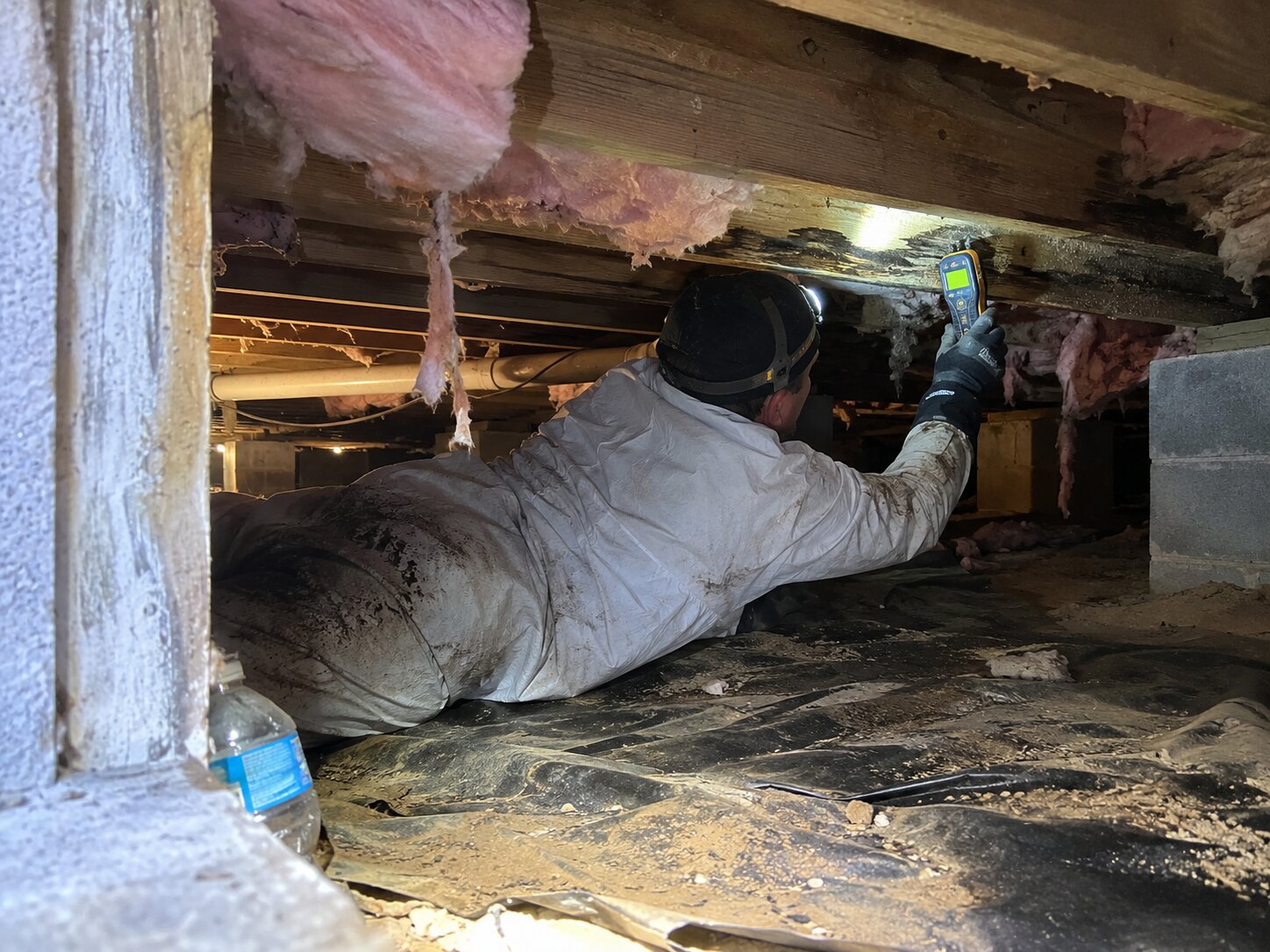
Crawlspace Water Damage — Utah County Response
Crawlspaces present a specific set of water damage challenges that don’t apply to above-grade living spaces. The physical characteristics — limited height, restricted access, close proximity to soil, exposure to seasonal moisture variation — produce damage patterns and response requirements distinct from other water damage situations. Utah County has significant crawlspace construction, particularly in homes built before the 1980s and in specific neighborhoods with historic construction patterns. Crawlspace water damage often goes unnoticed for extended periods due to the out-of-sight nature of the space, producing more extensive damage by the time it’s discovered. Vault Mold Removal handles crawlspace water damage across Utah County with the specific equipment, safety protocols, and technical approach these environments require. This page describes the specific considerations for crawlspace water damage response.
Why Crawlspaces Are Different
Physical Constraints
Crawlspace physical characteristics affect every aspect of response:
- Height: Typical crawlspace heights range from 18 inches to 48 inches, restricting standing work and requiring workers to crawl or work while lying down
- Access: Typical access is through a single hatch (interior) or exterior vent (exterior), with the hatch or vent dimensions further restricting movement of equipment and materials
- Visibility: Natural lighting is limited or absent, requiring portable lighting for all work
- Ventilation: Crawlspaces have limited ventilation, requiring supplemental ventilation during work involving chemicals or high-humidity conditions
- Ground surface: Most Utah County crawlspaces have dirt floors, sometimes with vapor barriers of varying condition, producing high ambient humidity even in dry conditions
Environmental Conditions
Crawlspaces have specific environmental characteristics:
- Ambient humidity: Higher than living space humidity due to soil moisture exposure and limited ventilation. Even “dry” crawlspaces typically have relative humidity in the 60–70% range, and can exceed 80% during humid weather or after water events.
- Temperature: Cooler than living space in summer (due to earth-cooling effect), variable in winter (typically 45–55°F depending on insulation and outdoor conditions)
- Air quality: Often has musty odor from ambient moisture and any decomposition of natural materials; some crawlspaces have specific air quality issues from radon, mold, or other sources
- Pest presence: Crawlspaces are common habitat for spiders, rodents, and other pests, which affects both safety and biological contamination considerations
Structural Implications
Crawlspace conditions affect the structural framing directly above:
- Floor joists, beams, and posts are exposed to ambient crawlspace conditions
- Wood framing at 15%+ moisture content develops rot over time
- Metal components (nails, connectors, ductwork) develop corrosion at elevated humidity
- Insulation between floor joists can hold moisture and develop mold
- Ductwork condensation can drip onto floor joists and other framing
Common Crawlspace Water Damage Sources
Plumbing Failures in Crawlspaces
Many homes route supply lines and drain lines through crawlspaces. Failures in this plumbing produce direct water damage in the crawlspace and often extend upward to affect the flooring and living spaces above:
- Supply line failures at connection points to the water heater, boiler, or manifold
- Drain line failures at joints in cast iron, ABS, or PVC drainage
- Water heater installation locations in crawlspaces (though less common than in utility rooms) with catastrophic tank failure potential
- Boiler and hydronic heating systems that use crawlspaces for equipment location
Groundwater Intrusion
Crawlspaces are the entry point for groundwater during high-water conditions:
- High water table events during spring runoff or after sustained precipitation
- Foundation cracks allowing seepage during high-water conditions
- Grade issues where the ground surface directs water toward the crawlspace
- Drainage failures (French drains, foundation drains, sump systems) allowing groundwater accumulation
Vapor Barrier Failures
Many Utah County crawlspaces have vapor barriers over the dirt floor to control soil moisture migration. Failures include:
- Aged or damaged vapor barriers allowing increased soil moisture migration
- Poorly-installed vapor barriers with gaps or improper edge sealing
- No vapor barrier at all in some older or informal construction
Vapor barrier failures don’t produce sudden water damage like plumbing failures but produce chronic elevated humidity that contributes to structural deterioration and mold growth over time.
Duct Condensation
HVAC ductwork routed through crawlspaces develops condensation issues:
- Cooling ducts in warm humid conditions develop exterior condensation
- Damaged duct insulation allows more extensive condensation
- Condensation dripping onto floor framing, insulation, and other crawlspace surfaces
Foundation and Below-Grade Wall Issues
Foundation waterproofing failures can produce crawlspace water damage:
- Concrete block foundation walls with mortar joint failures
- Poured concrete foundations with cracks allowing seepage
- Waterproofing coating deterioration on exterior foundation surfaces
Sump Pump Failures
Crawlspaces with drainage systems often include sump pumps to remove accumulated water. Pump failures produce water accumulation:
- Mechanical pump failure from age or component wear
- Power failure during periods when pump operation is needed
- Discharge line failures allowing water to return to the crawlspace
- Pump inadequate for the water volume during high-water events
Crawlspace Water Damage Response
Assessment
Initial crawlspace assessment covers:
- Source identification and status (active flow vs. resolved)
- Standing water extent and depth
- Affected framing (joists, beams, subfloor) with moisture readings
- Insulation condition
- Vapor barrier condition
- Ductwork status
- Any visible mold growth
- Structural implications from water exposure duration
- Safety hazards (electrical, structural, biological)
Water Extraction
Crawlspace extraction has specific considerations:
- Submersible pumps for standing water removal
- Wet vacuum equipment for residual water after pumping
- Extraction equipment sized for crawlspace access dimensions
- Discharge routing appropriate to water category (Category 1 to sanitary sewer, Category 3 to appropriate disposal)
Material Removal
Crawlspace material removal typically involves:
- Wet insulation: Fiberglass batt insulation between floor joists that has been saturated typically requires removal; wet insulation loses R-value, holds moisture, and develops mold
- Damaged vapor barrier: Vapor barrier that has been torn, damaged, or extensively contaminated during the water event typically requires replacement
- Damaged ductwork insulation: Insulation on ductwork that has been saturated typically requires replacement
- Rot-affected framing: Framing members with significant rot damage require replacement or sistering with new members
Structural Drying
Crawlspace drying uses specific approaches matched to the space:
- Air movers positioned to move air across affected framing
- Dehumidification with equipment sized for the crawlspace volume
- Ventilation coordination to remove moisture-laden air
- Heat introduction when beneficial for evaporation acceleration
- Extended drying timelines compared to above-grade spaces (typically 5–10 days for crawlspace drying vs. 3–7 days for equivalent above-grade areas)
Target moisture content: 15% or lower for wood framing before restoration is considered complete.
Disinfection
Crawlspace disinfection depends on the water category:
- Category 1 disinfection is minimal (standard antimicrobial application)
- Category 2 disinfection involves more thorough application
- Category 3 disinfection is comprehensive with hospital-grade products and multiple applications
Mold Assessment and Remediation
Crawlspaces have elevated mold risk due to the combination of moisture, temperature, and organic materials (wood framing, insulation). Mold assessment is essentially always part of crawlspace water damage response:
- Visual inspection for existing mold growth
- Assessment of contamination extent based on the water event duration
- IICRC S520 Condition classification
- Remediation scope development matched to the condition classification
- Antimicrobial application beyond routine disinfection where mold is present
Vapor Barrier Replacement
Where the existing vapor barrier is damaged or where none exists, vapor barrier installation is often part of the restoration scope:
- 6-mil polyethylene sheeting minimum thickness for standard applications
- Seams overlapped and taped for continuous coverage
- Edges sealed to foundation walls
- Extension up perimeter walls where appropriate
Encapsulation Considerations
For crawlspaces with chronic moisture issues, encapsulation (full sealing of the crawlspace with vapor barrier, wall insulation, and dehumidification) may be recommended as a permanent solution rather than repeated response to intermittent moisture. Encapsulation:
- Reduces ambient humidity in the crawlspace significantly
- Reduces mold and structural deterioration risk
- Improves energy efficiency of the space above
- Requires ongoing dehumidification and monitoring
Encapsulation is a specialty project typically coordinated with dedicated crawlspace specialists rather than standard water damage restoration, though the initial water damage response often coordinates with encapsulation contractors for the longer-term solution.
OSHA Confined Space Considerations
Some crawlspaces qualify as confined spaces under OSHA regulations (29 CFR 1910.146), triggering specific safety requirements:
- Limited or restricted entry and exit
- Limited size for work
- Not designed for continuous occupancy
For crawlspaces qualifying as permit-required confined spaces (specific criteria beyond the basic definition), additional protocols apply: atmospheric testing before entry, ventilation during work, continuous atmospheric monitoring, and standby personnel for emergency response. Most standard crawlspaces don’t require permit-required protocols, but the basic confined space considerations always apply. Our protocols address these safety requirements as part of standard crawlspace response.
Frequently Asked Questions
- My crawlspace has always been damp. Is that a problem I need to address?
- Depends on how damp and what “always damp” means. Some baseline moisture is normal in Utah County crawlspaces due to soil moisture and limited ventilation; relative humidity in the 60–70% range is common and doesn’t necessarily indicate a problem. Concerning conditions: relative humidity consistently above 70% without seasonal explanation, standing water in the crawlspace at any point, visible mold growth on framing or other surfaces, musty odor migrating up into living spaces, framing that appears wet or rotted, and health issues in the household that correlate with living in the property. Chronic dampness produces slow damage that isn’t dramatic day-to-day but accumulates over years: framing deterioration reducing structural capacity, mold growth affecting air quality throughout the home, insulation degradation reducing energy efficiency, and pest attraction from the moisture and warmth. Professional assessment of your crawlspace can identify whether current conditions warrant intervention or whether the dampness is within normal range. For homes with chronic dampness that hasn’t been addressed, crawlspace remediation is typically a worthwhile investment even without a specific water damage event.
- Can water damage in my crawlspace affect the rest of my house?
- Yes, in several ways. Air movement between crawlspaces and living spaces is more significant than most homeowners realize: air from the crawlspace typically moves upward through the property via the stack effect and pressure differences, carrying whatever the crawlspace air contains into the living spaces. Contamination effects include: musty odors migrating into living spaces, mold spores from crawlspace growth affecting indoor air quality, elevated humidity affecting comfort and building conditions in the living space, and potential health effects from mold, radon, and other crawlspace air quality issues. Structural effects: framing deterioration in the crawlspace affects the floor structure above, insulation issues in the crawlspace affect energy efficiency and comfort in the living space, and pest issues in the crawlspace can migrate to the living space. This is why crawlspace water damage warrants prompt response even though it’s not affecting living spaces directly.
- Do you have to remove all my crawlspace insulation?
- Depends on the specific condition. Wet insulation that has been saturated by the water event typically requires removal; wet fiberglass loses R-value, holds moisture, develops mold, and doesn’t recover to pre-wet condition through drying. Dry insulation that wasn’t affected by the water event stays. Damp insulation that was exposed to elevated humidity but not directly wetted is a case-by-case decision: sometimes it dries adequately and is preserved, sometimes it’s replaced as a precautionary measure, and sometimes the specific condition warrants replacement. Insulation decisions balance the specific condition assessment against the cost and disruption of replacement. For crawlspace insulation that has been chronically damp or has questionable condition prior to the current event, replacement as part of the response often produces long-term benefits beyond the immediate event.
- How long does crawlspace water damage restoration take?
- Typical timeline: 5–10 days for the mitigation phase (extraction, material removal, drying, disinfection) plus any additional time for structural repair or encapsulation work. Small crawlspace water events (localized damage, limited scope) can complete in 1–2 weeks total. Standard crawlspace events (widespread damage, moderate material replacement, mold remediation) typically take 3–6 weeks. Larger events (whole-crawlspace flooding, extensive structural damage, comprehensive encapsulation) can extend to 2–4 months. Timeline drivers: physical access limitations that slow work compared to above-grade spaces, extended drying times for wood framing in crawlspace conditions, potential mold remediation depending on the specific damage, and coordination with any structural repair or encapsulation work that’s part of the overall scope.
- Should I encapsulate my crawlspace after water damage restoration?
- Depends on your specific situation. Encapsulation makes sense when: your crawlspace has chronic moisture issues that will continue producing damage without permanent intervention, you’re already doing significant restoration work that makes the incremental encapsulation cost reasonable, you’re interested in the energy efficiency and air quality benefits, and you have the budget for the specialty work encapsulation requires. Encapsulation is often not the right choice when: your crawlspace is otherwise in good condition and the water event was from a specific resolvable source rather than chronic conditions, you’re not seeing sustained moisture issues in the space, the water damage restoration by itself addresses your immediate concerns adequately, or budget priorities favor other improvements to the property. Discussing encapsulation options during the restoration scope development lets you make an informed decision about whether the additional work makes sense for your specific situation. Encapsulation isn’t always the right answer, but for the right situations it produces significant long-term value beyond addressing the immediate water damage.
Contact Vault Mold Removal — Provo, UT
For crawlspace water damage response, mold assessment, or coordination for encapsulation projects following water damage, contact our office directly.
- Phone: (385) 250-2825
- Address: 1169 S 760 W, Provo, UT 84601
- Utah DOPL General Contractor License: #11876543-5501
- IICRC WRT / ASD / AMRT / OCT: #248317 / #248317-ASD / #319482 / #319482-OCT
Office Hours
- Monday – Saturday: 9:00 AM – 5:00 PM
- Sunday: Closed
Helpful guides: Mold on subfloor and framing · Sweating pipes