
Hidden water leaks
Not every leak shows up right away. A pinhole in a supply line, a drip under a cabinet or a slow leak behind a wall can run for weeks before anyone notices. Vault finds hidden water with moisture meters and a thermal camera.
- Call any hour: (385) 250-2825 is answered live 24/7 by the Vault crew. 45-minute arrival inside Provo city limits (Monday–Saturday, 8 AM–5 PM); typically under 60 minutes elsewhere in our Utah County service area.
- What Vault does: moisture mapping with Delmhorst-style pin meters, thermal camera to find temperature differences, flood cuts in drywall where needed, structural drying, and mold remediation if growth has started.
- Who does the work: Vault’s own W-2 crew, IICRC certified in WRT, ASD, AMRT and OCT, under Utah DOPL General Contractor License #11876543-5501. Meet the team
- Insurance: Xactimate scopes, daily moisture readings, direct billing to State Farm, USAA, Allstate, Farmers and Bear River Mutual.
- Pricing: free written estimates. Water mitigation typically $3,500–$8,500; reconstruction $4,500–$9,500. 24-month workmanship warranty · Wisetack financing
- Family-owned and veteran-operated, based in Provo since 2020.
Clean water (Cat 1) · Grey water (Cat 2) · Black water (Cat 3) · Hidden leaks · Crawlspace · Attic leaks
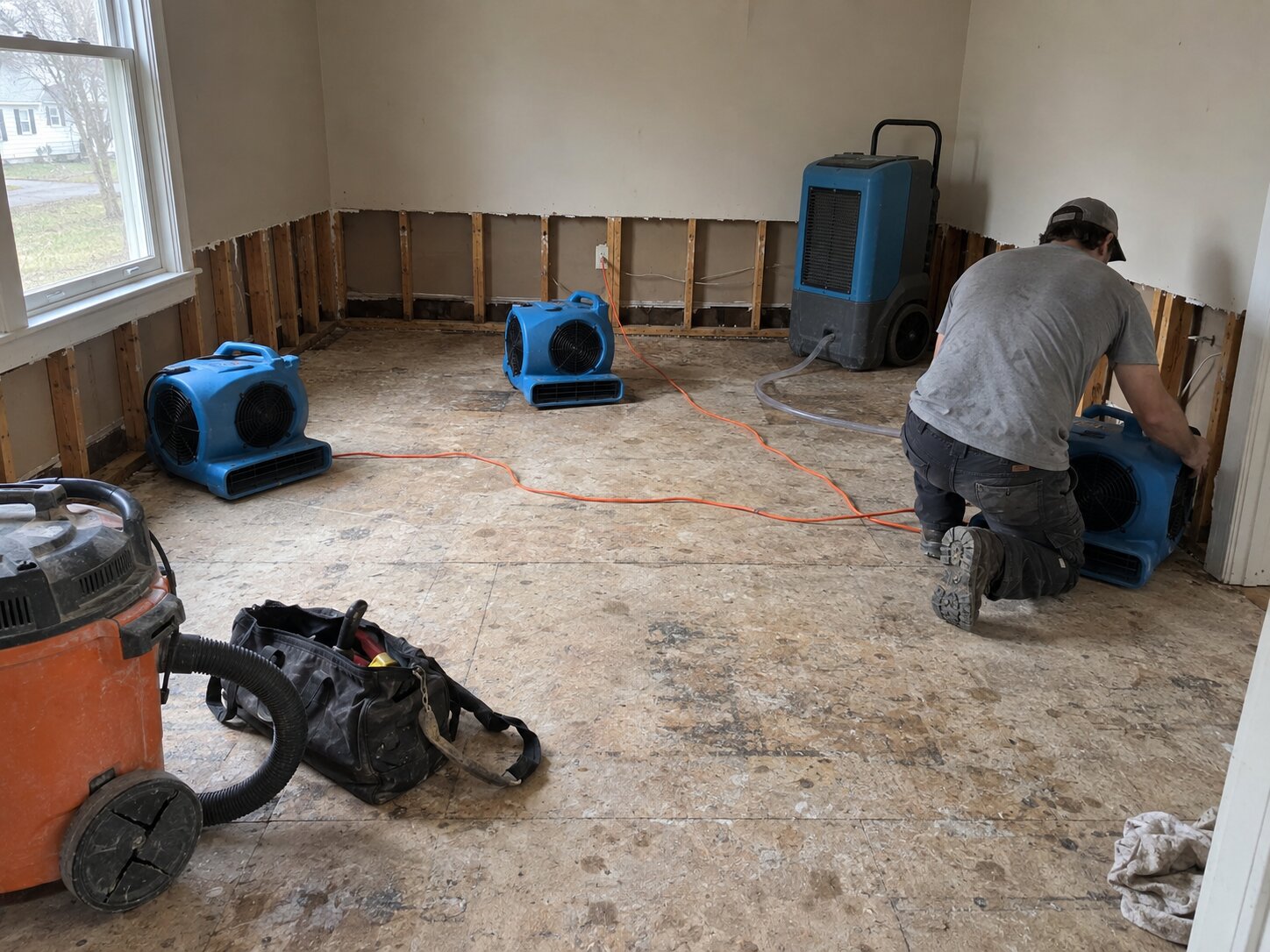
Hidden Leak Detection and Response — Utah County
Hidden leaks are water damage events where the source and often the extent aren’t immediately visible. Water travels inside wall assemblies, above ceilings, under floors, or through building systems in ways that can produce significant damage before any visible indication appears. By the time visible damage becomes apparent, hidden leaks have often been active for weeks or months, and the actual damage extent typically exceeds what’s visible on the surface. This makes hidden leaks a distinct category of water damage response: detection is a specialized skill separate from the mitigation work, mold development is nearly universal because the extended timeline provides ideal growth conditions, and scope development often requires more investigation than events with visible sources. Vault Mold Removal handles hidden leak detection and response across Utah County using non-destructive testing methods, systematic investigation protocols, and comprehensive remediation for the damage extent revealed during investigation.
Common Hidden Leak Sources
Inside Wall Plumbing Failures
Water supply lines and drain lines running inside wall cavities can develop leaks that release water into the wall assembly rather than into visible spaces:
- Copper pipe pinhole leaks: Copper piping develops pinhole failures particularly in Utah’s hard water conditions (22–26 gpg mineral content). Pinhole leaks release small volumes of water continuously over extended periods, often producing significant cumulative damage before discovery.
- PEX or CPVC line failures: Failures at fittings or connections in newer plastic plumbing can produce hidden leaks. Fitting-related failures are more common than material failures in the pipe itself.
- Cast iron drain line failures: Older cast iron drainage develops cracks and joint failures as it ages. Utah County homes built before approximately 1980 typically have cast iron drainage that’s approaching or exceeding typical service life.
- ABS or PVC drain line failures: Newer plastic drainage develops fewer failures than cast iron but can fail at fittings or after physical damage.
- Shower valve or bathtub plumbing failures: Behind-wall plumbing at shower and tub installations can leak into wall cavities during use.
Under Floor Leaks
Leaks in the space between the finished floor and the subfloor, or in the crawlspace or basement below, produce hidden damage patterns:
- Under-slab plumbing leaks in slab-on-grade construction
- Crawlspace plumbing leaks affecting flooring above
- Radiant floor heating system failures
- Basement waterproofing failures during high-water conditions
Roof Leaks with Delayed Interior Appearance
Roof leaks often produce interior damage that appears in locations remote from the actual roof failure point, and sometimes with significant delay:
- Water enters through a specific roof failure point but travels along framing before appearing on a ceiling
- Interior damage appears in one room from a leak actually located above a different area of the house
- Attic accumulation produces gradual insulation saturation before any ceiling damage appears
- Insulation-buffered leaks can be active for weeks before saturation reaches the point of ceiling penetration
HVAC System Leaks
HVAC systems can produce hidden water damage:
- Condensate line failures in attic or crawlspace air handler installations
- Refrigerant coil condensation issues when insulation fails
- Humidifier leaks (whole-house humidifier installations on furnaces or air handlers)
- Ductwork condensation on cooling ducts in warm humid spaces
Appliance Leaks with Concealed Damage
Some appliance leaks produce visible damage immediately; others produce concealed damage that only becomes apparent later:
- Slow refrigerator ice maker line leaks producing damage under the appliance or behind the wall
- Dishwasher leaks producing damage under cabinet bases
- Washing machine slow drain leaks accumulating in wall cavities behind the appliance
- Water heater slow leaks (before catastrophic tank failure) producing damage at the water heater installation location
Foundation and Below-Grade Leaks
Water intrusion at the foundation level can produce hidden damage:
- Foundation crack seepage during high-water conditions
- Window well drainage failures with subsequent basement infiltration
- Below-grade wall leaks in basements with waterproofing failures
- Sump pit overflow or pump failure producing gradual accumulation
Signs of Hidden Leaks
Visible Indicators
- Water stains on ceilings, walls, or floors (often yellowish, brown, or orange coloring)
- Paint peeling, bubbling, or discoloration on walls or ceilings
- Warped or buckled flooring
- Warped or damaged baseboards or trim
- Efflorescence (white mineral deposits) on masonry walls, indicating moisture migration through the material
- Rust stains on ceilings or walls where water contacts steel components inside the wall
Odor Indicators
- Musty odor that persists despite cleaning
- Odor localized to specific areas that doesn’t have an obvious source
- Odor that intensifies during rainy weather or when HVAC is operating
Utility Bill Indicators
- Unexplained increases in water usage on utility bills
- Water meter running when all fixtures are turned off (indicates active water flow somewhere in the system)
Physical Indicators
- Soft spots in flooring where water has weakened subfloor
- Cracking or damage patterns in walls or ceilings suggesting moisture-related movement
- Insect activity in specific areas (some insects are attracted to moisture)
- Visible mold growth (a late-stage indicator of hidden leak that has been active for weeks or months)
Health Indicators
- Family members developing respiratory symptoms that improve when away from the property
- Allergy-like symptoms with no obvious cause
- Asthma or other respiratory condition worsening in specific rooms
Non-Destructive Detection Methods
Moisture Mapping
Systematic measurement of moisture content across affected and adjacent areas identifies the moisture pattern:
- Pin-based moisture meters (Delmhorst BD-2100) for direct moisture readings through drywall or into wood
- Non-invasive moisture meters (Protimeter Surveymaster) for surface scanning without penetration
- Deep-wall probe extensions for readings inside wall cavities without cutting
- Concrete moisture meters for slab moisture assessment
Moisture mapping produces a grid of readings that shows the moisture pattern, typically pointing toward the leak source through the pattern of higher readings.
Thermal Imaging
Infrared thermal cameras (FLIR E60 or E75) show temperature differences that indicate moisture presence:
- Wet materials have different thermal properties than dry materials, appearing as temperature anomalies in thermal images
- Active water flow produces temperature signatures visible in thermal imaging
- Insulation gaps and moisture patterns often show clearly in thermal imaging that wouldn’t be visible otherwise
Thermal imaging is powerful but not definitive on its own — the temperature anomalies must be confirmed with moisture readings before conclusions are drawn. Thermal imaging alone can produce false positives from insulation issues, HVAC-related temperature differences, or other non-moisture temperature variations.
Acoustic Leak Detection
Some hidden leaks can be located through sound: water flowing through pipes produces specific acoustic signatures that can be located with sensitive listening equipment. Acoustic detection is particularly effective for active pressure line leaks that are producing continuous water flow.
Tracer Gas Detection
For leaks that are difficult to locate through other methods, tracer gas methods introduce a specific gas into the plumbing system and detect where the gas exits into the building. This is a specialty service typically brought in for difficult cases rather than a standard detection method.
Selective Demolition
When non-destructive methods narrow the leak location to a specific area but don’t identify the exact source, selective demolition (opening small access holes) may be required to confirm the source. Selective demolition is a last resort after non-destructive methods have narrowed the location, minimizing the extent of demolition needed for source identification.
Hidden Leak Response Approach
Investigation Phase
Standard investigation approach for hidden leaks:
- Interview with property owner about symptoms, timing, and any related information
- Visual inspection of the affected areas and adjacent spaces
- Moisture mapping across the visible affected area and adjacent areas
- Thermal imaging where beneficial for pattern identification
- Assessment of building systems (plumbing, HVAC, roofing) for likely source
- Selective demolition if needed to confirm source identification
- Documentation of investigation findings and scope development
Source Resolution
Once the source is identified, source resolution comes before restoration:
- Plumbing repair through licensed plumbers for plumbing-source leaks
- Roofing repair through licensed roofers for roof-source leaks
- HVAC repair for HVAC-source leaks
- Building envelope repair for infiltration issues
- Coordination with source-resolution contractors when their work needs to complete before restoration begins
Mold Assessment
Hidden leaks typically produce mold growth due to extended moisture exposure. Mold assessment is essentially always part of hidden leak response:
- Visual inspection for mold growth in affected areas
- Assessment of contamination extent based on the duration of the leak and the affected materials
- IICRC S520 Condition classification (I, II, or III based on contamination extent)
- Remediation scope development matched to the specific contamination condition
- Post-remediation verification through visual inspection and, for larger events, air sampling
Restoration Scope
Restoration for hidden leaks typically involves more material removal than events with visible sources:
- Removal of all clearly water-affected materials
- Removal of adjacent materials that may have hidden damage or mold growth
- Structural assessment for any framing damage from extended exposure
- Comprehensive drying of remaining materials
- Antimicrobial application to prevent mold recurrence
Reconstruction
Reconstruction after hidden leak response follows standard restoration reconstruction: framing repair if needed, insulation replacement, drywall replacement with joint work and texture matching, painting to match existing finish, flooring replacement or repair, and any specialized reconstruction needed for the specific damage.
Frequently Asked Questions
- I think I have a hidden leak but I’m not sure. How do I know if I really need professional investigation?
- Several signs warrant professional investigation: any visible water stains, discoloration, or paint issues on walls or ceilings even if small; persistent musty odor localized to specific areas; unexplained water bill increases; family members with unexplained respiratory symptoms that improve away from the property; and visible mold growth even in small amounts. Professional investigation is warranted before the situation gets worse because hidden leaks generally continue to produce damage until the source is resolved, and delayed response typically results in more extensive damage and higher restoration cost. Initial investigation is typically less expensive than the damage that continues to accumulate during procrastination. Contact us for an initial assessment; we can typically identify whether the situation warrants full investigation or is likely a different issue requiring a different approach.
- Can I locate hidden leaks myself before calling for professional help?
- Some initial investigation is reasonable, though professional detection typically finds issues that DIY approaches miss. DIY steps that can help: check your water meter with all fixtures turned off — if it’s still moving, water is flowing somewhere; walk the affected area looking for the highest concentration of symptoms (stains, odor, soft spots); check plumbing fixtures in adjacent rooms above the affected area for any signs of leak or moisture; check the attic for signs of leak or moisture concentration; look for high-humidity indicators in specific areas (condensation, unusually cool surfaces). What DIY can’t do effectively: quantitative moisture mapping to identify the leak source, thermal imaging without professional equipment, wall-cavity assessment without cutting into walls, and mold assessment beyond obvious visible growth. For any leak that hasn’t been resolved through your initial investigation, or where the extent isn’t clear, professional response is warranted before the situation continues to deteriorate.
- Will my insurance cover hidden leak damage that has been happening for a long time?
- Depends on the specific cause and policy. Standard homeowner policies generally exclude damage from gradual leaks and long-term seepage while covering sudden and accidental water damage. This creates coverage complications for hidden leaks: if the leak has been happening for weeks or months before discovery, coverage may be disputed on the basis of “long-term seepage” exclusion. What supports coverage: documentation of the specific sudden event that started the damage (a specific pipe failure vs. gradual deterioration), evidence that the property owner responded promptly upon discovery of the issue, and any policy provisions that specifically address delayed-discovery situations. What complicates coverage: extended time between when damage began and when it was discovered, evidence that the property owner had indicators of the leak but delayed response, and gradually-developed damage patterns rather than sudden failure patterns. Insurance claim development for hidden leaks often involves discussion with the adjuster about the specific timeline and cause, with documentation supporting the coverage position. For questions specific to your situation, discussing with your insurance carrier or a public adjuster can clarify the specific coverage picture.
- How long does hidden leak restoration typically take?
- Depends significantly on the extent of damage discovered during investigation. Small hidden leaks discovered relatively early (localized damage, moderate mold, limited material replacement) typically complete in 3–6 weeks total including investigation, source resolution, mold remediation, and restoration. Standard hidden leaks (multi-room damage, moderate mold contamination) typically take 6–12 weeks. Larger hidden leaks with extensive concealed damage (whole-wall or ceiling assemblies affected, significant mold contamination, extensive framing exposure) can extend to 3–6 months. The main time drivers: investigation and source resolution phase before restoration begins, mold remediation timing when significant contamination is present, and reconstruction scope after mitigation completes. Hidden leaks with significant mold contamination generally take longer than simple water damage events of similar area because mold remediation adds specific work beyond standard water damage response.
- What if you can’t locate the source through investigation?
- Rare with systematic investigation, but does occasionally happen. When standard investigation methods don’t identify the source: expanded investigation with additional methods (tracer gas, acoustic detection, more extensive thermal imaging) may be warranted for difficult cases, plumbing pressure testing can identify system-wide leaks that aren’t obvious from visible investigation, and in some cases sequential elimination approaches (temporarily isolating specific plumbing sections to see if damage stops) may be needed. Most hidden leaks can be located through systematic investigation, though the timeline for identification varies with case complexity. If investigation isn’t identifying a clear source, additional approaches or specialty investigators may be needed. In some rare cases, the leak is from a source that has already resolved itself (a pipe that leaked briefly and then stopped without visible indication of the failure), leaving only the residual damage without an ongoing water source. These situations are addressed by remediating the existing damage while monitoring for any recurrence.
Contact Vault Mold Removal — Provo, UT
For hidden leak investigation, moisture mapping, thermal imaging assessment, or restoration response after hidden leak discovery, contact our office directly.
- Phone: (385) 250-2825
- Address: 1169 S 760 W, Provo, UT 84601
- Utah DOPL General Contractor License: #11876543-5501
- IICRC WRT / ASD / AMRT / OCT: #248317 / #248317-ASD / #319482 / #319482-OCT
Office Hours
- Monday – Saturday: 9:00 AM – 5:00 PM
- Sunday: Closed
Helpful guides: Water meter leak test · Thermal imaging for leaks · High water pressure