
Grey water (Category 2) damage
Grey water is Category 2: dishwasher or washing machine overflow, aquarium water, water from a toilet bowl with no solids. It contains some contamination, so wet porous materials often come out even though the water is clear.
- Call any hour: (385) 250-2825 is answered live 24/7 by the Vault crew. 45-minute arrival inside Provo city limits (Monday–Saturday, 8 AM–5 PM); typically under 60 minutes elsewhere in our Utah County service area.
- What Vault does: extraction, removal of carpet pad and other porous materials that can’t be cleaned, antimicrobial treatment of hard surfaces, structural drying, and reconstruction.
- Who does the work: Vault’s own W-2 crew, IICRC certified in WRT, ASD, AMRT and OCT, under Utah DOPL General Contractor License #11876543-5501. Meet the team
- Insurance: Xactimate scopes, daily moisture readings, direct billing to State Farm, USAA, Allstate, Farmers and Bear River Mutual.
- Pricing: free written estimates. Water mitigation typically $3,500–$8,500; reconstruction $4,500–$9,500. 24-month workmanship warranty · Wisetack financing
- Family-owned and veteran-operated, based in Provo since 2020.
Clean water (Cat 1) · Grey water (Cat 2) · Black water (Cat 3) · Hidden leaks · Crawlspace · Attic leaks
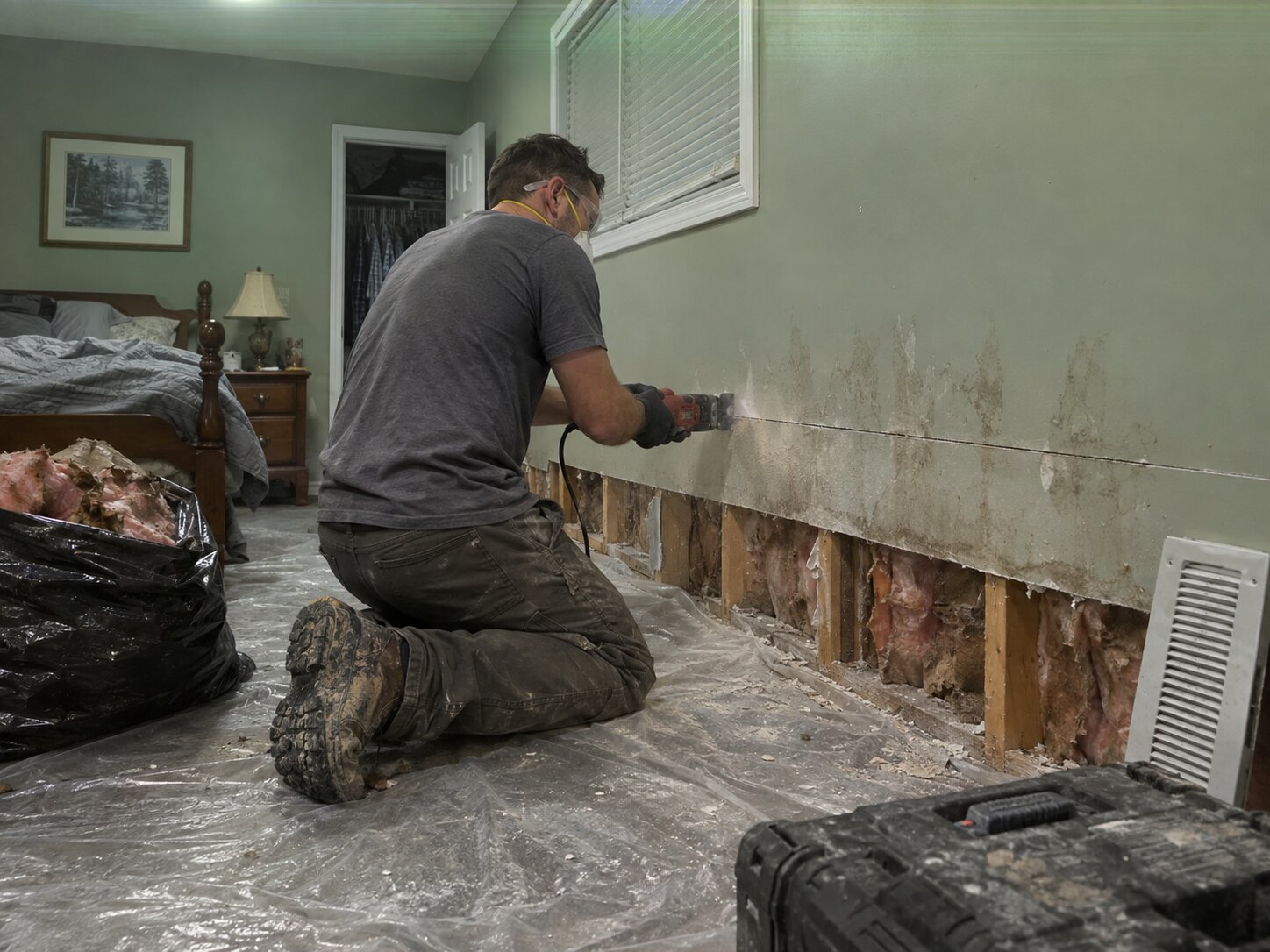
Category 2 Grey Water Damage — Utah County Response
Grey water damage — IICRC Category 2 under the S500 Standard — is water damage from a source with significant contamination that could cause discomfort or illness if consumed but doesn’t rise to the pathogenic contamination level of Category 3. The response protocols are more restrictive than Category 1 but less than Category 3: enhanced PPE, targeted disinfection, and typically replacement of porous materials with extensive contact. Category 2 events have specific handling requirements that produce meaningfully different scope than Category 1 events with similar visible damage. And like Category 1, time matters: Category 2 water progresses to Category 3 within 24–48 hours if not addressed, particularly at Utah’s summer temperatures. Vault Mold Removal handles Category 2 water damage across Utah County with IICRC S500 protocols including appropriate disinfection, material handling, and worker protection.
Common Category 2 Water Sources
Washing Machine Failures
Washing machine water is Category 2 due to detergent contamination, dirt from laundered items, and any bacterial content from soiled fabrics. Common failure modes:
- Supply hose failure at either the wall connection or the machine connection
- Drain hose failure or displacement during cycle operation
- Internal pump failure allowing water to escape the wash tub
- Door or lid seal failure on front-loading machines
- Overflow from clogged drain lines that back up into the wash tub
Washing machine events typically produce moderate-volume flooding contained to the laundry area but can extend to adjacent rooms through door openings and to lower floors in multi-story homes.
Dishwasher Failures
Dishwasher water is Category 2 due to detergent contamination, food debris, and grease from cleaning cycles. Common failure modes:
- Door seal failure allowing water to escape during cycle operation
- Supply line failure at the dishwasher connection
- Internal pump or spray arm failure with unusual water flow patterns
- Overflow from clogged drain
- Air gap or high-loop failure allowing sink drain water back into the dishwasher
Dishwasher events typically produce localized flooding at the appliance location extending under cabinetry to adjacent rooms. Damage to adjacent cabinet bases and flooring is common.
Aquarium and Fish Tank Failures
Aquarium water contains fish waste, uneaten food, algae, and bacterial content from the biological filtration system. Sudden aquarium failures (tank cracking, seal failure, filter overflow) release significant water with Category 2 contamination. Marine (saltwater) aquariums add salt contamination to the water damage scope, requiring additional consideration for corrosion damage to metals contacted.
Waterbed Failures
Waterbeds contain treated water that develops significant bacterial contamination during service. Waterbed failures release large volumes of Category 2 water — a typical full-size waterbed holds 150–200 gallons, king-size 200–250 gallons.
Toilet Overflow — Urine Only (No Fecal Matter)
Toilet overflow limited to urine content is Category 2; toilet overflow with fecal matter is Category 3. Distinguishing between these scenarios depends on what was in the toilet when overflow occurred and what backed up from the drain line. Common Category 2 toilet scenarios: bowl overflow from urination when the fill valve was already malfunctioning, toilet tank overflow from float mechanism failure with clean water in the tank, and clog-related bowl overflow where the clog is above the trap and only clean tank water was in the bowl at the time.
Sink and Bathtub Drain Backups
Drain backups from sinks or bathtubs with limited contamination (mostly clean water from the fixture with drain content contamination) are Category 2. Distinguishing from Category 3: source content matters. Backup from a bathroom sink drain (limited waste content) is Category 2; backup from a kitchen sink drain with food waste is Category 2 to 3 depending on contents; backup from any drain with sewer content is Category 3.
Overflow from Broken Aquarium Filters or Water Features
Home water features (fountains, aquascapes, water gardens) contain water that develops bacterial and algal content during service. Overflow or failure of these features produces Category 2 water damage.
Water That Has Sat and Progressed
Category 1 water that has sat unaddressed becomes Category 2 within 24–48 hours through bacterial growth. When we arrive at events where response has been delayed, we may be dealing with water that started clean but has progressed to Category 2 through elapsed time.
Roof Leaks with Extended Contact
Rain intrusion that starts as Category 1 becomes Category 2 as it flows through wall assemblies, contacts insulation, and picks up contamination from dust and organic matter in the wall cavity. Roof leaks discovered days or weeks after the actual water entry point are typically Category 2 at the point of response.
Broken Water Beds and Hydronic Heating
Hydronic heating systems (baseboard hot water heat, radiant floor heat) contain treated water that develops bacterial content over years of service. Failures in these systems produce Category 2 water damage. Utah County has significant residential radiant heat installation, particularly in newer construction, making this a not-uncommon scenario.
IICRC S500 Response for Category 2
PPE Requirements
Category 2 response uses enhanced PPE compared to Category 1:
- Safety glasses or protective eyewear
- Nitrile gloves for hand protection
- Water-resistant footwear or booties
- Protective clothing (Tyvek suits or equivalent for extensive Category 2 work)
- N95 respirators for dusty conditions or during material removal
Water Extraction
Category 2 extraction follows standard protocols with additional handling for the contaminated water:
- Portable extraction units or truck-mounted extraction depending on volume
- Discharge to sanitary sewer through cleanouts (Category 2 water is appropriate for sanitary sewer discharge)
- Extraction equipment decontamination after use
Material Handling
Category 2 material handling requires more removal than Category 1:
- Carpet: Carpet face can sometimes be dried in place with prompt response and thorough disinfection; carpet pad in extensive Category 2 contact typically requires removal
- Wood flooring: Solid wood may be salvageable with prompt drying and disinfection; engineered flooring is more variable; laminate typically requires replacement
- Drywall: Drywall in extensive Category 2 contact typically requires removal; drywall in limited contact (wetted only at the surface, no wicking upward) may be salvageable with disinfection
- Insulation: Wet insulation typically requires removal regardless of category
- Cabinetry: Base cabinets with extensive Category 2 contact typically require replacement; upper cabinets less affected
- Subflooring: Subflooring in extensive Category 2 contact typically requires removal, particularly OSB or particleboard construction; plywood subflooring may be salvageable with drying and disinfection
Drying Protocols
Category 2 drying uses standard structural drying equipment similar to Category 1 but with more attention to airflow patterns and disinfection during the drying process. Standard Category 2 drying timeline is 5–10 days from setup to verified dry conditions.
Disinfection
Category 2 disinfection is more comprehensive than Category 1:
- Application of EPA-registered antimicrobial products to affected surfaces
- Multiple disinfection applications during the drying process
- Verification through visual inspection and, in some cases, surface sampling for larger events
- Final disinfection before drying equipment removal
Documentation
Category 2 documentation is more detailed than Category 1:
- Photo documentation of affected areas before, during, and after work
- Documentation of categorization decision and the specific factors that led to Category 2 vs. other categories
- Moisture readings at initial assessment, throughout drying, and at completion
- Equipment placement documentation
- Scope narrative describing categorization decision and response protocols
- Daily moisture logs during drying phase
- Disinfection product documentation (products used, application locations, timing)
- Completion verification with final moisture readings and disinfection verification
Category 2 Progression Risk
Category 2 water progresses to Category 3 within 24–48 hours if not addressed. Progression pathways include:
- Extended time allowing bacterial multiplication
- Higher temperatures accelerating growth (relevant during Utah County summer conditions)
- Contact with additional contaminated surfaces
- Contact with sewer or drain systems allowing pathogen introduction
- Pest activity in the affected area introducing biological contamination
The category progression is why response speed matters even for Category 2 events that seem less urgent than Category 1 events. A Category 2 event addressed within the first 24 hours typically maintains Category 2 classification through the response; a Category 2 event allowed to sit for 48+ hours often progresses to Category 3 requiring the more extensive response protocols.
Category 2 vs. Category 3 Distinctions
The distinction between Category 2 and Category 3 significantly affects scope and cost. Distinguishing factors:
Source Content
- Category 2: Detergent, soap, food debris, urine (without fecal matter), moderate bacterial content
- Category 3: Sewage, fecal matter, floodwater from surface flow, blood or bodily fluids from injury/illness, chemical contamination
Time Progression
- Category 2 water that has sat 48+ hours is typically treated as Category 3 due to progression
- Category 3 doesn’t progress upward (already at highest category)
Regulatory Implications
- Category 2 disposal typically to sanitary sewer without permitted discharge concerns
- Category 3 disposal may require specific handling protocols and regulatory notification for larger events
Frequently Asked Questions
- My washing machine flooded — is that really Category 2 or is it clean since it’s soap and water?
- Category 2. Washing machine water contains: detergent (Category 2 categorization on its own due to skin/eye irritation potential), dirt and bacteria from the items being washed (variable but typically significant contamination), lint and fiber debris from the wash cycle, and sometimes food particles or bodily fluid contamination depending on what was in the wash. The combination puts washing machine water solidly in Category 2. Category 1 misclassification of washing machine events produces problems: inadequate disinfection allowing bacterial growth, materials preserved that should have been removed, and potential health effects from ongoing contamination. The Category 2 classification isn’t overkill; it’s the appropriate response protocol for the specific contamination profile of washing machine water. Same reasoning applies to dishwasher failures — the detergent and food debris put dishwasher water in Category 2 regardless of how “clean” it might appear.
- Can Category 2 damage be dried in place like Category 1?
- Some materials, yes; others typically require removal. The general principle: less-porous materials with limited contact time can often be dried in place with appropriate disinfection; highly-porous materials in extensive contact typically require removal. Specific examples: solid wood flooring with prompt response is often salvageable; carpet face without pad involvement can sometimes be preserved; drywall wetted only at the surface without extended contact may be salvageable. Materials that typically require removal in Category 2 events: wet carpet padding, drywall with extended wetting or wicking, saturated insulation, MDF or particleboard cabinets with water contact, and OSB or particleboard subflooring in extensive contact. The specific decisions for your event depend on the materials, extent, and elapsed time. The scope discussion during initial assessment covers what stays and what goes for your specific situation.
- How is grey water different from black water for insurance purposes?
- Coverage typically doesn’t distinguish between Category 2 and Category 3 directly; both are considered water damage claims under the property policy. The distinction that matters for coverage is cause of loss: sudden and accidental water damage from covered perils is typically covered regardless of category, while excluded causes (flood, sewer backup without specific endorsement, gradual seepage) are excluded regardless of category. The IICRC category affects scope and cost of the restoration but doesn’t typically drive coverage decisions. Where category can matter: some policies have separate coverage for specific perils (sewer backup coverage as a separate rider covers Category 3 sewer events), and some claims have deductible variations for specific perils. For your specific situation, the insurance adjuster’s coverage determination is based on cause of loss and policy provisions rather than the IICRC category itself.
- Do you need to remove my hardwood flooring for a Category 2 event?
- Depends on the specific event characteristics. Solid hardwood flooring in Category 2 events is often salvageable with prompt response and appropriate drying — the wood itself doesn’t retain contamination the way porous materials do, and thorough drying and disinfection can preserve the flooring. Engineered hardwood is more variable because the plywood core can retain moisture and contamination. Laminate flooring typically requires replacement due to the fiberboard core swelling with any water exposure. The decision factors for your specific event: elapsed time since the event (prompt response supports preservation), extent of wetting (localized surface contact vs. extensive saturation), condition of the flooring (older or already-damaged flooring is more variable), and moisture penetration into any subflooring. The scope discussion during initial assessment addresses your specific hardwood floor decision with these factors in mind.
- How long does Category 2 restoration typically take?
- Typical timeline: 5–10 days for the mitigation phase (extraction, drying, disinfection), with reconstruction adding 2–6 weeks depending on the extent of material replacement needed. Category 2 events with limited material removal complete faster; events with extensive drywall, flooring, and cabinetry replacement take longer. Small events (single room, limited scope) can complete in 2–3 weeks total. Standard events (multi-room damage, moderate material replacement) typically take 4–8 weeks total. Larger events (extensive damage, significant reconstruction) can extend to 3–4 months. The mitigation phase is relatively consistent across events of similar scope; the reconstruction phase varies significantly based on the specific materials requiring replacement and any coordination with insurance carrier approvals.
Contact Vault Mold Removal — Provo, UT
For Category 2 grey water damage response, particularly for appliance-related events and situations where response speed prevents further progression, contact our office directly.
- Phone: (385) 250-2825
- Address: 1169 S 760 W, Provo, UT 84601
- Utah DOPL General Contractor License: #11876543-5501
- IICRC WRT / ASD / AMRT / OCT: #248317 / #248317-ASD / #319482 / #319482-OCT
Office Hours
- Monday – Saturday: 9:00 AM – 5:00 PM
- Sunday: Closed
Helpful guides: Toilet leaking at the base · Washer leaks and mold