
Types of water damage Vault handles
Vault handles every category of water damage, from clean-water burst pipes to Category 3 sewer backups, and the hidden slow leaks in between. The approach depends on where the water came from and how long materials sat wet.
- Call any hour: (385) 250-2825 is answered live 24/7 by the Vault crew. 45-minute arrival inside Provo city limits (Monday–Saturday, 8 AM–5 PM); typically under 60 minutes elsewhere in our Utah County service area.
- What Vault does: source identification, Category 1/2/3 classification per IICRC S500, moisture mapping with meters and a thermal camera, extraction, drying, and removal of what can’t be saved.
- Who does the work: Vault’s own W-2 crew, IICRC certified in WRT, ASD, AMRT and OCT, under Utah DOPL General Contractor License #11876543-5501. Meet the team
- Insurance: Xactimate scopes, daily moisture readings, direct billing to State Farm, USAA, Allstate, Farmers and Bear River Mutual.
- Pricing: free written estimates. Water mitigation typically $3,500–$8,500; reconstruction $4,500–$9,500. 24-month workmanship warranty · Wisetack financing
- Family-owned and veteran-operated, based in Provo since 2020.
Clean water (Cat 1) · Grey water (Cat 2) · Black water (Cat 3) · Hidden leaks · Crawlspace · Attic leaks
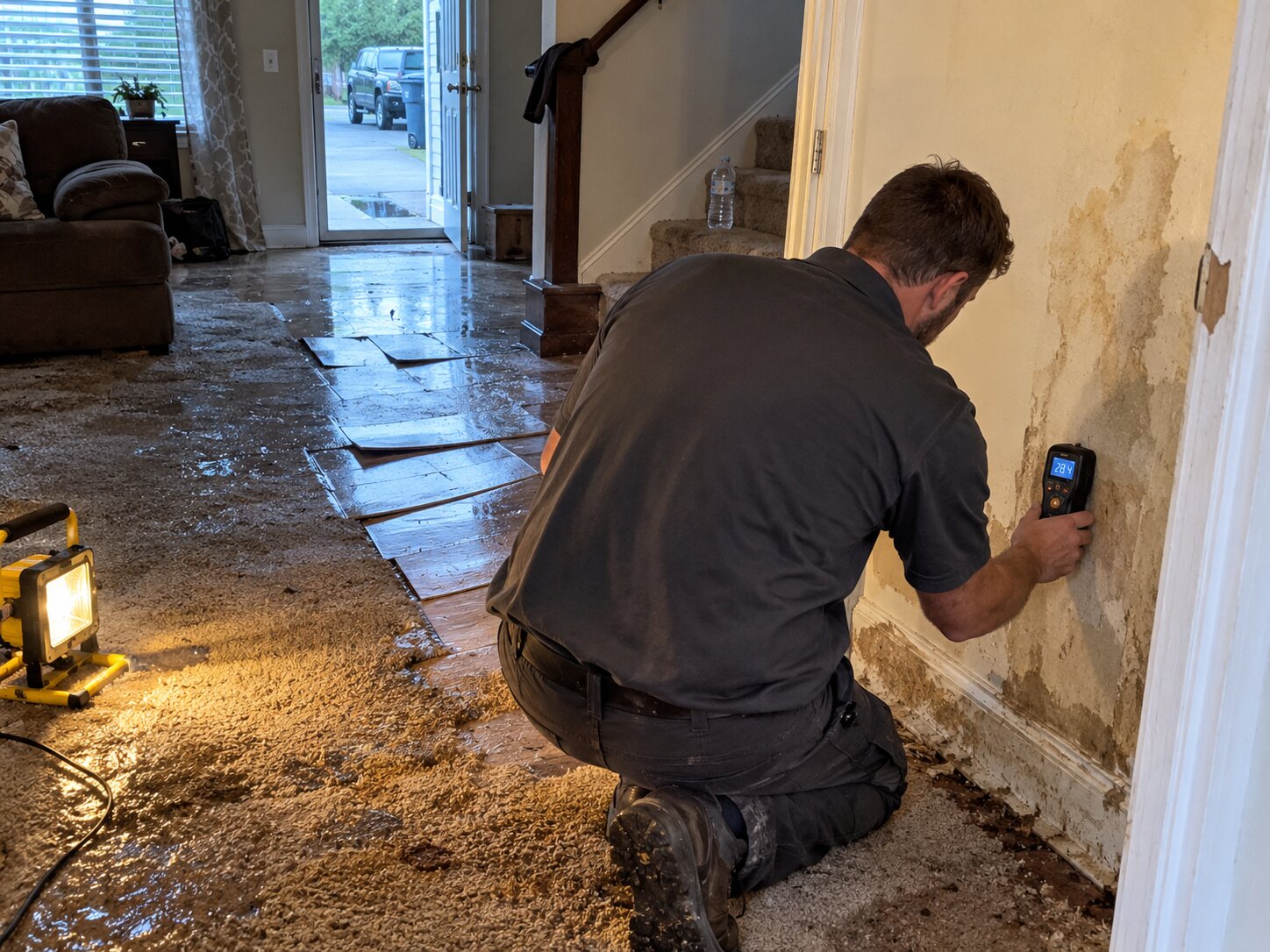
Types of Water Damage — IICRC Categories and Common Sources
Water damage classification matters because it drives every subsequent decision about how a property gets restored. A basement flood from a supply line failure and a basement flood from a sewer backup look similar on arrival but require completely different response protocols, different equipment, different personal protective equipment for the workers, and different documentation for insurance and regulatory purposes. The IICRC (Institute of Inspection, Cleaning, and Restoration Certification) S500 Standard defines the classification framework used across the restoration industry, dividing water damage into three categories based on contamination level. Beyond category classification, damage source and location produce specific patterns that affect scope development and restoration approach. This page introduces the IICRC categorization framework and the source-based classification we use for scope development on Utah County restoration projects. Detailed pages for each specific damage type provide deeper information about scope, response, and considerations.
The IICRC S500 Three-Category Framework
The S500 Standard for Professional Water Damage Restoration classifies water damage into three categories based on the contamination level of the source water. Each category has specific implications for how restoration proceeds:
Category 1 — Clean Water
Water from a source that doesn’t pose substantial harm to humans. Typical sources include supply line failures, water heater tank failures, faucet leaks, and precipitation events with initial contact only. Category 1 response is the least restrictive: standard PPE requirements, materials often can be dried in place rather than replaced, and disinfection requirements are minimal. Category 1 water begins degrading toward Category 2 within 24–48 hours if not addressed, particularly at Utah’s summer temperatures.
Category 2 — Grey Water
Water that contains significant contamination and could cause discomfort or illness if consumed. Typical sources include washing machine discharge, dishwasher discharge, aquarium water, water from finished flooring failures (drywall run-off, adhesive contamination), and toilet overflow contained to urine only (no fecal matter). Category 2 response involves enhanced PPE, targeted disinfection, and typically replacement of porous materials in extensive contact. Category 2 water degrades to Category 3 within 24–48 hours if not addressed.
Category 3 — Black Water
Water that is grossly contaminated and can contain pathogenic, toxigenic, or other harmful agents. Typical sources include sewer backups, toilet overflow containing fecal matter, floodwater from surface flow, and rising water from groundwater or waterways. Category 3 response involves full PPE, containment protocols, disposal of most porous materials in contact, and enhanced disinfection throughout the affected area. Category 3 water requires OSHA-compliant procedures for worker protection.
Category Progression Over Time
A specific principle from S500: categories aren’t static. Water that starts as Category 1 progresses to Category 2, and Category 2 progresses to Category 3, when contamination increases through:
- Extended contact time allowing bacterial growth
- Contact with contaminated materials (subfloor debris, contents that contain contamination sources)
- Temperature conditions favoring biological growth
- Elapsed time between the water event and mitigation response
This progression is why response speed matters. Water damage addressed within hours of the event often remains Category 1 and can be dried in place with limited material removal. The same event addressed 48–72 hours later has often progressed to Category 2 or beyond, requiring more extensive material removal, disinfection, and reconstruction. Utah’s summer temperatures (frequent 90°F+ days in Utah County during June through September) accelerate the progression significantly.
Source-Based Classification
Beyond IICRC category, water damage source affects scope development. We use source-based classification for detailed scope work:
Hidden Leaks
Water damage where the source isn’t immediately visible: leaks inside walls, under floors, in ceiling assemblies, or in other concealed locations. Hidden leaks often produce more damage than visible events because they continue for extended periods before discovery. Detection typically involves moisture mapping, thermal imaging, and sometimes selective demolition to locate the source. Mold development is common with hidden leaks due to extended moisture exposure. See our moisture detection service page for the technical approach to hidden leak identification.
Crawlspace Water Damage
Water damage in crawlspaces has specific considerations: limited access affecting response logistics, close proximity to soil producing higher humidity and mold risk, structural implications from prolonged moisture exposure to floor framing, and often complex remediation requirements. Common crawlspace damage sources include plumbing failures in supply and drain lines running through crawlspaces, groundwater intrusion during high-water events, drainage issues from the exterior, and vapor intrusion from unsealed dirt floors.
Attic Leaks and Water Damage
Attic water damage typically comes from roof leaks, HVAC condensate failures, or plumbing running through attic spaces. Damage patterns include insulation saturation, framing moisture exposure, and ceiling damage below. Attic damage often produces mold growth due to the combination of warm temperatures, moisture, and organic materials (insulation, framing) providing ideal conditions.
Scenario-Based Damage Types
Basement Flooding
Basement flooding is one of the most common scenarios in Utah County due to below-grade construction and specific hydrogeology near Utah Lake and the Provo River. Sources include supply line failures, water heater failures, sump pump failures, sewer backups, foundation infiltration during high-water events, and floor drain backups. Categorization depends on the specific source: supply line failures are Category 1 initially, foundation infiltration during storm events is Category 3, sewer backups are Category 3.
Sewage Backups
Sewage backups produce Category 3 water damage with specific protocols. See our sewage cleanup pages for the specific response approach including OSHA compliance, disposal requirements, and disinfection standards.
Storm-Related Water Damage
Storm-related water damage covers roof leaks during precipitation, wind damage causing water intrusion, ice dam events producing interior water damage, and flash flooding events. Categorization varies by specific source: roof leaks during precipitation events are typically Category 1 initially, ice dam damage is typically Category 2 by the time it reaches interior spaces, flash flooding is Category 3.
Sudden Water Events
Sudden water events (supply line rupture, appliance failure, water heater tank failure) produce rapid, high-volume water release with different response characteristics than gradual leaks. Response focuses on rapid extraction to limit damage extent, immediate drying setup, and prompt scope development.
Fire-Related Water Damage
Fire suppression activities produce water damage as an unavoidable consequence of firefighting. Fire-related water damage is typically categorized as Category 2 (contact with fire debris) or Category 3 (contact with contaminated materials during firefighting). See our fire damage restoration pages for the integrated response approach.
How Category Classification Affects Your Situation
Insurance Coverage Implications
Insurance coverage for water damage often depends on cause of loss, not just contamination category:
- Sudden and accidental water damage: Typically covered under standard homeowner policies regardless of category
- Gradual leaks and long-term damage: Often excluded from standard coverage even if the underlying cause is a covered peril
- Flood damage (external water): Excluded from standard policies; requires flood insurance (NFIP or private)
- Sewer backup: Often excluded from standard policies; may be covered under separate sewer backup endorsement
- Sump pump failure: Often excluded from standard policies; may be covered under separate endorsement
Category classification affects scope but generally doesn’t affect coverage determination directly. Documentation of the specific cause matters more for coverage than the resulting contamination category.
Restoration Scope Implications
Category classification directly affects restoration scope:
- Category 1: Materials often dried in place, minimal disposal, standard disinfection
- Category 2: Porous materials in extensive contact typically disposed, enhanced disinfection
- Category 3: Most porous materials in contact disposed, comprehensive disinfection, containment during work
These differences produce significant cost variations: Category 3 restoration typically costs 2–4 times what Category 1 restoration costs for equivalent affected areas, primarily due to more extensive material replacement.
Timeline Implications
- Category 1: Typically 3–7 days for mitigation, plus reconstruction for any material replacement
- Category 2: Typically 5–10 days for mitigation, plus reconstruction
- Category 3: Typically 7–14 days for mitigation, plus more extensive reconstruction
Frequently Asked Questions
- How do you determine the category of my water damage?
- Assessment during initial arrival based on multiple factors: identifiable source of water (supply line vs. sewer vs. surface flow, etc.), visible contamination indicators (color, debris content, odor), time elapsed since the event began, temperature conditions during the exposure period, and materials the water contacted. Categorization is typically clear for events with identifiable sources; assessment gets more complex for events with unclear or multiple sources, or events where significant time has passed. In borderline cases, we err toward the more conservative categorization to ensure appropriate response protocols. Documentation of the categorization decision supports both scope development and any subsequent questions from insurance carriers, health authorities, or property owners.
- Can Category 1 damage become worse over time even if it doesn’t get wet again?
- Yes, category progression is time-based rather than exposure-based. Water that starts as Category 1 doesn’t stay clean indefinitely once it’s outside its original source. Bacterial growth begins immediately upon contact with organic materials (drywall paper, subflooring, contents), and progresses more rapidly at higher temperatures. IICRC S500 recognizes progression from Category 1 to Category 2 within 24–48 hours as a general timeframe, though specific circumstances (temperature, materials contacted, initial contamination level) affect the specific timeline. This is why response speed matters: prompt response often keeps damage at Category 1 with minimal scope; delayed response often results in category progression requiring more extensive scope.
- What if my water damage came from multiple sources with different categories?
- Scope developed based on the highest category involved, with specific documentation of what came from what source. Common scenarios: initial supply line failure (Category 1) followed by sewer backup during the response period, roof leak (Category 1) that reached materials already contaminated from a different cause, or basement flooding with mixed groundwater and sewer sources. Response protocols follow the highest category for the entire affected area since mixing prevents reliable segregation of the different categories. Insurance claim documentation identifies each source separately for coverage determination, since different sources may have different coverage under the same policy.
- Why does Utah County water damage progress faster than in cooler climates?
- Temperature is the primary factor in category progression, and Utah County’s summer temperatures accelerate the process. Standard IICRC progression estimates (24–48 hours from Category 1 to Category 2) assume moderate temperature conditions. At Utah County’s summer temperatures — frequent 90°F+ days from mid-June through mid-September, with interior temperatures often reaching 85°F+ during power outages or non-air-conditioned conditions — progression can occur significantly faster. Interior conditions after water events often include elevated humidity in addition to elevated temperature, creating ideal conditions for bacterial growth. Winter events have slower progression due to lower temperatures, though interior heated space maintains temperatures conducive to progression regardless of outdoor conditions.
- Which specific damage type page should I look at for my situation?
- Depends on what you know about your situation. If you know the water source, source-based pages provide the most relevant information: clean water for supply line failures, water heater failures, and similar sudden events; grey water for appliance-related events and non-fecal toilet overflow; black water for sewer backups and flood events. If you know the location but not the source: crawlspace, attic leaks, or basement flooding pages cover location-specific considerations. If you suspect a leak but haven’t found the source: hidden leaks covers detection approaches. For any active water event where identifying the appropriate page delays response, calling directly is the better option; we can identify the applicable classification during initial assessment.
Contact Vault Mold Removal — Provo, UT
For water damage response with appropriate categorization and scope development matched to your specific situation, contact our office directly.
- Phone: (385) 250-2825
- Address: 1169 S 760 W, Provo, UT 84601
- Utah DOPL General Contractor License: #11876543-5501
- IICRC WRT / ASD / AMRT / OCT: #248317 / #248317-ASD / #319482 / #319482-OCT
Office Hours
- Monday – Saturday: 9:00 AM – 5:00 PM
- Sunday: Closed