
Emergency water damage services
The phone is answered live by the Vault crew, not a call center. We log the time we answer and the time we arrive on your work order, so there’s no dispute about response time.
- Call any hour: (385) 250-2825 is answered live 24/7 by the Vault crew. 45-minute arrival inside Provo city limits (Monday–Saturday, 8 AM–5 PM); typically under 60 minutes elsewhere in our Utah County service area.
- In-house: emergency extraction, source containment, moisture mapping, structural drying setup within the first visit, and documentation for your insurer.
- Who does the work: Vault’s own W-2 crew, IICRC certified in WRT, ASD, AMRT and OCT, under Utah DOPL General Contractor License #11876543-5501. No subcontractors. Meet the team
- Insurance: Xactimate scopes, daily moisture readings on file, direct billing to State Farm, USAA, Allstate, Farmers and Bear River Mutual.
- Pricing: free written estimates. Water mitigation typically $3,500–$8,500; reconstruction $4,500–$9,500. 24-month workmanship warranty · Wisetack financing
- Family-owned and veteran-operated, based in Provo since 2020.
Water damage restoration · Mold remediation · Sewage cleanup · Reconstruction & repairs
Emergency Water Damage Response — Utah County
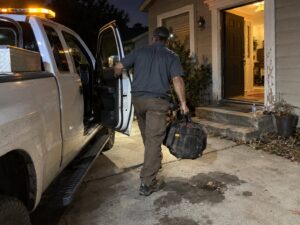
When water is actively flowing or has recently stopped, minutes matter. The first hour after discovery determines whether the loss stays a manageable Category 1 event or escalates through migration into wall cavities, subfloor assemblies, and adjacent rooms. Vault Mold Removal maintains an emergency response protocol for Utah County: business-hours calls answered live at (385) 250-2825 with average dispatch times ranging from 34 minutes in Provo to 52 minutes in Mapleton, and after-hours calls routed through our on-call rotation with slower but still-available response. This page describes what emergency response actually looks like, what we do in the first hour on-site, and how customers can prepare during the dispatch window.
How Our Emergency Response Actually Works
Restoration companies often market themselves with “24/7 emergency” language that implies instant response at any hour. The reality across the industry is more nuanced — most restoration contractors, including us, staff differently for business hours versus after-hours coverage. We prefer to be direct about what we actually provide rather than overselling the service.
Business Hours (Monday – Saturday, 9 AM – 5 PM)
Calls to (385) 250-2825 are answered live by a technician who begins dispatch triage immediately. Timothy Ellis, Marcus Wheeler, or Daniel Hoffmann can typically deploy within the response times listed below. During business hours, we’re staged for rapid dispatch across our primary service area.
After Hours (Sunday and Monday–Saturday 5 PM – 9 AM)
Calls to the same number route to our on-call rotation. The primary after-hours technician is Daniel Hoffmann, based in Orem, with backup rotation through Marcus Wheeler and Timothy Ellis. After-hours calls are answered within typically 15 minutes of the original call, though response times to the property are slower than business hours because the on-call technician is dispatched from home rather than from staged equipment at our 1169 S 760 W Provo office.
When Our Response Isn’t Fast Enough
For time-critical situations where our response time isn’t adequate to your specific loss, we can activate partner IICRC-certified restoration contractors in the Wasatch Front mutual-aid network. Partners closer to your property may be able to dispatch faster, with Vault Mold Removal remaining the estimator and project manager of record. We tell you at the time of the call if we recommend this coordination, and we make the connection directly rather than expecting you to shop for alternatives during an emergency.
Response Times by City
Averages from our documented dispatch archive across 2,400+ jobs:
- Provo — 34 minutes business hours, 62 minutes after hours
- Orem — 41 minutes business hours, 68 minutes after hours
- Springville — 48 minutes business hours, 74 minutes after hours
- Vineyard — 45 minutes business hours, 71 minutes after hours
- Lindon — 44 minutes business hours, 69 minutes after hours
- Mapleton — 52 minutes business hours, 82 minutes after hours
Extended service cities (Pleasant Grove, American Fork, Spanish Fork, Payson, Salem, Cedar Hills, Alpine, Highland, Saratoga Springs) receive response times 15–30 minutes longer than primary cities. Emergency response calls from further outside Utah County are directed to appropriate regional IICRC-certified contractors, since our response time from Provo wouldn’t be competitive with local providers.
Peak-Demand Response Considerations
Certain events overwhelm normal dispatch capacity across all Utah County restoration contractors. During the January 2023 freeze event, we logged 87 emergency calls in four days — more than three weeks of typical winter volume compressed into one week. During peak-demand periods, response times extend and we’re transparent about it at the time of the call. Peak-demand events we’ve documented:
- Multi-day freeze events (January–February, sub-10°F sustained temperatures)
- Spring snowmelt runoff periods (March–May when Wasatch snowpack is above 130% of normal)
- Summer monsoon storms (July–August intense precipitation events)
- Multi-day power outages that affect sump pumps and HVAC during weather events
- Water main breaks affecting multiple properties simultaneously
What to Do While Waiting for Response
The 30–90 minutes between your call and technician arrival is not wasted time. Practical actions during the dispatch window:
Immediate Safety
- Shut off the water source if you can do so safely. Main water valve at the meter for supply line failures; specific appliance shutoff for dishwasher, washing machine, or ice maker; main electrical breaker if water has reached outlets or electrical equipment.
- Evacuate the affected area if there’s structural collapse risk (ceiling assemblies with water pooling above, wall systems visibly compromised by water intrusion).
- Keep pets and children away from affected areas, particularly with any suspected Category 2 or 3 water.
Documentation for Insurance
- Photos of the entire affected area before touching anything. Wide shots for context, close-ups for specific damage. Include timestamps by using your phone’s camera app (which embeds timestamp metadata automatically).
- Photo of the water source if identifiable — the burst pipe, the failed appliance, the point of water intrusion.
- Photos of affected personal property, particularly items with significant value that may need replacement (electronics, furniture, artwork, appliances).
Damage Mitigation
- Move upholstered furniture and personal property out of standing water if possible. This is part of your policyholder duty to mitigate damage.
- Lift the edges of area rugs off standing water to reduce absorption.
- Open cabinet doors under sinks and vanities if water may have migrated into cabinet interiors.
- Do not use a household vacuum on standing water (it’s not designed for it and creates electrical hazard). A wet-dry shop vacuum can be used on small surface areas of clean water.
Coordination Preparation
- Locate your homeowner insurance policy or the insurance carrier’s contact number. You’ll want to file the claim soon after emergency response begins.
- Consider whether the loss might be your neighbor’s responsibility (shared plumbing, HOA-managed water supply, upstairs unit in multi-family properties). Your insurance carrier can advise on subrogation possibilities.
- Identify a family member or trusted friend who can be at the property with the technician if you can’t be there yourself.
The First Hour On-Site
When the technician arrives, the first hour on-site follows a defined sequence:
- Safety verification. Confirm water source is secured, electrical hazard has been addressed, and structural integrity is not compromised.
- Initial assessment. FLIR thermal imaging of the affected area to identify the visible loss extent and any obvious hidden moisture patterns.
- Category and class determination. IICRC S500 classification based on water source, materials affected, and time-since-loss.
- Immediate extraction. For standing water, submersible pumps and truck-mounted vacuum extraction begin within 5–10 minutes of arrival. For saturated carpet without significant standing water, weighted portable extraction is deployed.
- Rapid triage decisions. Some materials need to come out immediately during the first hour: carpet pad in Category 2 or 3 saturation, drywall base courses that are heavily saturated, or wet insulation in wall cavities. These decisions are made based on IICRC S500 removal criteria.
- Customer communication. The technician walks you through what we’re doing and why, what the initial scope looks like, and what to expect in the next 24 hours.
What Emergency Response Includes and Excludes
Includes
- Same-day dispatch during business hours, on-call after-hours dispatch
- Initial safety verification and hazard mitigation
- Water source identification and shutoff assistance
- Immediate extraction of standing water and saturated materials
- Initial moisture mapping and category/class assessment
- Free written scope of work delivered within 24 hours
- Xactimate-format scope for insurance coordination
- Documentation package for insurance claim initiation
Excludes (Handled Separately)
- Plumbing repair (we do not perform plumbing repairs; we work with local licensed plumbers when repair is part of the source resolution)
- Electrical repair beyond immediate hazard isolation
- Roofing repair for storm-driven external water intrusion (we coordinate with roofing subcontractors)
- Reconstruction of finished spaces (this is a separate scope after drying is complete)
Emergency Response Costs
Emergency response — the initial site visit, safety verification, immediate extraction of standing water, and initial scope development — is generally covered under standard homeowner insurance policies as part of the “duty to mitigate” obligation. Emergency mitigation charges are documented at time-and-materials rates and billed separately from the subsequent scope of work. Typical emergency mitigation billing runs $400–$1,200 for standard Category 1 residential losses, with Category 2 and 3 responses higher due to additional labor and disposal costs. Insurance carriers routinely pay these charges as part of the loss claim; out-of-pocket customers receive the same scope with the same documentation.
Frequently Asked Questions
- What’s the fastest way to reach Vault Mold Removal in an emergency?
- Call (385) 250-2825 directly. During business hours (Monday–Saturday, 9 AM to 5 PM), calls are answered live by a technician who begins dispatch triage immediately. After hours, calls route to our on-call rotation with Daniel Hoffmann as the primary responder. Do not send social media messages, email, or website contact form submissions for active water emergencies — those channels are not monitored in real time. If the phone rings through without an answer during business hours, leave a voicemail with the property address and call-back number; voicemails are checked continuously and returned within 15 minutes.
- Should I try to clean up water myself before you arrive?
- Yes, up to the point of your own safety and capability. Shutting off the water source, moving furniture off wet areas, extracting standing water with a wet-dry shop vacuum on small areas, and photographing damage for insurance are all valuable during the dispatch window. What you shouldn’t do: assume that dry-looking surfaces mean the assembly is actually dry, use household vacuums on water (not designed for it, creates electrical hazard), or attempt to disinfect Category 2 or Category 3 water without appropriate PPE. When the technician arrives, they’ll assess what you’ve already done and coordinate the professional response from there.
- Do I need to be home when the technician arrives?
- Preferred but not required. Someone with authority to authorize the scope of work needs to be reachable by phone during the initial assessment, but doesn’t need to be physically present. Common arrangements: a spouse or trusted friend is at the property while the primary decision-maker is at work, or the primary decision-maker authorizes the initial emergency scope by phone and completes the full scope authorization in person later. For rental properties, the property manager or landlord typically handles this coordination. For commercial properties, a designated authorized representative is required per lease or corporate authorization requirements.
- How long does emergency response typically take on-site?
- Initial emergency response — assessment, extraction of standing water, initial drying equipment placement — typically takes 2–4 hours on-site for standard residential Category 1 losses. Larger losses, Category 2 or 3 water, or losses affecting multiple rooms can extend to 6–8 hours or longer. During the on-site time, the technician also produces the initial scope of work, coordinates with the insurance carrier if applicable, and sets up the drying equipment that will run for the subsequent 3–10 day drying phase. After emergency response is complete, the technician returns daily for moisture monitoring and equipment adjustment during the drying phase.
- Will I be charged for emergency response if I decide not to proceed with the full scope?
- Emergency mitigation charges — the initial site visit, safety verification, extraction of standing water, and initial scope development — are billable regardless of whether you proceed with the subsequent full restoration scope. This is standard industry practice and reflects the actual costs of the response (technician time, equipment operation, disposal fees for extracted water, mobilization costs). If you decline the full restoration scope after emergency mitigation, we’ll produce a final invoice for the mitigation work only, along with documentation you can use to work with another contractor or handle the remaining scope yourself. Utah Code § 13-5-9 provides a 3-business-day right of cancellation for home solicitation contracts, which applies to the full scope but not to already-performed emergency mitigation work.
Contact Vault Mold Removal — Provo, UT
For active water damage emergencies, call (385) 250-2825 directly. Business-hours calls answered live; after-hours calls route to on-call rotation.
- Phone: (385) 250-2825
- Address: 1169 S 760 W, Provo, UT 84601
- Utah DOPL General Contractor License: #11876543-5501
- IICRC WRT / ASD / AMRT / OCT: #248317 / #248317-ASD / #319482 / #319482-OCT
Office Hours
- Monday – Saturday: 9:00 AM – 5:00 PM
- Sunday: Closed
Written warranty
24-month workmanship warranty on drying, structural repairs, drywall, flooring, cabinetry and paint done by Vault. 90-day mold warranty from post-remediation clearance for recurrence from the same moisture source. Both are transferable once to a new homeowner, in writing on the work order.
We bill your carrier directly
Direct-billing with State Farm, USAA, Allstate, Farmers and Bear River Mutual. Every scope is written in Xactimate; you pay only your deductible plus anything the policy doesn’t cover. Not on this list? We still handle the claim.
What “24/7 live-answered” actually means at Vault
Water damage is time-sensitive — every hour between the loss and extraction compounds the damage class per IICRC S500. These are the specific commitments behind our 24/7 line:
No voicemail, ever
Calls to (385) 250-2825 are answered by a live Vault technician — day, night, weekend, holiday. If every tech is on an active job, the call rolls to the owner’s cell, not to voicemail.
No call center, no outsourced dispatch
You talk to the person coming to your door, not an operator reading from a script in another state. The technician who answers takes the address, routes the truck, and arrives.
Dispatch time is logged
Every call is timestamped when answered and when the truck pulls up. Those times print on your work order, so arrival is auditable, not advertised.
Our W-2 crew only
Marcus, Ryan, Elena, Daniel and Joseph — all employees of Vault, all IICRC-certified. No subcontractors on the first truck. Reconstruction (drywall, flooring, cabinetry, paint) is done by the same crew under Utah DOPL License #11876543-5501.
Dispatch times are logged, not promised
Every emergency call to Vault produces a dispatch log entry. Those entries aren’t marketing — they appear on your work order, available to you and your adjuster.
| Field | What we log |
|---|---|
| Call answered | Timestamp when a Vault technician picked up (385) 250-2825. |
| Dispatch | Timestamp when the truck left the Provo office. |
| Arrival | Timestamp when the crew pulled into your address. |
| First reading | Initial moisture reading per IICRC S500 category and class. |
Why the first 60 minutes matters — the damage math
Water damage escalates on a predictable timeline. The IICRC S500 standard assigns classes 1–4 to intrusions by rate of absorption and affected square footage; delay moves a loss up a class.
A 45-minute Provo arrival keeps most losses inside the Cat 1 / Class 1–2 window — the cheapest and least invasive to restore. Call (385) 250-2825 immediately after shutting the water off.
Helpful guides: Water damage electrical safety · Documenting damage for insurance · Plumber or restoration first?