
Water damage restoration when it can’t wait, in Lindon, Utah: Vault is a licensed, family-owned IICRC Certified Firm that answers live 24/7 and gives free written estimates.
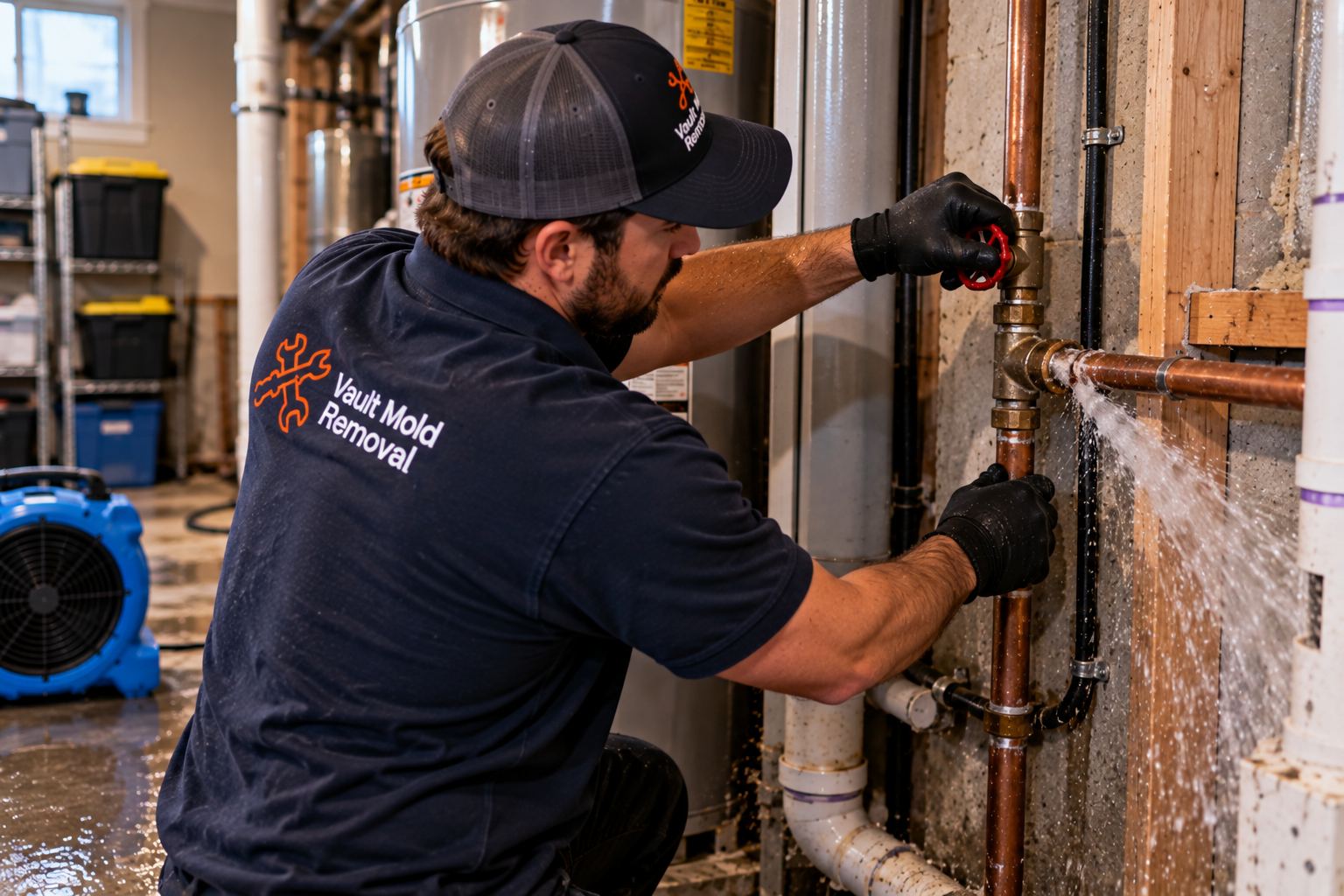
Water damage keeps getting worse while it sits: soaked drywall swells and crumbles, wood floors warp, carpet pad holds dirty water and starts to smell, and hidden moisture turns into a mold risk. Good damage restoration stops that spread before a small leak becomes a costly rebuild.
A burst pipe, a failed water heater or a flooded basement does the most damage in the first hours. Our emergency water damage restoration crew stops the source, removes the water and starts drying, then handles the damage restoration and repairs afterward.
Calls from Lindon are answered live 24/7, and our average arrival is about 44 minutes. Details: emergency water damage service. More about Vault in Lindon.
If water is coming into your Lindon home or business right now, call (385) 250-2825. The phone is answered live 24/7 by the Vault crew, not a call center. Vault Mold Removal provides emergency water damage restoration in Lindon, Utah: we stop the source, extract standing water, set up drying equipment and document the damage for your insurance claim. Arrival to Lindon averages about 44 minutes from our Provo office. Burst pipes, failed water heaters, washer hoses and sewage backups do the most damage in the first hours, so the sooner drying starts, the less drywall, flooring and cabinetry has to come out.
Vault water damage work in Lindon
Vault handles water damage work in Lindon from a staffed office, shop and warehouse at 1169 S 760 W in Provo.
- Call any hour: (385) 250-2825 is answered live 24/7 by the Vault crew, not a call center. Arrival to Lindon typically under 60 minutes.
- Who does the work: Vault’s own W-2 crew, IICRC certified in WRT, ASD, AMRT and OCT, under Utah DOPL General Contractor License #11876543-5501. No subcontractors. Meet the team
- Insurance: Xactimate scopes, daily moisture readings on your work order, direct billing to State Farm, USAA, Allstate, Farmers and Bear River Mutual.
- Pricing: free written estimates. Water mitigation typically $3,500–$8,500; reconstruction $4,500–$9,500. 24-month workmanship warranty · Wisetack financing
- Family-owned and veteran-operated, based in Provo since 2020.
Vault in Lindon · Water damage restoration · Mold remediation · Sewage cleanup
Emergency Water Damage Response in Lindon, Utah
When a copper supply line pinholes at 3 a.m. in a 1978 rancher off 400 North, or when a second-floor PEX manifold lets go in a foothills walkout above 1600 East, what determines the outcome is the timing of the first two hours. Standing water in a Lindon crawlspace sitting on Provo bench soil doesn’t drain on its own — it wicks into subfloor, into insulation, into HVAC ductwork routed through the crawl. Vault Mold Removal dispatches from Provo with a typical arrival window of 44 minutes daytime and 69 minutes overnight to Lindon addresses, measured over three years of loss records against dispatch geodata.
What arrives is not a truck with a shop vac. Emergency response for a Lindon call runs a category-specific equipment load-out: truck-mounted extraction unit at 180 GPM, Delmhorst BD-2100 pin moisture meter and Protimeter Surveymaster non-invasive scanner, FLIR E75 thermal camera for cavity and hidden-space diagnosis, two Phoenix R150 LGR dehumidifiers as baseline, six Phoenix Focus air movers, Novatek NA-1500 HEPA scrubber for Category 2 or 3 airborne management, and 6-mil poly with zipper doors for containment. The truck runs a full IICRC S500 response with nothing missing.
What Lindon Emergencies Actually Look Like
Original Lindon center — the pre-1960 farmhouses along the older plats — fails at galvanized supply-line corrosion. When a fitting gives out in a 70-year-old galvanized run, the water comes through a lath-and-plaster wall and often through balloon-framed exterior walls that let it travel two rooms from the source before surfacing. We map these losses with thermal imaging before opening any wall, because a wrong cut in period plaster is expensive to close up. Response to the original center runs 44 minutes daytime typical.
The 1970s and 1980s tract housing that dominates central Lindon fails predictably at three points: dishwasher supply lines (rubber hose fatigue at fittings), washing machine supply (braided stainless failure at the wall crimp), and water heater tanks (sacrificial anode depletion followed by tank rupture, usually with 40 to 50 gallons of hot water in the mechanical room). These are routine calls — familiar failure modes, standard extraction and drying, clean scope. Response runs 40 to 44 minutes daytime.
Foothills construction east of 1200 East — post-2000 walkout basements with engineered floor systems — fails at PEX manifold connections and at second-floor laundry hookups. Water dropping from a second-floor washing machine to a finished walkout basement traverses three levels in under ten minutes and saturates engineered I-joists along the vertical path. We prioritize these calls with a two-tech rollout: one working extraction on the lowest level, one working containment and content protection on the source level. Response runs 48 to 52 minutes daytime.
Crawlspace Losses Are a Lindon Specialty
Mid-century Lindon tract housing sits mostly on shallow crawlspaces — 24 to 36 inches typical, dirt or gravel floor, minimal ventilation. When a supply line above the crawl gives out, or when a slab plumbing failure floods the crawl from below, the space becomes an environmental problem before it becomes a structural one. Standing water in a crawl saturates fiberglass insulation (which then falls in sheets from the joist bays), soaks the underside of the subfloor, and eventually reaches HVAC ductwork if routed through the space.
We handle crawl losses in a specific sequence: submersible pump extraction first, then physical removal of any standing water the pump can’t reach with squeegees and shop vacs, then removal of soaked insulation (which will never dry in a crawlspace and will grow mold within 48 hours), then containment and drying with dehumidifiers positioned at the crawl access. Ductwork exposed to Category 2 or 3 water requires interior cleaning or replacement per NADCA and IICRC standards — we assess board-by-board and document what’s salvageable.
The First 30 Minutes
Dispatch confirms address, water category, and utility status. If the electrical panel needs to come off, we walk the homeowner through it over the phone before arrival. On arrival: photo documentation of source and affected materials before any manipulation, moisture reading log with grid coordinates, category assignment, and a written scope of work delivered to the homeowner before drying equipment is placed. That scope goes to your adjuster the same day, built to Xactimate line-item structure for efficient claim review.
Lindon Coverage Zones
- Original Lindon Center
- 200 East to 400 East, 200 North to 400 North. Pre-1960 farmhouses, galvanized supply. Response: 44 min daytime typical.
- Central Flats
- State Street to 1200 East, 700 North to 400 South. 1970s-90s tract housing. Response: 42 min daytime typical.
- Foothills East
- 1200 East and higher, running up toward Timpanogos. Post-2000 walkout basements. Response: 48 min daytime typical.
- State Street / Commercial
- I-15 corridor, Lindon Marketplace area. Response: 44 min daytime typical.
- Provo River Corridor / Agricultural
- Western Lindon, farm outbuildings. Response: 55 min daytime typical.
Frequently Asked Questions
- What do I do before you arrive?
- Kill the water main if you can find it — typically at the front hose bib line or basement mechanical room. Kill the electrical panel if any water is near outlets, appliances, or the panel itself. Do not enter standing water in a basement or crawlspace until the panel is off. Take photos of everything before moving anything. If you can safely close doors between the affected area and unaffected rooms, do that to slow humidity migration.
- How fast is 44 minutes, actually? Is that a marketing figure?
- It’s a logged average from three years of Lindon dispatch records, measured from confirmed dispatch to on-site arrival. Central Lindon between 700 North and 400 South runs tighter — 40 to 42 minutes daytime. Foothills addresses east of 1200 East run longer, 48 to 52 minutes daytime. Overnight response adds 25 minutes to each of those numbers because dispatch has to reach the on-call tech at home before the truck rolls.
- Do you work with my insurance carrier?
- Yes, all the major residential carriers in Utah County — State Farm, USAA, Allstate, Farmers, Bear River Mutual, and most of the smaller carriers. We provide Xactimate-native scoping from the first visit, submit daily moisture logs during drying, and coordinate directly with the adjuster on scope questions. You remain the policyholder and sign off on all work; the documentation runs between us and the carrier.
- Is your response 24 hours a day?
- Our office hours are Monday through Saturday 9 AM to 5 PM. Emergency dispatch runs outside those hours through our on-call rotation — response time is longer overnight (69 minutes typical to Lindon versus 44 daytime) because the on-call tech has to reach the dispatch point before the truck rolls. Call (385) 250-2825 anytime.
- My house has a crawlspace with water in it. Now what?
- Do not enter the crawlspace until you know the source is stopped and the electrical is off. Crawlspace flooding creates specific environmental hazards — displaced insects and rodents, saturated fiberglass insulation that will grow mold within 48 hours, and potentially compromised ductwork if HVAC is routed through the space. This is exactly the call to make first thing. We handle the extraction, insulation removal, containment, drying, and HVAC assessment in the standard emergency response.
Contact Vault Mold Removal
Phone: (385) 250-2825
Address: 1169 S 760 W, Provo, UT 84601
Hours: Monday–Saturday, 8:00 AM – 5:00 PM
Service Area: Lindon, Provo, Orem, Springville, Vineyard, Mapleton, and surrounding Utah County communities.
Written warranty
24-month workmanship warranty on drying, structural repairs, drywall, flooring, cabinetry and paint done by Vault. 90-day mold warranty from post-remediation clearance for recurrence from the same moisture source. Both are transferable once to a new homeowner, in writing on the work order. Full terms at /warranty/.
We bill your carrier directly
Direct-billing with State Farm, USAA, Allstate, Farmers and Bear River Mutual. Every scope is written in Xactimate; you pay only your deductible plus anything the policy doesn’t cover. Not on this list? We still handle the claim.
Who shows up on your job
You get Vault’s W-2 crew — Marcus, Ryan, Elena, Daniel and Joseph — not a lead-gen handoff and not a franchise sub. Reconstruction (drywall, flooring, cabinetry, paint) is done by the same crew under Utah DOPL License #11876543-5501.
Dispatch times are logged, not promised
Every emergency call to Vault produces a dispatch log entry. Those entries aren’t marketing — they appear on your work order, available to you and your adjuster.
| Field | What we log |
|---|---|
| Call answered | Timestamp when a Vault technician picked up (385) 250-2825. |
| Dispatch | Timestamp when the truck left the Provo office. |
| Arrival | Timestamp when the crew pulled into your address. |
| First reading | Initial moisture reading per IICRC S500 category and class. |
Emergency water damage in Lindon: common questions
How fast can you get to my Lindon home?
We dispatch from our Provo office. Arrival in Lindon is typically under 60 minutes. The hard 45-minute guarantee applies only Monday–Saturday, 8 AM–5 PM, inside Provo city limits.
Who answers if I call at night?
The Vault crew answers (385) 250-2825 live, 24/7. There’s no call center. If every technician is on a job, the call rolls to the owner’s cell instead of going to voicemail.
Is my arrival time documented?
Yes. The time we answer your call and the time the crew arrives are both logged on your work order.
Will you bill my insurance?
We bill State Farm, USAA, Allstate, Farmers and Bear River Mutual directly and write scopes in Xactimate. You pay your deductible plus anything the policy doesn’t cover. Financing is available for that part.
Who does the work?
Vault’s own W-2 crew does every job. They’re IICRC certified and work under Utah DOPL General Contractor License #11876543-5501. Vault is family-owned and veteran-operated.
Helpful guides: Water damage electrical safety · Documenting damage for insurance · Plumber or restoration first?
All our services in Lindon
Emergency water damage restoration in Lindon: find us and quick answers
When water is actively coming in, the first hours matter most. Vault’s crew stops the source, extracts standing water and sets up drying for Lindon homes and businesses.
Where we are
1169 S 760 W, Provo, UT 84601
Phone: (385) 250-2825 (answered live 24/7)
Email: info@vaultmoldremoval.xyz
Office: Monday–Saturday, 8 AM–5 PM
Getting to you
Arrival to Lindon averages about 44 minutes.
Quick answers
What counts as a water damage emergency in Lindon?
Active leaks, burst pipes, water heater or washer failures, water through a ceiling, standing water in a basement, sewage backups, or water near outlets. If you’re not sure, call (385) 250-2825 and the crew will tell you on the phone.
How fast is emergency response to Lindon?
Arrival to Lindon averages about 44 minutes. The phone is answered live 24/7, and the dispatch time is logged on your work order.
What does emergency water damage work cost?
Typical water mitigation runs $3,500–$8,500. The written estimate is free, insured jobs are billed to your carrier directly, and Wisetack financing ($500–$25,000 over 3–24 months) covers deductibles or uninsured work.
Check our license in the Utah DOPL license lookup; our crew works to IICRC standards.
For emergency water damage restoration in Lindon, call (385) 250-2825 any hour. A real person on the Vault crew answers.
Call (385) 250-2825Get a free estimate More about Vault in Lindon
Emergency water damage costs in Lindon: no surprises
| Service | Typical cost |
|---|---|
| Water mitigation (extraction, flood cuts, drying) | $3,500–$8,500 |
| Reconstruction (drywall, flooring, cabinetry, paint) | $4,500–$9,500 |
| Written estimate | Free |
| Wisetack financing | $500–$25,000 over 3–24 months |
No surprises: you get a free written estimate before work starts. On insured jobs Vault documents the damage, records daily moisture readings, writes the scope in Xactimate and bills State Farm, USAA, Allstate, Farmers or Bear River Mutual directly, so you pay your deductible plus anything the policy doesn’t cover.
Water damage detection
Water travels inside walls and under floors before it shows. Vault finds it with FLIR thermal cameras and Delmhorst and Protimeter moisture meters, then maps every wet area before drying starts. More on moisture detection.
Commercial water removal
Vault also handles water damage for Lindon businesses, offices and rental buildings with the same W-2 crew and insurance documentation. See commercial water damage.
Related services
Call (385) 250-2825 for emergency water damage restoration in Lindon, any hour.
Flood cleanup and water damage restoration
When water is coming in, the first hour decides how much has to be torn out later. Vault answers (385) 250-2825 live 24/7 with our own crew, and arrival to Lindon averages about 44 minutes from our Provo office. Here is what to do before we arrive and what our emergency water damage restoration in Lindon covers once we are there.
The first hour
- Stop the water at the main shutoff valve, usually where the water line enters the house or near the water heater.
- Stay safe: do not walk through standing water near outlets or appliances. If you can reach the breaker panel from a dry spot, turn off power to the wet area.
- Protect belongings: lift furniture off wet carpet, move rugs, electronics and papers to a dry room.
- Take photos and video of every wet room before anything is moved. Your insurer will ask for them.
- Skip the shop vac on sewage and do not run a household vacuum on wet floors.
- Call us at (385) 250-2825; we talk you through the rest while the crew is on the way.
What counts as a water damage emergency
- A burst pipe or failed supply line in Lindon, especially during a winter freeze (frozen pipe: what to do)
- A water heater leak or rupture (water heater leak: what to do)
- A flooded basement from a sump pump failure or spring snowmelt (basement flooding)
- A sewage backup from a toilet, floor drain or main line (sewage cleanup)
- Water coming through a ceiling or light fixture
- Roof and window leaks after wind-driven rain (storm damage)
Cleaning flood water from carpet, hardwood floors and drywall
- Carpet and pad: pad soaked by clean water is usually replaced; carpet can sometimes be dried in place if we get there fast. Anything touched by sewage or outside flood water is removed.
- Hardwood floors: dried with mat drying systems and dehumidifiers where the wood is salvageable, with moisture readings until it is back to normal. See structural drying.
- Drywall and insulation: wet drywall is cut above the water line inside ZipWall containment with a HEPA air scrubber, so the wall cavity can dry.
- Crawl spaces and basements: standing water is extracted and the space is dried with dehumidifiers. See water extraction.
Repairs after the water is out
The same crew. Drywall, flooring, trim, cabinets and paint are rebuilt under our Utah DOPL General Contractor license, and every repair carries a 24-month workmanship warranty. We document the damage, write the scope in Xactimate and bill your insurer directly. See reconstruction and repairs.
Jobs we have done here
- Case study: irrigation backflow at spring startup
- Case study: frozen spigot burst in a detached workshop
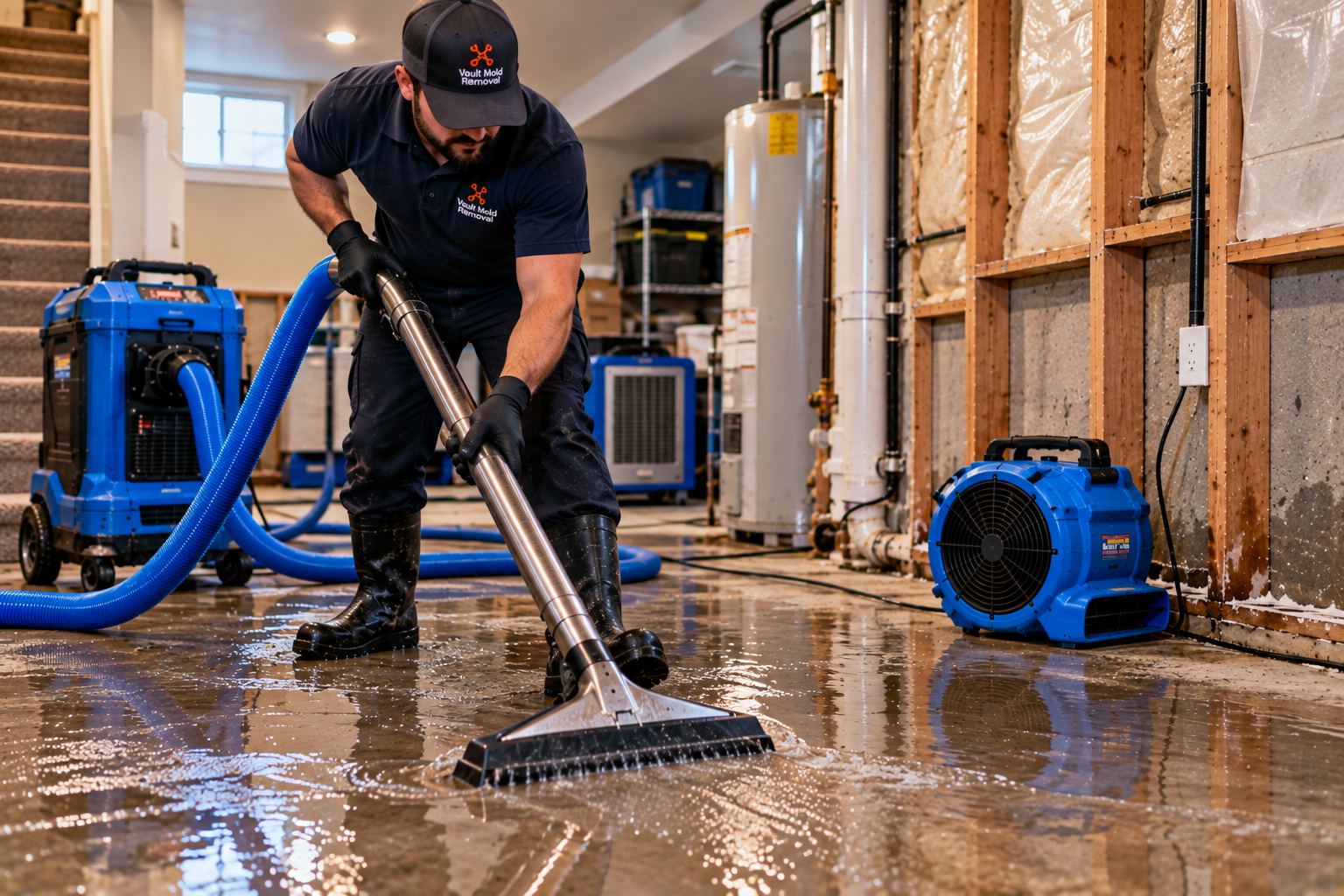
Water in your Lindon home or business right now? Call (385) 250-2825 for emergency flood cleanup and water damage restoration.
More questions
Can I pay over time?
Financing is available through Wisetack, from $500 to $25,000 over 3–24 months, with a soft credit check and subject to approval. See financing.
Services and service area
Our emergency water damage restoration services cover Lindon homes and commercial property around the clock. The phone is answered live 24/7, our average arrival in Lindon is about 44 minutes, and the crew starts water extraction and structural drying as quickly as the property allows.
The process: stop the source, remove standing water, move or protect contents, then dry walls, floors and framing with air movers and dehumidifiers while we take daily moisture readings. When materials are damaged, our local crew does the damage repair too, so homeowners deal with one company from flood cleanup to finished restoration.
Burst pipes, a failed water heater, a leaking roof after a storm, or sewage coming up a drain all get the same fast response. Service areas: Lindon and the surrounding communities we serve — Provo, Orem, Springville, Vineyard and Mapleton. Call (385) 250-2825; every water damage job gets a free written estimate.
Call (385) 250-2825Free estimateFinancingOur processAll local services
More questions from homeowners
What should I do while I wait for the crew?
Shut off the main water valve if you can, turn off power to wet rooms only from a dry spot, take photos for your insurance claim and move electronics and papers out of the water.
Does the 45-minute arrival guarantee cover my area?
The guarantee covers Provo city limits, daytime Monday–Saturday 8 AM–5 PM. Arrival in Lindon is about 44 minutes.
What happens if every technician is already on a job?
The call rolls to the owner’s cell, not voicemail, so a person still answers.
Need emergency water damage service in Lindon? Average arrival in Lindon is 44 minutes. Call (385) 250-2825, answered live 24/7.