
Water damage restoration when it can’t wait, in Springville, Utah: Vault is a licensed, family-owned IICRC Certified Firm that answers live 24/7 and gives free written estimates.
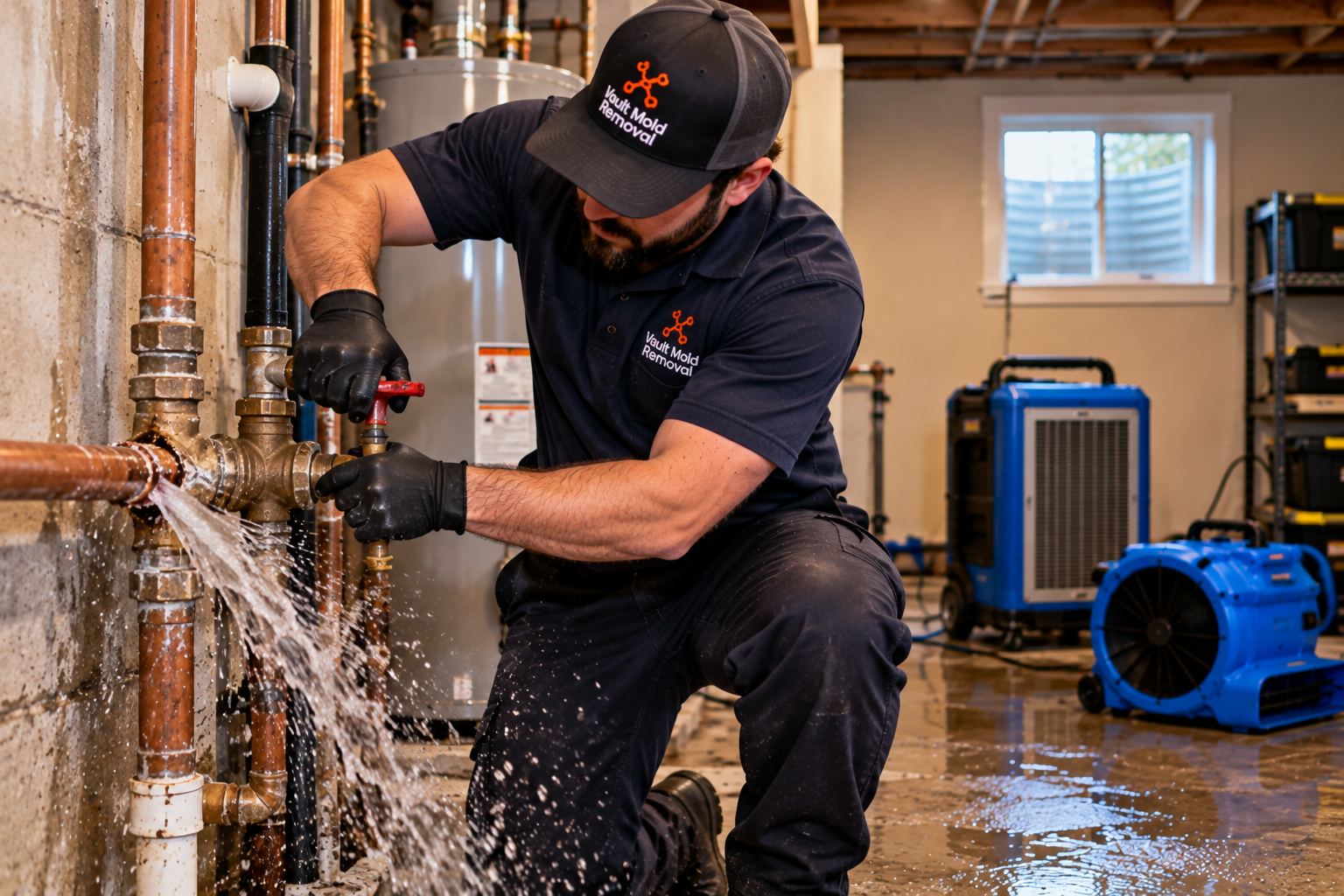
Water damage keeps getting worse while it sits: soaked drywall swells and crumbles, wood floors warp, carpet pad holds dirty water and starts to smell, and hidden moisture turns into a mold risk. Good damage restoration stops that spread before a small leak becomes a costly rebuild.
A burst pipe, a failed water heater or a flooded basement does the most damage in the first hours. Our emergency water damage restoration crew stops the source, removes the water and starts drying, then handles the damage restoration and repairs afterward.
Calls are answered live 24/7, and arrival is typically under an hour. Details: emergency water damage service.
What happens after you call: the crew stops the source, extracts standing water, finds hidden moisture with a FLIR thermal camera and sets up drying chambers. Moisture readings are logged every day until the structure is dry, and call-answered, dispatch and arrival times are printed on your work order. If every technician is on a job, the call rolls to the owner’s cell, not voicemail.
What it costs: typical Utah water mitigation runs $3,500–$8,500 and reconstruction $4,500–$9,500, and the written estimate is free. Covered losses are billed to your insurer directly — you pay the deductible and anything not covered — and Wisetack financing covers $500–$25,000 over 3–24 months, subject to approval.
If water is coming into your home or business right now, call (385) 250-2825. The phone is answered live 24/7 by the Vault crew, not a call center. Vault Mold Removal provides emergency water damage restoration in Springville, Utah: we stop the source, extract standing water, set up drying equipment and document the damage for your insurance claim. Arrival to Springville averages about 48 minutes from our Provo office. Burst pipes, failed water heaters, washer hoses and sewage backups do the most damage in the first hours, so the sooner drying starts, the less drywall, flooring and cabinetry has to come out.
Vault water damage restoration work in Springville
Vault handles water damage work in Springville from a staffed office, shop and warehouse at 1169 S 760 W in Provo.
- Call any hour: (385) 250-2825 is answered live 24/7 by the Vault crew, not a call center. Arrival to Springville typically under 60 minutes.
- Who does the work: Vault’s own W-2 crew, IICRC certified in WRT, ASD, AMRT and OCT, under Utah DOPL General Contractor License #11876543-5501. No subcontractors. Meet the team
- Insurance: Xactimate scopes, daily moisture readings on your work order, direct billing to State Farm, USAA, Allstate, Farmers and Bear River Mutual.
- Pricing: free written estimates. Water mitigation typically $3,500–$8,500; reconstruction $4,500–$9,500. 24-month workmanship warranty · Wisetack financing
- Family-owned and veteran-operated, based in Provo since 2020.
Vault in Springville · Water damage restoration · Mold remediation · Sewage cleanup
Emergency Water Damage Response — Springville, Utah
Emergency water damage response addresses the critical time-sensitive first phase of water damage in local properties. Rapid response limits damage extent, protects salvageable materials, and prevents secondary damage development including mold growth within 24–72 hours. From our Provo base at 1169 S 760 W, we arrive at Springville locations in approximately 48 minutes during typical conditions and up to 74 minutes during peak times. Different property types have specific emergency response considerations: historic downtown homes near the Museum of Art with pre-1930 construction requiring preservation-focused response; mid-century tract housing in central Springville with typical residential emergency patterns; newer eastern hillside subdivisions with modern building considerations; Hobble Creek Canyon-mouth properties with semi-rural characteristics; farm and agricultural properties with multi-structure potential; and commercial properties along Main Street and 400 South. This page covers Springville-specific emergency water damage response.
Response Time Commitment
Response Structure
- Typical response: 48 minutes from initial phone call to on-site arrival
- Peak response: 74 minutes during severe conditions, extreme traffic, or multiple simultaneous events
- Coverage base: Provo office at 1169 S 760 W provides Springville coverage
- Travel distance: 20–30 minute typical drive to most Springville locations
- Office hours: Monday–Saturday, 8:00 AM to 5:00 PM
What “Response Time” Means
- Interval from initial phone contact through on-site arrival
- Assumes phone contact during business hours (Monday–Saturday 9–5)
- Assumes normal weather and traffic conditions
- Assumes standard locations (bench-area or canyon-mouth properties may extend somewhat)
- Peak-time response reflects real conditions (heavy snowstorm, multiple simultaneous events, extreme rush hour)
Preparation Before Arrival
Property owners can take specific actions before we arrive:
- Turn off water source at the main shutoff if the event is plumbing-related and source can be identified
- Turn off power at the breaker for affected areas if water contacts electrical outlets or fixtures
- Move contents to unaffected areas if you can do so safely
- Document with photos for insurance claim support
- Contact your insurance carrier to initiate the claim if you have specific policy questions
- Wait for professional response rather than attempting extensive DIY response
Emergency Response Actions
Arrival Assessment
- Safety evaluation (electrical status, structural integrity, contamination)
- Source identification and containment verification
- Category classification (1, 2, or 3)
- Extent evaluation with initial moisture detection
- Contents assessment for immediate protection needs
Immediate Mitigation
- Standing water extraction using truck-mounted or portable equipment
- Weighted extraction from carpet and pad
- Content protection or salvage from affected areas
- Initial material removal for extensively saturated non-salvageable materials
- Setup of drying equipment (air movers, dehumidifiers) for continued response
Documentation
- Photo documentation of pre-response conditions
- Moisture readings at established points
- Category determination documentation
- Scope development supporting insurance claim
- Coordination with insurance carrier and adjuster as appropriate
Springville Property-Type Response
Historic Downtown Response
Pre-1930 Springville historic homes near the Museum of Art:
- Preservation-focused emergency approach protecting original materials
- Careful equipment placement in historic spaces
- Original hardwood floor emergency techniques
- Plaster wall considerations during emergency response
- Historic character preservation as a scope driver
Mid-Century Central Springville Response
Standard mid-century tract housing:
- Standard residential emergency protocols
- Ranch and split-level layout familiarity
- Finished basement emergency response common
- Standard drywall and modern flooring approach
Eastern Hillside Newer Development Response
Newer subdivisions toward Mapleton border:
- Larger scope for larger properties
- Modern building materials with typical response
- Higher ceilings and larger spaces affecting equipment
- Contemporary flooring and finishes
Canyon-Mouth Property Response
Semi-rural Hobble Creek Canyon-mouth properties:
- Larger scope for larger properties
- Sometimes multiple structures affected simultaneously
- Cold-weather emergency considerations during winter
- Access considerations for rural equipment deployment
- Extended response time for far-canyon locations
Farm and Agricultural Property Response
Semi-rural Springville properties:
- Multi-structure emergency assessment (residence, garage, shop, barn, outbuildings)
- Specialized structure considerations
- Prioritization when multiple structures need response
- Rural infrastructure considerations
Commercial Springville Response
Commercial emergency response along Springville business corridors:
- Business continuity coordination during emergency response
- Main Street historic commercial with preservation considerations
- 400 South commercial and mixed-use response
- Restaurant response with health department coordination
- Retail and office response with operations coordination
Common Springville Emergency Scenarios
Plumbing Failures
- Supply line failures at kitchen and bathroom fixtures
- Water heater failures (basement or utility installations)
- Washing machine hose failures
- Dishwasher failures
- Toilet supply line or seal failures
Frozen Pipe Events
Winter frozen pipe events in Springville, particularly in canyon-mouth and unheated spaces:
- Concentrated water release from ruptured pipes when thawing
- Exterior wall pipe events during severe cold
- Vacation home events when properties left unheated during winter absence
- Garage and outbuilding freeze events on semi-rural properties
Roof Leak Events
- Storm-related roof damage producing water intrusion
- Ice dam events on bench-area or canyon-mouth properties
- Aging roof failures on older Springville homes
- Attic-source events with concealed extension
Appliance Failures
- Water heater tank rupture
- Washing machine drain and supply failures
- Dishwasher failures
- Refrigerator ice-maker line failures
Basement Events
- Sump pump failure during runoff
- Foundation infiltration in older properties
- Basement plumbing failures
- Sewer backup events (Category 3)
Flood-Related Events
- Hobble Creek flooding during exceptional runoff or storm events
- Surface flooding during heavy rain
- Snowmelt-related events during warm spells
Insurance Coordination
Emergency response coordinates with your insurance carrier:
- Documentation supporting the claim from the initial response
- Coordination with adjuster if desired
- Xactimate line-item pricing following industry standards
- Direct billing arrangements available for many carriers
Frequently Asked Questions
- How quickly can you actually get to my home during a water emergency?
- Typical response time to Springville locations is 48 minutes from your initial phone call to our arrival on-site during standard conditions. During peak conditions, response extends to approximately 74 minutes. What affects response time: distance from our Provo office (typical locations are 20–30 minutes drive in normal traffic); current call volume (multiple simultaneous events may extend response for later-called events); weather conditions (snow, storm events, road closures affect travel); traffic conditions (rush hour, particular events affect drive time); and specific Springville location (canyon-mouth and far-eastern properties add travel time compared to central Springville). Response time expectations: 48-minute standard response applies to typical business-hours call for standard Springville locations during normal conditions; peak-condition 74-minute response applies during heavy weather events, multiple simultaneous calls, or specific challenging conditions; after-hours calls (outside Mon–Sat 9–5) follow next-business-day response for non-emergency scope, with call routing for genuine emergency situations. What you can do during response wait: turn off water at main shutoff if plumbing-related; turn off power for affected electrical areas; move contents from affected areas if you can do so safely; document conditions with photos; and contact your insurance carrier. What you should not attempt during response wait: extensive DIY extraction that may miss concealed damage; running your HVAC in ways that spread water damage; using consumer equipment that isn’t adequate for genuine restoration; and delaying professional response through extended DIY attempts.
- My property is a farm and I have water damage in multiple buildings. How do you prioritize emergency response?
- Multi-structure emergency response requires prioritization based on urgency and scope. Initial prioritization considerations: primary residential structure typically takes priority for immediate response; occupied vs. unoccupied structures affect priority (residential occupied space vs. storage outbuilding); severity of individual events (extensive damage in one structure vs. minor issue in another); Category of individual events (Category 3 warrants immediate response regardless of location); and specific salvage priorities (irreplaceable contents or specialized equipment). Response approach for multi-structure events: initial assessment across all affected structures during first visit; emergency mitigation at highest-priority location first; scheduled subsequent visits for lower-priority structures; and coordination for structures with less immediate response need. Sometimes multi-crew response: for extensive multi-structure events, multiple crew deployment addresses simultaneous work; each crew focuses on specific structures; coordination between crews maintains overall project management. Property owner input: your priorities factor into the response approach (some property owners have specific priorities about which structures matter most); communication about priorities during initial contact and on-site assessment supports appropriate response; and specific salvage priorities (family heirlooms, irreplaceable equipment) get specific attention. For your specific farm property with multi-structure damage, initial contact discusses the specific circumstances; response prioritization reflects both technical urgency and your specific priorities.
- My home is a historic property near the Museum of Art. What emergency response considerations do you have for historic homes?
- Historic property emergency response balances speed with preservation. Preservation-focused approach: rapid response is still essential (preservation doesn’t mean slow); but response protocols include preservation considerations from the initial visit; and specific techniques protect original materials during emergency mitigation. Historic home emergency considerations: original hardwood floor extraction using preservation-focused techniques; careful equipment placement to avoid damage to historic finishes; plaster wall considerations different from drywall; original cabinetry and millwork protection during extraction; original trim and moldings protected from damage during equipment deployment; and historic character preservation as scope consideration during initial response. Balance between speed and preservation: emergency response must be rapid to prevent mold and additional damage; preservation-focused techniques don’t slow initial response substantially; some techniques take longer for historic properties (careful floor extraction vs. rapid extraction); and overall project timeline for historic properties may extend, but emergency response phase remains prompt. Coordination with preservation specialists: for particularly significant historic properties, coordination with historic preservation specialists may be appropriate during scope development (after initial emergency response); and specific approach reflects both technical requirements and preservation priorities. Realistic expectations: historic property restoration takes longer overall than modern property restoration; some materials warrant specialty replacement or restoration rather than modern equivalents; and historic character preservation adds cost but often adds value to the property. For your specific historic property, discussion during initial emergency response addresses preservation priorities alongside standard emergency work.
- What if my water emergency happens on Sunday or after your Saturday closing?
- Weekend and after-hours coverage varies by circumstance. Standard office hours: Monday through Saturday, 8:00 AM to 5:00 PM, we provide standard emergency response with typical response times. Outside office hours: our office is closed Sunday and daily outside 8:00 AM to 5:00 PM. What “outside office hours” means for water damage: response calls received outside office hours are processed during the next business day for non-critical situations; genuine emergency circumstances may warrant different arrangements; specific coverage details depend on the specific circumstances of your situation. What to do for weekend or after-hours emergencies: call our office phone (385) 250-2825; leave a detailed message if we’re closed; specify that you have a water emergency and the specific severity; and take immediate mitigation actions yourself (turn off water source, turn off power for affected areas, move salvageable contents). Mitigation you can do while waiting: turn off the water source; turn off power for affected electrical areas; contain water spread with towels or blankets if safe; move salvageable contents to unaffected areas; document with photos for insurance; and avoid attempting extensive DIY response for anything beyond minor cleanup. Priorities for weekend calls: we prioritize response to weekend and after-hours emergency calls when we return to business hours; typically Monday morning for weekend calls; and severity of the situation affects specific response prioritization when we return. Realistic expectations: for genuine emergency circumstances (active flooding, extensive damage), sometimes other resources may provide faster response outside our office hours; contact your insurance carrier for their preferred vendor arrangements if we’re unavailable; and for less-urgent situations (small events, situations where DIY mitigation has stabilized the situation), waiting for our standard response typically produces the best outcome.
- How much does emergency water damage response cost?
- Emergency response cost depends on specific scope, but insurance typically covers standard water damage claims. Cost structure: initial emergency response includes assessment, extraction, and initial mitigation work; extraction phase pricing based on affected square footage, water category, and equipment needed; drying phase pricing based on equipment deployment and monitoring visits over the drying period; material removal and disposal for non-salvageable materials; and reconstruction phase pricing separate from emergency and drying work. Xactimate line-item pricing: industry-standard pricing tool used across restoration contractors and insurance adjusters; specific line items for each type of work at industry-standard rates; supports transparency and consistency across claims; and adjusters review Xactimate line items for coverage determination. Insurance coverage: standard homeowner insurance typically covers sudden and accidental water damage (plumbing failures, appliance failures, weather-related roof damage); flood damage excluded requiring separate flood insurance (NFIP or private); mold coverage typically limited to specific dollar amounts or excluded requiring endorsement; and specific coverage details depend on your specific policy. Out-of-pocket for typical Springville events: for covered events, deductible amount is typical out-of-pocket cost (commonly $500–$2,500 depending on policy); coverage above deductible pays for the restoration work; and specific coverage details reviewed with adjuster. For uncovered events: full cost paid by property owner; sometimes property owner cost-sharing arrangements for partial coverage situations; direct pricing discussion during initial assessment. For your specific emergency event, initial assessment identifies scope and specific costs; and insurance discussion supports realistic expectations for your specific coverage.
Contact Vault Mold Removal — Provo, UT
For emergency water damage response in Springville during business hours (Monday–Saturday 9–5), contact our office directly.
- Phone: (385) 250-2825
- Address: 1169 S 760 W, Provo, UT 84601
- Utah DOPL General Contractor License: #11876543-5501
- IICRC WRT / ASD / AMRT / OCT: #248317 / #248317-ASD / #319482 / #319482-OCT
Office Hours
- Monday – Saturday: 8:00 AM – 5:00 PM
- Sunday: Closed
Written warranty
24-month workmanship warranty on drying, structural repairs, drywall, flooring, cabinetry and paint done by Vault. 90-day mold warranty from post-remediation clearance for recurrence from the same moisture source. Both are transferable once to a new homeowner, in writing on the work order. Full terms at /warranty/.
We bill your carrier directly
Direct-billing with State Farm, USAA, Allstate, Farmers and Bear River Mutual. Every scope is written in Xactimate; you pay only your deductible plus anything the policy doesn’t cover. Not on this list? We still handle the claim.
Who shows up on your job
You get Vault’s W-2 crew — Marcus, Ryan, Elena, Daniel and Joseph — not a lead-gen handoff and not a franchise sub. Reconstruction (drywall, flooring, cabinetry, paint) is done by the same crew under Utah DOPL License #11876543-5501.
Dispatch times are logged, not promised
Every emergency call to Vault produces a dispatch log entry. Those entries aren’t marketing — they appear on your work order, available to you and your adjuster.
| Field | What we log |
|---|---|
| Call answered | Timestamp when a Vault technician picked up (385) 250-2825. |
| Dispatch | Timestamp when the truck left the Provo office. |
| Arrival | Timestamp when the crew pulled into your address. |
| First reading | Initial moisture reading per IICRC S500 category and class. |
Emergency water damage in Springville: common questions
How fast can you get to my home?
We dispatch from our Provo office. Arrival in Springville is typically under 60 minutes. The hard 45-minute guarantee applies only Monday–Saturday, 8 AM–5 PM, inside Provo city limits.
Who answers if I call at night?
The Vault crew answers (385) 250-2825 live, 24/7. There’s no call center. If every technician is on a job, the call rolls to the owner’s cell instead of going to voicemail.
Is my arrival time documented?
Yes. The time we answer your call and the time the crew arrives are both logged on your work order.
Will you bill my insurance?
We bill State Farm, USAA, Allstate, Farmers and Bear River Mutual directly and write scopes in Xactimate. You pay your deductible plus anything the policy doesn’t cover. Financing is available for that part.
Who does the work?
Vault’s own W-2 crew does every job. They’re IICRC certified and work under Utah DOPL General Contractor License #11876543-5501. Vault is family-owned and veteran-operated.
Water damage in Springville? See water damage restoration in Springville, UT — 24/7 response, insurance billing, free written estimates. Or call (385) 250-2825.
Helpful guides: Water damage electrical safety · Documenting damage for insurance · Plumber or restoration first?
All our services in Springville
Emergency water damage restoration in Springville: find us and quick answers
When water is actively coming in, the first hours matter most. Vault’s crew stops the source, extracts standing water and sets up drying for Springville homes and businesses.
Where we are
1169 S 760 W, Provo, UT 84601
Phone: (385) 250-2825 (answered live 24/7)
Email: info@vaultmoldremoval.xyz
Office: Monday–Saturday, 8 AM–5 PM
Getting to you
Arrival to Springville averages about 48 minutes from our Provo office.
Quick answers
What counts as a water damage emergency in Springville?
Active leaks, burst pipes, water heater or washer failures, water through a ceiling, standing water in a basement, sewage backups, or water near outlets. If you’re not sure, call (385) 250-2825 and the crew will tell you on the phone.
How fast is emergency response to Springville?
Arrival to Springville averages about 48 minutes from our Provo office. The phone is answered live 24/7, and the dispatch time is logged on your work order.
What does emergency water damage work cost?
Typical water mitigation runs $3,500–$8,500. The written estimate is free, insured jobs are billed to your carrier directly, and Wisetack financing ($500–$25,000 over 3–24 months) covers deductibles or uninsured work.
Check our license in the Utah DOPL license lookup; our crew works to IICRC standards.
For emergency water damage restoration in Springville, call (385) 250-2825 any hour. A real person on the Vault crew answers.
Call (385) 250-2825Get a free estimate More about Vault in Springville
Emergency water damage costs in Springville: no surprises
| Service | Typical cost |
|---|---|
| Water mitigation (extraction, flood cuts, drying) | $3,500–$8,500 |
| Reconstruction (drywall, flooring, cabinetry, paint) | $4,500–$9,500 |
| Written estimate | Free |
| Wisetack financing | $500–$25,000 over 3–24 months |
No surprises: you get a free written estimate before work starts. On insured jobs Vault documents the damage, records daily moisture readings, writes the scope in Xactimate and bills State Farm, USAA, Allstate, Farmers or Bear River Mutual directly, so you pay your deductible plus anything the policy doesn’t cover.
Water damage detection
Water travels inside walls and under floors before it shows. Vault finds it with FLIR thermal cameras and Delmhorst and Protimeter moisture meters, then maps every wet area before drying starts. More on moisture detection.
Commercial water removal
Vault also handles water damage for Springville businesses, offices and rental buildings with the same W-2 crew and insurance documentation. See commercial water damage.
Related services
Call (385) 250-2825 for emergency water damage restoration in Springville, any hour.
Flood cleanup and water damage restoration
When water is coming in, the first hour decides how much has to be torn out later. Vault answers (385) 250-2825 live 24/7 with our own crew, and arrival to Springville averages about 48 minutes from our Provo office. Here is what to do before we arrive and what our emergency water damage restoration in Springville covers once we are there.
The first hour
- Stop the water at the main shutoff valve, usually where the water line enters the house or near the water heater.
- Stay safe: do not walk through standing water near outlets or appliances. If you can reach the breaker panel from a dry spot, turn off power to the wet area.
- Protect belongings: lift furniture off wet carpet, move rugs, electronics and papers to a dry room.
- Take photos and video of every wet room before anything is moved. Your insurer will ask for them.
- Skip the shop vac on sewage and do not run a household vacuum on wet floors.
- Call us at (385) 250-2825; we talk you through the rest while the crew is on the way.
What counts as a water damage emergency
- A burst pipe or failed supply line in Springville, especially during a winter freeze (frozen pipe: what to do)
- A water heater leak or rupture (water heater leak: what to do)
- A flooded basement from a sump pump failure or spring snowmelt (basement flooding)
- A sewage backup from a toilet, floor drain or main line (sewage cleanup)
- Water coming through a ceiling or light fixture
- Roof and window leaks after wind-driven rain (storm damage)
Cleaning flood water from carpet, hardwood floors and drywall
- Carpet and pad: pad soaked by clean water is usually replaced; carpet can sometimes be dried in place if we get there fast. Anything touched by sewage or outside flood water is removed.
- Hardwood floors: dried with mat drying systems and dehumidifiers where the wood is salvageable, with moisture readings until it is back to normal. See structural drying.
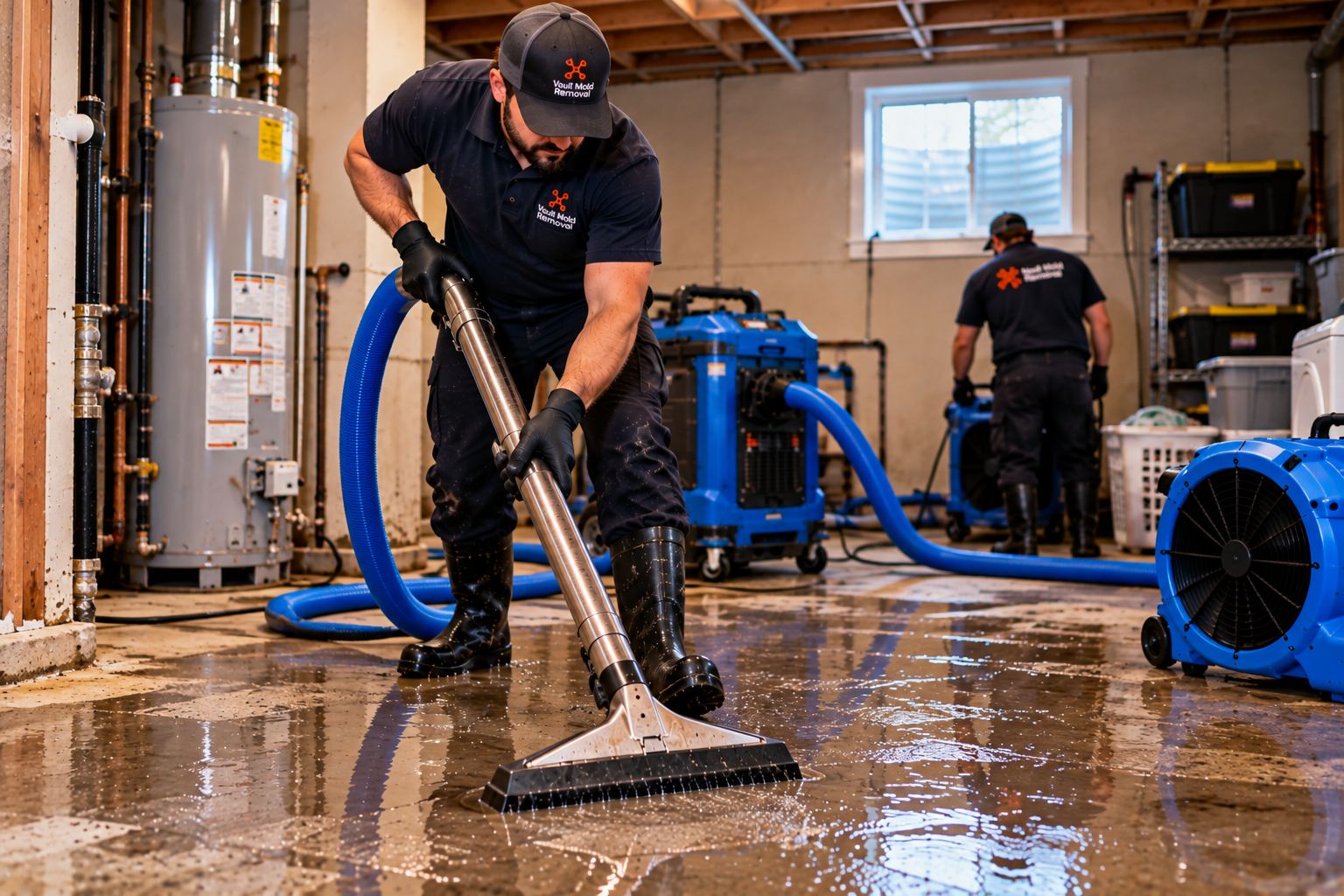
- Drywall and insulation: wet drywall is cut above the water line inside ZipWall containment with a HEPA air scrubber, so the wall cavity can dry.
- Crawl spaces and basements: standing water is extracted and the space is dried with dehumidifiers. See water extraction.
Repairs after the water is out
The same crew. Drywall, flooring, trim, cabinets and paint are rebuilt under our Utah DOPL General Contractor license, and every repair carries a 24-month workmanship warranty. We document the damage, write the scope in Xactimate and bill your insurer directly. See reconstruction and repairs.
Jobs we have done here
Water in your home or business right now? Call (385) 250-2825 for emergency flood cleanup and water damage restoration.
More questions
Can I pay over time?
Financing is available through Wisetack, from $500 to $25,000 over 3–24 months, with a soft credit check and subject to approval. See financing.
Services and service area
Our emergency water damage restoration services cover Springville homes and commercial property around the clock. The phone is answered live 24/7, our average arrival in Springville is about 48 minutes, and the crew starts water extraction and structural drying as quickly as the property allows.
The process: stop the source, remove standing water, move or protect contents, then dry walls, floors and framing with air movers and dehumidifiers while we take daily moisture readings. When materials are damaged, our local crew does the damage repair too, so homeowners deal with one company from flood cleanup to finished restoration.
Burst pipes, a failed water heater, a leaking roof after a storm, or sewage coming up a drain all get the same fast response. Service areas: Springville and the surrounding communities we serve — Provo, Orem, Vineyard, Lindon and Mapleton. Call (385) 250-2825; every water damage job gets a free written estimate.
Call (385) 250-2825Free estimateFinancingOur processAll local services
More questions from homeowners
What should I do while I wait for the crew?
Shut off the main water valve if you can, turn off power to wet rooms only from a dry spot, take photos for your insurance claim and move electronics and papers out of the water.
Does the 45-minute arrival guarantee cover my area?
The guarantee covers Provo city limits, daytime Monday–Saturday 8 AM–5 PM. Arrival in Springville is about 48 minutes.
What happens if every technician is already on a job?
The call rolls to the owner’s cell, not voicemail, so a person still answers.
How do you dry out a flooded basement?
Standing water is extracted, the area is dried inside drying chambers and readings are logged daily. See basement flooding help.
Do you handle sewage backups too?
Yes. Backed-up drains are “black water” and are handled with sealed containment and PPE. See sewage backup help.
Can water damage cause mold?
It can. The EPA advises drying wet materials within 24–48 hours to keep mold from starting.
Need emergency water damage service in Springville? Average arrival in Springville is 48 minutes. Call (385) 250-2825, answered live 24/7.