
Mold remediation in Orem, Utah: Vault is a licensed, family-owned IICRC Certified Firm, and mold inspections in Orem start at $99.
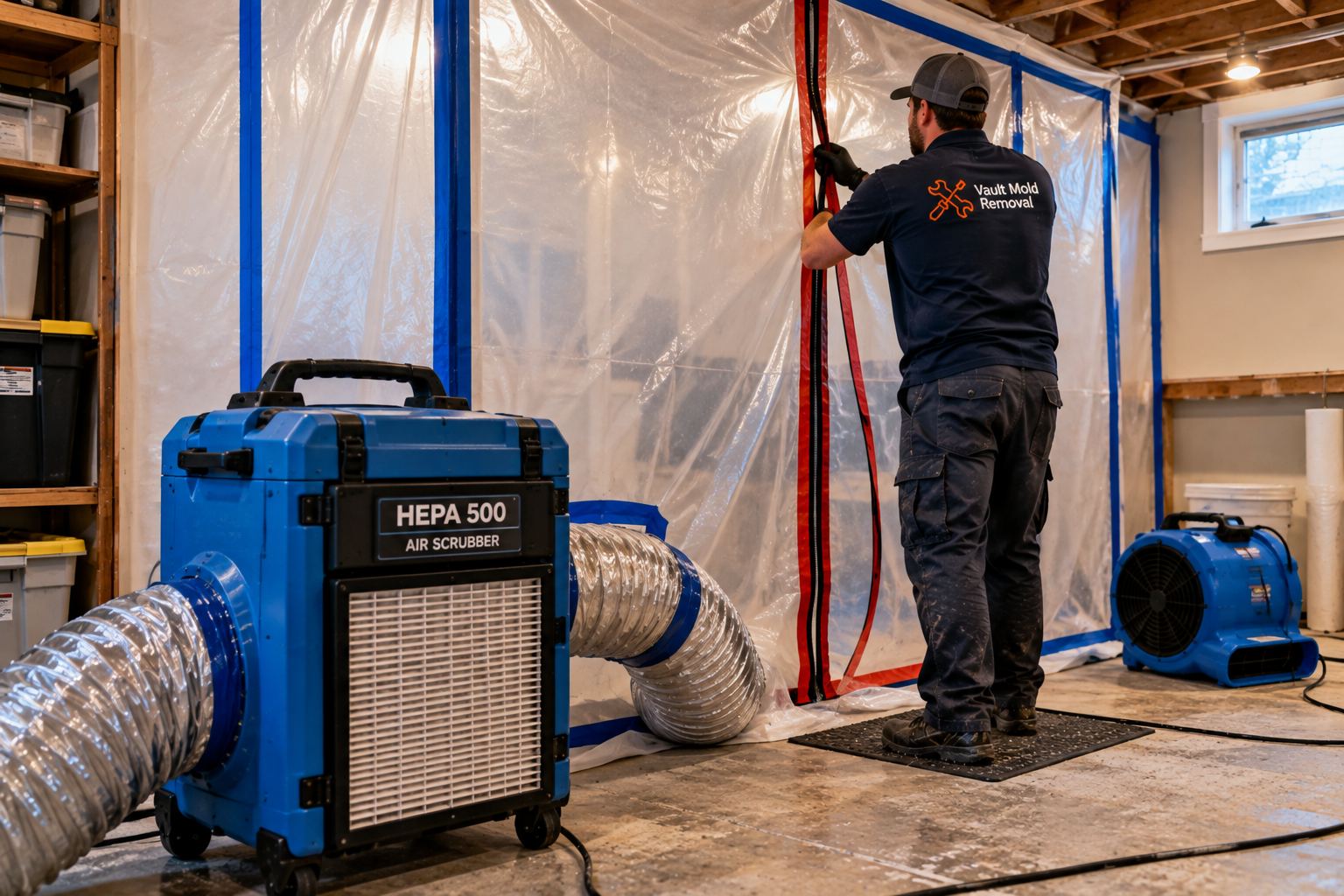
Mold grows where moisture stays: a slow leak, a damp crawl space or an attic after an ice dam. Our mold remediation finds the moisture source, contains the area, removes the growth and confirms the result with Sporecyte, an outside lab.
Homes in Orem get the same process. Current inspection prices start at $99, and the remediation estimate is free after the initial assessment.
Mold remediation in Orem at a glance
Vault handles mold remediation in Orem from a staffed office, shop and warehouse at 1169 S 760 W in Provo. Same W-2 crew does the inspection, the containment, and the clearance.
- Call any hour: (385) 250-2825 is answered live 24/7 by the Vault crew. Arrival to Orem typically under 60 minutes.
- Who does the work: Vault’s own W-2 crew, IICRC AMRT #319482 and OCT #319482-OCT, under Utah DOPL General Contractor License #11876543-5501. No subcontractors. Meet the team
- Clearance: Vault does its own post-remediation clearance; air samples analyzed by Sporecyte lab.
- Inspection pricing: $99 basic visual · $199 with moisture meter + thermal camera · $349 with air sampling + lab analysis. Mold remediation jobs start at $500.
- Insurance: Xactimate scopes, direct billing to State Farm, USAA, Allstate, Farmers and Bear River Mutual.
- Warranty: 24-month workmanship + 90-day mold warranty from post-remediation clearance. Wisetack financing available.
- Family-owned and veteran-operated, based in Provo since 2020.
Vault in Orem · Mold remediation · Containment process · Orem case studies
Vault mold remediation at a glance
- Who does the work: Vault’s own W-2 crew, no subcontractors. Our mold lead is Ryan Bautista, Mold Remediation & Drying Specialist (IICRC WRT and AMRT). Meet the team
- Credentials: IICRC AMRT (Applied Microbial Remediation) firm certification #319482, plus WRT, ASD and OCT · Utah DOPL General Contractor #11876543-5501 · EPA RRP lead-safe firm #NAT-F187294-1 · The Hartford GL + WC · bonded · BBB Accredited. Verify our credentials
- Where we’re based: staffed office, shop and warehouse at 1169 S 760 W, Provo, UT 84601. Phone answered live 24/7 at (385) 250-2825.
Mold inspection and remediation pricing
| Service | Price | What’s included |
|---|---|---|
| Basic visual inspection | $99 | Visual inspection of one area |
| Inspection with moisture mapping | $199 | Visual inspection plus moisture meter and thermal camera |
| Inspection with air sampling | $349 | Moisture meter and thermal camera, plus air sampling analyzed by Sporecyte, an outside lab |
| Removal | From $500 | Free written remediation estimate after the initial assessment |
Our 90-day mold warranty
Remediation is covered for 90 days from post-remediation clearance. If mold returns in that time, we reinspect within 7 business days and re-remediate at no charge. The warranty transfers once to a new owner with a signed transfer form. Warranty details
Paying for it
When mold is covered by your policy, we document it, write the scope in Xactimate and bill State Farm, USAA, Allstate, Farmers or Bear River Mutual directly. For deductibles, uncovered work or uninsured jobs, financing is available through Wisetack: $500–$25,000 over 3–24 months, with a soft credit check. Financing
Where we work
Provo, Orem, Springville, Vineyard, Lindon and Mapleton. See mold remediation in Provo, Orem, mold inspection and testing and black mold.
Mold Remediation in Orem, Utah
Mold remediation follows the IICRC S520 Standard for Professional Mold Remediation — the industry-standard protocol for assessing mold contamination, containing spread during removal, physically removing contaminated materials, cleaning affected surfaces, and verifying successful remediation. Our Orem mold remediation follows S520 protocols across the range of Orem mold scenarios: basement mold from flooding events in mid-century homes along State Street corridor, attic mold from ice dam damage in foothill neighborhoods (Suncrest, Cascade, Northridge), bathroom and kitchen mold from humidity or plumbing issues, HVAC-related mold, UVU-area rental property mold, and other patterns encountered in Orem’s diverse building stock. Arrival to Orem addresses averages about 41 minutes from our Provo office. This page covers mold remediation specifically as we deliver it to Orem properties.
IICRC S520 Framework
Condition Classifications
S520 uses three conditions to categorize mold situations:
- Condition 1 (normal fungal ecology): Indoor environment with normal fungal presence — no visible mold growth beyond what settles naturally from outdoors
- Condition 2 (settled spores, no active growth): Elevated mold spore concentrations from a mold source, but no active growth in the assessed area
- Condition 3 (active fungal growth): Visible mold growth or elevated concentrations indicating active fungal amplification
Remediation goal: return Condition 2 or 3 areas to Condition 1 through proper protocols.
S520 Remediation Steps
Standard S520 remediation follows sequential steps:
- Assessment: Identify affected areas, moisture sources, and appropriate scope
- Moisture source resolution: Address underlying moisture causing the mold before remediation begins
- Containment: Prevent contamination spread during remediation work
- Contaminated material removal: Physical removal of materials with active fungal growth
- Cleaning: HEPA vacuuming and antimicrobial application on remaining surfaces
- Drying: Ensure moisture conditions supporting mold don’t return
- Post-remediation verification: Visual inspection and often air testing to verify Condition 1 restoration
Remediation Equipment and Protocols
Containment
Containment prevents mold spore spread during remediation:
- Plastic sheeting barriers: 6-mil plastic sheeting with proper sealing at edges creates physical barriers around remediation areas
- Negative air pressure: HEPA-filtered air scrubbers pull air from the containment area, creating negative pressure that prevents contaminated air from escaping
- Decontamination zones: Airlock configurations for workers entering and exiting containment
- Zippered doorways: Access to containment areas without breaking the barrier
HEPA Filtration
HEPA air scrubbers are essential for mold remediation:
- Novatek NA-1500: Standard HEPA air scrubber for restoration work, filtering 99.97% of particles 0.3 microns and larger (including mold spores)
- Air changes per hour: Multiple air changes per hour target for containment areas to reduce airborne spore concentrations
- Deployment: 1–3 units for typical residential remediation, more for larger scope
- Duration: Continuous operation during remediation and post-remediation cleaning phase
Personal Protective Equipment
Technicians wear appropriate PPE during mold remediation:
- N95 respirators for Condition 2 work
- Half-face or full-face P100 respirators for Condition 3 work with heavy contamination
- Disposable protective clothing (Tyvek suits) for direct contact with contaminated materials
- Eye protection, gloves, and shoe covers for standard remediation
- Enhanced PPE for high-contamination situations
Antimicrobial Application
EPA-registered antimicrobials for surface treatment:
- Application to remaining surfaces after contaminated materials removed
- Contact time as specified by product manufacturer
- Coverage of all surfaces within the containment area
- Follow-up cleaning after antimicrobial contact time
Common Mold Scenarios in Orem Properties
Basement Mold in Mid-Century Homes
Basement mold following flooding events in Orem’s mid-century housing stock (State Street corridor, central Orem):
- Post-flooding mold development when drying wasn’t adequate or timing was delayed
- Chronic moisture-related mold from unresolved foundation or drainage issues
- Sump pump area mold from moisture around sump systems
- Behind-wall mold in finished basements where cavity moisture wasn’t properly addressed
- Water heater area mold from unrepaired water heater leaks or condensation
Attic Mold from Ice Dam Damage
Ice dam events in foothill Orem neighborhoods (Suncrest, Cascade, Northridge) produce specific mold patterns:
- Attic sheathing mold from ice dam water intrusion
- Insulation mold requiring insulation removal
- Attic framing mold with structural considerations
- Ceiling below attic with mold when ice dam water traveled downward
Bathroom and Kitchen Mold
Orem bathrooms and kitchens produce standard mold patterns:
- Shower area mold from ongoing moisture and inadequate ventilation
- Under-sink cabinet mold from slow leaks
- Around-toilet mold from wax ring failures or supply line issues
- Behind-appliance mold in kitchens (dishwasher, refrigerator ice maker areas)
- Ventilation improvement often part of comprehensive response
HVAC-Related Mold
HVAC system mold in Orem properties:
- Air handler area mold from condensate drainage issues
- Duct mold in specific systems where moisture has entered the duct system
- Coil mold from ongoing condensation without proper drainage
- Return air area mold from moisture entering through return grilles
UVU-Area Rental Property Mold
Student rental properties near UVU have specific mold patterns:
- High-humidity mold in high-occupancy properties
- Ventilation-related mold when systems aren’t adequately maintained
- Bathroom mold in high-usage student housing bathrooms
- Coordination with property management for remediation authorization
- Tenant coordination during remediation work
Older Central Orem Residential
Older Orem residential with specific mold considerations:
- Original construction sometimes lacks modern moisture management (vapor barriers, foundation waterproofing, attic ventilation)
- Aging systems producing chronic moisture issues that support mold development
- Basement conversion issues in older homes
- Original insulation with different characteristics than modern insulation
Post-Remediation Verification
Visual Inspection
Visual verification confirms physical remediation completion:
- Complete inspection of remediation area
- Verification of contaminated material removal
- Assessment of remaining surfaces for any missed areas
- Documentation with photos of completed remediation
Air Testing
Air quality testing when appropriate:
- Post-remediation air sampling to verify Condition 1 restoration
- Comparison of inside air to outside air baseline
- Laboratory analysis of collected samples by Sporecyte, an outside lab
- Documentation supporting insurance claim completion and property owner assurance
Moisture Verification
Moisture verification confirms conditions that prevent mold recurrence:
- All previously-affected materials at dry standards
- No remaining moisture sources that could support mold return
- Documentation for restoration completion and future reference
Insurance Coverage for Mold in Orem
Insurance coverage for mold remediation varies significantly:
- Standard homeowner policies typically have specific mold coverage limits (the dollar limit varies by policy, so check yours) below general water damage coverage
- Mold coverage often requires the mold to result from a covered peril (typically water damage from a covered cause) rather than from gradual moisture
- Some carriers offer mold coverage endorsements for enhanced coverage
- Coverage for mold from excluded perils (flood, gradual leaks, maintenance issues) is typically not available under standard homeowner policies
Frequently Asked Questions
- I found mold in my basement. Do I need professional remediation or can I handle it myself?
- Depends on the scope and specific circumstances. Small mold situations (less than 10 square feet, confined to accessible surfaces, non-porous materials) can sometimes be handled with DIY cleaning if the underlying moisture source is resolved and appropriate precautions are taken (respiratory protection, careful handling to prevent spore spread, complete cleaning with appropriate products). Situations warranting professional remediation: mold beyond 10 square feet (industry threshold for professional response), mold in inaccessible areas or wall cavities (proper access and containment requirements), mold on porous materials that may require removal (drywall, carpet, insulation), mold when air quality symptoms are present in the property, mold that keeps recurring (indicates unresolved moisture source), or any Category 3 water event that produced mold. For your specific Orem situation, honest assessment helps determine appropriate response: extensive mold, hard-to-reach mold, or mold with health symptom correlation warrants professional response. Small localized mold on hard surfaces with clear moisture source resolution may be manageable DIY. For any uncertainty, professional assessment (which is often minor cost) provides clarity on appropriate approach.
- My home tested positive for “black mold” on a home test kit. What does that mean?
- “Black mold” is a term used informally for various dark-colored mold species, and it doesn’t automatically indicate specific health hazards or need for extensive remediation. What “black mold” typically refers to: Stachybotrys chartarum, a specific species that produces mycotoxins under some conditions and has been associated with health effects in specific circumstances; other dark-colored species (Cladosporium, Alternaria, and various others) that appear similar visually but have different characteristics. Home test kit limitations: many home tests are unreliable for species identification; visual color alone doesn’t identify specific species; some non-toxic species appear identical to Stachybotrys. Actual health risk assessment: any indoor mold growth warrants attention regardless of specific species; Stachybotrys warrants professional response due to potential toxicity concerns; other species have varying health implications. Recommended approach: professional assessment can identify the actual mold species through proper testing (samples analyzed by laboratory rather than home tests); remediation protocols follow S520 for any active mold growth regardless of species; specific species identification affects some remediation decisions but doesn’t change the fundamental response protocols.
- Will my insurance cover mold remediation in my home?
- Depends on the specific policy, cause of the mold, and coverage limits. Common coverage patterns: mold from covered water damage (pipe failure, appliance failure, storm damage) typically has some coverage, often subject to specific limits ($5,000–$15,000 typical mold sublimit within the overall policy); mold from excluded causes (flood, gradual leaks, maintenance issues) typically excluded entirely; mold from unknown or long-term causes often disputed by carriers. Specific policy provisions to check: mold coverage limits (typically lower than general water damage coverage), mold coverage triggers (what must have caused the mold for coverage to apply), mold coverage exclusions (specific circumstances excluded), and any mold coverage endorsements you may have purchased for enhanced coverage. Practical approach: remediation is often necessary regardless of coverage outcome (mold left unaddressed produces continued property damage and potential health issues); coverage disputes can be addressed separately from the restoration work; some mold situations have coverage that requires documentation supporting the specific cause and timeline.
- How long does mold remediation typically take?
- Depends on scope, but typical timelines: small residential remediation (single room, limited materials, straightforward access) — 2–5 days total; standard residential remediation (multi-area, moderate scope, some material removal) — 5–10 days; larger remediation (extensive scope, significant material removal, complex containment) — 10–20 days; very large or complex remediation — 3–6 weeks. Timeline drivers: scope of contaminated material requiring removal, complexity of containment required, drying phase for materials requiring moisture verification before reconstruction, post-remediation verification including any air testing (typically 1–3 days for testing and results), and reconstruction after remediation completion (often longer than remediation itself for extensive material replacement). For attic remediation: often 5–10 days for typical scope; for basement remediation: often 7–14 days; for whole-house remediation from extensive water event: 3–8 weeks depending on scope.
- How do I know when mold remediation is actually complete and it’s safe to be back in the affected area?
- Verified through multiple confirmation approaches. Standard verification: visual inspection confirming all visible mold is removed and surfaces are properly cleaned; moisture verification confirming affected materials are at dry standards; air testing when appropriate (post-remediation air samples compared against baseline showing return to Condition 1 fungal ecology); documentation supporting all verification steps. What tells you it’s complete: professional verification (rather than just elapsed time or your own assessment); Condition 1 fungal ecology in previously-affected areas confirmed by testing when performed; underlying moisture sources addressed (mold won’t return without moisture); and thorough documentation of the complete process. Practical considerations: some property owners want extra assurance through additional air testing beyond standard verification; some situations warrant follow-up testing after 30–60 days for extra confidence; for property owners with mold sensitivity or health concerns, additional verification steps are reasonable. Our approach emphasizes thorough verification supporting property owner confidence in remediation completion.
Contact Vault Mold Removal — Provo, UT
For mold remediation services in Orem or coordination for specific projects, contact our office directly.
- Phone: (385) 250-2825
- Address: 1169 S 760 W, Provo, UT 84601
- Utah DOPL General Contractor License: #11876543-5501
- IICRC WRT / ASD / AMRT / OCT: #248317 / #248317-ASD / #319482 / #319482-OCT
Office Hours
- Monday – Saturday: 8:00 AM – 5:00 PM
- Sunday: Closed
Written warranty
24-month workmanship warranty on drying, structural repairs, drywall, flooring, cabinetry and paint done by Vault. 90-day mold warranty from post-remediation clearance for recurrence from the same moisture source. Both are transferable once to a new homeowner, in writing on the work order. Full terms at /warranty/.
We bill your carrier directly
Direct-billing with State Farm, USAA, Allstate, Farmers and Bear River Mutual. Every scope is written in Xactimate; you pay only your deductible plus anything the policy doesn’t cover. Not on this list? We still handle the claim.
Who shows up on your job
You get Vault’s W-2 crew — Marcus, Ryan, Elena, Daniel and Joseph — not a lead-gen handoff and not a franchise sub. Reconstruction (drywall, flooring, cabinetry, paint) is done by the same crew under Utah DOPL License #11876543-5501.
How we contain the work area
Containment keeps mold spores, dust and contamination in the work area and out of the rest of the house. What we set up depends on the job:
| Type of job | How Vault contains the work area |
|---|---|
| Clean-water pipe leak | Plastic sheeting, ZipWall poles, floor protection |
| Basement flooding | Floor protection, plastic barriers where needed |
| Drywall flood cuts | ZipWall, 6-mil plastic, zipper door, HEPA air scrubber |
| Mold remediation | Sealed containment, HEPA negative air machine, zipper entry |
| Sewage backup | Sealed containment, negative air equipment where appropriate, PPE |
| Structural drying | Temporary barriers or drying chambers to control the drying environment |
Clearance: when remediation is finished, Vault’s AMRT-certified crew performs the post-remediation clearance with a visual inspection and moisture readings. Air samples are analyzed by Sporecyte, an outside laboratory. Your 90-day mold warranty starts from that clearance. See our full containment process
Mold guides for Orem homeowners
- How to tell if you have mold
- Found black mold? What to do
- Musty smell in your house
- Mold in your basement
- Mold in your bathroom
- Mold in your attic
- Window condensation mold
- Do I need mold testing?
- Mold remediation cost in Utah
- Is mold covered by insurance?
All guides: resources library · Or call (385) 250-2825
Helpful guides: Post-remediation clearance · Negative air containment · Mold on drywall
All our services in Orem
Mold remediation in Orem: find us and quick answers
Vault’s AMRT-certified crew finds the moisture source, seals off the work area, removes what can’t be saved and does its own clearance, with air samples analyzed by Sporecyte.
Where we are
1169 S 760 W, Provo, UT 84601
Phone: (385) 250-2825 (answered live 24/7)
Email: info@vaultmoldremoval.xyz
Office: Monday–Saturday, 8 AM–5 PM
Getting to you
Arrival to Orem averages about 41 minutes from our Provo office.
Quick answers
Do I need a mold inspection first?
Not always. Inspections start at $99 for a basic visual check of one area, $199 adds a moisture meter and thermal camera, and $349 adds air sampling with lab analysis by Sporecyte.
How much does mold remediation in Orem cost?
Remediation jobs start at $500 for small areas, and the remediation estimate is free after the initial assessment. Wisetack financing is available.
What if the mold comes back?
Vault’s 90-day mold warranty starts at post-remediation clearance. If mold returns from the same moisture source, we reinspect within 7 business days and re-remediate free.
Helpful reading: the EPA mold guide. Check our license in the Utah DOPL license lookup.
Ready to talk about mold remediation in Orem? Call (385) 250-2825 or request a free estimate below.
Call (385) 250-2825Get a free estimate More about Vault in Orem
Related services in Orem
Vault serves Orem homeowners, landlords and businesses with the same licensed, insured W-2 crew for every service:
- Moisture detection
- Dehumidification
- Water damage restoration in Orem
- Basement flooding
- Structural drying
- Emergency water damage
Where we find mold in Orem homes
Most mold we remove grows where water sat too long: crawl spaces and basements after leaks or seepage, attics after ice dams or bath fans vented into the attic, and behind showers, sinks and appliances with slow leaks. Fixing that moisture source is part of every job. Musty odor usually clears once the mold is removed and the area is dry; for odor that lingers, see odor removal. Not sure what you have? Start with a mold inspection.
Mold remediation in nearby cities
Serving Orem and the surrounding Utah County areas from our Provo office:
- Mold remediation in Provo
- Mold remediation in Springville
- Mold remediation in Vineyard
- Mold remediation in Lindon
- Mold remediation in Mapleton
Questions about mold remediation in Orem? Call (385) 250-2825; the phone is answered live 24/7.
Professional mold removal and testing in Orem
Mold remediation in Orem starts with finding out what is growing and why. Vault’s AMRT-certified crew inspects, tests, removes the mold in sealed containment, fixes the moisture that caused it and then verifies the result with clearance testing. Every mold job is done by our own W-2 technicians under our Utah DOPL General Contractor license.
When mold testing makes sense
If you can see mold and know the source, testing is often not needed before removal. Testing helps when you smell mold but cannot find it, after water damage, or when you need proof for a sale, a landlord or an insurer. Vault’s mold inspection options:
- $99 visual mold inspection of one area
- $199 inspection with moisture meter and FLIR thermal camera
- $349 inspection with air sampling, analyzed by Sporecyte, an outside lab
See mold inspection and testing and do I need mold testing after water damage.
Where mold grows
- Black mold on drywall and wood that stayed wet for weeks (black mold: what to do)
- Attic mold on roof sheathing from ice dams, roof leaks or bath fans vented into the attic (mold in attics)
- Crawl space mold on joists and subfloor from ground moisture and plumbing leaks (mold in crawl spaces)
- Basement mold behind finished walls after seepage or a flood (mold in basements)
- Bathroom mold behind showers and under sinks from slow leaks (mold in bathrooms)
Signs you need professional mold remediation
A musty smell that keeps coming back, visible growth larger than a few square feet, mold that returns after cleaning, staining after a past leak, or mold in HVAC returns. Scrubbing or bleach on porous materials does not remove the growth inside them and can spread spores through the home. See how to tell if you have mold in your house.
Mold removal vs. mold remediation
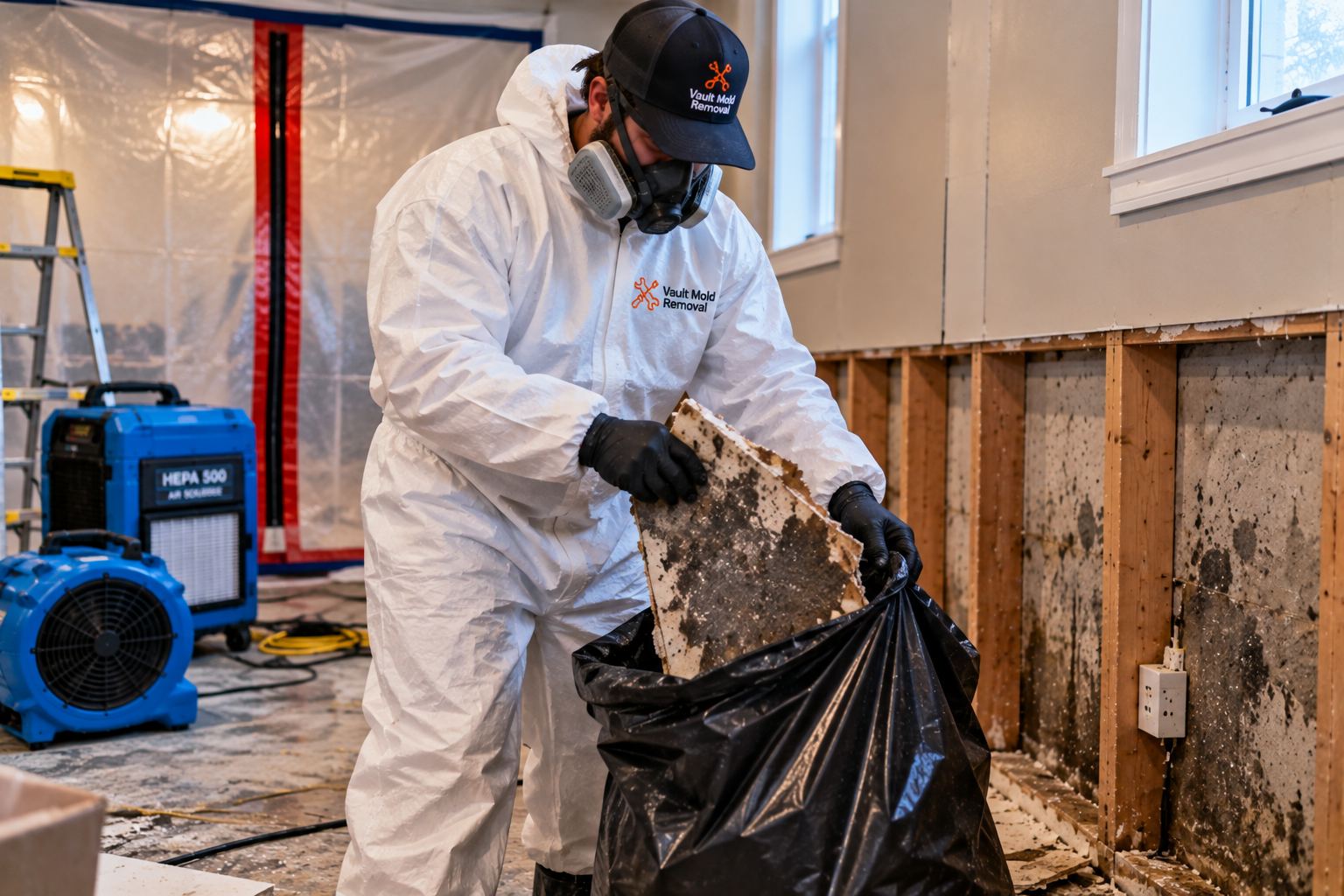
Mold removal is taking the growth out. Mold remediation is the full process: sealed containment with HEPA negative air and a zipper entry, removal of contaminated materials, HEPA vacuuming and cleaning, drying, fixing the moisture source and clearance testing. That is how every mold job in Orem is done, and it is why the result is covered by a warranty.
Typical mold remediation costs
Mold remediation starts at $500, and you get a free remediation estimate after the initial assessment. Wisetack financing is available, subject to approval. After clearance, a 90-day mold warranty applies: if mold returns from the same moisture source, we reinspect within 7 business days and re-remediate free. Water damage behind the mold? See water damage restoration in Orem.
Jobs we have done here
Real projects our crew documented in Orem:
Ready for professional mold removal in Orem? Call (385) 250-2825; the phone is answered live 24/7 by the Vault crew.
More questions
What does a mold inspection cost?
$99 for a visual inspection of one area, $199 with moisture meter and thermal camera, and $349 with air sampling and lab analysis. Remediation starts at $500, and the remediation estimate is free after the initial assessment.
How do you keep mold from spreading during removal?
Sealed containment with HEPA negative air and a zipper entry, so spores stay in the work area. See negative air containment.
How do I know the mold is gone?
Clearance is done by our AMRT-certified crew, and air samples are analyzed by Sporecyte, an outside lab. The U.S. EPA explains why the moisture source has to be fixed too: EPA mold guidance.
Is mold remediation guaranteed?
Yes — a 90-day mold warranty from post-remediation clearance. If mold returns, we reinspect within 7 business days and re-remediate free.
Services and service area
Vault provides mold remediation services for Orem homeowners, landlords and commercial property owners. Our local, AMRT-certified crew finds the moisture source, sets up sealed containment with HEPA negative air, removes mold growth and damaged materials, and cleans what can be saved.
Mold removal is only half of the job, so we also handle the water damage restoration and structural repairs that follow: drywall, flooring and framing under our Utah DOPL General Contractor license. Attic mold, basement mold and crawl space mold each get the same process, and clearance air samples go to Sporecyte, an outside lab.
Older homes can contain lead paint or asbestos — see asbestos and lead in older homes. We also handle smoke damage, sewage and biohazard cleanup. Service areas: Orem and the surrounding communities we serve — Provo, Springville, Vineyard, Lindon and Mapleton. Inspections start at $99, and the remediation estimate is free after the initial assessment.
Call (385) 250-2825Free estimateFinancingOur processAll local services
How mold removal works, step by step
Musty smell, stains or an old leak
Most calls start with a musty smell that keeps coming back, dark staining on drywall or baseboards, or a leak that was never fully dried. Growth usually hides behind walls, under flooring and in attics, so what you can see is often only part of it.
- A musty odor in one room or the basement
- Water stains, peeling paint or warped trim
- A past leak, flood or sewage backup
- Condensation on windows and cold exterior walls
Inspection options and prices in Orem
You pick the level of testing. Every option is priced up front:
- $99 — visual inspection of one area
- $199 — adds a moisture meter and FLIR thermal camera
- $349 — adds air sampling with lab analysis by Sporecyte
How Orem homes are sealed off before work starts
Contaminated material is never torn out in the open. The work area is closed off with sealed containment, a zipper entry and HEPA negative air, so spores stay inside the work zone instead of drifting into clean rooms.
Removing damaged, contaminated materials from Orem homes
Porous materials that can’t be cleaned — typically drywall, insulation and carpet pad — are bagged and removed inside containment. Framing and other solid surfaces are HEPA-vacuumed and cleaned, not just painted over.
Fixing the moisture that caused it
Growth comes back if the water source stays. We find the leak, condensation or humidity problem with Delmhorst and Protimeter moisture meters and dry the structure before anything is closed up.
Clearance testing on Orem jobs by an AMRT-certified crew
The job isn’t finished until it passes clearance. Clearance is done by our AMRT-certified crew, and air samples go to Sporecyte, an outside lab, so the result doesn’t rest on our word alone.
90-day warranty and free re-treatment
Every job carries a 90-day mold warranty from clearance. If growth returns, we reinspect within 7 business days and re-treat it free.
Cost, estimates and financing
Removal starts at $500, and the estimate is free after the initial assessment. Financing is available through Wisetack: $500–$25,000 over 3–24 months, soft credit check, subject to approval.
When to call right away
The EPA advises drying wet materials within 24–48 hours to keep growth from starting. Call the same day if:
- Water got into walls, floors or ceilings in the last two days
- Visible growth covers more than about 10 square feet — the EPA’s point for bringing in a professional
- The problem started after a sewage backup
The phone is answered live 24/7 by the crew: (385) 250-2825.
More questions from homeowners
What are common signs of hidden mold?
A musty smell that keeps coming back, water stains, peeling paint or warped trim, and any past leak or flood that wasn’t fully dried.
Which inspection should I choose?
$99 covers a visual inspection of one area, $199 adds a moisture meter and thermal camera, and $349 adds air sampling with lab analysis.
Who analyzes the air samples?
Sporecyte, an outside lab, so the results don’t rest on our word alone.
What should I do if I find black mold?
Don’t scrub or dry-brush it, which can spread spores, and keep the area closed off. See our guide: black mold: what to do.
Can I remove mold myself?
The EPA says a homeowner can usually handle an area smaller than about 10 square feet. Larger areas, or growth inside walls or HVAC, call for a professional.
Can I finance mold removal?
Yes — Wisetack financing covers $500–$25,000 over 3–24 months, soft credit check, subject to approval.
Do you fix the leak that caused the mold?
Yes. We find leaks with moisture meters and a thermal camera and handle the drying. See water damage restoration in Orem.
Can you remove mold in attics and basements?
Yes, with the same sealed containment and HEPA negative air. See our guides on attic mold and basement mold.
Vault serves Orem for mold problems from our Provo office at 1169 S 760 W. If you’re in Orem, call (385) 250-2825 — answered live 24/7 by the crew — or ask for a free estimate for your Orem home.