
About this job
A real Vault job in Provo. The crew that handled it was Vault’s own W-2 team — no subcontractors, no franchisee hand-off. Same crew answers the phone and shows up at the door.
- Call any hour: (385) 250-2825 answered live 24/7. 45-min guarantee Provo (Mon-Sat 8-5); under 60 min elsewhere in Utah County.
- Who did the work: Vault’s W-2 crew, IICRC WRT/ASD/AMRT/OCT, Utah DOPL #11876543-5501.
- Insurance: Xactimate scopes submitted direct to State Farm, USAA, Allstate, Farmers, Bear River Mutual, and most national carriers.
- Pricing: water mitigation $3,500-$8,500; reconstruction $4,500-$9,500. 24-month warranty, Wisetack financing.
- Family-owned and veteran-operated, based in Provo since 2020.
See Vault in Provo, all Provo case studies, or water damage services.
Real Vault job — North Park, Provo
- Approximate location
- Near 500 N and 500 W
- When
- January 2026
- What happened
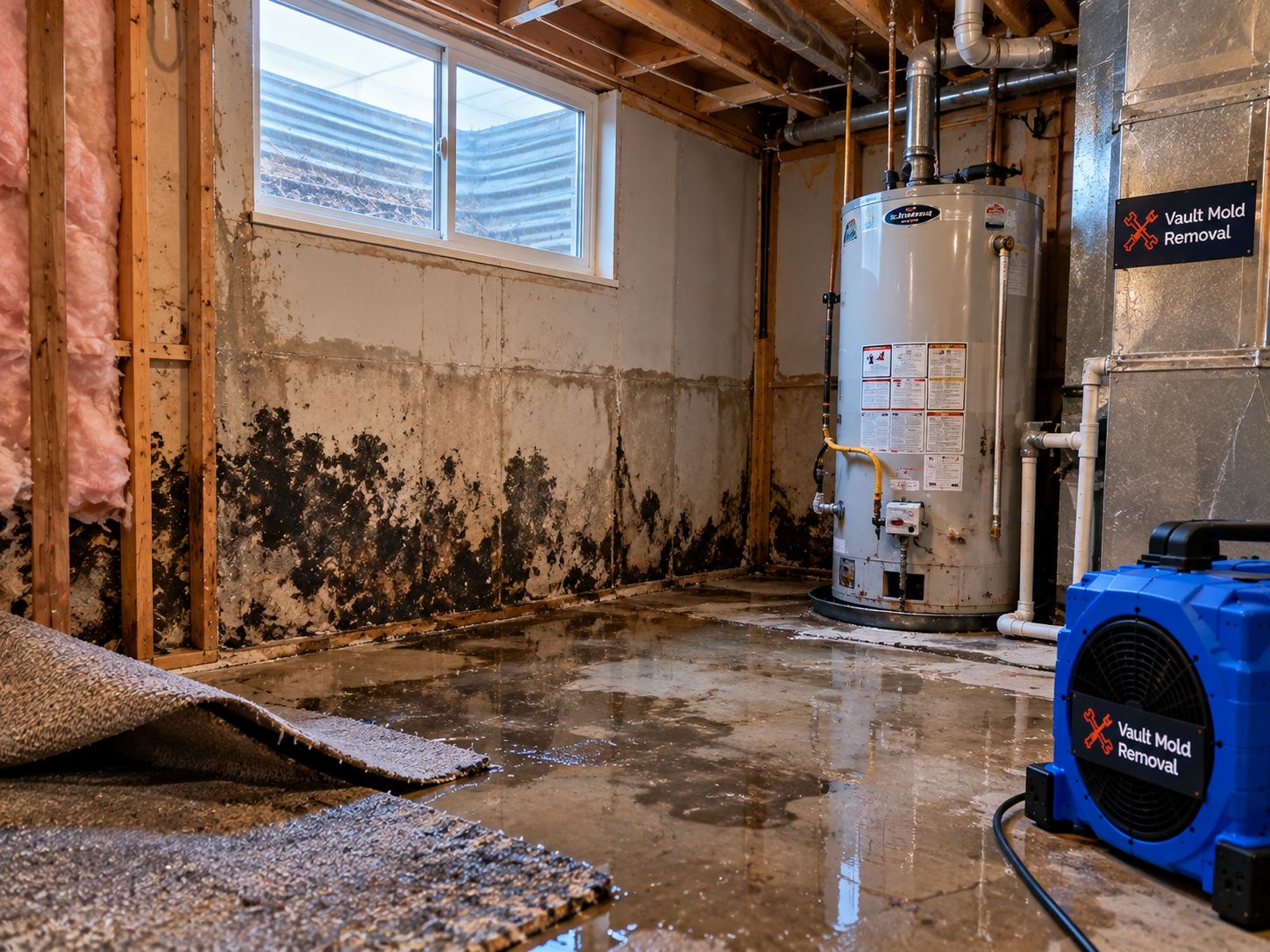
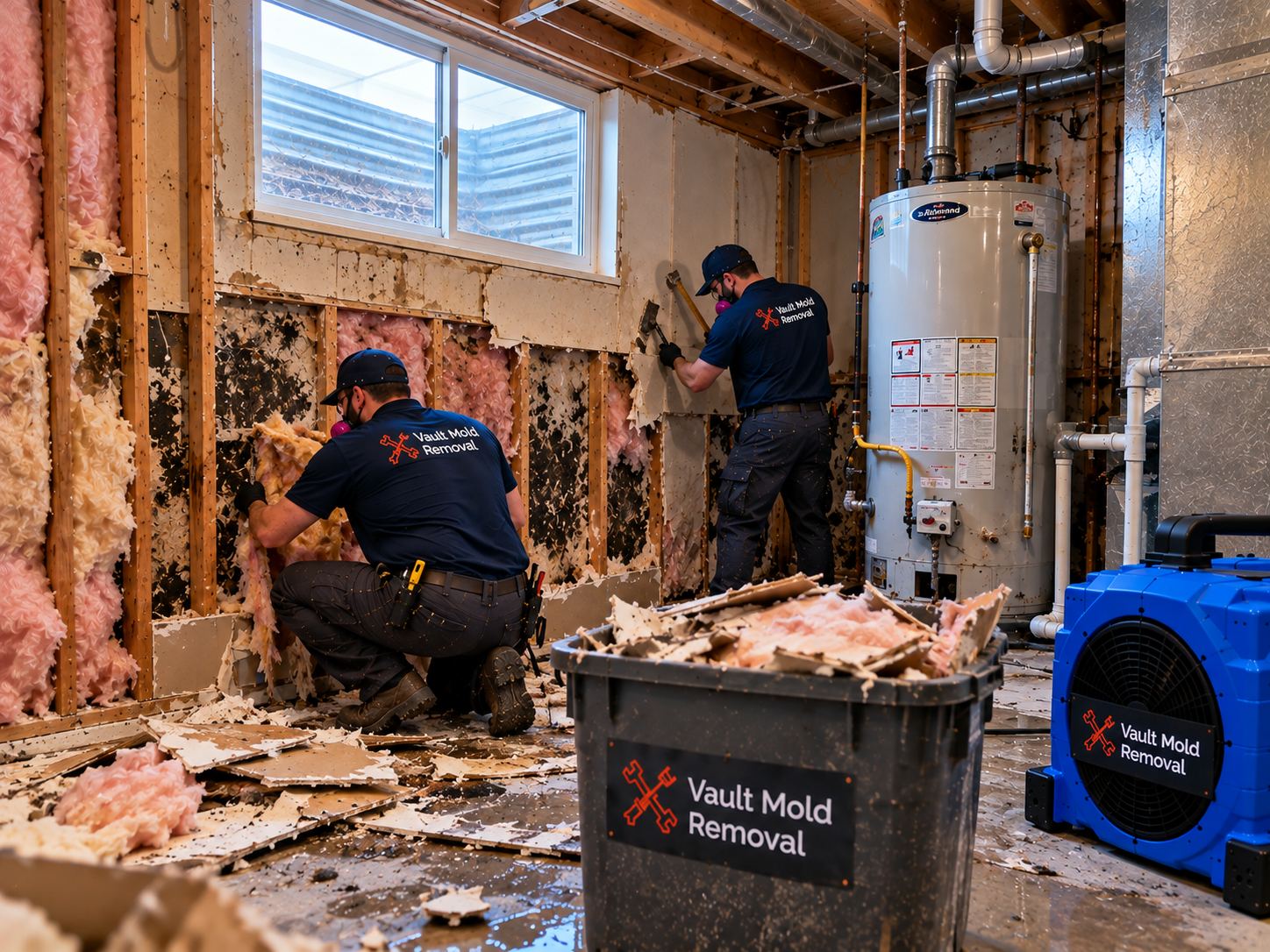
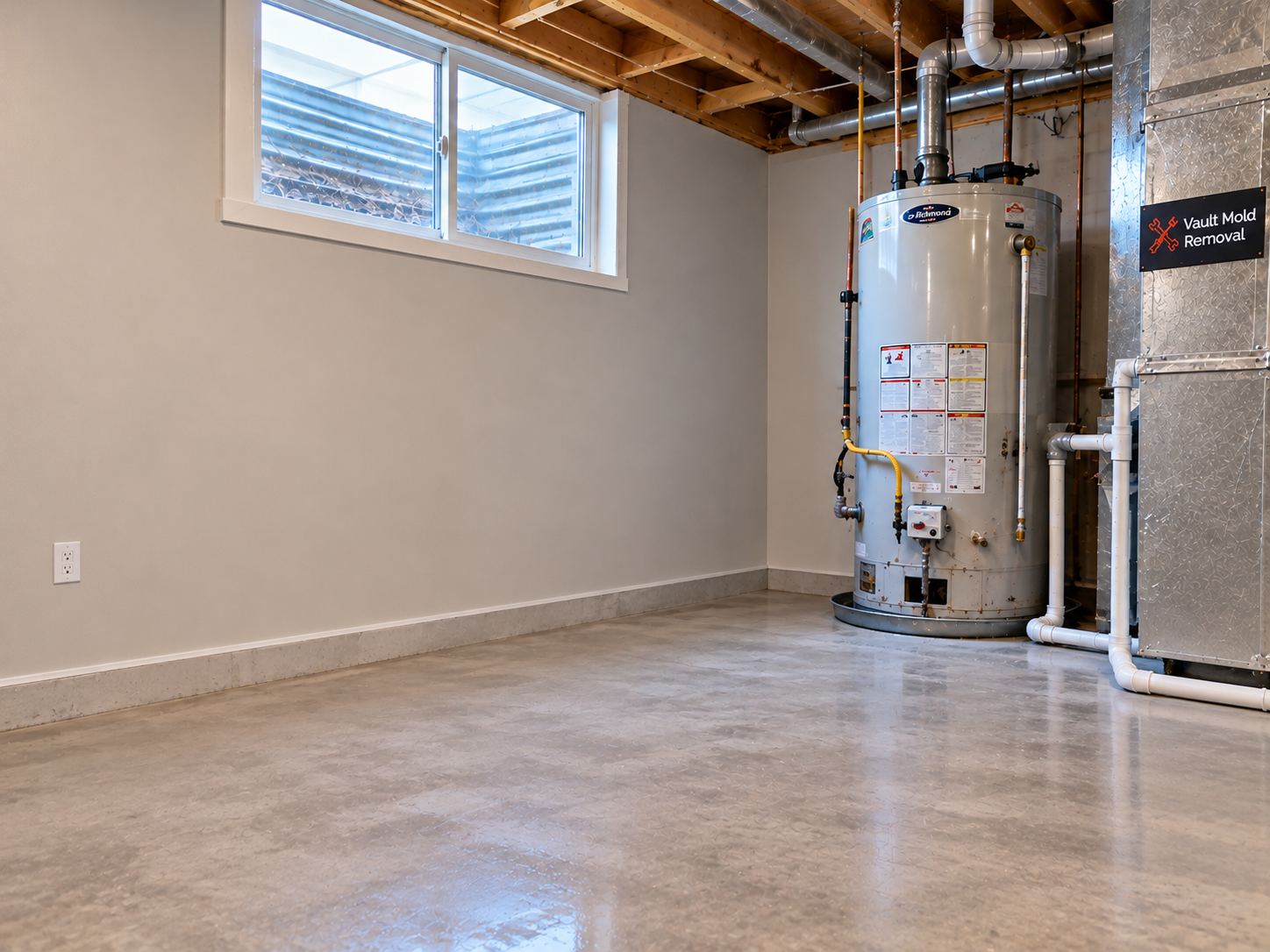
- Frozen exterior hose bib pipe ruptured inside a wall, flooding basement storage room and damaging insulation and drywall.
- What Vault did
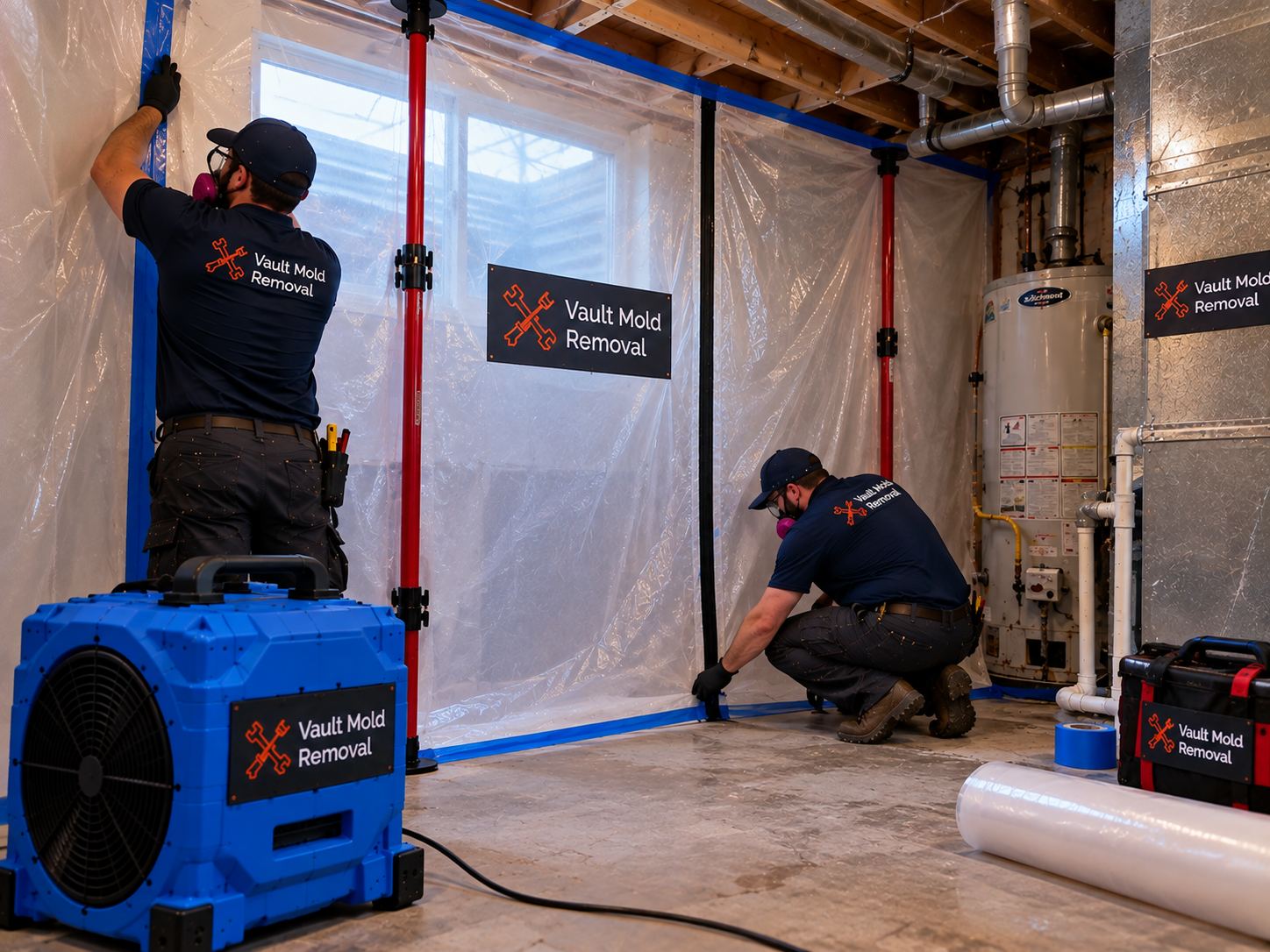
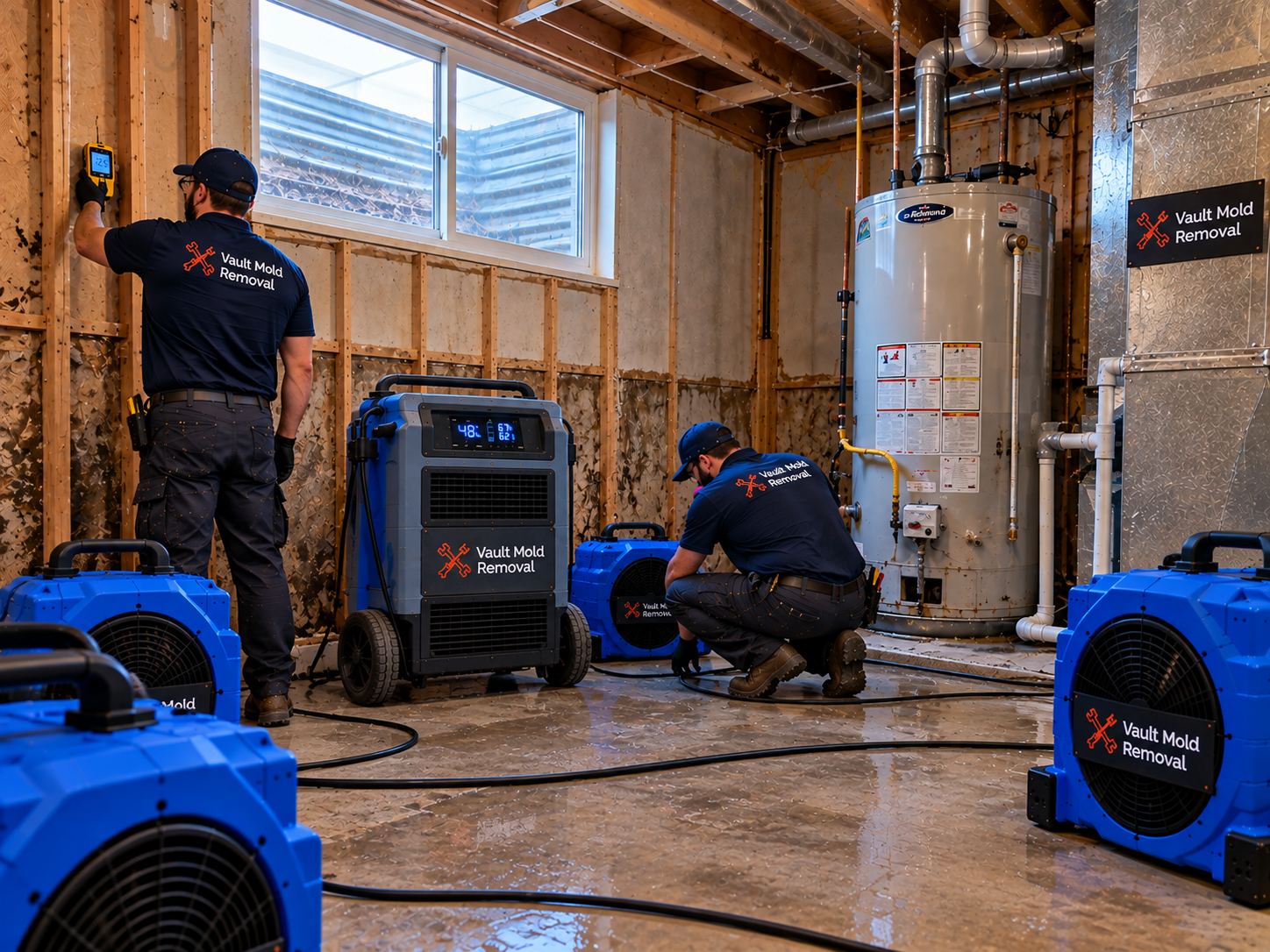
- Flood cuts and drying.
Water Damage Restoration in North Park, Provo
North Park is the residential neighborhood immediately north of Bulldog Boulevard and the BYU campus edge, tightly clustered between University Avenue on the west and about 900 East on the east, running north to roughly 1200 North. Development happened primarily during Provo’s mid-century BYU expansion — the 1950s and 1960s — with some earlier housing along University Avenue and some later infill construction on remaining lots into the 1980s. Lots are small, houses are close together, mature trees form a nearly complete canopy over most streets, and the neighborhood retains the walkable, professional-community character it developed when much of the housing served BYU faculty and staff. Restoration work here shares the mid-century predictability of Grandview South with the added complication of very tight access for equipment.
Response time from our Provo dispatch to a North Park address averages 22 minutes daytime and 46 minutes overnight, logged over three years of dispatch records. Central North Park runs 20 to 22 minutes daytime. Eastern edges approaching Edgemont run 24 to 26 minutes daytime.
What North Park Construction Looks Like
North Park’s mid-century core (roughly 85% of the housing stock) shares Provo’s standard mid-century profile: platform framing with fire blocking, copper supply lines (original 1950s-1960s installations), cast-iron drain with partial ABS re-piping, drywall over 2×4 framing, forced-air HVAC. Foundations are almost universally full basements — mid-century Provo standard in the flat central-north area. Slab-on-grade is rare here.
Houses are close together on tight lots. Standard North Park lot is 6,000 to 8,000 square feet with houses set back 15 to 25 feet from the street and side-yard setbacks of 5 to 8 feet between adjacent structures. That’s normal for the density but creates specific access challenges — our trucks can rarely park directly at side or rear access points, and larger equipment sometimes has to be walked in from street frontage.
Pre-1950 housing along University Avenue and some scattered older parcels shares Joaquin’s balloon-frame construction, lath-and-plaster walls, and galvanized supply-line profile. These represent maybe 10% of North Park housing stock but present the same diagnostic considerations as Joaquin work.
Tight Access Considerations
North Park’s tight lot pattern and mature tree canopy affect restoration work in specific ways. Truck access to the back of the property is often impossible — we work from street frontage with longer supply and discharge lines than we run in more spacious neighborhoods. Extraction discharge to sanitary sewer requires longer discharge hoses when the sewer cleanout is not near the front of the property. Container placement for demolition debris requires coordination on street frontage or driveway staging, and sometimes coordination with neighbors on shared driveway or alley access.
Tree canopy affects overhead access. Truck-mounted equipment with vacuum booms sometimes has limited overhead clearance under mature trees, particularly during summer when the canopy is fully leafed. We route around obstructions but the equipment setup takes longer.
BYU Professional Community Character
North Park retains a strong BYU-affiliated professional community character even as ownership has diversified over the decades. Practical implications for restoration: many homes carry insurance through carriers popular in the BYU professional community (USAA is disproportionately represented for anyone with military connection, Bear River Mutual is common as a Utah-based option), and property owners often have expectations for restoration quality that reflect professional-community norms rather than pure-cost-minimization thinking. Our documentation standard and reconstruction quality fits these expectations without adjustment.
Typical North Park Failure Patterns
- Copper pinhole leaks in original 1950s-1960s installations
- Age-related failure of original copper supply lines, now well past 60-year service life. Common enough that whole-neighborhood re-pipe activity is ongoing.
- Water heater tank rupture
- Standard failure mode. Full basement mechanical rooms usually have inadequate drainage for full tank release.
- Washing machine and dishwasher supply hose failures
- Braided stainless supply-hose failures at fittings. Standard modern-appliance failure mode across the housing stock.
- Cast-iron drain root intrusion
- Mature tree canopy means mature root systems. Cast-iron drain runs at 50+ years of age are vulnerable to root intrusion at fitting joints, producing sewer backups.
- Frozen supply lines in unheated basement runs
- Provo January design temperature 7°F stresses exposed supply lines in some North Park basements with minimal insulation.
Insurance Documentation for North Park Losses
Utah Code 31A-26-301.5 requires acknowledgment within 15 days and coverage determination within 30 days of proof of loss. North Park claims run standard mass-market and BYU-community carrier programs — State Farm, USAA, Allstate, Farmers, Bear River Mutual. Documentation preferences vary slightly between carriers; our baseline standard fits all of them.
Watch-items on North Park claims: pre-1978 homes (nearly all of the housing stock) fall under EPA RRP for lead-safe work practices; sewer backup requires specific endorsement to be covered; gradual pinhole damage can face coverage disputes; access constraints may require additional equipment staging costs that need documentation in the initial scope.
Frequently Asked Questions
- My street is so narrow your trucks might not fit. Is that a problem?
- Not usually. Our dispatch trucks are standard commercial vans and utility body trucks, which fit most Provo residential streets even where parking is tight on both sides. Truck-mounted extraction and dehumidification equipment operates from where the truck can park; we run longer supply and discharge lines when needed. Extreme cases (extraordinarily narrow streets, obstructed access) sometimes require different equipment configurations, but this is rare in North Park.
- My driveway is shared with a neighbor. How do you handle access?
- Coordination with the neighbor. Shared driveway configurations are common in North Park’s tight lot pattern. We identify shared access constraints during initial dispatch call, coordinate with neighbors on staging timing, and try to minimize disruption to their access when possible. Most neighbors accommodate emergency response cooperatively; extended restoration work (5-10 days of daily activity) sometimes requires more formal scheduling.
- My house is 1958 with original copper. It’s had one pinhole. Should I re-pipe the whole thing?
- Statistically reasonable at this point. 67-year-old copper in Provo’s aggressive water chemistry has significantly reduced wall thickness across the system. First pinhole failures are usually followed by additional failures within a few years. Whole-house re-pipe to PEX costs $8,000 to $18,000 depending on home size and complexity but typically saves the cost of multiple future pinhole restoration claims. It’s a plumbing decision rather than a restoration one, but the timing math often favors proactive re-pipe.
- My insurance is through USAA. Does that change anything?
- USAA emphasizes daily monitoring compliance on active claims and generally has efficient adjuster response on residential losses. Documentation standards are similar to other mass-market carriers but USAA reviews claims quickly, which means initial documentation quality matters more than with slower carriers. Our baseline standard fits USAA expectations without modification.
- The mature trees on my street have been dropping branches into my gutters and now they’re overflowing. Is that a claim?
- The overflow itself is typically not directly claimable (that’s a maintenance issue — cleaning gutters is your responsibility). Any water damage that results from the overflow into your home, however, may be covered as sudden and accidental discharge — for example, if overflow water intrudes into wall cavities through a compromised eave or if it causes ice damming during winter that then produces interior damage. We document the specific pathway from the overflow to interior damage to support the strongest coverage position.
Contact Vault Mold Removal
Phone: (385) 250-2825
Address: 1169 S 760 W, Provo, UT 84601
Hours: Monday–Saturday, 9:00 AM – 5:00 PM
Service Area: North Park, all Provo neighborhoods, and surrounding Utah County communities.
Water damage in Provo?
Call (385) 250-2825 — answered live 24/7 by the Vault crew, not a call center. Inside Provo city limits, Monday–Saturday, 8 AM–5 PM, we guarantee arrival in 45 minutes — see the terms.
Real Vault jobs in Provo
Each of these is a real job done by Vault’s own W-2 crew. Call (385) 250-2825, answered live 24/7.
- Downtown — February 2026
- East Bay — July 2026
- Edgemont — June 2026
- Foothills — May 2026
- Franklin — December 2025
- Franklin South — March 2026
- Grandview North — September 2026
- Grandview South — August 2026
- Indian Hills — April 2026
- Joaquin — November 2025
- North Park — January 2026
- Oak Hills — July 2026
- Provost — June 2026
- Riverbottoms — May 2026
- Rivergrove — March 2026
- Rock Canyon — February 2026
- Sherwood Hills — April 2026
- Sunset — August 2026
- Timp — December 2025
- Wasatch — January 2026
- 1908 Joaquin Bungalow Galvanized Failure
- Downtown Mid-Rise Sprinkler Discharge
- Edgemont Hidden Crawlspace Pinhole
- Foothills Walkout Washer Cascade
- Franklin Sewer Backup Root Intrusion
If a job like this is happening to you
Vault handles jobs like the one above every day across Utah County. Here’s what else is worth reading before you call:
- Why Vault — W-2 crew, 45-min Provo guarantee, in-house mold clearance, no franchise call center.
- Insurance claims — how we document the damage and bill State Farm, USAA, Allstate, Farmers, Bear River Mutual directly.
- 24-month warranty — what’s covered and how to open a claim.
- Wisetack financing — $500-$25,000 over 3-24 months, soft credit check.
- Service area — confirm your city is one of the 6 we cover.
- Water damage timeline — why every hour of head start cuts the final bill.
Call now: (385) 250-2825 — answered live 24/7 by the Vault crew.
Photos from this North Park job
Real photos taken by the Vault crew during this North Park, Provo water damage job in January 2026 — frozen hose bib ruptured during a cold snap at 500 N / 500 W.
Dealing with something similar?
This job started with a frozen hose bib rupture. If that sounds like what you’re facing, these guides cover what to do first:
Winter pipe protection in Utah · Finding your main water shut-off
Or call (385) 250-2825 — answered live 24/7.
Helpful guides: What if water damage isn’t fixed? · Documenting damage for insurance
Need help with a job like this?
water damage restoration in Provo · emergency water damage restoration in Provo · sewage cleanup in Provo · mold remediation in Provo
Have a job like this in Provo? See emergency water damage in Provo, or call (385) 250-2825 for a free written estimate.