
About this job
A real Vault job in Provo. The crew that handled it was Vault’s own W-2 team — no subcontractors, no franchisee hand-off. Same crew answers the phone and shows up at the door.
- Call any hour: (385) 250-2825 answered live 24/7. 45-min guarantee Provo (Mon-Sat 8-5); under 60 min elsewhere in Utah County.
- Who did the work: Vault’s W-2 crew, IICRC WRT/ASD/AMRT/OCT, Utah DOPL #11876543-5501.
- Insurance: Xactimate scopes submitted direct to State Farm, USAA, Allstate, Farmers, Bear River Mutual, and most national carriers.
- Pricing: water mitigation $3,500-$8,500; reconstruction $4,500-$9,500. 24-month warranty, Wisetack financing.
- Family-owned and veteran-operated, based in Provo since 2020.
See Vault in Provo, all Provo case studies, or water damage services.
Real Vault job — Indian Hills, Provo
- Approximate location
- Near Indian Hills Drive
- When
- April 2026
- What happened
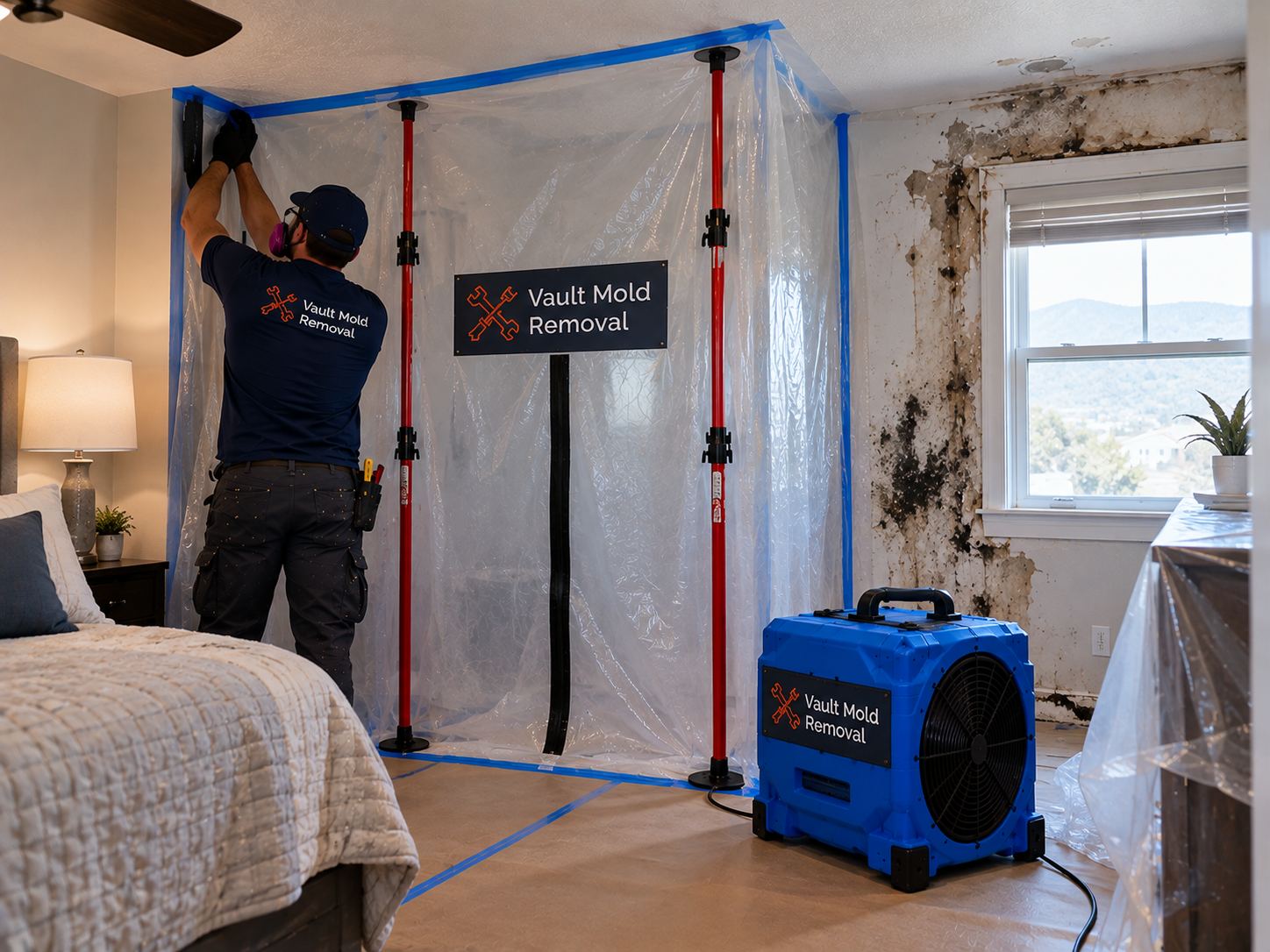
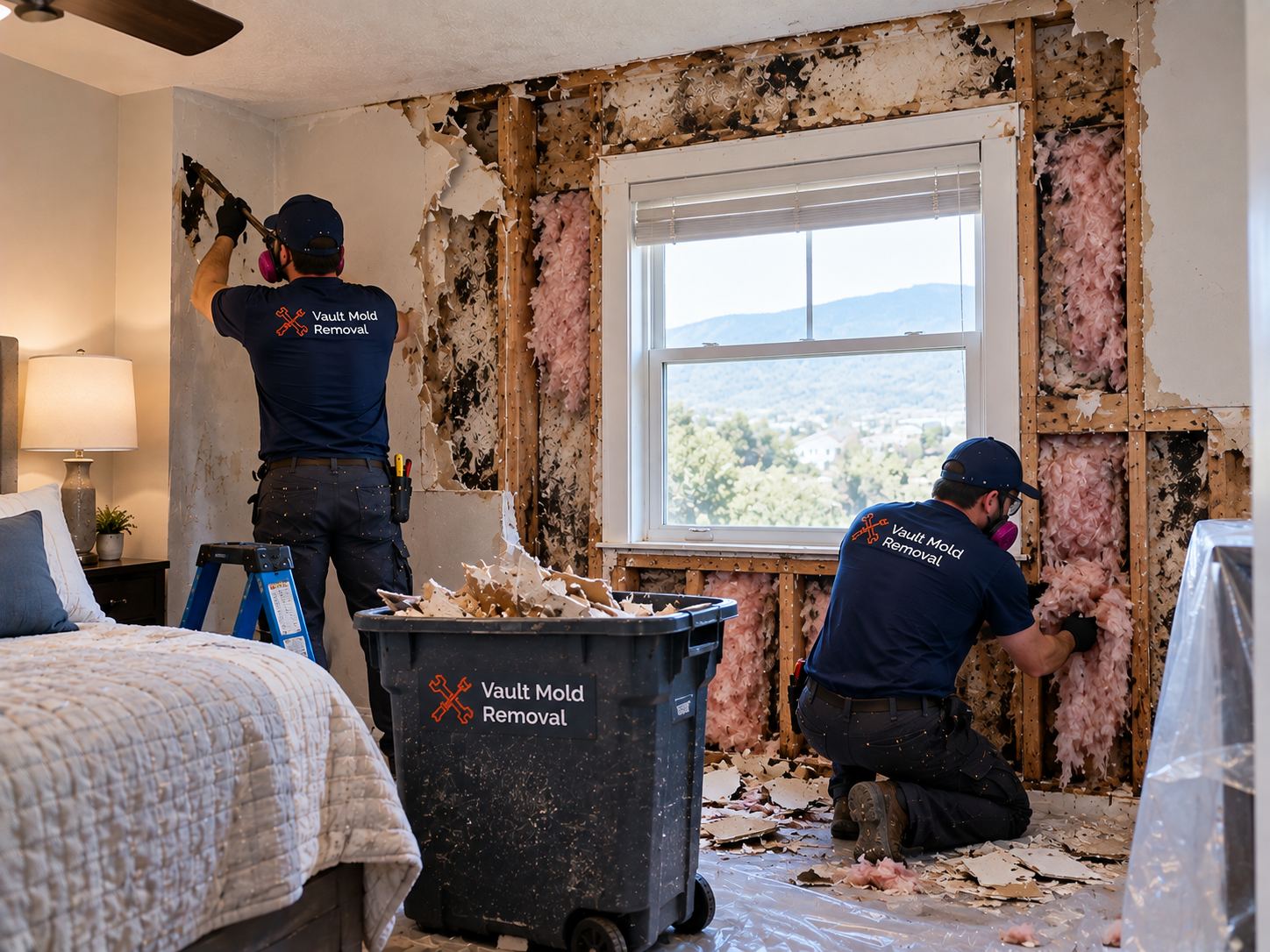
- Wind-driven rain entered through deteriorated window flashing, soaking bedroom drywall, insulation, and carpet.
- What Vault did
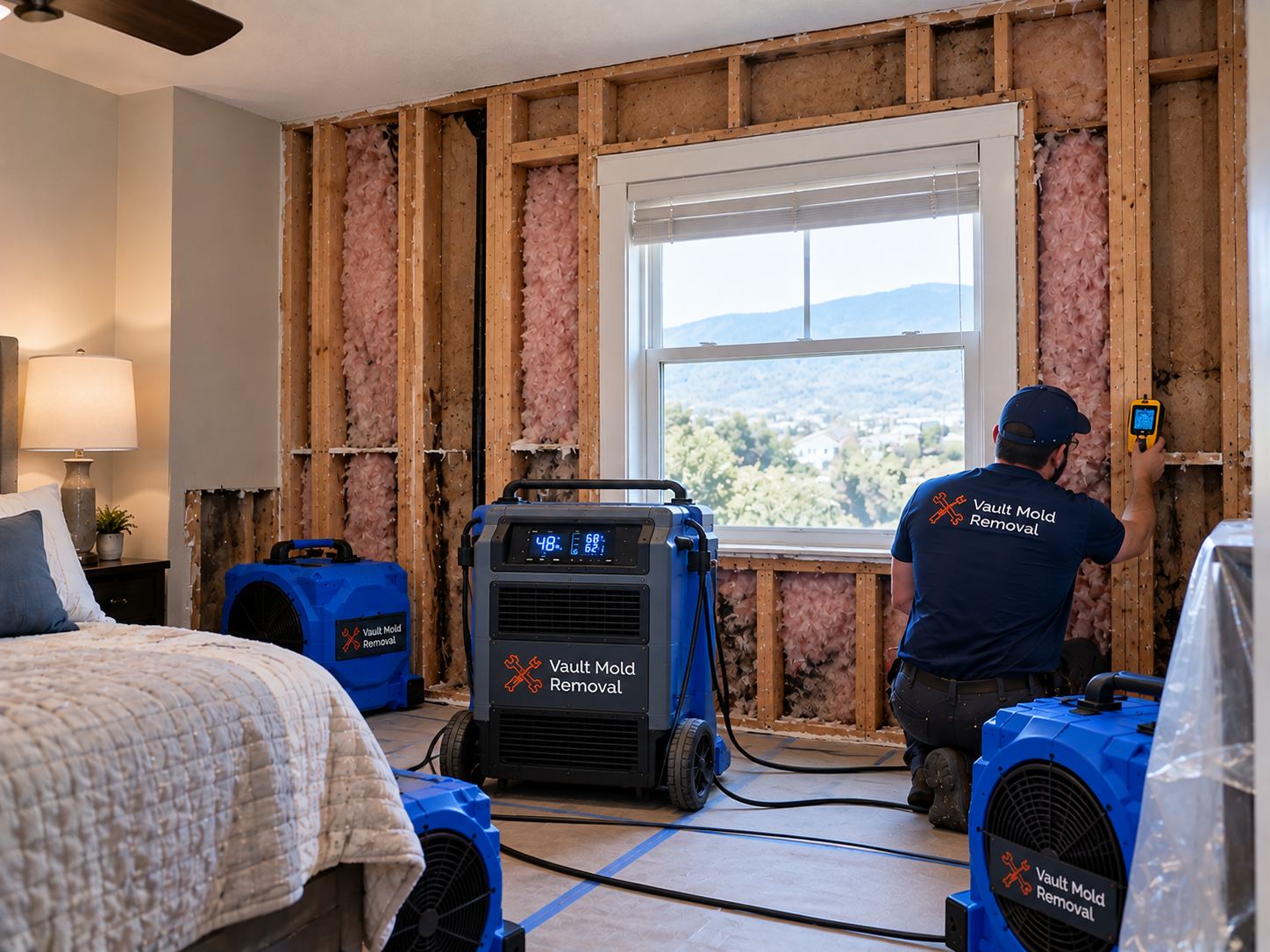
- Material removal and moisture monitoring.
Water Damage Restoration in Indian Hills, Provo
Indian Hills sits on the east bench between Foothills below and Oak Hills above, terraced along the hillside grade with streets like Indian Hills Drive, Osmond Lane, and Cherokee Lane cutting laterally across the slope. Development happened in three waves: an early 1970s wave that produced the first tract of split-level and multi-level ranchers, a 1990s wave that filled in remaining upper lots with larger custom builds, and a scattered post-2010 wave that redeveloped some original 1970s lots into contemporary custom construction. What that means for water damage response is that adjacent houses on the same Indian Hills street can be entirely different construction generations — a 1972 split-level with copper supply next door to a 2016 custom with PEX manifold. The diagnostic approach adapts to the specific address.
Response time from our Provo dispatch to an Indian Hills address averages 35 minutes daytime and 59 minutes overnight, logged over three years of dispatch records. Lower Indian Hills near the Foothills border runs 32 to 34 minutes daytime. Upper Indian Hills approaching Oak Hills runs 37 to 40 minutes daytime.
Indian Hills Construction Generations
1970s original tract construction. Split-level and multi-level ranchers on hillside grades, typically 2×4 platform framing with fire blocking, copper supply lines (now approaching 55 years of service), cast-iron drain converted to ABS in most homes through partial re-piping, drywall interiors, forced-air HVAC. Foundations are typically stepped concrete following the hillside slope, with lower levels partially below-grade on the uphill side. Copper failures on the 55-year-old original installations are common — pinhole leaks at fittings and bends, small-volume, often gradual.
1990s upper-lot custom builds. Larger homes on formerly undeveloped upper parcels, mixing engineered floor systems (early I-joist installations) with dimensional lumber in some assemblies, copper supply lines standard (some early PEX in higher-end builds), modern drywall assemblies, walkout basements common due to hillside slope. Construction quality varies more than tract housing because these were individual custom builds by various contractors.
Post-2010 redevelopment. Contemporary custom construction replacing some original 1970s tract homes. Full modern profile: engineered floor systems throughout, PEX manifold plumbing, spray foam insulation, integrated smart home systems, high-efficiency HVAC. The diagnostic and restoration approach for these homes matches Oak Hills more than the surrounding 1970s Indian Hills stock.
Hillside Terracing and Grade Considerations
Indian Hills lots are almost universally on graded hillside terraces, which affects water damage response in two ways. First, exterior drainage: water flows downhill across lots, and perimeter drainage systems (French drains, downspout extensions, grading) matter for keeping runoff out of below-grade spaces. Failed exterior drainage during spring snowmelt (from Wasatch snowpack draining downhill through the neighborhood) or summer thunderstorm events can produce basement or garage flooding that isn’t a plumbing issue. Diagnosis distinguishes these from plumbing-source losses.
Second, retaining walls: many Indian Hills lots have concrete or masonry retaining walls to hold graded terraces. Wall failures (from settling, drainage backup behind the wall, or original construction deficiency) can allow soil and water intrusion into adjacent below-grade spaces. This is not restoration scope — retaining wall repair is licensed general contractor work — but we identify and document it when it appears connected to a water intrusion event.
Typical Indian Hills Failure Patterns
- Copper pinhole leaks in 1970s original installations
- Age-related failure of original 1970s copper supply lines. Small-volume, often gradual. Common enough on Indian Hills that whole-house re-pipe consideration is reasonable after the first pinhole in a 1970s home.
- Split-level plumbing complexity
- Split-level designs have plumbing runs across multiple half-story levels, often with limited access to vertical stack routing. Failures at fittings between levels can be difficult to localize without thermal imaging.
- Water heater tank rupture
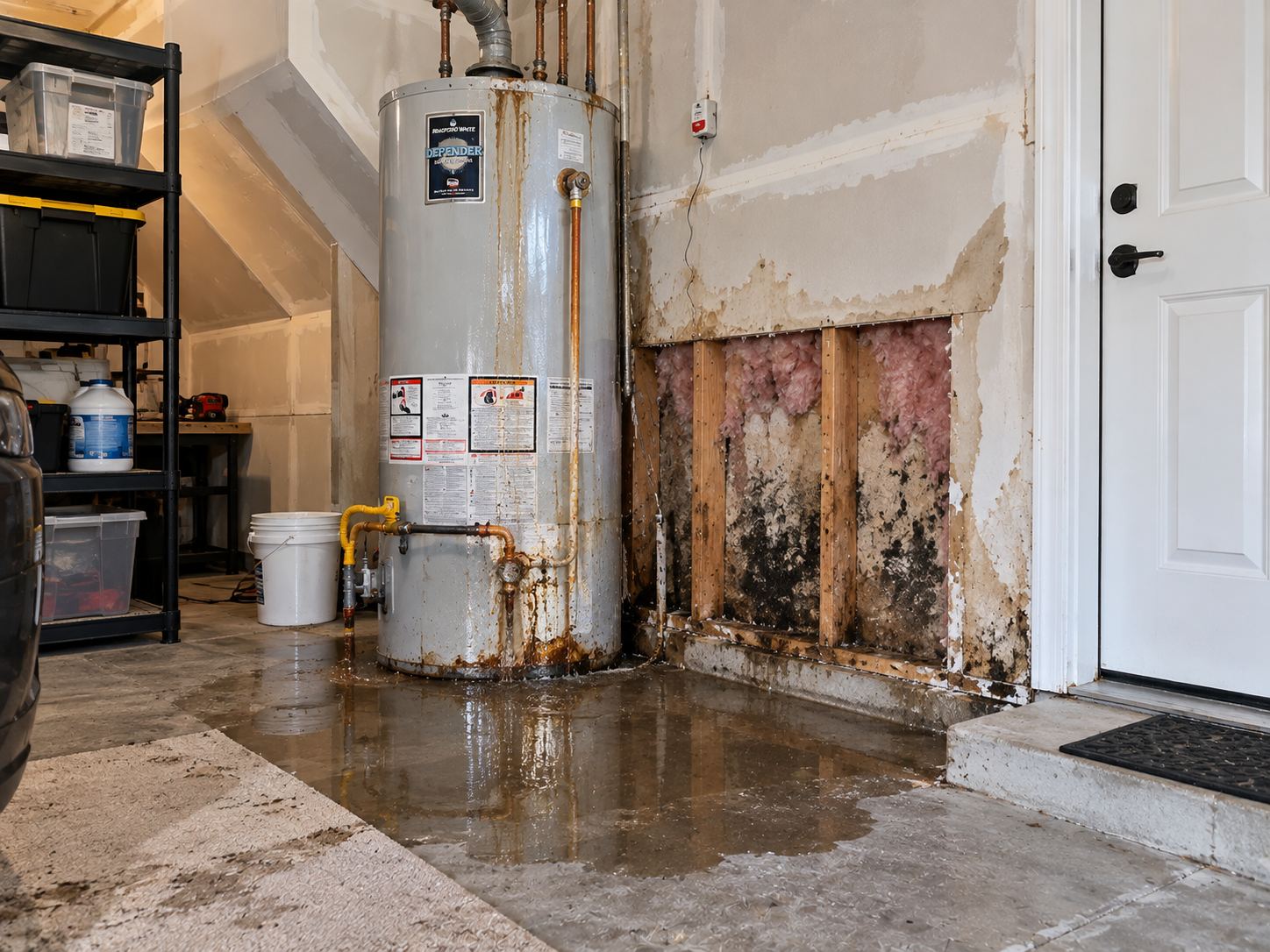
- Standard failure mode. Mid-century mechanical rooms on split-level lower levels often have inadequate drainage for full tank release.
- Walkout basement PEX manifold failures (post-1990 homes)
- PEX manifold branches feeding upper-floor fixtures pass through walkout basement mechanical rooms. Failures can flood the walkout finished space.
- Exterior drainage failures during snowmelt
- Wasatch snowpack draining downhill through Indian Hills can overwhelm perimeter drainage during rapid melt events. Water intrudes into garages, window wells, and window-well drainage failures.
Insurance Documentation for Indian Hills Losses
Utah Code 31A-26-301.5 requires acknowledgment within 15 days and coverage determination within 30 days of proof of loss. Indian Hills claims cover the range from routine mass-market policies (State Farm, USAA, Allstate, Farmers, Bear River Mutual) on the older tract housing to high-net-worth carriers (Chubb, PURE, AIG Private Client) on some newer custom builds. Documentation standards adjust accordingly, though our baseline standard fits either.
Watch-item on 1970s Indian Hills claims: pre-1978 homes fall under EPA RRP requirements at 40 CFR 745 for lead-safe work practices, but the transition period matters — homes built in 1978 or 1979 may or may not have used lead paint depending on when specific finishes were applied. When we’re uncertain, we test rather than assume, and RRP protocols apply until testing confirms otherwise.
Frequently Asked Questions
- My split-level has water coming through the wall where the levels meet. Where’s the source?
- Common Indian Hills diagnostic problem. Split-level designs have plumbing that crosses between half-story levels at the interior stack, and failures at these transitions can produce visible water damage at the level intersection that’s hard to trace to source. We map with thermal imaging first to identify the affected wall cavity zones, then narrow to specific pipe runs with pressure isolation. Half-story stack access sometimes requires drywall opening from a specific level; we plan the access points before cutting anything.
- My house is 1974 with original copper. Should I be worried?
- Yes, moderately. Copper supply lines have documented service life of roughly 50 to 70 years, and 1974 installation is now 50+ years old. Pinhole failures at fittings and bends are common in this cohort. If you haven’t had a plumbing assessment recently, that’s a reasonable proactive step — a licensed plumber can assess wall thickness and remaining life. Whole-house re-pipe to PEX is a common Indian Hills decision after the first failure or with an assessment showing significant remaining copper wear.
- Water is coming in from outside during heavy rain. Is that a homeowners claim?
- Depends on the source. Failed exterior drainage systems (French drains, downspouts, grading issues) allowing water intrusion into below-grade spaces are typically not covered under standard HO-3 policies — that’s a maintenance issue rather than sudden and accidental discharge. Roof leaks from wind-driven rain into attic or ceiling spaces are typically covered. Retaining wall failures allowing water and soil intrusion are typically not covered. We diagnose the source first, then help you present accurate documentation to your adjuster.
- My retaining wall is cracked and leaking during snowmelt. Do you fix that?
- No — retaining wall repair is licensed general contractor or specialty structural work, not water damage restoration. What we do handle is the interior damage from any water that intruded due to the wall failure. If the wall is contributing to an active water event, we coordinate with a structural contractor for wall assessment and repair, then handle interior restoration once the source is controlled.
- My property is post-2010 custom construction with PEX and engineered floors. Different response than my neighbor’s 1974 house?
- Different diagnostic sequence, same equipment loadout, same drying goals. Modern construction gets thermal imaging first for engineered joist cavity moisture, PEX manifold isolation testing to identify failed branches, and possibly spray foam removal where saturated. 1970s construction gets pin meter readings on framing behind drywall, pressure testing on copper supply segments, and simpler drying because there’s no engineered cavity complexity. Same techs, same trucks, adjusted approach.
Contact Vault Mold Removal
Phone: (385) 250-2825
Address: 1169 S 760 W, Provo, UT 84601
Hours: Monday–Saturday, 9:00 AM – 5:00 PM
Service Area: Indian Hills, all Provo neighborhoods, and surrounding Utah County communities.
Water damage in Provo?
Call (385) 250-2825 — answered live 24/7 by the Vault crew, not a call center. Inside Provo city limits, Monday–Saturday, 8 AM–5 PM, we guarantee arrival in 45 minutes — see the terms.
Real Vault jobs in Provo
Each of these is a real job done by Vault’s own W-2 crew. Call (385) 250-2825, answered live 24/7.
- Downtown — February 2026
- East Bay — July 2026
- Edgemont — June 2026
- Foothills — May 2026
- Franklin — December 2025
- Franklin South — March 2026
- Grandview North — September 2026
- Grandview South — August 2026
- Indian Hills — April 2026
- Joaquin — November 2025
- North Park — January 2026
- Oak Hills — July 2026
- Provost — June 2026
- Riverbottoms — May 2026
- Rivergrove — March 2026
- Rock Canyon — February 2026
- Sherwood Hills — April 2026
- Sunset — August 2026
- Timp — December 2025
- Wasatch — January 2026
- 1908 Joaquin Bungalow Galvanized Failure
- Downtown Mid-Rise Sprinkler Discharge
- Edgemont Hidden Crawlspace Pinhole
- Foothills Walkout Washer Cascade
- Franklin Sewer Backup Root Intrusion
If a job like this is happening to you
Vault handles jobs like the one above every day across Utah County. Here’s what else is worth reading before you call:
- Why Vault — W-2 crew, 45-min Provo guarantee, in-house mold clearance, no franchise call center.
- Insurance claims — how we document the damage and bill State Farm, USAA, Allstate, Farmers, Bear River Mutual directly.
- 24-month warranty — what’s covered and how to open a claim.
- Wisetack financing — $500-$25,000 over 3-24 months, soft credit check.
- Service area — confirm your city is one of the 6 we cover.
- Water damage timeline — why every hour of head start cuts the final bill.
Call now: (385) 250-2825 — answered live 24/7 by the Vault crew.
Photos from this Indian Hills job
Real photos taken by the Vault crew during this Indian Hills, Provo water damage job in April 2026 — wind-driven rain through failed window flashing on Indian Hills Dr.

Dealing with something similar?
This job started with wind-driven rain through window flashing. If that sounds like what you’re facing, these guides cover what to do first:
Storm damage restoration cost · Hidden water damage signs
Or call (385) 250-2825 — answered live 24/7.
Helpful guides: What if water damage isn’t fixed? · Documenting damage for insurance
Need help with a job like this?
water damage restoration in Provo · emergency water damage restoration in Provo · sewage cleanup in Provo · mold remediation in Provo
Have a job like this in Provo? See water damage restoration in Provo, or call (385) 250-2825 for a free written estimate.