
About this job
A real Vault job in Provo. The crew that handled it was Vault’s own W-2 team — no subcontractors, no franchisee hand-off. Same crew answers the phone and shows up at the door.
- Call any hour: (385) 250-2825 answered live 24/7. 45-min guarantee Provo (Mon-Sat 8-5); under 60 min elsewhere in Utah County.
- Who did the work: Vault’s W-2 crew, IICRC WRT/ASD/AMRT/OCT, Utah DOPL #11876543-5501.
- Insurance: Xactimate scopes submitted direct to State Farm, USAA, Allstate, Farmers, Bear River Mutual, and most national carriers.
- Pricing: water mitigation $3,500-$8,500; reconstruction $4,500-$9,500. 24-month warranty, Wisetack financing.
- Family-owned and veteran-operated, based in Provo since 2020.
See Vault in Provo, all Provo case studies, or water damage services.
Real Vault job — Foothills, Provo
- Approximate location
- Near Foothill Drive
- When
- May 2026
- What happened
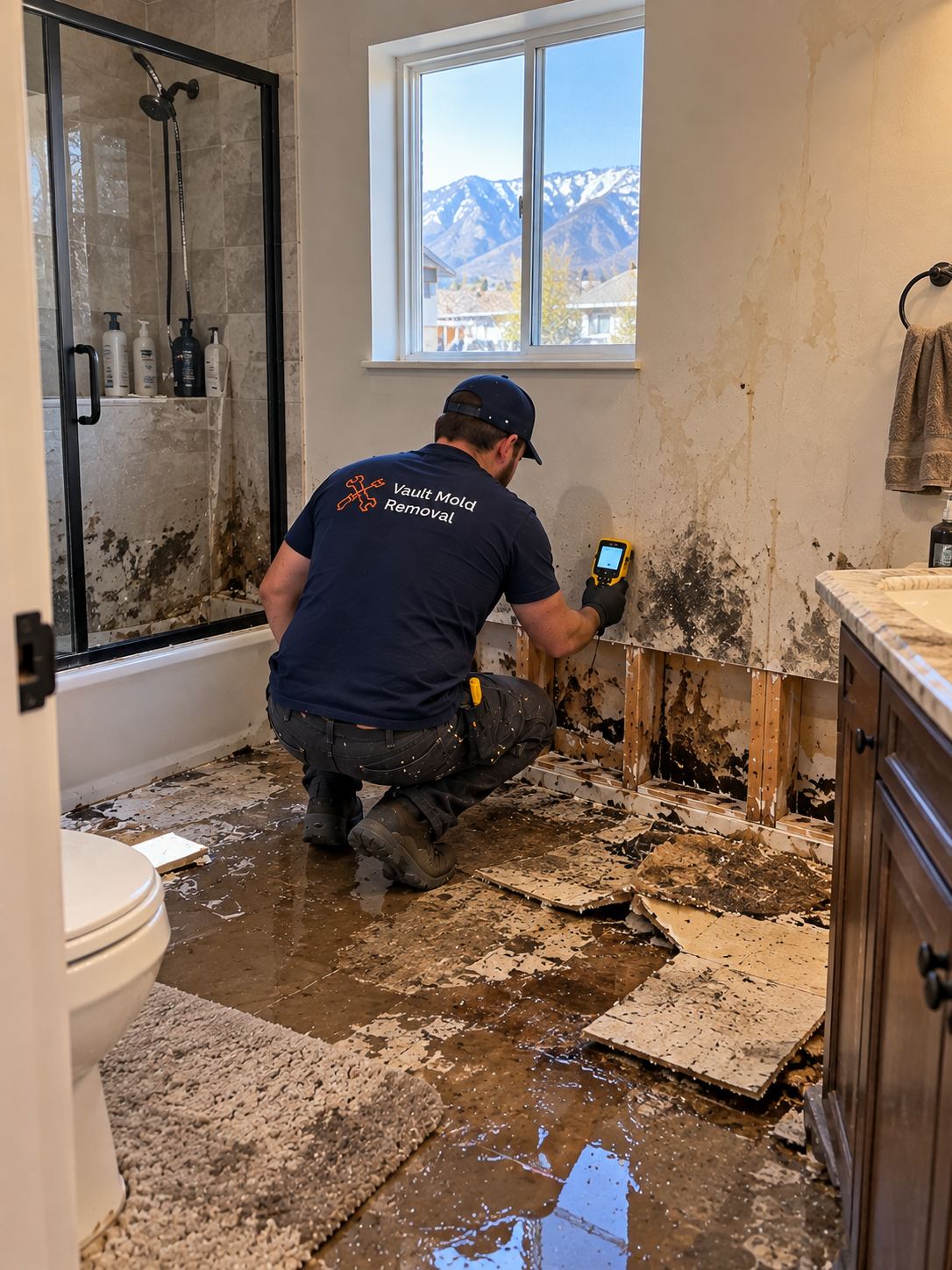
- Spring thunderstorm damaged roof shingles and flashing, allowing water into attic insulation and bedroom ceiling.
- What Vault did
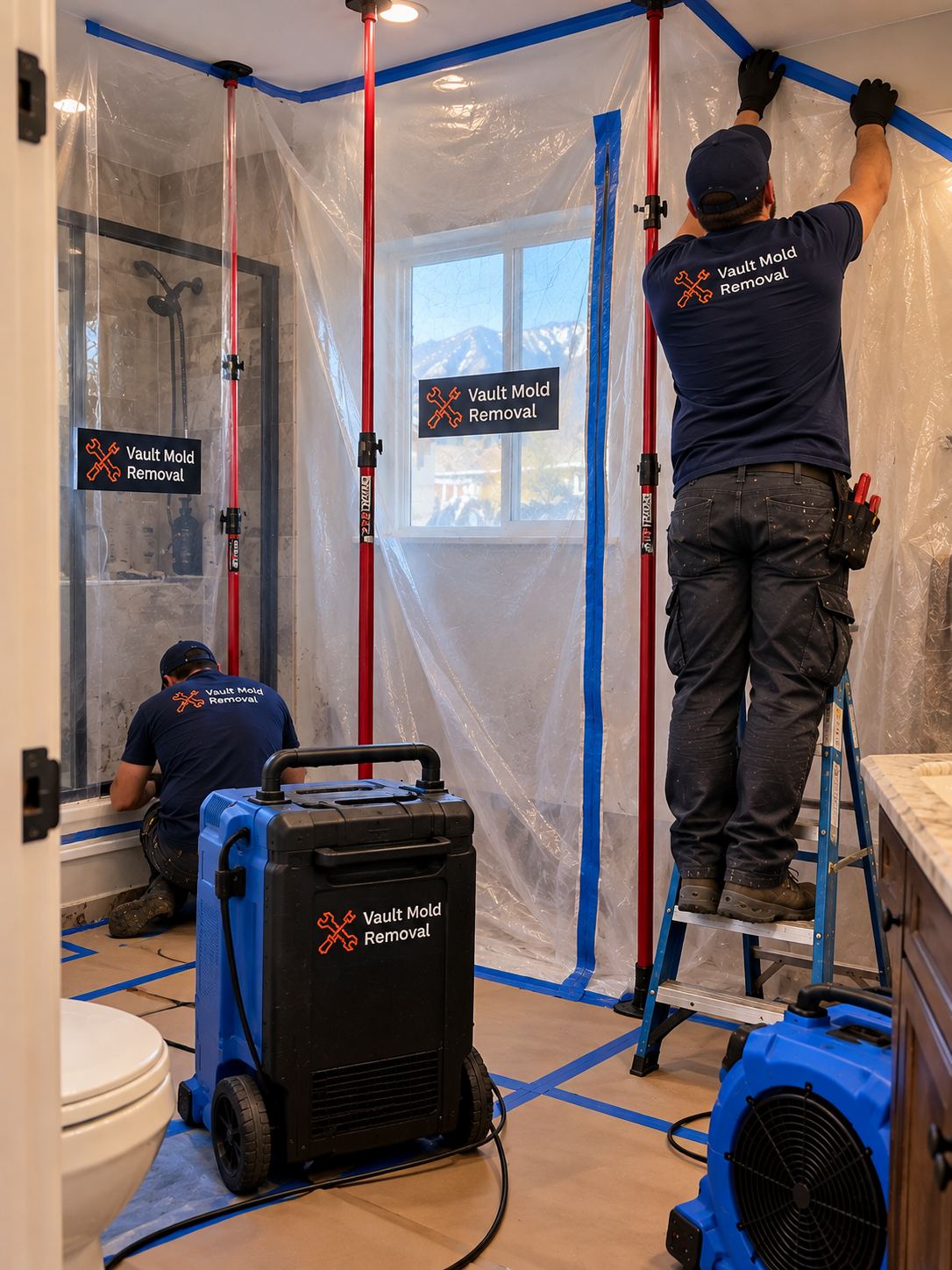
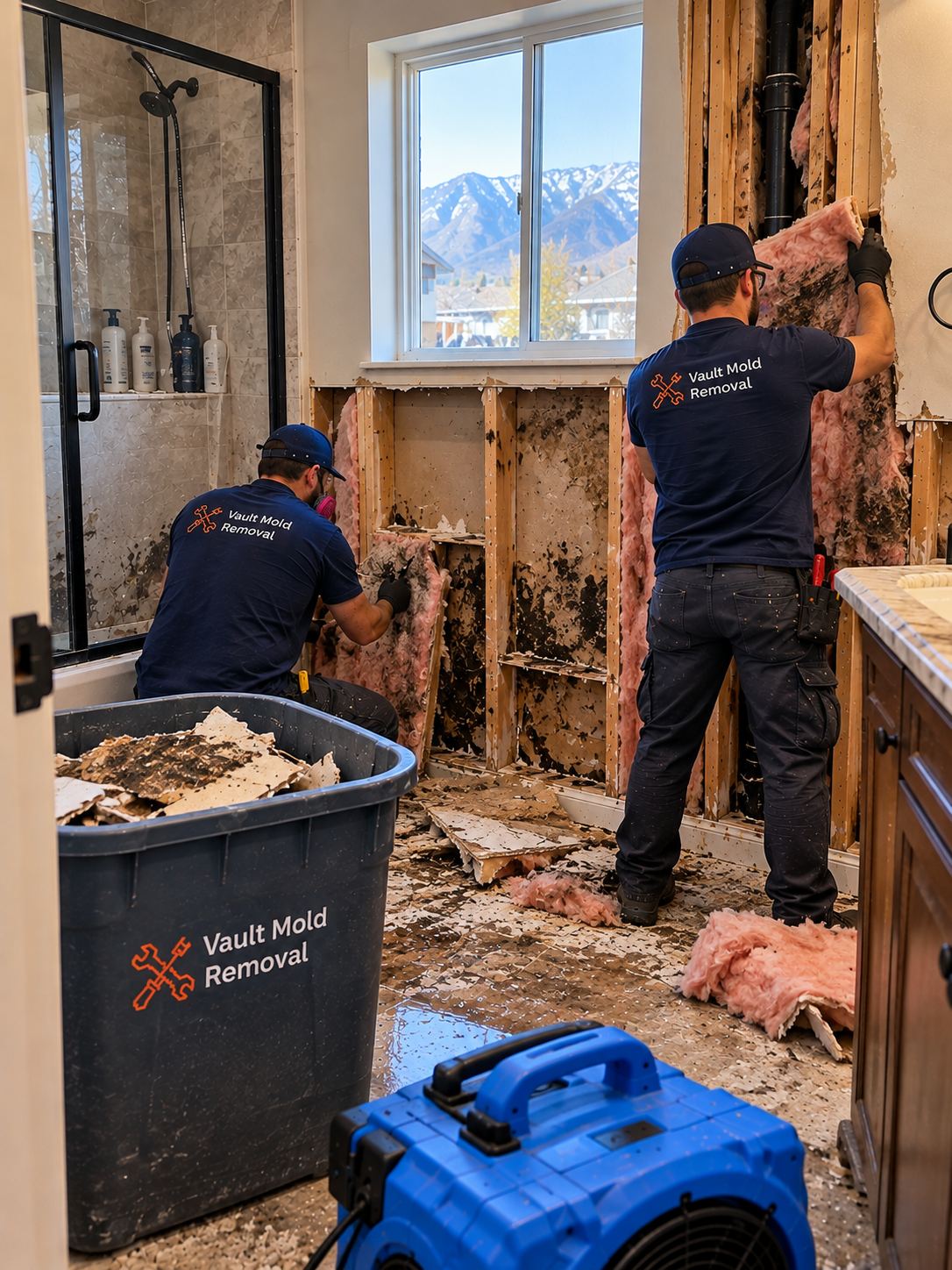
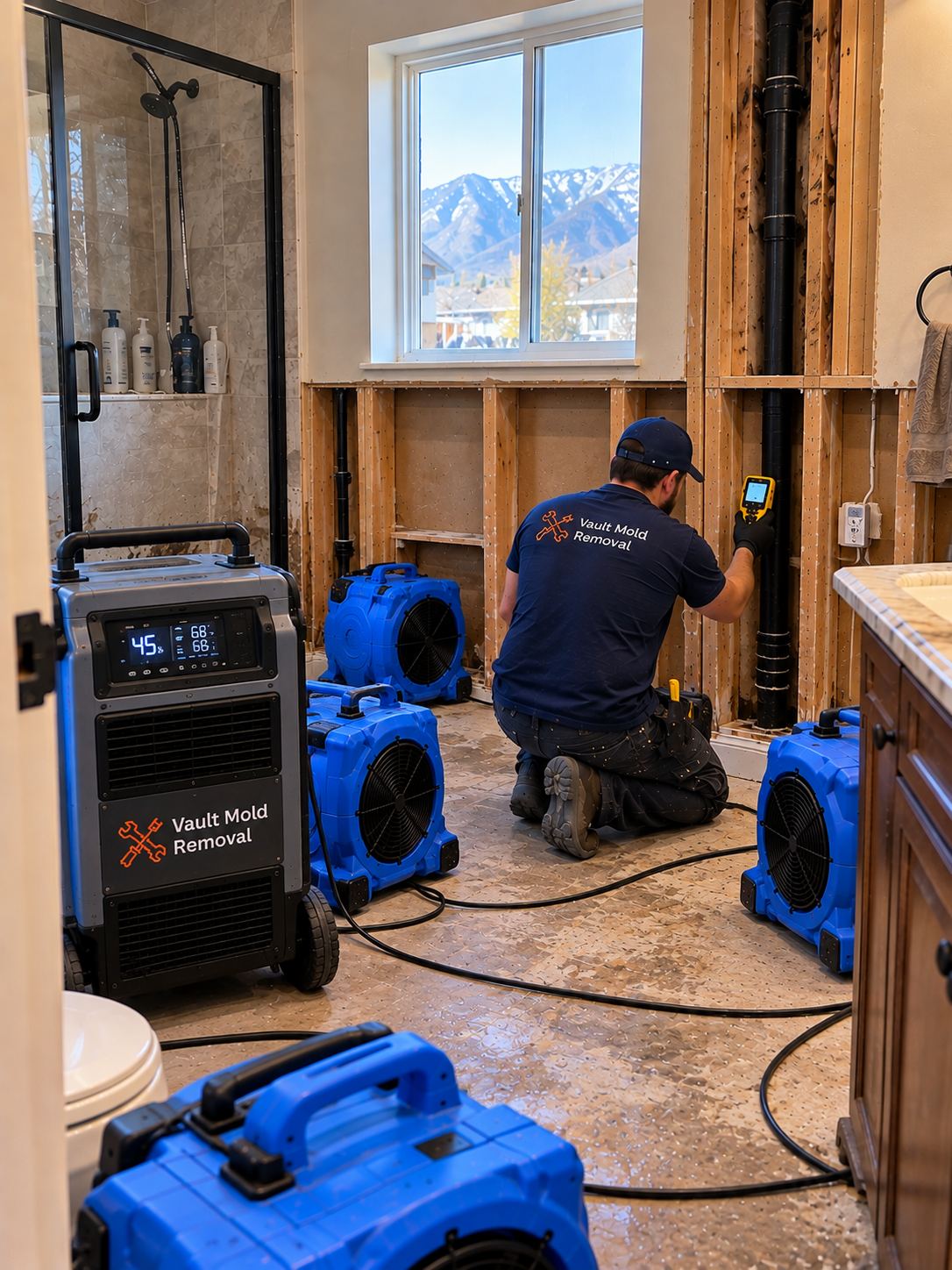
- Insulation removal and structural drying.
Water Damage Restoration in Foothills, Provo
Foothills is the East Provo bench climbing from Edgemont’s upper boundary toward the base of Y Mountain — roughly 900 East eastward, running north to south along the mountain edge. Development here started in the 1970s and 1980s with the first hillside subdivisions, and continued through the 2000s and 2010s as remaining bench land got platted and built out. Housing stock is almost entirely single-family detached, primarily custom builds on quarter-acre to half-acre lots, with a mix of walkout basements (very common due to the slope) and full above-grade construction on the flatter parcels. From a restoration standpoint, Foothills is squarely modern-construction territory — engineered floor systems, PEX manifold plumbing, walkout basement complexity, and often spray foam insulation. That construction profile determines the diagnostic and drying approach.
Response time from our Provo dispatch to a Foothills address averages 32 minutes daytime and 56 minutes overnight, logged over three years of dispatch records. Lower Foothills near the 900 East boundary runs 28 to 30 minutes daytime. Upper Foothills climbing toward Oak Hills and the Y Mountain trailhead runs 35 to 40 minutes daytime due to hillside route complexity.
What Foothills Construction Looks Like
Foothills post-1980 construction shares a consistent modern profile: engineered I-joist floor systems (Weyerhaeuser TJI, Georgia-Pacific Wood I Beam, or comparable products), PEX manifold plumbing with home-run distribution from a central manifold to each fixture, spray foam insulation (open-cell in most cases, closed-cell in some higher-end builds), fire-blocked platform framing with modern wall assemblies, and either a walkout basement (most common on sloped lots) or slab-on-grade (less common, mostly on the flatter parcels).
Walkout basement construction is the defining Foothills feature. A walkout basement is a below-grade level on two or three sides that daylights on the downhill side — you can walk out to grade from the lower level. What that means for water damage: the lowest habitable level is fully finished space rather than utility space, contents and finishes are at basement-level risk without basement-level tolerance for damage, and water dropping from upper levels can traverse three fully finished floors before exiting the structure. Multi-level extraction sequencing matters more here than in single-level or above-grade-only construction.
Engineered I-joist floors present the diagnostic challenge specific to Foothills. When water pools on a second-floor subfloor before extraction, it wicks laterally through the OSB or LVL web of the I-joist for the entire length of the joist bay. Standard visual inspection from below shows nothing — the bottom flange looks dry, the ceiling drywall below may look unaffected. Thermal imaging shows the saturation as a linear cold signature along the joist run. Without thermal, you dry the finished floor and leave 12 to 20 linear feet of saturated engineered joist in place, which then mold-colonizes over the following weeks.
PEX Manifold Diagnostics
PEX manifold plumbing (essentially standard in post-2000 Foothills homes) means each fixture in the house has its own dedicated supply run back to a central manifold, typically located in the mechanical room. When a leak occurs, the source can be difficult to identify because the visible symptom may be far from the failed run — the water tracks along the PEX pathway, through wall cavities or floor cavities, before surfacing.
Diagnosis process: isolate individual manifold runs and pressurize them separately to identify which circuit is leaking. Then use thermal imaging along the identified run to localize the failure point. Then open a small inspection port at the identified location to confirm before larger demolition. This process typically takes 30 to 60 minutes but saves significant unnecessary demolition compared to exploratory drywall cuts.
Spray Foam Insulation Considerations
Spray foam is common in Foothills construction, particularly in homes built after 2005. Two types matter for water damage response:
Closed-cell spray foam (2-lb density) is vapor-impermeable, structural, and expensive. When water gets between closed-cell foam and the sheathing behind it, the water has essentially no path to dry — vapor transfer through the foam is negligible, and the water sits at the sheathing interface until the foam is removed. In Foothills homes with confirmed wet closed-cell foam, we remove the affected foam sections to expose the sheathing and framing for drying, and coordinate replacement with a spray foam contractor during reconstruction. This adds cost and time but is not optional under IICRC S500.
Open-cell spray foam (0.5-lb density) is vapor-permeable but absorbs and holds water. Wet open-cell foam doesn’t dry through vapor transfer alone in a reasonable window and typically has to be removed and replaced. Similar process to closed-cell but usually simpler removal.
Typical Foothills Failure Patterns
- Braided supply hose failure at fixtures
- Most common Foothills failure. Braided stainless supply hoses at toilets, dishwashers, refrigerator ice makers, and washing machines reach end-of-life at 5 to 10 years. Failure is catastrophic — full open flow at 4 to 6 GPM for hours if no one is home.
- Second-floor washing machine or bathroom failures
- Common Foothills configuration. Failure at an upstairs source drops water through three floors of finished space in a walkout basement configuration.
- Water heater expansion tank rupture
- Common in mechanical rooms with high-pressure municipal supply. Expansion tank absorbs pressure surges; failure floods the mechanical room and adjacent spaces.
- PEX manifold branch failures
- Crimp connections at manifold branches can fail from installation defects or manufacturing issues. Water tracks along PEX pathways to distant surfacing points.
- Winter freeze failures at exterior wall PEX runs
- Provo January design temperature is 7°F. Exterior wall PEX runs without adequate insulation can freeze during extended cold snaps. Failure typically at fittings when thawing occurs.
Insurance Documentation for Foothills Losses
Utah Code 31A-26-301.5 requires acknowledgment within 15 days and coverage determination within 30 days of proof of loss. Foothills losses often involve higher-value structures than Provo average, and scope tends to run longer because of engineered floor drying timelines and spray foam demolition requirements. State Farm, USAA, Allstate, Farmers, and Bear River Mutual all handle Foothills residential claims, and some higher-value Foothills properties carry with high-net-worth carrier programs (Chubb Masterpiece, PURE, AIG Private Client) which have their own documentation preferences. We build to whichever carrier is on the policy.
Frequently Asked Questions
- Why is Foothills response time longer than other Provo neighborhoods?
- Distance and route complexity. Foothills addresses are 4 to 6 miles from our dispatch, on hillside routes with elevation gain and winding streets. Lower Foothills near 900 East runs 28 to 30 minutes daytime. Upper Foothills climbing toward the Y Mountain trailhead runs 35 to 40 minutes daytime. Overnight response adds roughly 25 minutes because dispatch has to reach the on-call tech before the truck rolls.
- My house has spray foam insulation and water damage. Do you have to remove all the foam?
- Only the affected foam. We map water spread with thermal imaging and moisture readings before determining removal extent. Where thermal or meters indicate wet foam or foam-substrate interface moisture, that section comes out. Unaffected foam stays in place. Replacement is coordinated with a spray foam contractor during reconstruction; we don’t apply foam ourselves.
- My walkout basement is flooded and it’s my only fully finished level. Where do I start?
- Emergency response is the same as any water damage call — kill the source, kill electrical if any water is near the panel or outlets, take photos, call us. What’s different about walkout basement losses is that the affected space is often 100% of your habitable ground-floor square footage, which means displacement (temporary lodging under ALE coverage) is more likely to be needed during restoration. We help you document the displacement need for your carrier.
- How does engineered joist saturation affect drying time?
- Engineered I-joist webs dry in 3 to 5 days with proper cavity ventilation — comparable to solid dimensional lumber but requires cavity access ports at the top and bottom of the joist bay to allow airflow into the web. Without cavity access, drying stalls at the surface and interior moisture persists. We open ventilation ports as standard practice on engineered floor losses, then dry with directed airflow at the openings.
- My insurance policy is through Chubb Masterpiece. Do you work with high-net-worth insurers?
- Yes. Chubb, PURE, AIG Private Client, and other high-net-worth carriers have specific documentation preferences and often adjust scope differently than mass-market carriers. Documentation quality, matching for period-appropriate finishes on higher-value homes, and coordination on temporary lodging or contents pack-out often runs more elaborately on these claims. Our documentation standard exceeds what mass-market carriers require, which fits high-net-worth expectations without modification.
Contact Vault Mold Removal
Phone: (385) 250-2825
Address: 1169 S 760 W, Provo, UT 84601
Hours: Monday–Saturday, 9:00 AM – 5:00 PM
Service Area: Foothills, all Provo neighborhoods, and surrounding Utah County communities.
Water damage in Provo?
Call (385) 250-2825 — answered live 24/7 by the Vault crew, not a call center. Inside Provo city limits, Monday–Saturday, 8 AM–5 PM, we guarantee arrival in 45 minutes — see the terms.
Real Vault jobs in Provo
Each of these is a real job done by Vault’s own W-2 crew. Call (385) 250-2825, answered live 24/7.
- Downtown — February 2026
- East Bay — July 2026
- Edgemont — June 2026
- Foothills — May 2026
- Franklin — December 2025
- Franklin South — March 2026
- Grandview North — September 2026
- Grandview South — August 2026
- Indian Hills — April 2026
- Joaquin — November 2025
- North Park — January 2026
- Oak Hills — July 2026
- Provost — June 2026
- Riverbottoms — May 2026
- Rivergrove — March 2026
- Rock Canyon — February 2026
- Sherwood Hills — April 2026
- Sunset — August 2026
- Timp — December 2025
- Wasatch — January 2026
- 1908 Joaquin Bungalow Galvanized Failure
- Downtown Mid-Rise Sprinkler Discharge
- Edgemont Hidden Crawlspace Pinhole
- Foothills Walkout Washer Cascade
- Franklin Sewer Backup Root Intrusion
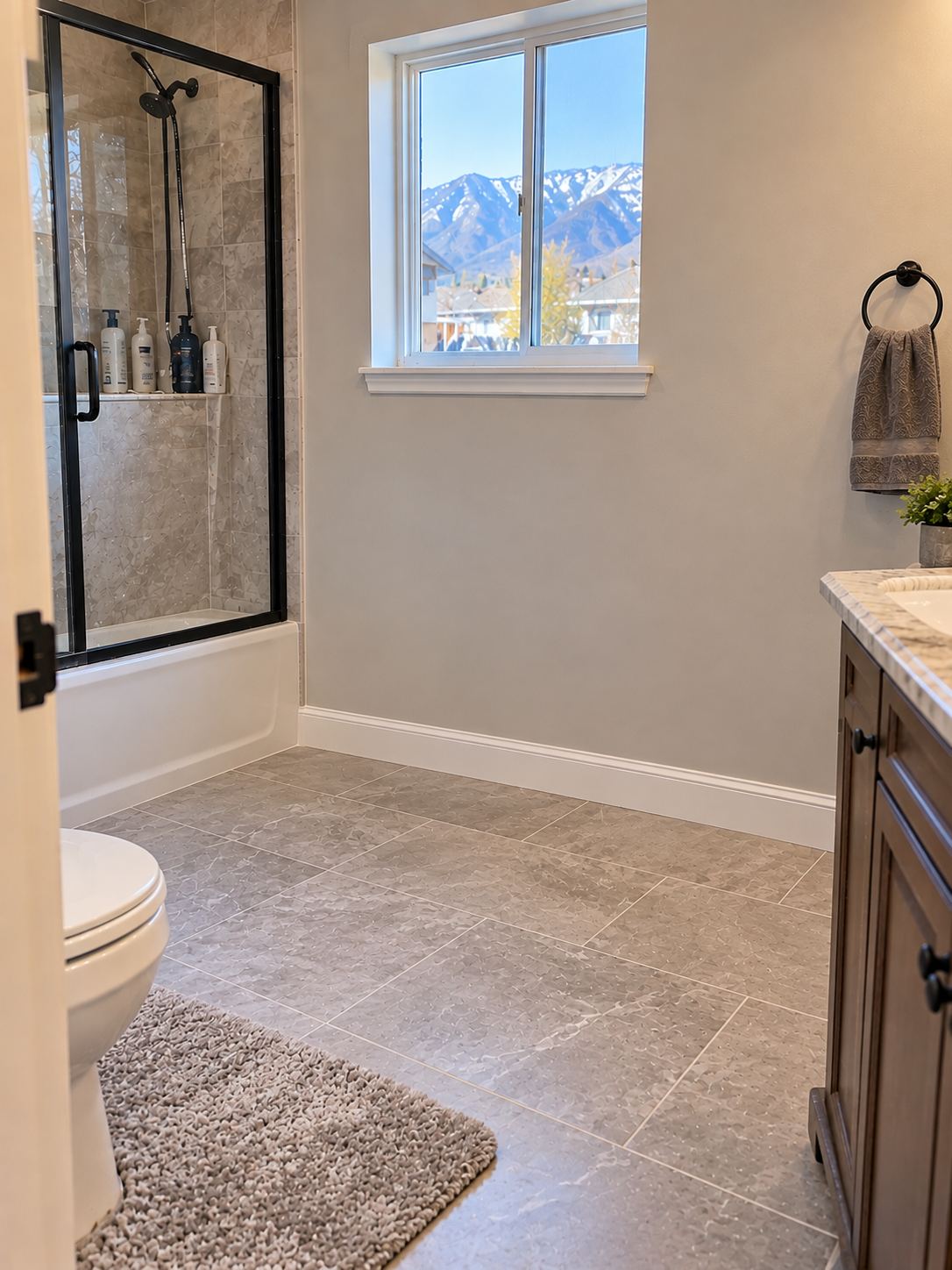
Photos from this Foothills job
Real photos taken by the Vault crew during this Foothills, Provo job in May 2026.
If a job like this is happening to you
Vault handles jobs like the one above every day across Utah County. Here’s what else is worth reading before you call:
- Why Vault — W-2 crew, 45-min Provo guarantee, in-house mold clearance, no franchise call center.
- Insurance claims — how we document the damage and bill State Farm, USAA, Allstate, Farmers, Bear River Mutual directly.
- 24-month warranty — what’s covered and how to open a claim.
- Wisetack financing — $500-$25,000 over 3-24 months, soft credit check.
- Service area — confirm your city is one of the 6 we cover.
- Water damage timeline — why every hour of head start cuts the final bill.
Call now: (385) 250-2825 — answered live 24/7 by the Vault crew.
Dealing with something similar?
This job started with storm-damaged roof shingles and flashing. If that sounds like what you’re facing, these guides cover what to do first:
Roof leak — interior water damage · Storm damage restoration cost
Or call (385) 250-2825 — answered live 24/7.
Helpful guides: What if water damage isn’t fixed? · Documenting damage for insurance
Need help with a job like this?
water damage restoration in Provo · emergency water damage restoration in Provo · sewage cleanup in Provo · mold remediation in Provo
Have a job like this in Provo? See water damage restoration in Provo, or call (385) 250-2825 for a free written estimate.