
Water damage restoration for Provo homes and the rest of Utah County, Utah — done by our own W-2 crew, an IICRC Certified Firm, with every reading logged until your home is dry.
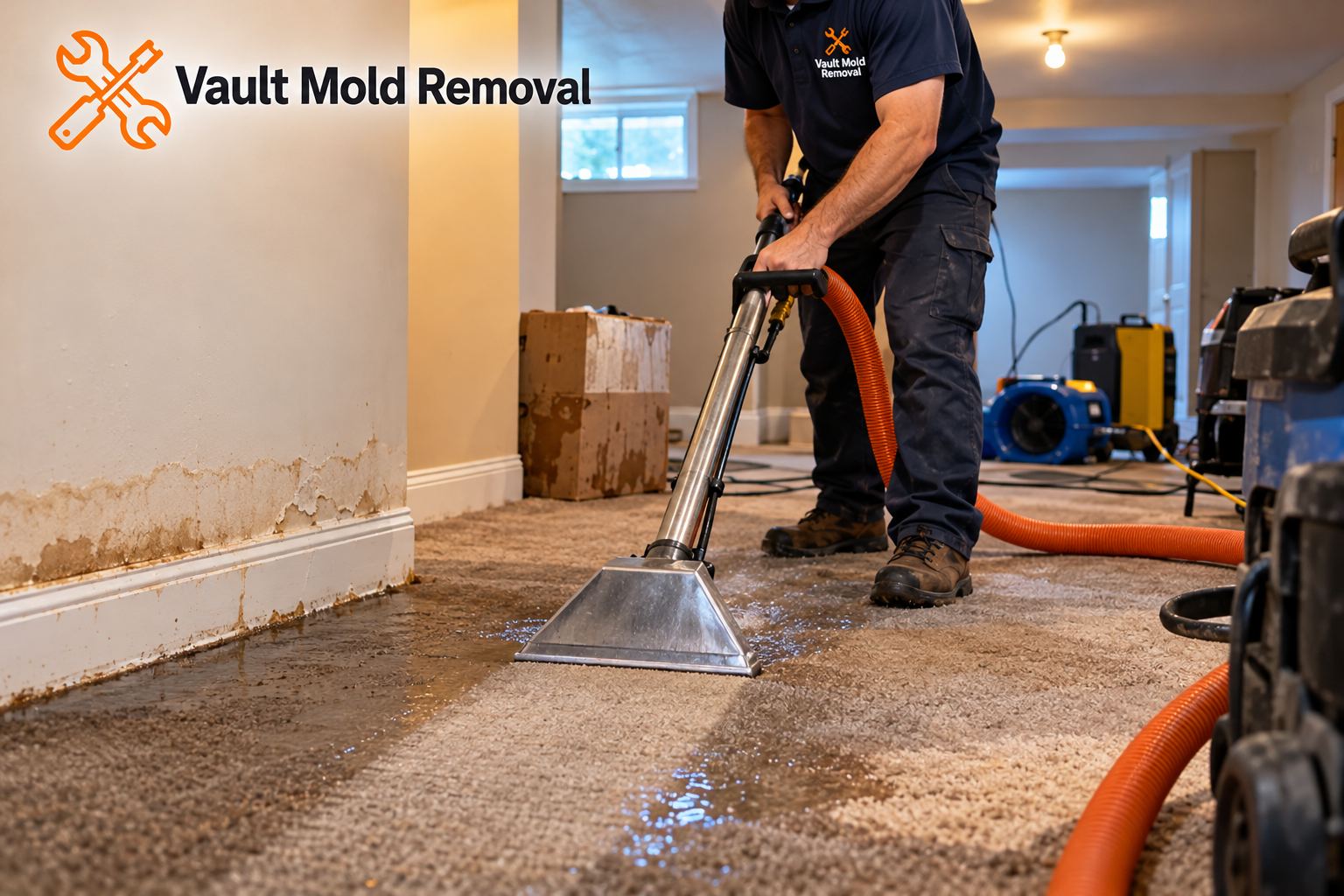
Vault Mold Removal provides water damage restoration in Provo, UT from our staffed office, shop and warehouse at 1169 S 760 W. Our own IICRC-certified W-2 crew handles the whole job: emergency water extraction, structural drying with daily moisture readings, and the repairs afterward under our Utah DOPL General Contractor license. Arrival to Provo averages about 34 minutes, and the phone is answered live 24/7 at (385) 250-2825.
Water damage restoration at a glance
- Call any hour: (385) 250-2825 is answered live 24/7 by the Vault crew, not a call center. 45-minute arrival guarantee (Monday–Saturday, 8 AM–5 PM) inside Provo city limits.
- Who does the work: Vault’s own W-2 crew, IICRC certified in WRT, ASD, AMRT and OCT, working under Utah DOPL General Contractor License #11876543-5501. No subcontractors. Meet the team
- Insurance: we document the damage, log daily moisture readings, write the scope in Xactimate and bill State Farm, USAA, Allstate, Farmers or Bear River Mutual directly.
- Warranty: 24-month workmanship warranty on drying, drywall, flooring, cabinetry and paint, plus a 90-day mold warranty from post-remediation clearance. Warranty details
- Financing: through Wisetack, $500–$25,000 over 3–24 months, soft credit check. Financing
- Family-owned and veteran-operated, based in Provo since 2020.
Pricing
| Service | Typical range |
|---|---|
| Water mitigation (extraction, flood cuts, drying) | $3,500–$8,500 |
| Reconstruction (drywall, flooring, cabinetry, paint) | $4,500–$9,500 |
| Written estimate for water damage | Free |
Sewage cleanup · Mold remediation · How we contain the work area · Sewer line services
How we restore water damage
Water damage restoration in Provo covers the full response scope from initial emergency dispatch through final reconstruction, adapted to the specific characteristics of Provo properties. Our location at 1169 S 760 W puts us in position to respond faster to local addresses than contractors based elsewhere in Utah County or in Salt Lake, with typical business-hours response times of 34–62 minutes to any neighborhood. Beyond response speed, our extensive local work means we understand the specific patterns that show up in this city’s diverse building stock: historic homes in the older neighborhoods requiring preservation-focused approaches, mid-century established homes with characteristic aging plumbing patterns, foothill properties with elevation-related considerations, and newer construction across specific development areas. This page covers the full water damage restoration service as it applies to local properties.
What the job includes
Our water damage restoration services include:
- Emergency response: Fast response by our technicians: dispatch, safety assessment, source containment and mitigation setup
- Inspection and assessment: Damage extent, water category, moisture mapping, and an Xactimate scope
- Water extraction: Standing water removal and cleanup using extraction equipment sized to the job
- Structural drying: Air movement and dehumidification systems producing controlled drying of building materials
- Antimicrobial treatment: Disinfection appropriate to water category (IICRC S500 protocols)
- Material removal: Removal of unsalvageable materials (drywall, flooring, insulation, cabinetry) with proper disposal
- Mold remediation: If mold has developed or is likely to develop, IICRC S520 remediation protocols
- Contents handling: Pack-out, off-site cleaning if appropriate, storage, and return
- Reconstruction: Drywall, flooring, painting, cabinetry, trim, and other rebuilding to restore pre-loss condition
- Insurance coordination: Documentation, communication with adjuster, scope submission, and claim development throughout
- Final verification: Moisture verification confirming completion, walkthrough with property owner, and warranty documentation
Local response considerations
Arrival times
Arrival to Provo addresses averages about 34 minutes from our office at 1169 S 760 W. Inside Provo city limits, during the day Monday–Saturday 8 AM–5 PM, arrival is guaranteed within 45 minutes (terms). After hours the phone is still answered live 24/7 and the on-call technician is dispatched for active water; the call, dispatch and arrival times are logged on your work order. Winter storms and region-wide demand can slow any crew down.
Historic home water damage
Provo’s substantial historic housing stock in Joaquin, Franklin, Franklin South, and adjacent neighborhoods produces specific response patterns. Historic home characteristics affecting water damage response: original wood floors that can often be saved if dried quickly, plaster and lath walls that dry differently than drywall, original millwork worth preserving, aging copper, galvanized and cast iron plumbing, basements with little waterproofing, and historic preservation rules in some districts.
Our approach to historic homes emphasizes preservation of original materials where practical: mat drying systems for direct wood drying rather than automatic replacement, plaster wall repair techniques rather than automatic drywall replacement, and careful coordination for exterior work in designated historic districts. For homes with significant historic character or those with preservation priorities, our approach protects the historic value while completing thorough restoration.
Mid-Century Established Home Response
Provo’s substantial mid-century housing stock (1940s–1970s in Grandview, Sherwood Hills, older Edgemont, and other established neighborhoods) has specific patterns:
- Original copper plumbing now 50–80 years old, approaching end of typical service life; pinhole leaks common
- Cast iron drainage with characteristic failures
- Original electrical systems that may not meet current code (relevant during reconstruction)
- Popcorn ceiling texture common; pre-1980 popcorn may contain asbestos requiring specific handling
- Finished basements common with specific moisture and flood exposure patterns
- Standard framing and drywall construction responding to standard restoration protocols
Foothill Neighborhood Response
Provo’s foothill neighborhoods (Foothills, Oak Hills, Indian Hills, Rock Canyon) have specific considerations: more freeze-thaw cycles and ice dam risk at higher elevation, hillside lots, harder winter access, and upscale finishes that need care during restoration.
Riverbottoms and homes near the river
Properties in Riverbottoms, Rivergrove, and along the Provo River corridor have specific flood exposure: river flooding during high-water events, higher groundwater during spring runoff, and some properties in FEMA flood zones that need NFIP coverage.
Downtown and Commercial Response
Commercial water damage cleanup for downtown properties and mixed-use buildings has specific needs: older plumbing and roofs, apartments above businesses, owners who are not the tenants, historic district rules for exterior work, and keeping the business open during the work.
Insurance coordination
We offer free estimates on every water damage job, and insurance coordination follows each carrier’s process. We bill State Farm, USAA, Allstate, Farmers and Bear River Mutual directly; American Family, Liberty Mutual, Progressive and Auto-Owners claims follow their standard process.
Documentation practices matter across all carriers. Our documentation approach: photo and video documentation from initial arrival through completion, Xactimate scope development with detailed line-item pricing, moisture readings documented systematically throughout drying, and complete project records supporting the claim regardless of specific carrier.
Reconstruction considerations
Reconstruction work here operates under Provo City building codes with specific considerations: city building permits above certain scopes, historic preservation review for exterior work, current-code upgrades, and Ordinance and Law coverage for code-upgrade costs when applicable.
Typical project timelines
Typical timelines for professional water damage restoration:
- Small Category 1 event: 1–2 weeks total (3–5 days mitigation, 1–2 weeks reconstruction)
- Standard event: 3–6 weeks total
- Larger event: 8–16 weeks total
- Historic home projects: Timelines can be extended due to preservation coordination and historic material considerations
- Very large or complex events: 3–6 months or longer
Frequently Asked Questions
- Do you work in every Provo neighborhood?
- Yes, our service covers all neighborhoods including all the neighborhoods listed on our Provo hub page and adjacent areas. Response time varies somewhat by specific neighborhood based on distance from our base and specific access considerations, but our capability applies across the city. For any specific address, contact us to discuss response coordination for your particular situation. This is our largest market, with more projects here than in any other Utah County city, so specific neighborhood characteristics are familiar rather than novel.
- My home is in a historic district. Does that create complications?
- Some, but the complications are manageable with appropriate coordination. Historic district properties in Provo have specific requirements for exterior work: Provo City historic preservation review for changes affecting exterior appearance, material compatibility requirements for replacement materials visible from public rights-of-way, and design review for certain modifications. Interior work is generally less regulated, though preservation of historic interior elements is often a property owner priority even without regulatory requirements. Our approach for historic district properties: coordinate with Provo City historic preservation office when work requires their review, use materials compatible with historic character when replacement is necessary, prioritize preservation over replacement whenever practical, and maintain thorough documentation supporting any required review processes. The regulatory coordination adds some timeline to projects but doesn’t fundamentally change the restoration approach. For property owners in historic districts, working with contractors familiar with these requirements (as we are) supports smoother project execution than working with contractors new to historic district work.
- How does response to my property compare in cost to my neighbor’s identical event?
- Cost is scope-driven rather than property-driven, so identical events at neighboring properties typically produce similar costs. Factors that produce cost variation between similar properties: specific damage extent (a Category 1 event affecting one room costs less than a Category 1 event affecting three rooms even in identical homes), specific materials affected (hardwood floors cost more than carpet to replace; custom cabinetry costs more than standard cabinetry), category classification (Category 1 events cost less than Category 2 or 3 events of the same physical extent), and any complicating factors (concealed damage discovered during work, mold development requiring remediation, structural implications). For your specific situation, our Xactimate scope development produces line-item pricing that both you and your insurance adjuster can review. If you want to understand typical cost ranges for events similar to yours, our restoration cost page provides general guidance; for your specific project, the actual scope determines the actual cost. Our pricing follows standard Xactimate costs without location-based premium, so cost between neighborhoods is essentially uniform across the city.
- My home is a rental. How does that affect your work?
- Rental properties involve some specific coordination but don’t fundamentally change the restoration work. Coordination considerations: property owner (landlord) is typically the client and insurance policyholder rather than the tenant; tenant coordination for access, timing, and communication about the work; potential need for temporary tenant relocation if the property is uninhabitable during restoration; Fit Premises Act compliance for landlord obligations toward tenant during and after restoration; and specific coordination with property management companies for larger rental portfolios. Our approach for rental properties: work with property owner or property management as the primary client, coordinate tenant access appropriately, complete work with appropriate consideration for tenant occupancy, and document appropriately for landlord insurance claim and any tenant-related considerations. Provo has substantial rental market particularly around BYU; rental restoration is a significant portion of our work with established processes for the specific coordination requirements. If you own rental property needing water damage response, contact us to discuss the specific project.
- What if my water damage is more extensive than initial assessment showed?
- Common situation, and we handle it through standard scope revision procedures. Water damage extent often becomes clearer as work progresses: initial assessment sees what’s visible; investigation during mitigation reveals concealed damage; drying progress may reveal additional affected areas; mold assessment may identify contamination not initially apparent. Our approach for scope changes: prompt communication when new damage is identified; documentation supporting the scope revision; coordination with your insurance adjuster for scope approval and coverage confirmation; adjustment of timeline and cost expectations based on the revised scope. For insurance-covered events, scope revisions typically fit within the coverage as long as the additional damage is related to the covered event; for property owners paying out-of-pocket, scope revisions warrant discussion about cost implications and priorities before proceeding. We aim to identify likely scope expansion during initial assessment through thorough investigation (moisture mapping, thermal imaging, systematic evaluation) rather than discovering major additions during work, but some concealed damage inherently isn’t apparent until physical access reveals it. Prompt communication and thorough documentation keep scope revisions manageable rather than surprising.
Contact Vault Mold Removal
For residential water and commercial water damage restoration anywhere in Provo, contact our office directly. The phone is answered live 24/7 by the Vault crew.
- Phone: (385) 250-2825
- Address: 1169 S 760 W, Provo, UT 84601
- Utah DOPL General Contractor License: #11876543-5501
- IICRC WRT / ASD / AMRT / OCT: #248317 / #248317-ASD / #319482 / #319482-OCT
Office Hours
- Monday – Saturday: 8:00 AM – 5:00 PM
- Sunday: Closed
Written warranty
24-month workmanship warranty on drying, structural repairs, drywall, flooring, cabinetry and paint done by Vault. 90-day mold warranty from post-remediation clearance for recurrence from the same moisture source. Both are transferable once to a new homeowner, in writing on the work order. Full terms at /warranty/.
We bill your carrier directly
Direct-billing with State Farm, USAA, Allstate, Farmers and Bear River Mutual. Every scope is written in Xactimate; you pay only your deductible plus anything the policy doesn’t cover. Not on this list? We still handle the claim.
Who shows up on your job
You get Vault’s W-2 crew — Marcus, Ryan, Elena, Daniel and Joseph — not a lead-gen handoff and not a franchise sub. Reconstruction (drywall, flooring, cabinetry, paint) is done by the same crew under Utah DOPL License #11876543-5501.
Provo neighborhoods we serve
Water damage restoration pages for each neighborhood, each built around a real Vault job there. All are inside Provo city limits, so the 45-minute arrival guarantee applies (Monday–Saturday, 8 AM–5 PM). Phone answered live 24/7 at (385) 250-2825.
- Downtown — commercial pipe burst, February 2026
- East Bay — commercial supply-line burst, July 2026
- Edgemont — shower pan failure, June 2026
- Foothills — storm-damaged roof, May 2026
- Franklin — under-sink leak with mold, December 2025
- Franklin South — sewer backup, March 2026
- Grandview North — laundry hose burst, September 2026
- Grandview South — water heater rupture, August 2026
- Indian Hills — window flashing leak, April 2026
- Joaquin — drain leak into rental, November 2025
- North Park — frozen hose bib burst, January 2026
- Oak Hills — ice maker line leak, July 2026
- Provost — bathtub overflow, June 2026
- Riverbottoms — basement seepage, May 2026
- Rivergrove — sump pump failure, March 2026
- Rock Canyon — ice dam leak, February 2026
- Sherwood Hills — roof flashing leak, April 2026
- Sunset — washer drain hose flood, August 2026
- Timp — pinhole leak behind cabinets, December 2025
- Wasatch — upstairs supply-line burst, January 2026
Water damage guides for homeowners
- Burst pipe — what to do
- Frozen pipe — before it bursts
- Finding your main water shut-off
- Sump pump failure
- Window well flooding
- Water damage on your ceiling
- Drywall — repair or replace?
- Structural drying explained
- Insurance claim timeline
- How long restoration takes
All guides: resources library · Or call (385) 250-2825
Helpful guides: What if water damage isn’t fixed? · How long drywall takes to dry · Your deductible, explained
What our customers say
“We had a pipe leak behind our laundry room wall and didn’t realize how much damage it caused until the drywall started smelling musty. The crew explained what needed to be removed and how the drying process worked. Everything was handled carefully, and they kept the work area clean.”
— Michael R., Provo, Utah
What our customers say
“We discovered water damage in our living room after a pipe had been leaking inside the wall. The crew checked the affected areas, removed the wet drywall, and set up drying equipment. They explained everything clearly and kept us updated throughout the process. The whole experience was much less stressful than I expected.”
— Michael N., Provo, Utah
All our services
Find us, costs and quick answers
Vault Mold Removal provides water damage restoration in Provo from our office and shop at 1169 S 760 W. Our licensed and insured crew handles water extraction, structural drying, mold prevention and rebuild, and every job starts with a free written estimate.
Find us
1169 S 760 W, Provo, UT 84601
Phone: (385) 250-2825 (answered live 24/7)
Email: info@vaultmoldremoval.xyz
Office: Monday–Saturday, 8 AM–5 PM
Vault is based in Provo, serving Provo and the surrounding areas: Orem, Springville, Vineyard, Lindon and Mapleton. Outside Provo, arrival is typically under 60 minutes.
How much does water damage restoration cost?
Typical water mitigation (extraction, flood cuts and drying) runs $3,500–$8,500, and reconstruction (drywall, flooring, cabinetry and paint) runs $4,500–$9,500. The written estimate is free. On insured losses Vault scopes the job in Xactimate and bills your carrier directly, so you pay your deductible plus anything the policy doesn’t cover. Financing through Wisetack is available for the rest.
How fast can a crew reach my home?
Inside Provo city limits Vault guarantees arrival within 45 minutes, Monday–Saturday 8 AM–5 PM; if the crew is late, the emergency inspection is free. The phone is answered live 24/7 by the Vault crew, not a call center.
Is Vault licensed and insured?
Yes. Vault Mold Removal LLC holds Utah DOPL General Contractor License #11876543-5501, is an IICRC certified firm (WRT, ASD, AMRT and OCT), carries general liability and workers’ compensation through The Hartford, and is bonded. Every job is done by Vault’s own W-2 crew, with no subcontractors.
Check us yourself: our Utah general contractor license #11876543-5501 is listed in the Utah DOPL license lookup, and our crew follows the IICRC standards for water damage and mold work.
Find Vault online: Facebook · Instagram · LinkedIn · YouTube
Related: emergency water damage · water extraction · structural drying · storm damage · cost guide
Need water damage restoration in Provo now? Call (385) 250-2825 and the Vault crew will walk you through shutting off the water while a truck is dispatched. We document the damage for your insurance, dry the structure to standard and back the work with a 24-month workmanship warranty.
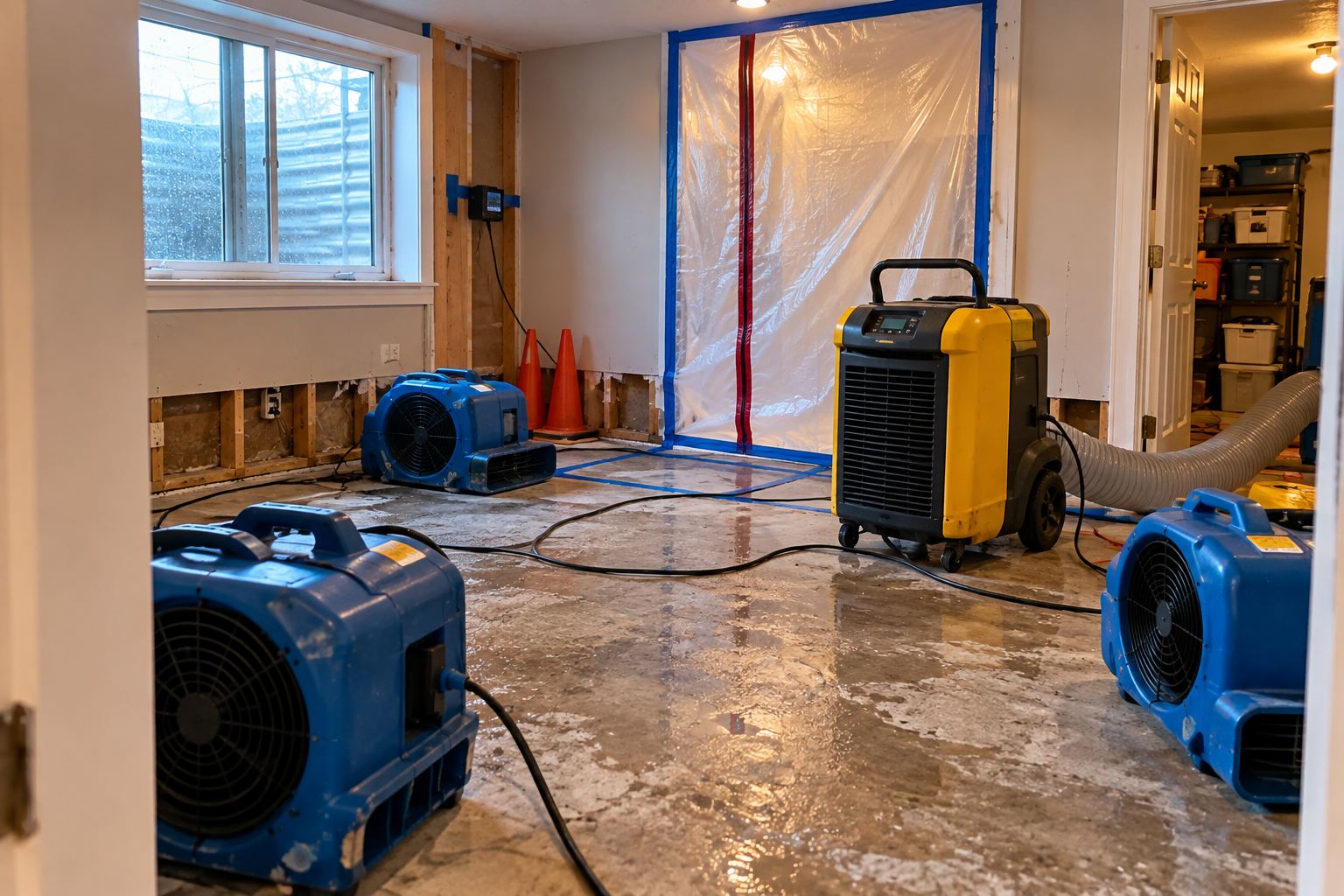
Need water damage restoration? Our water damage restoration crew answers live 24/7 at (385) 250-2825 and starts with a free written estimate.