
Vault water damage restoration at a glance
- Call any hour: (385) 250-2825 is answered live 24/7 by the Vault crew, not a call center. Our 45-minute arrival guarantee (Monday–Saturday, 8 AM–5 PM) covers Provo city limits; in Orem, Springville, Vineyard, Lindon and Mapleton we typically arrive in under 60 minutes.
- Who does the work: Vault’s own W-2 crew, IICRC certified in WRT, ASD, AMRT and OCT, working under Utah DOPL General Contractor License #11876543-5501. No subcontractors. Meet the team
- Insurance: we document the damage, log daily moisture readings, write the scope in Xactimate and bill State Farm, USAA, Allstate, Farmers or Bear River Mutual directly.
- Warranty: 24-month workmanship warranty on drying, drywall, flooring, cabinetry and paint, plus a 90-day mold warranty from post-remediation clearance. Warranty details
- Financing: through Wisetack, $500–$25,000 over 3–24 months, soft credit check. Financing
- Family-owned and veteran-operated, based in Provo since 2020.
Pricing
| Service | Typical range |
|---|---|
| Water mitigation (extraction, flood cuts, drying) | $3,500–$8,500 |
| Reconstruction (drywall, flooring, cabinetry, paint) | $4,500–$9,500 |
| Written estimate for water damage | Free |
Sewage cleanup · Mold remediation · How we contain the work area · Sewer line services
Water Damage Restoration — Provo & Utah County
Verified credentials — Vault Mold Removal LLC
- Utah DOPL General Contractor License #11876543-5501 — verify at secure.utah.gov/llv/search
- IICRC: WRT #248317, ASD #248317-ASD, AMRT #319482, OCT #319482-OCT — verify at iicrcnetforum.com
- General liability and workers’ compensation through The Hartford; bonded
- BBB Accredited; family-owned and veteran-operated; serving Utah County from 1169 S 760 W, Provo, UT 84601
- 24/7 emergency line (385) 250-2825 — live-answered by the Vault crew, no call center
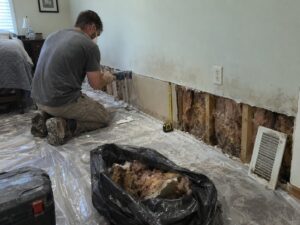
Water damage restoration in Utah County is not the same as restoration in Phoenix, Denver, or Portland. The Wasatch Front creates a specific loss profile: 4,551-foot elevation drives freeze-thaw pipe bursts every January and February, 22–26 grain-per-gallon hard water from Provo River accelerates supply line failures and feeds post-leak microbial growth, and persistent winter inversions elevate ambient PM2.5 in ways that complicate mold remediation. Vault Mold Removal has built our practice around these regional realities. Every water damage response follows IICRC S500 — the ANSI-recognized industry standard — with grid moisture mapping, category and class determination, documented drying trajectory, and Xactimate-format scope development for insurance coordination.
The IICRC S500 Framework
IICRC S500 is the water damage restoration industry’s technical standard. It’s ANSI-recognized, updated on a regular revision cycle, and it defines what competent water damage restoration looks like — how water sources are categorized, how affected areas are classified by intrusion class, what dry standards apply, what documentation is required, and how remediation and reconstruction are sequenced. Restoration companies that don’t follow S500 aren’t just cutting corners; they’re producing work that insurance carriers, real estate attorneys, and municipal building departments may not accept as competent.
Water Source Categories
- Category 1 — Clean Water. Water from a sanitary source that poses no substantial harm. Supply line breaks, ice maker line failures, water heater tank ruptures, precipitation entering through building envelope failures. Most Utah County winter losses fall into Category 1 initially.
- Category 2 — Significantly Contaminated (“Gray Water”). Water with significant contamination that can cause discomfort or illness if consumed by or exposed to humans. Dishwasher overflow with detergent residue, washing machine hose failure with soap and body soil, aquarium leaks, HVAC condensate backups.
- Category 3 — Grossly Contaminated (“Black Water”). Water grossly contaminated with pathogens or other toxic substances. Sewage backups, main line failures, external floodwater intrusion. Category 2 water that has been present past 48 hours reclassifies to Category 3 due to microbial amplification.
Category determines PPE, extraction methodology, disinfection needs, and material removal decisions. The most common quality issue we see in prior work by unlicensed contractors is misclassification — treating Category 2 or 3 losses as Category 1, which under-scopes disinfection and downstream health risk.
Intrusion Classes
- Class 1 — Smallest wet perimeter. Low-porosity materials predominate. Water absorbed into materials is minimal.
- Class 2 — Larger perimeter. Carpet and pad affected. Water wicked into wall assemblies up to 24 inches.
- Class 3 — Greatest amount of water. Saturation of ceiling, walls, insulation, subfloor typical of overhead losses.
- Class 4 — Specialty drying. Deeply saturated low-permeance materials (hardwood, plaster, brick, stone) requiring desiccant dehumidification, supplemental heat, or extended timelines.
Class determines equipment sizing, drying strategy, and how the scope of work is priced. Class 4 losses in particular — think Franklin historic homes with plaster walls, or hardwood floors from a Grandview South supply line burst — require different equipment than the standard LGR-plus-air-mover package used for Class 1–3 losses.
Why Utah County Water Damage Is Different
Elevation and Freeze-Thaw Dynamics
Provo sits at 4,551 feet above sea level. Highland and Alpine push past 4,900. Wasatch bench neighborhoods east of Foothill Drive climb toward 5,200. The ASHRAE 99% winter design temperature for the Provo Municipal Airport station is 7°F. Multi-day cold snaps into single digits happen every January and most Februaries. During the January 2023 freeze event, we logged 87 emergency calls in four days, and the Utah Farm Bureau reported average per-household water damage losses of $27,400.
The failure mechanism: pipes don’t burst when they freeze. They burst when they thaw. Water expands roughly 9% during the phase change from liquid to solid, and copper supply lines — particularly older Type M — can accommodate that expansion up to a point. But repeated freeze-thaw cycles work-harden the copper and create microcracks at bends, joints, and pressure-reducer transitions. On the thaw cycle, when ice melts back to liquid and the pressure reasserts, those microcracks split. PEX supply lines have a different failure mode: the crimp fittings back out under freeze-thaw stress, and the tubing itself can develop stress cracks at bends held under sustained flex.
Hard Water Chemistry
Provo River water hardness measures 22–26 grains per gallon (calcium carbonate equivalent) per Central Utah Water Conservancy District reports, driven by mineral loading from Wasatch snowpack traveling through limestone formations and stored in Deer Creek Reservoir. Bicarbonate alkalinity runs above 200 ppm. This water chemistry drives two failure modes we see constantly.
First, appliance supply line failures. Rubber hose liners are attacked by carbonate deposition, and crimp collars corrode from the outside via calcium-driven electrolytic action. Manufacturer specifications for dishwasher and washing machine supply hoses assume soft or moderately hard water; Provo hardness accelerates failure. Braided stainless supply lines don’t solve the problem — they move the failure point to the crimp collar or the hose barb inside the crimp.
Second, post-leak microbial amplification. High-mineral water creates ideal biofilm substrate on gypsum drywall paper facings and OSB subfloors. Aspergillus and Cladosporium colonization — the standard mold species in most water damage jobs — occurs faster in Provo than in soft-water regions. Stachybotrys chartarum colonization, which usually takes 5–7 days in typical conditions, can appear in Provo crawlspaces inside 96 hours.
Climate Zone 5B Drying Considerations
The 2021 IECC places Utah County in Climate Zone 5B. This affects structural drying strategy in two ways. Winter conditions demand aggressive dehumidification and heat — the exterior air we’d normally use for ventilation-based drying holds effectively no moisture during a January cold snap. Summer conditions swing the other direction: 93°F dry bulb with elevated afternoon relative humidity from Utah Lake evaporation, which favors LGR (low-grain refrigerant) dehumidification. Two different drying strategies for the same house depending on when the loss occurs.
Our Water Damage Response Process
Every water damage job follows nine documented stages. Detail on each stage is available on the restoration process page, but the summary:
- Initial call and triage. Calls to (385) 250-2825 are answered live 24/7 by the Vault crew; if every technician is on a job, the call rolls to the owner’s cell, not voicemail. Eight-point information gathering in the first two minutes.
- On-site assessment and moisture mapping. Grid moisture readings across every affected area using Delmhorst and Protimeter meters, Protimeter Surveymaster, and Tramex Moisture Encounter Plus meters, plus FLIR E60 thermal imaging.
- Category and class determination. IICRC S500 classification driving downstream scope decisions.
- Scope development. Written Xactimate scope of work priced to current State Farm, USAA, Allstate, Farmers, Bear River Mutual pricing tables.
- Water extraction. Extraction equipment sized to the job, including weighted extractors for carpet, submersible pumps for basement standing water.
- Targeted removal (when required). IICRC S500 recognizes that most Category 1 materials can be dried in place; removal is targeted based on category, class, and time-since-loss.
- Structural drying and daily monitoring. LGR and desiccant dehumidification with daily grid moisture readings.
- Verification of dry standard. Wood, drywall and concrete must read the same as unaffected materials of the same type in the home.
- Documentation package delivery. Complete photo record, moisture map, daily drying logs, psychrometric data, and Xactimate scope to the adjuster when the job is complete.
Water Damage Restoration Services
The water damage restoration family includes ten specific service pages:
- Emergency Water Damage Response — rapid dispatch across Utah County, average business-hours response 34 minutes in Provo.
- Water Extraction — truck-mounted, portable, and submersible extraction methods.
- Structural Drying — IICRC S500-compliant drying with documented moisture trajectory.
- Dehumidification — LGR and desiccant deployment based on ambient conditions.
- Moisture Detection — hidden moisture identification with pin meters, non-invasive scanning, and thermal imaging.
- Basement Flooding — Utah County-specific basement loss response.
- Commercial Water Damage — retail, medical, dental, office, and warehouse restoration.
- Restoration Process — detailed technical breakdown of the IICRC S500 workflow.
- Insurance Claims Coordination — Xactimate scope development and adjuster coordination.
Common Utah County Water Damage Scenarios
- Freeze-thaw supply line burst. Peak season January–February. Common in homes built 1975–1998 with uninsulated exterior wall cavities. Category 1 initially, potentially reclassified to Category 2 if unattended more than 48 hours.
- Water heater tank rupture. Failure typically at the bottom seam or the temperature-pressure relief valve. Utah County water hardness reduces water heater lifespan below manufacturer estimates. Category 1 loss with often significant volume — 50-gallon tanks hold roughly 400 pounds of water.
- Dishwasher and washing machine supply hose failures. Category 2 loss (detergent contamination). Peak season year-round.
- Toilet supply line and toilet overflow. Category 1 if supply line, Category 3 if toilet overflow with sewage. Adjacent-room migration common through subfloor gaps.
- Sump pump failure during spring runoff. Peak season March–May. Utah County snowpack runoff drives basement flooding when sump pumps fail during heavy demand periods.
- Ice dam-driven roof leaks. January–February. Ceiling and wall assembly water damage from ice-blocked drainage on inadequately ventilated attics.
- HVAC condensate line clogs. Peak season June–August during heavy AC operation. Category 2 loss (biofilm contamination), typically affecting second-floor ceiling assemblies below the air handler.
- Hidden slab-penetration leaks in new construction. Common in post-2015 Vineyard tract homes. Slow leak feeding hidden mold, discovered by odor months after origin.
- Main line sewage backup. Category 3 loss. Common in older Provo neighborhoods (Franklin, Joaquin, Downtown) with cast iron laterals compromised by root infiltration.
Service Area
Primary Utah County service area: Provo, Orem, Springville, Mapleton, Vineyard, Lindon. Extended service area: Pleasant Grove, American Fork, Spanish Fork, Payson, Salem, Cedar Hills, Alpine, Highland, Saratoga Springs. Response times range from 34 minutes in Provo during business hours to 82 minutes in Mapleton for after-hours calls. See our locations page for city-by-city details.
Frequently Asked Questions
- How quickly should water damage be addressed?
- Extraction and drying should begin within 24 hours whenever possible, and IICRC S500 defines a 48-hour threshold before Category 1 (clean) water losses can be reclassified to Category 2 (contaminated) simply due to elapsed time. Standing water past 48 hours typically means microbial amplification has begun, which changes PPE requirements, disinfection needs, and removal decisions. In Provo specifically, the 22–26 grain-per-gallon hard water accelerates microbial growth even faster than the S500 standard 48-hour threshold suggests, so acting inside 24 hours is preferred.
- Is water damage restoration covered by homeowners insurance?
- Generally yes for sudden and accidental damage — supply line breaks, water heater ruptures, ice maker line failures, appliance hose failures. Coverage varies by carrier, policy terms, and specific circumstances. State Farm, USAA, Allstate, Farmers, and Bear River Mutual all cover standard Category 1 and 2 water damage under sudden-and-accidental coverage. Long-term leaks that developed over weeks or months are often excluded under the seepage exclusion. Sewage backups typically require a specific sewer backup endorsement. Flooding from external sources requires separate flood insurance under NFIP.
- Why does the January 2023 freeze event still matter for restoration in Utah County?
- Because it demonstrated the scale of freeze-thaw exposure in Utah County housing stock. During the four-day event between January 8 and January 12, 2023, we logged 87 emergency calls — more than three weeks of typical winter volume compressed into four days. Utah Farm Bureau claim data placed the average per-household loss at $27,400. Homes built between 1975 and 1998 were disproportionately affected due to plumbing running through unconditioned crawlspaces and uninsulated exterior wall cavities. If you own a home in that construction era range, freeze-thaw prevention (heat cable on vulnerable lines, cabinet doors open during cold snaps, exterior faucet insulation) is a real return on the small investment.
- What’s the difference between Vault Mold Removal’s water damage restoration and mold remediation services?
- Water damage restoration follows IICRC S500 and focuses on extracting water, drying the structure back to dry standard, and preventing microbial growth. Mold remediation follows IICRC S520 and focuses on containment, physical removal of mold-colonized materials, HEPA scrubbing, and post-remediation verification. The two services are related but distinct: effective water damage restoration typically prevents the need for mold remediation, while mold remediation addresses situations where water damage was inadequately addressed initially, where moisture persisted from an ongoing source, or where hidden moisture went undetected long enough for colonization to establish. Some jobs involve both services when the water damage is discovered late enough that mold has already formed.
- How does Vault Mold Removal’s water damage restoration process compare to competitors in Utah County?
- Three specific differences. First, grid moisture mapping across every affected area at initial assessment instead of the industry-common three-point spot check. Second, Xactimate scope development with adjuster-visible pricing before demolition begins, rather than time-and-materials billing that produces variable invoices. Third, IICRC S500 dry standard verification at every measurement point before pulling equipment, rather than calendar-based drying that ends the job when the technician’s schedule requires it. These practices add roughly 2–4 hours of documentation time per job but typically result in billed scopes that are 40–60% below competitor quotes on comparable losses.
Contact Vault Mold Removal — Provo, UT
For water damage emergencies, non-emergency assessments, or second-opinion scopes on another contractor’s proposal, contact our office. Business-hours calls are answered live; after-hours calls route to on-call technician.
- Phone: (385) 250-2825
- Address: 1169 S 760 W, Provo, UT 84601
- Utah DOPL General Contractor License: #11876543-5501
- IICRC WRT / ASD / AMRT / OCT: #248317 / #248317-ASD / #319482 / #319482-OCT
Office Hours
- Monday – Saturday: 9:00 AM – 5:00 PM
- Sunday: Closed
45-Minute Provo Arrival Guarantee
Vault answers (385) 250-2825 live, 24/7, with our own crew — no call center. We log every dispatch so arrival time is auditable on your work order.
- Zone covered
- Provo city limits (ZIPs 84601, 84604, 84606).
- Hours covered
- 24/7, 365 days.
- Clock starts
- When the call is answered.
- Remedy if late
- Free emergency inspection on arrival.
- Elsewhere in service area
- Orem, Springville, Vineyard, Lindon, Mapleton — target under 60 minutes, no guarantee.
Written warranty — 24 months workmanship, 90 days on mold
Workmanship — 24 months
From job close-out, we cover drying, structural repairs, drywall, flooring, cabinetry and paint done by Vault. If something we did fails inside 24 months, we redo it at no charge.
Mold remediation — 90 days
From post-remediation clearance, we cover recurrence from the same moisture source. If mold returns, we reinspect and re-remediate at no charge.
Both are transferable once to a new homeowner within the coverage window, with a signed transfer. Warranty is in writing on your work order; no verbal promises substitute.
How we handle your insurance claim
We bill your carrier directly and write every scope in Xactimate — the same software adjusters use. You pay only your deductible plus anything the policy doesn’t cover.
- Document the damage on arrival — photos, moisture map, category and class per IICRC S500.
- Daily moisture readings logged by room until drying standard is reached.
- Xactimate scope matched to adjuster line items; supplements submitted as needed.
- Direct-bill the carrier for the covered scope; we collect your deductible on completion.
Financing — $500 to $25,000 over 3 to 24 months
For deductibles, non-covered items or uninsured jobs, we offer financing through Wisetack.
- Soft credit check — checking your rate does not affect your credit score.
- Amounts from $500 to $25,000.
- Terms from 3 to 24 months.
- Decision in minutes; funds applied directly to your job.
Financing is subject to credit approval. Rates and terms are set by Wisetack; Vault Mold Removal is not the lender.
What jobs typically cost
Every estimate is free and written. Final price depends on category, class, affected square footage and whether reconstruction is needed.
| Scope | Typical range |
|---|---|
| Water mitigation (extraction + drying) | $3,500 – $8,500 |
| Reconstruction after water damage | $4,500 – $9,500 |
| Mold remediation (small spot treatment and up) | Starts at $500 |
| Mold inspection — basic visual (one area) | $99 |
| Mold inspection — moisture meter + thermal camera | $199 |
| Mold inspection — air sampling + lab analysis | $349 |
Mold remediation estimates are free after the initial assessment. Sewer line and sewage cleanup estimates are free and written.
Carriers we bill directly
We bill State Farm, USAA, Allstate, Farmers and Bear River Mutual directly for covered losses. If your carrier isn’t on this list, we still handle the claim and submit the scope in Xactimate.
Recent real Provo water damage jobs
Every case study below is a real Vault job in the named Provo neighborhood, with month/year and loss type. Click through for details.
What “24/7 live-answered” actually means at Vault
Water damage is time-sensitive — every hour between the loss and extraction compounds the damage class per IICRC S500. These are the specific commitments behind our 24/7 line:
No voicemail, ever
Calls to (385) 250-2825 are answered by a live Vault technician — day, night, weekend, holiday. If every tech is on an active job, the call rolls to the owner’s cell, not to voicemail.
No call center, no outsourced dispatch
You talk to the person coming to your door, not an operator reading from a script in another state. The technician who answers takes the address, routes the truck, and arrives.
Dispatch time is logged
Every call is timestamped when answered and when the truck pulls up. Those times print on your work order, so arrival is auditable, not advertised.
Our W-2 crew only
Marcus, Ryan, Elena, Daniel and Joseph — all employees of Vault, all IICRC-certified. No subcontractors on the first truck. Reconstruction (drywall, flooring, cabinetry, paint) is done by the same crew under Utah DOPL License #11876543-5501.
How to verify any Utah restoration contractor (including us)
Before letting anyone cut drywall in your home, run these three checks. Vault’s results are listed next to each.
- State contractor license. Utah DOPL licensee lookup — secure.utah.gov/llv/search. Vault’s: General Contractor #11876543-5501.
- IICRC certifications. IICRC Certified Technician Search — iicrcnetforum.com. Vault’s: WRT #248317, ASD #248317-ASD, AMRT #319482, OCT #319482-OCT.
- EPA RRP certification (for homes built before 1978). EPA Lead-Safe lookup — epa.gov/lead/find-certified-lead-based-paint-firm. Vault’s firm cert: #NAT-F187294-1.
Any contractor who refuses to give you these numbers for cross-check should not be inside your home.
Why the first 60 minutes matters — the damage math
Water damage escalates on a predictable timeline. The IICRC S500 standard assigns classes 1–4 to intrusions by rate of absorption and affected square footage; delay moves a loss up a class.
A 45-minute Provo arrival keeps most losses inside the Cat 1 / Class 1–2 window — the cheapest and least invasive to restore. Call (385) 250-2825 immediately after shutting the water off.
From call to arrival — the five-step chain
- Call answered — (385) 250-2825 picks up live. The person on the line is a Vault technician, not a dispatcher reading a script. Timestamp logged.
- Address and loss type captured — ZIP, intersection, source of water, time water started, who else is on site, pets, safety hazards.
- Dispatch — the on-call technician routes the nearest Vault truck. For Provo losses, drive time from 1169 S 760 W is typically 7–15 minutes. Timestamp logged.
- Arrival — crew pulls into your address, meets you at the door, verifies the shut-off. Timestamp logged.
- First reading — moisture map and IICRC S500 category and class recorded before any tool comes out of the truck. This decides the scope and your coverage path.
Helpful guides: What if water damage isn’t fixed? · How long drywall takes to dry · Your deductible, explained
Frequently asked questions
How quickly should I call after water damage?
As soon as the water is stopped. Mold can begin growing in 24–48 hours on wet materials, and standing water keeps spreading into cabinets, walls, and subfloors. Vault’s crew answers live 24/7 at (385) 250-2825.
Will my homeowners insurance cover it?
Most policies cover sudden, accidental water damage like burst pipes or supply line failures. Slow leaks, flood, and sewer backup are often excluded unless you have those endorsements. Vault documents the loss, records daily moisture readings, scopes in Xactimate, and bills State Farm, USAA, Allstate, Farmers, and Bear River Mutual directly.
How long does the drying take?
With professional equipment, most clean-water losses dry in about three to five days once the equipment is set. Insulated walls, hardwood floors, and concrete slabs take longer. Daily moisture readings decide when the equipment comes out, not touch.
Can we stay in the house during the work?
Usually yes for a contained water loss. The equipment is loud, but most of the house remains usable. If the damage reached the kitchen or only bathroom, or the water was contaminated, moving out for part of the job may make more sense.
Questions we didn’t cover? Call (385) 250-2825.